A
                 Seminar
                    on
                 HD Radio


Presented By:-              Guided By:-
   Vivek Singh                Mr. Shyam Sundar Maurya
   0913931115                 (Lecturer, EC Dept.)
   B.Tech (EC)
   Sem-VIth
INTRODUCTION
• It is a multicasting program channels and operating modes.

• It is a two-box approach consisting of the Generation-II exciter and
  the Exciter Auxiliary Service Unit (EASU) was conceived to deliver
  the first commercial platforms.

• The Gen II was a far cry from its predecessor, the Gen I, having
  moved from a PC104-based platform using 14 Analog Devices
  SHARC processors, to a more conventional Intel Pentium IV PC
  architecture.
• The Gen II exciter consists of a motherboard with integrated
  video/LAN, 3GHz Intel Pentium processor, memory, touch-
  screen, video controller, AES audio cards, digital up-
  converter (DUC), RF up-converter (RFU), Station Interface
  Card (SIC), hard drive, CD drive, Linux operating system
  and the manufacturer-integrated version of the Ibiquity
  Reference System Software (IRSS).

• The Gen II platform accomplished the digital signals MPS
  audio bit-reduction and the multiplexing of the Program
  Service Data (PSD) to the MPS air interface.

• The EASU, which is also called the synchronizer, contains a
  GPS receiver/10MHz time base, word-clock generator, rate
  converter and audio bypass switching for maintenance.
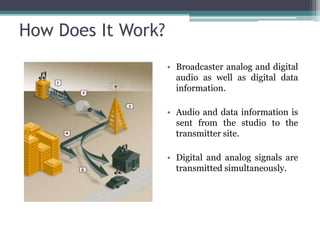
How Does It Work?
                    • Broadcaster analog and digital
                      audio as well as digital data
                      information.

                    • Audio and data information is
                      sent from the studio to the
                      transmitter site.

                    • Digital and analog signals are
                      transmitted simultaneously.
• Signal travel throughout the broadcast area.

• Digitally compressed for, multicasting and enhanced services.

• Receivers shot through “bounced” signals therefore enhancing
  clearity.

• Same as regular radio, except a bundled signal (digital and
  analog).

• HD radio equipped receivers now experience free, crystal clear
  digital audio and additional FM content.
The HD Radio System

• Once MPS was established, broadcasters became intrigued with HD
  Radio's ability to deliver multiple, independent, program streams,
  over the same digital signal as Supplemental Program Services
  (SPS), which is now commonly referred to as multicast.

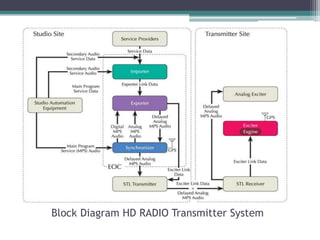
• Its transmitters signal using these functions
  ▫   Importer
  ▫   Exgine
  ▫   Exporter
  ▫   Synchronizer
Block Diagram HD RADIO Transmitter System
Importer

• The importer contains the hardware and software necessary to
  deliver Advanced Application Services (AAS).

• The importer establishes session connections between multiple
  service providers. Once a session is established, service providers
  can pass service data over the importer-to-exporter link (I2E),we
  will be broadcast over the air to HD Radio digital receivers.

• AAS from data service providers, the importer also accepts SPS and
  PSD.
Exgine
• The exgine subsystem accepts the exporter-to-exgine link (E2X)
  data from the exciter's host processor and performs the Orthogonal
  Frequency Division Multiplexing (OFDM) modulation for the digital
  portion of the HD Radio waveform.

• The Exgine element is comprised of a Texas Instruments C64XX
  processor, SDRAM and Flash memory and enables the Layer 1
  modulation to be executed on the Digital Signal Processor (DSP).

• The HD Radio data stream is fed to the exgine over a simplex UDP
  Ethernet connection.
Exporter

• The Exporter accepting the MPS AES audio, PSD, multiplexed SPS
  audio, and advanced application service data from the importer.

• An exporter is essentially a Gen II exciter without the RFU and DUC
  sub-assemblies.

• The exporter accepts digital MPS audio over its audio interface, bit
  reduces (i.e. compresses) the audio and outputs the bit-reduced
  audio to the exgine over the simplex E2X.
Synchronizer
• The synchronizer accepts MPS audio and rate converts it to the
  proper system clock.

• The synchronizer provides the master system clock used by the
  exporter.

• This master clock is also synchronized to the exciter's clock by use of
  the GPS unit. The synchronizer derives the master clock from an on
  board GPS unit's 10MHz output signal.

• The synchronizer is also used to bypass (or redirect) the analog MPS
  audio from being passed through the exporter in the event the
  exporter is removed for maintenance.
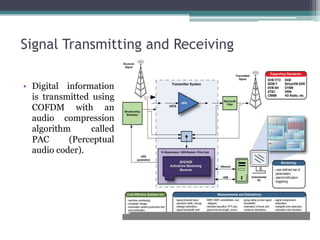
Signal Transmitting and Receiving

• Digital information
  is transmitted using
  COFDM with an
  audio compression
  algorithm      called
  PAC      (Perceptual
  audio coder).
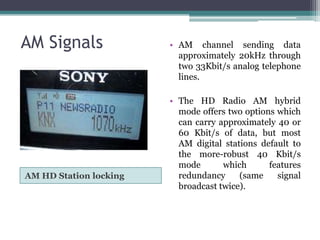
AM Signals              • AM channel sending data
                          approximately 20kHz through
                          two 33Kbit/s analog telephone
                          lines.

                        • The HD Radio AM hybrid
                          mode offers two options which
                          can carry approximately 40 or
                          60 Kbit/s of data, but most
                          AM digital stations default to
                          the more-robust 40 Kbit/s
                          mode       which      features
AM HD Station locking     redundancy     (same    signal
                          broadcast twice).
• The pure digital mode transmissions will stay within the AM station's
  channel instead of spilling into the channels next to the station
  transmitting "HD radio" as the hybrid digital stations do.

• AM radio stations are spaced at 9 kHz (Europe) or 10 kHz (Americas)
  intervals, much of the digital information overlaps adjacent channels
  when in hybrid mode.

• The digital radio signal received on a conventional AM receiver tuned
  to an adjacent channel sounds like a large waterfall or similar white
  noise-like hiss, as can be heard in the audio sound clip referenced in
  the previous sentence.

• AM is used DRM system, Digital Radio Mondiale (DRM) is a system
  designed primarily for world band radio and AM Radio. DRM is very
  similar to AM HD Radio in that each station is broadcast via a
  channel 20 kilohertz wide (+/-10 kHz).
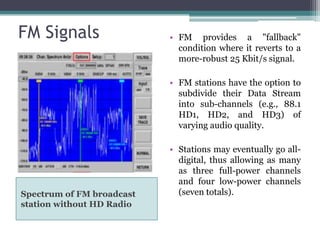
FM Signals                 • FM provides a "fallback"
                             condition where it reverts to a
                             more-robust 25 Kbit/s signal.

                           • FM stations have the option to
                             subdivide their Data Stream
                             into sub-channels (e.g., 88.1
                             HD1, HD2, and HD3) of
                             varying audio quality.

                           • Stations may eventually go all-
                             digital, thus allowing as many
                             as three full-power channels
                             and four low-power channels
Spectrum of FM broadcast     (seven totals).
station without HD Radio
• Stations can transmit HD Radio through their existing antennas
  using a diplexer as on AM, or are permitted by the FCC to use a
  separate antenna at the same location, or at a site licensed as an
  analog auxiliary, provided it is within a certain distance and
  height referenced to the analog main signal.

• FM is use DBA system, That station is then subdivided into
  multiple digital streams of between 9 and 12 programs. In
  contrast FM HD Radio is assigned to the traditional 200
  kilohertz-wide channels, with capability of 300 Kbit/s in pure
  digital mode.

• FM HD Radio uses a codec based upon the MPEG-4HE-AAC
  standard. Several psychoacoustic studies/tests have shown HE-
  AAC codec’s achieve the same perceived quality as MP2.
Features
• Worldwide FM band support (64–108 MHz).

• Worldwide AM (MW) band support (520–1710 kHz).

• Digital audio output.

• FM multi-path channel equalizer.

• Dynamic AM and FM channel bandwidth control.

• Configurable AM and FM noise blanking.

• Configurable FM stereo-mono blend.

• Multi-path detection and mitigation.
Applications

• OEM car radio systems.

• OEM automotive infotainment systems.

• Aftermarket car radio systems.

• OEM car PND docking system.
Thanks
   To
Give Your
Attention

High Definition Radio ppt

  • 1.
    A Seminar on HD Radio Presented By:- Guided By:- Vivek Singh Mr. Shyam Sundar Maurya 0913931115 (Lecturer, EC Dept.) B.Tech (EC) Sem-VIth
  • 2.
    INTRODUCTION • It isa multicasting program channels and operating modes. • It is a two-box approach consisting of the Generation-II exciter and the Exciter Auxiliary Service Unit (EASU) was conceived to deliver the first commercial platforms. • The Gen II was a far cry from its predecessor, the Gen I, having moved from a PC104-based platform using 14 Analog Devices SHARC processors, to a more conventional Intel Pentium IV PC architecture.
  • 3.
    • The GenII exciter consists of a motherboard with integrated video/LAN, 3GHz Intel Pentium processor, memory, touch- screen, video controller, AES audio cards, digital up- converter (DUC), RF up-converter (RFU), Station Interface Card (SIC), hard drive, CD drive, Linux operating system and the manufacturer-integrated version of the Ibiquity Reference System Software (IRSS). • The Gen II platform accomplished the digital signals MPS audio bit-reduction and the multiplexing of the Program Service Data (PSD) to the MPS air interface. • The EASU, which is also called the synchronizer, contains a GPS receiver/10MHz time base, word-clock generator, rate converter and audio bypass switching for maintenance.
  • 4.
    How Does ItWork? • Broadcaster analog and digital audio as well as digital data information. • Audio and data information is sent from the studio to the transmitter site. • Digital and analog signals are transmitted simultaneously.
  • 5.
    • Signal travelthroughout the broadcast area. • Digitally compressed for, multicasting and enhanced services. • Receivers shot through “bounced” signals therefore enhancing clearity. • Same as regular radio, except a bundled signal (digital and analog). • HD radio equipped receivers now experience free, crystal clear digital audio and additional FM content.
  • 6.
    The HD RadioSystem • Once MPS was established, broadcasters became intrigued with HD Radio's ability to deliver multiple, independent, program streams, over the same digital signal as Supplemental Program Services (SPS), which is now commonly referred to as multicast. • Its transmitters signal using these functions ▫ Importer ▫ Exgine ▫ Exporter ▫ Synchronizer
  • 7.
    Block Diagram HDRADIO Transmitter System
  • 8.
    Importer • The importercontains the hardware and software necessary to deliver Advanced Application Services (AAS). • The importer establishes session connections between multiple service providers. Once a session is established, service providers can pass service data over the importer-to-exporter link (I2E),we will be broadcast over the air to HD Radio digital receivers. • AAS from data service providers, the importer also accepts SPS and PSD.
  • 9.
    Exgine • The exginesubsystem accepts the exporter-to-exgine link (E2X) data from the exciter's host processor and performs the Orthogonal Frequency Division Multiplexing (OFDM) modulation for the digital portion of the HD Radio waveform. • The Exgine element is comprised of a Texas Instruments C64XX processor, SDRAM and Flash memory and enables the Layer 1 modulation to be executed on the Digital Signal Processor (DSP). • The HD Radio data stream is fed to the exgine over a simplex UDP Ethernet connection.
  • 10.
    Exporter • The Exporteraccepting the MPS AES audio, PSD, multiplexed SPS audio, and advanced application service data from the importer. • An exporter is essentially a Gen II exciter without the RFU and DUC sub-assemblies. • The exporter accepts digital MPS audio over its audio interface, bit reduces (i.e. compresses) the audio and outputs the bit-reduced audio to the exgine over the simplex E2X.
  • 11.
    Synchronizer • The synchronizeraccepts MPS audio and rate converts it to the proper system clock. • The synchronizer provides the master system clock used by the exporter. • This master clock is also synchronized to the exciter's clock by use of the GPS unit. The synchronizer derives the master clock from an on board GPS unit's 10MHz output signal. • The synchronizer is also used to bypass (or redirect) the analog MPS audio from being passed through the exporter in the event the exporter is removed for maintenance.
  • 12.
    Signal Transmitting andReceiving • Digital information is transmitted using COFDM with an audio compression algorithm called PAC (Perceptual audio coder).
  • 13.
    AM Signals • AM channel sending data approximately 20kHz through two 33Kbit/s analog telephone lines. • The HD Radio AM hybrid mode offers two options which can carry approximately 40 or 60 Kbit/s of data, but most AM digital stations default to the more-robust 40 Kbit/s mode which features AM HD Station locking redundancy (same signal broadcast twice).
  • 14.
    • The puredigital mode transmissions will stay within the AM station's channel instead of spilling into the channels next to the station transmitting "HD radio" as the hybrid digital stations do. • AM radio stations are spaced at 9 kHz (Europe) or 10 kHz (Americas) intervals, much of the digital information overlaps adjacent channels when in hybrid mode. • The digital radio signal received on a conventional AM receiver tuned to an adjacent channel sounds like a large waterfall or similar white noise-like hiss, as can be heard in the audio sound clip referenced in the previous sentence. • AM is used DRM system, Digital Radio Mondiale (DRM) is a system designed primarily for world band radio and AM Radio. DRM is very similar to AM HD Radio in that each station is broadcast via a channel 20 kilohertz wide (+/-10 kHz).
  • 15.
    FM Signals • FM provides a "fallback" condition where it reverts to a more-robust 25 Kbit/s signal. • FM stations have the option to subdivide their Data Stream into sub-channels (e.g., 88.1 HD1, HD2, and HD3) of varying audio quality. • Stations may eventually go all- digital, thus allowing as many as three full-power channels and four low-power channels Spectrum of FM broadcast (seven totals). station without HD Radio
  • 16.
    • Stations cantransmit HD Radio through their existing antennas using a diplexer as on AM, or are permitted by the FCC to use a separate antenna at the same location, or at a site licensed as an analog auxiliary, provided it is within a certain distance and height referenced to the analog main signal. • FM is use DBA system, That station is then subdivided into multiple digital streams of between 9 and 12 programs. In contrast FM HD Radio is assigned to the traditional 200 kilohertz-wide channels, with capability of 300 Kbit/s in pure digital mode. • FM HD Radio uses a codec based upon the MPEG-4HE-AAC standard. Several psychoacoustic studies/tests have shown HE- AAC codec’s achieve the same perceived quality as MP2.
  • 17.
    Features • Worldwide FMband support (64–108 MHz). • Worldwide AM (MW) band support (520–1710 kHz). • Digital audio output. • FM multi-path channel equalizer. • Dynamic AM and FM channel bandwidth control. • Configurable AM and FM noise blanking. • Configurable FM stereo-mono blend. • Multi-path detection and mitigation.
  • 18.
    Applications • OEM carradio systems. • OEM automotive infotainment systems. • Aftermarket car radio systems. • OEM car PND docking system.
  • 19.
    Thanks To Give Your Attention