Software Project Management Asim Shahzad
Successful software development programs require effective software project managers. Software managers are facing issues today unprecedented in the history of software development: perhaps the greatest shortfall of software engineering resources in the past two decades, shifting software development paradigms (e.g., software systems that incorporate more COTS and less traditionally developed code), and the continued evolution of software development standards.  Software Project Management
Activities plan, control and organize a software project that delivers on time and to cost  divide a large project into small, manageable steps  use techniques that enable the project to deliver the customer's requirements  understand the major issues of project management and the methods and techniques for dealing with them  understand the processes that have to be in place for a software project to meet it's objectives
The Software Process  What distinguishes software development management  How software can be managed like other projects  Software development life-cycle (SDLC) models  Choosing the right model  Defining a project’s objectives  Establishing criteria for success
The Software Development Project Plan  Considerations for the project manager  Contents of the project plan  Planning tools and techniques  Work breakdown structure (WBS)  Scheduling  Resource planning Rolling wave concepts
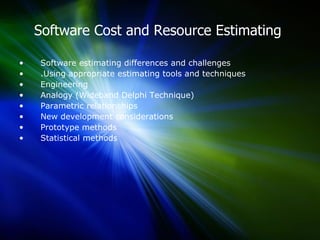
Software Cost and Resource Estimating   Software estimating differences and challenges  .Using appropriate estimating tools and techniques  Engineering  Analogy (Wideband Delphi Technique)  Parametric relationships New development considerations  Prototype methods  Statistical methods
Organizing for Complete Involvement of the User  Defining needs and requirements  Distinguishing needs from wants  User vs. customer—a critical distinction  Roles and commitments of the user  User’s participation in the SDLC
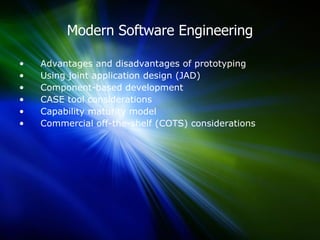
Modern Software Engineering Advantages and disadvantages of prototyping  Using joint application design (JAD)  Component-based development  CASE tool considerations  Capability maturity model  Commercial off-the-shelf (COTS) considerations
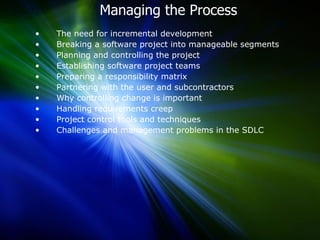
Managing the Process  The need for incremental development  Breaking a software project into manageable segments  Planning and controlling the project Establishing software project teams  Preparing a responsibility matrix  Partnering with the user and subcontractors  Why controlling change is important  Handling requirements creep  Project control tools and techniques  Challenges and management problems in the SDLC
Managing Testing  Establishing test objectives  Preparing test plans  Identifying testing responsibilities  Recognizing testing pitfalls  Determining the type of testing needed
Managing Documentation Requirements  Need for usable documentation  How to anticipate common management problems  Solving the documentation dilemma  Document control
Systems Implementation and Project Closeout  Ensuring customer acceptance and sign-off  Meeting all contractual obligations  Reassigning project staff  Conducting a post-implementation review  Lessons-learned database

Software Project Management

  • 1.
  • 2.
    Successful software developmentprograms require effective software project managers. Software managers are facing issues today unprecedented in the history of software development: perhaps the greatest shortfall of software engineering resources in the past two decades, shifting software development paradigms (e.g., software systems that incorporate more COTS and less traditionally developed code), and the continued evolution of software development standards. Software Project Management
  • 3.
    Activities plan, controland organize a software project that delivers on time and to cost divide a large project into small, manageable steps use techniques that enable the project to deliver the customer's requirements understand the major issues of project management and the methods and techniques for dealing with them understand the processes that have to be in place for a software project to meet it's objectives
  • 4.
    The Software Process What distinguishes software development management How software can be managed like other projects Software development life-cycle (SDLC) models Choosing the right model Defining a project’s objectives Establishing criteria for success
  • 5.
    The Software DevelopmentProject Plan Considerations for the project manager Contents of the project plan Planning tools and techniques Work breakdown structure (WBS) Scheduling Resource planning Rolling wave concepts
  • 6.
    Software Cost andResource Estimating Software estimating differences and challenges .Using appropriate estimating tools and techniques Engineering Analogy (Wideband Delphi Technique) Parametric relationships New development considerations Prototype methods Statistical methods
  • 7.
    Organizing for CompleteInvolvement of the User Defining needs and requirements Distinguishing needs from wants User vs. customer—a critical distinction Roles and commitments of the user User’s participation in the SDLC
  • 8.
    Modern Software EngineeringAdvantages and disadvantages of prototyping Using joint application design (JAD) Component-based development CASE tool considerations Capability maturity model Commercial off-the-shelf (COTS) considerations
  • 9.
    Managing the Process The need for incremental development Breaking a software project into manageable segments Planning and controlling the project Establishing software project teams Preparing a responsibility matrix Partnering with the user and subcontractors Why controlling change is important Handling requirements creep Project control tools and techniques Challenges and management problems in the SDLC
  • 10.
    Managing Testing Establishing test objectives Preparing test plans Identifying testing responsibilities Recognizing testing pitfalls Determining the type of testing needed
  • 11.
    Managing Documentation Requirements Need for usable documentation How to anticipate common management problems Solving the documentation dilemma Document control
  • 12.
    Systems Implementation andProject Closeout Ensuring customer acceptance and sign-off Meeting all contractual obligations Reassigning project staff Conducting a post-implementation review Lessons-learned database