 International business is a term used to
collectively describe all commercial
transactions (private and government, sales,
investments, logistics, and transportation) that
take place between two or more regions,
countries and nations beyond their political
boundary. Usually, private companies
undertake such transactions for profit;
governments undertake them for profit and for
political reasons.
 It refers to all those business activities which
involves cross border transactions of goods,
services, resources between two or more
nations. Transaction of economic resources
include capital, skills, people etc. for
international production of physical goods and
services such as finance, banking, insurance,
construction etc.
 A multinational enterprise (MNE) is a company
that has a worldwide approach to markets and
production or one with operations in more than
a country. An MNE is often called multinational
corporation (MNC) or transnational company
(TNC). Well known MNCs include fast food
companies such as McDonald's and vehicle
manufacturers such as General Motors,
Ford Motor Company and Toyota, consumer
electronics companies like Samsung, LG and
Sony.
 Most companies are either international or
compete with international companies.
 Modes of operation may differ from those
used domestically.
 The best way of conducting business may
differ by country.
 An understanding helps you make better
career decisions.
 An understanding helps you decide what
governmental policies to support.
There has been growth in globalization in recent decades
due to the following seven factors:
 Technology is expanding, especially in transportation
and communications.
 Governments are removing international business
restrictions.
 Institutions provide services to ease the conduct of
international business.
 Consumers know about and want foreign goods and
services.
 Competition has become more global.
 Political relationships have improved among some major
economic powers.
 Cross-national cooperation and agreements.
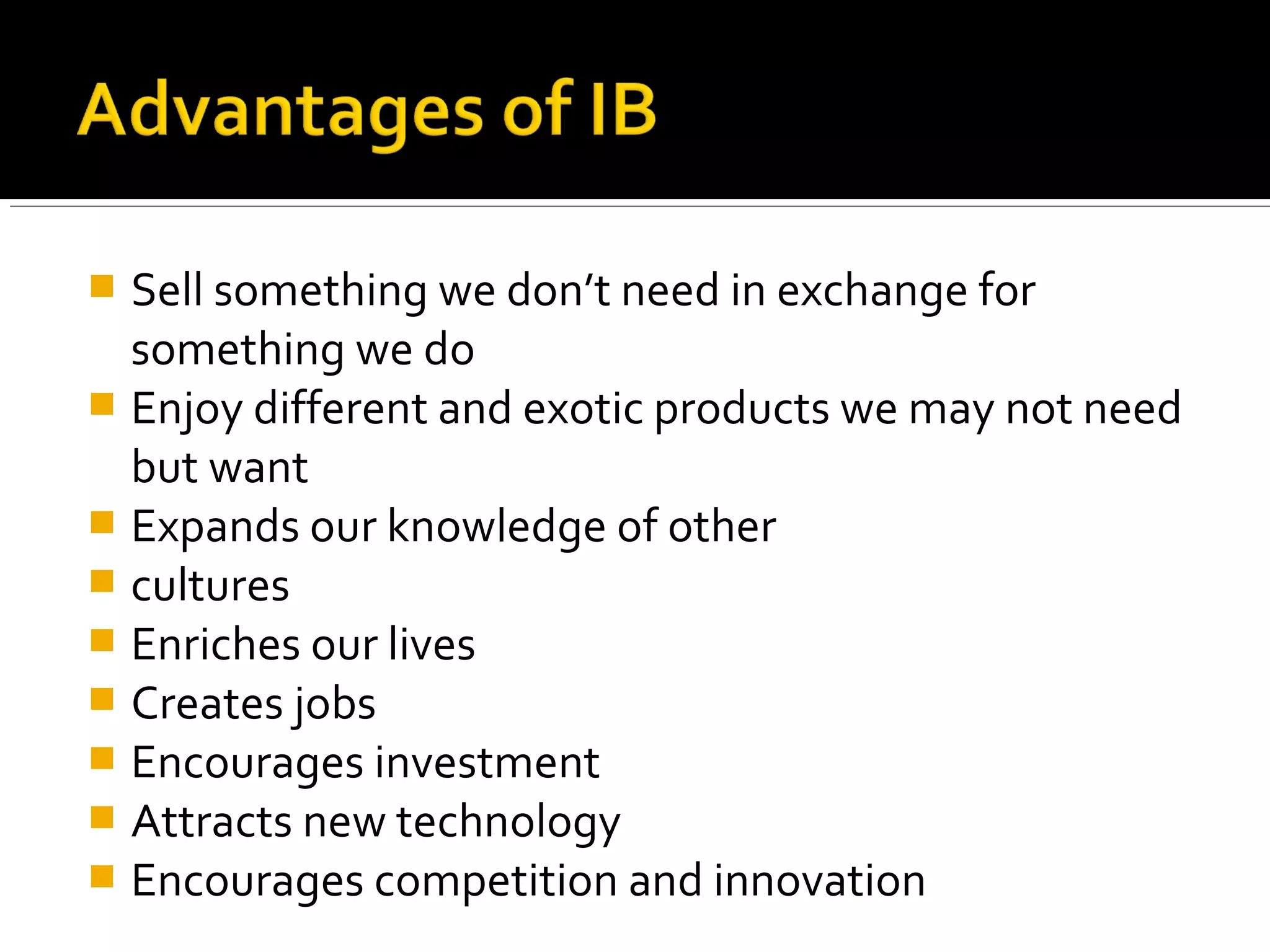
 Sell something we don’t need in exchange for
something we do
 Enjoy different and exotic products we may not need
but want
 Expands our knowledge of other
 cultures
 Enriches our lives
 Creates jobs
 Encourages investment
 Attracts new technology
 Encourages competition and innovation
 Creates prosperity for some but poverty for others
 Goods and services sold by dominant countries such as
America also promote American values and culture at
expense of local values and culture
 The desire for cheaper goods may lead to exploitation of
workers and lower standards for wages and benefits
 Environmental protections may be ignored to produce
cheaper goods
Difference between domestic trade and foreign trade and
their peculiar problems Trade, no doubt, implies exchange of
goods between persons, but there are marked differences
between domestic trade and international trade. The
differences and the complications arise therein are as
follows:
Distance
The distance involved in export of goods in external trade is
generally greater than on the domestic trade.
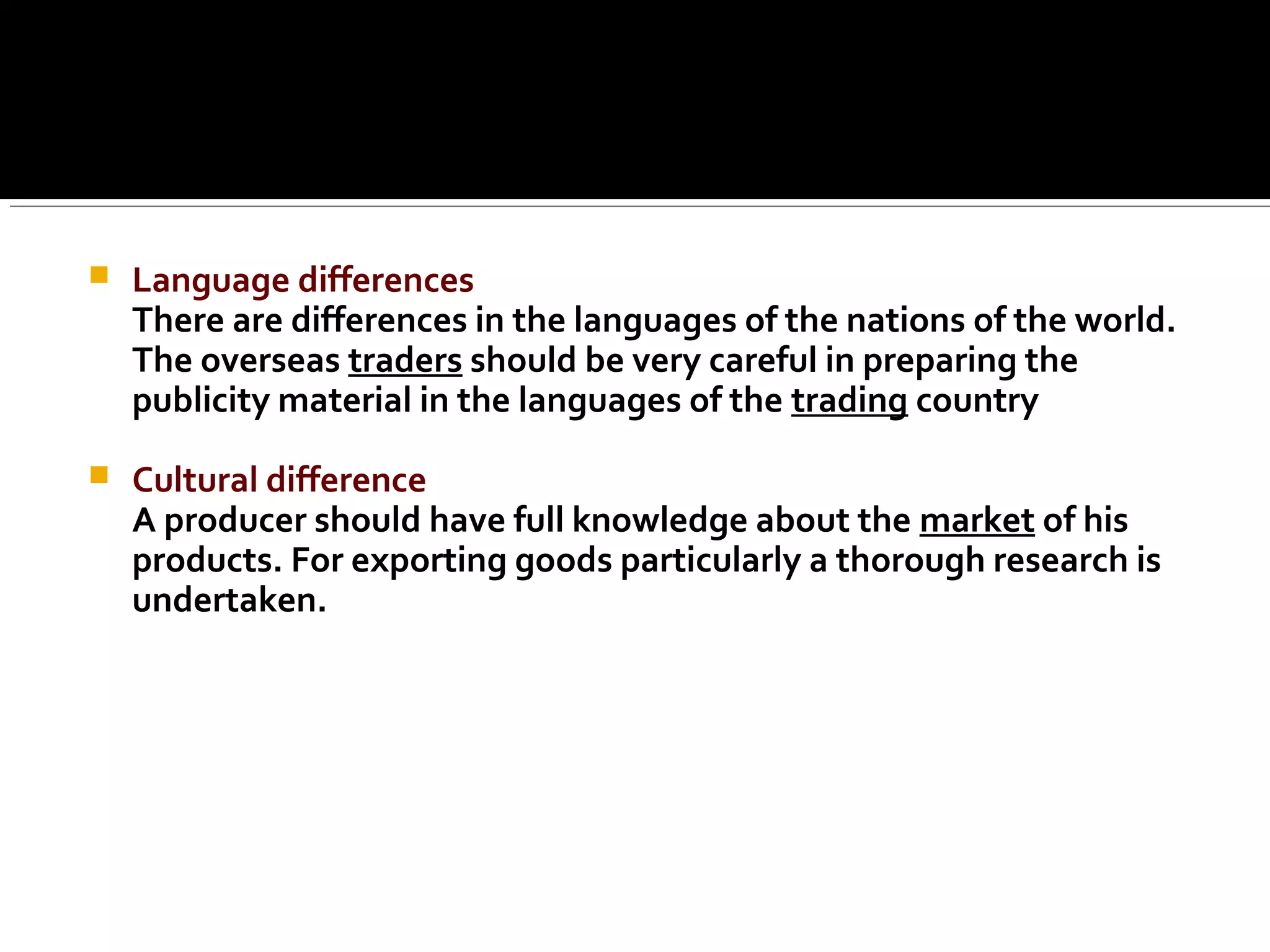
 Language differences
There are differences in the languages of the nations of the world.
The overseas traders should be very careful in preparing the
publicity material in the languages of the trading country
 Cultural difference
A producer should have full knowledge about the market of his
products. For exporting goods particularly a thorough research is
undertaken.

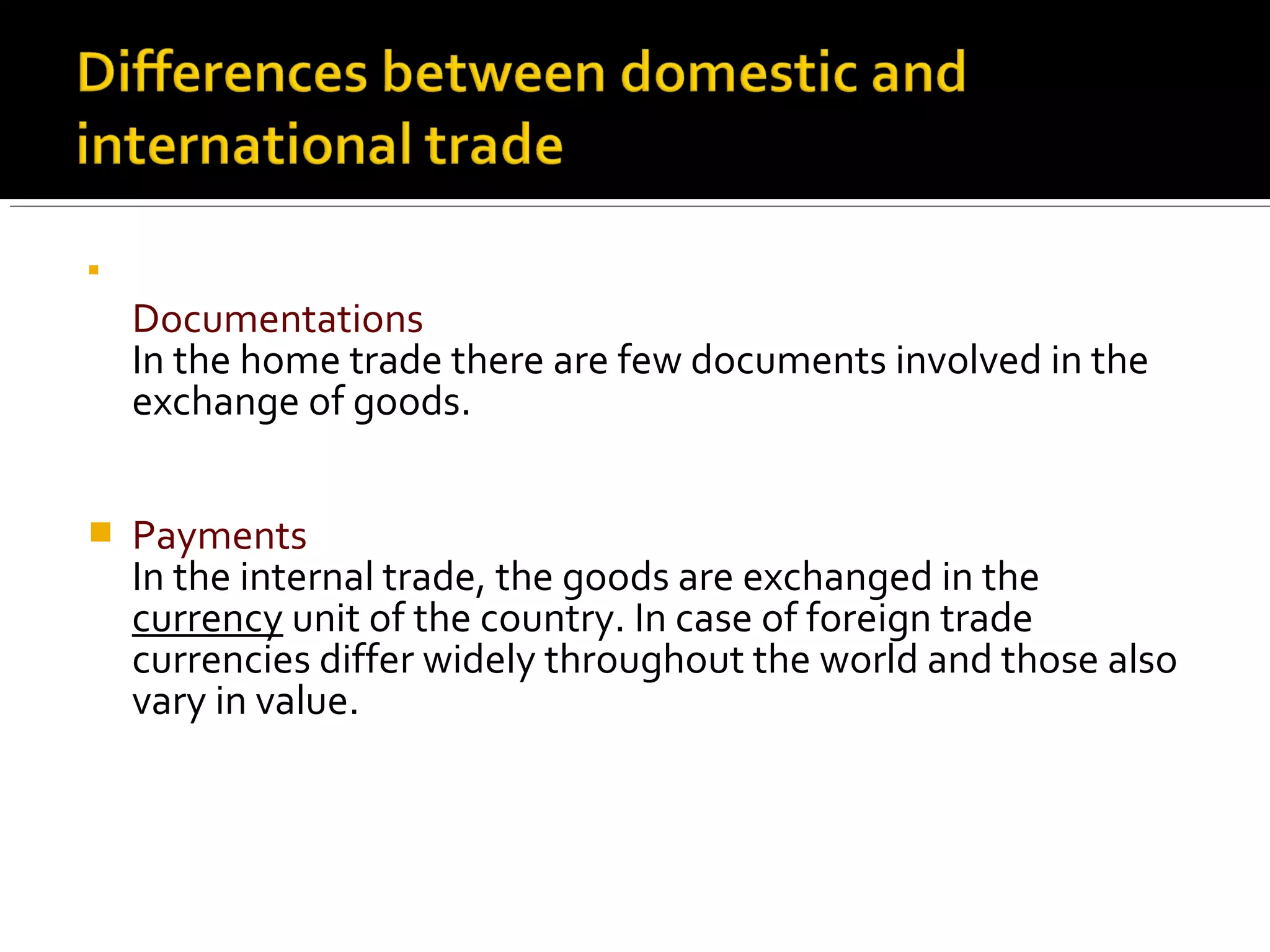
Documentations
In the home trade there are few documents involved in the
exchange of goods.
 Payments
In the internal trade, the goods are exchanged in the
currency unit of the country. In case of foreign trade
currencies differ widely throughout the world and those also
vary in value.
 Transport and insurance cost
The transport and insurance costs are less in case of domestic trade. For
the exports, on the other hand the cost of transport is high and the
insurance is complicated.
 Technical difference
In the national market the difference in the technical specification
for goods and their requirements is not wide.
 Tariff barriers
In the national trade, there are no custom duties, exchange
restrictions, fixed quotas or other tariff barriers.
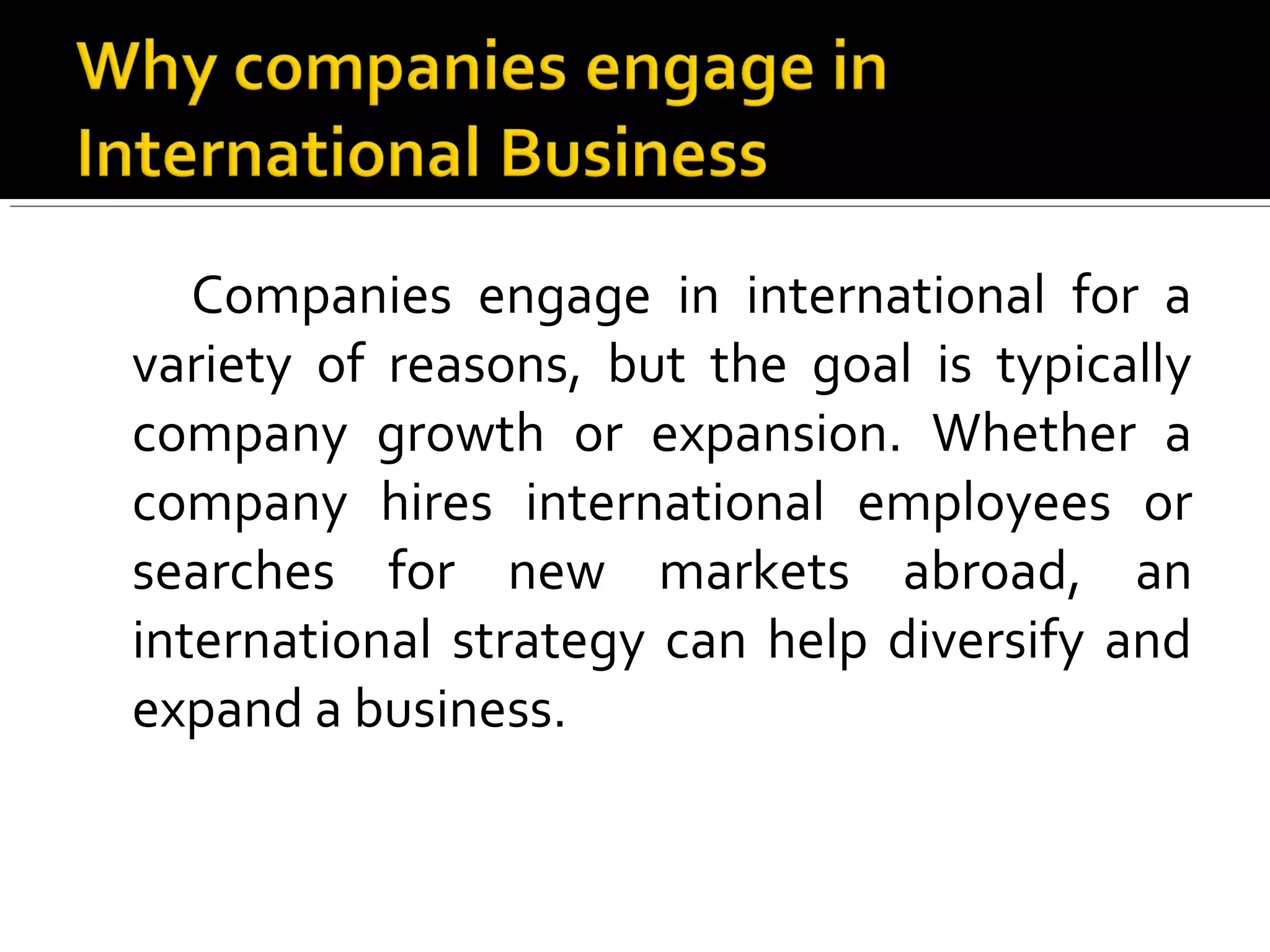
Companies engage in international for a
variety of reasons, but the goal is typically
company growth or expansion. Whether a
company hires international employees or
searches for new markets abroad, an
international strategy can help diversify and
expand a business.
There are three major operating objectives
that may induce companies to engage in
International Business.
 Expanding Sales
 Acquiring Resources
 Minimizing Risk
Many companies look to international
markets for growth. Introducing new
products internationally can expand a
company's customer base, sales and revenue.
For example, after Coca-Cola dominated the
U.S. Market, it expanded their business
globally starting in 1926 to increase sales and
profits
Companies go international to find alternative
sources of labor. Some companies look to
international countries for lower-cost
manufacturing, technology assistance and
other services in order to maintain a
competitive advantage.
Some companies go international to locate
resources that are difficult to obtain in their
home markets, or that can be obtained at a
better price internationally.
Companies go international to broaden their
work force and obtain new ideas. A work
force comprised of different backgrounds
and cultural differences can bring fresh ideas
and concepts to help a company grow. For
example, IBM actively recruits individuals
from diverse back grounds because it
believes it's a competitive advantage that
drives innovation and benefits customers.
Some companies go international to
diversify. Selling products and services in
multiple countries reduces the company's
exposure to possible economic and political
instability in a single country.
Thanks

IB

  • 2.
     International businessis a term used to collectively describe all commercial transactions (private and government, sales, investments, logistics, and transportation) that take place between two or more regions, countries and nations beyond their political boundary. Usually, private companies undertake such transactions for profit; governments undertake them for profit and for political reasons.
  • 3.
     It refersto all those business activities which involves cross border transactions of goods, services, resources between two or more nations. Transaction of economic resources include capital, skills, people etc. for international production of physical goods and services such as finance, banking, insurance, construction etc.
  • 4.
     A multinationalenterprise (MNE) is a company that has a worldwide approach to markets and production or one with operations in more than a country. An MNE is often called multinational corporation (MNC) or transnational company (TNC). Well known MNCs include fast food companies such as McDonald's and vehicle manufacturers such as General Motors, Ford Motor Company and Toyota, consumer electronics companies like Samsung, LG and Sony.
  • 5.
     Most companiesare either international or compete with international companies.  Modes of operation may differ from those used domestically.  The best way of conducting business may differ by country.  An understanding helps you make better career decisions.  An understanding helps you decide what governmental policies to support.
  • 6.
    There has beengrowth in globalization in recent decades due to the following seven factors:  Technology is expanding, especially in transportation and communications.  Governments are removing international business restrictions.  Institutions provide services to ease the conduct of international business.  Consumers know about and want foreign goods and services.  Competition has become more global.  Political relationships have improved among some major economic powers.  Cross-national cooperation and agreements.
  • 8.
     Sell somethingwe don’t need in exchange for something we do  Enjoy different and exotic products we may not need but want  Expands our knowledge of other  cultures  Enriches our lives  Creates jobs  Encourages investment  Attracts new technology  Encourages competition and innovation
  • 9.
     Creates prosperityfor some but poverty for others  Goods and services sold by dominant countries such as America also promote American values and culture at expense of local values and culture  The desire for cheaper goods may lead to exploitation of workers and lower standards for wages and benefits  Environmental protections may be ignored to produce cheaper goods
  • 10.
    Difference between domestictrade and foreign trade and their peculiar problems Trade, no doubt, implies exchange of goods between persons, but there are marked differences between domestic trade and international trade. The differences and the complications arise therein are as follows: Distance The distance involved in export of goods in external trade is generally greater than on the domestic trade.
  • 11.
     Language differences Thereare differences in the languages of the nations of the world. The overseas traders should be very careful in preparing the publicity material in the languages of the trading country  Cultural difference A producer should have full knowledge about the market of his products. For exporting goods particularly a thorough research is undertaken.
  • 12.
     Documentations In the hometrade there are few documents involved in the exchange of goods.  Payments In the internal trade, the goods are exchanged in the currency unit of the country. In case of foreign trade currencies differ widely throughout the world and those also vary in value.
  • 13.
     Transport andinsurance cost The transport and insurance costs are less in case of domestic trade. For the exports, on the other hand the cost of transport is high and the insurance is complicated.  Technical difference In the national market the difference in the technical specification for goods and their requirements is not wide.  Tariff barriers In the national trade, there are no custom duties, exchange restrictions, fixed quotas or other tariff barriers.
  • 14.
    Companies engage ininternational for a variety of reasons, but the goal is typically company growth or expansion. Whether a company hires international employees or searches for new markets abroad, an international strategy can help diversify and expand a business.
  • 15.
    There are threemajor operating objectives that may induce companies to engage in International Business.  Expanding Sales  Acquiring Resources  Minimizing Risk
  • 16.
    Many companies lookto international markets for growth. Introducing new products internationally can expand a company's customer base, sales and revenue. For example, after Coca-Cola dominated the U.S. Market, it expanded their business globally starting in 1926 to increase sales and profits
  • 17.
    Companies go internationalto find alternative sources of labor. Some companies look to international countries for lower-cost manufacturing, technology assistance and other services in order to maintain a competitive advantage. Some companies go international to locate resources that are difficult to obtain in their home markets, or that can be obtained at a better price internationally.
  • 18.
    Companies go internationalto broaden their work force and obtain new ideas. A work force comprised of different backgrounds and cultural differences can bring fresh ideas and concepts to help a company grow. For example, IBM actively recruits individuals from diverse back grounds because it believes it's a competitive advantage that drives innovation and benefits customers.
  • 19.
    Some companies gointernational to diversify. Selling products and services in multiple countries reduces the company's exposure to possible economic and political instability in a single country.
  • 20.