2006 International Conference on Improving University Teaching  Rick Shelton  Northeastern State University Tahlequah, Oklahoma USA Expanding the Classroom: Exploring Podcasts and Vodcasts in Education
Agenda What are podcasts and vodcasts? How are universities using these technologies? Where do you find content? How do you develop pod- and vodcast-based assignments? How do you create a podcast? NSU initiative Let’s make a podcast
What Are Podcasts and Vodcasts?
Podcasts and Vodcasts Digital audio and video files distributed over the Internet Download and use the content on a computer or a mobile device such as an iPod or an MP3 player Available through direct download from websites or through a subscription feed Podcasting software – iTunes, Juice, iPodder –  needed to subscribe Once downloaded, the podcasts and vodcasts are not limited to online use
Podcasts and Vodcasts Pod- and vodcasting are based on RSS, the software that makes subscription possible RSS is server-side, not local software Digital audio can be converted to an MP3 file, a format recognized by RSS Digital video can be converted to a variety of formats that RSS can deliver The RSS file includes text that describes your MP3 or video file for the potential user
How Are Universities Using These Technologies?
Methods for Using the Technology Universities are using podcasts and vodcasts As content delivery methods for online or hybrid courses As supplements to traditional courses accessed through course management systems such as Blackboard or through dedicated servers As outreach or recruiting tools for the university
Methods for Using the Technology University use of podcasts and vodcasts Published podcasts and vodcasts with content appropriate for the course Content created by the instructor Content created by other university staff Content created by students A number of institutions have initiated podcast-based programs
Current Use of Technologies Stanford University Stanford on iTunes Offering audio content from lectures, interviews, and other university events Some content free and available to public, other content restricted to Stanford community See  http://itunes.stanford.edu/  for more information
Current Use of Technologies Duke University iPod First-Year Experience Incoming freshmen in fall 2004 given iPods and recording accessories Academic use did not meet expectations University’s own evaluation of the project revealed a number of challenges, including faculty training Now the Duke Digital Initiative, modified and reduced in scope to identified courses For more information, see  http://www.dukenews.duke.edu/2005/12/ipodupdate.html
Current Use of Technologies Georgia College and State University Milledgeville, central Georgia 90 miles from Atlanta The iVillage A virtual learning community for freshmen using iPods and WebCT Created fall 2005 http://ipod.gcsu.edu/
Sources of Content
Sources of Content Podcast directories are searchable and generally organized into subject matter categories Some more academically oriented than others The Education Podcast Network,  http://epnweb.org Podcasting News,  http://www.podcastingnews.com/ Podcast.net,  http://www.podcast.net
Sources of Content Podcast directories, continued Podcast Alley,  http://www.podcastalley.com The Podcast Network,  http://www.thepodcastnetwork.com iTunes Podcasts,  www.apple.com/itunes/podcasts/ Vodstock,  http://www.vodstock.com The Voice Booth,  www.thevoicebooth.com/podcasting.htm
Sources of Content Other podcast and vodcast sources are more traditional online sites offering new delivery methods NPR,  www.npr.org CNN,  www.cnn.com Radio New Zealand,  http://www.radionz.co.nz/rss
Sources of Content:  A Warning Podcasts and vodcasts are easy and inexpensive to create Anyone can and does publish them Files containing adult content, extreme views, and inaccurate information are common As with all online content, instructors must be cautious
Creating Podcast- and Vodcast-Based Assignments
Designing a Podcast Determine content Establish goals Outline your podcast Record your podcast Incorporate it into your class work *From Podcasting@the University of Wisconsin
Determining Content Avoid overly complex topics Establish a focus Make it interesting Generally avoid just   recording lectures *From Podcasting@the University of Wisconsin
Establish Goals Use a rubric  Clear goals, purposes and expected outcomes help focus the lesson Eliminate clutter from the podcast
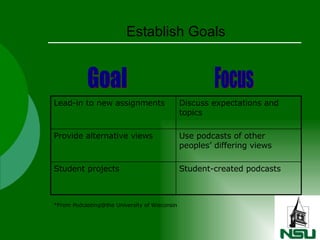
Establish Goals   Student-created podcasts Student projects Use podcasts of other peoples’ differing views Provide alternative views Discuss expectations and topics Lead-in to new assignments Goal Focus *From Podcasting@the University of Wisconsin
Outline Be creative Use humor Music Use a co-host Plan it out PowerPoint Notes Flowchart
Outline Some ideas  Provide a stimulus for students to react to or reflect upon for deeper analysis Use experts on specific topics Case studies illustrate a key topic or learning goal For more ideas see:  http://engage.doit.wisc.edu/podcasting/teachAndLearn / *From Podcasting@the University of Wisconsin
Record Record the podcast Be natural and talk as if you have the student in front of you Express your views and ideas Use outline notes, not a firm script Don’t worry about flaws, you can always edit later *From Podcasting@the University of Wisconsin
Incorporate  Add the content into your course Make it a logical fit Make it core material, not ancillary Start planning early  Know where and why you want to use it
How Do You Create A Podcast?
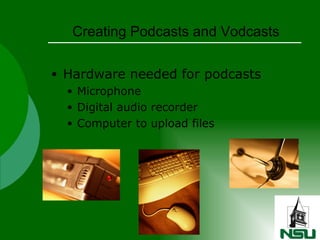
Creating Podcasts and Vodcasts Hardware needed for podcasts Microphone  Digital audio recorder Computer to upload files
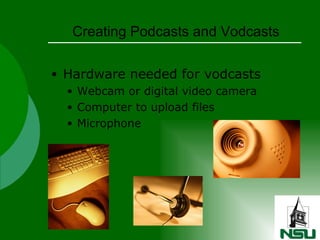
Creating Podcasts and Vodcasts Hardware needed for vodcasts Webcam or digital video camera Computer to upload files Microphone
Creating Podcasts and Vodcasts Software needed for vodcasts Screen capture applications such as Camtasia Apple QuickTime Pro Windows Movie Maker Drupal
Creating Podcasts and Vodcasts Software needed for podcasts Application to download the digital file from the recorder to the computer Generally comes with the recorder File conversion application, such as iTunes www.apple.com/itunes , free download RSS server software for subscriptions Open-source applications such as Drupal,  www.drupal.org Server software would be managed by university IT staff
Creating Podcasts and Vodcasts Record content Save the audio at maximum quality  Convert the file to MP3 format using iTunes or another application Upload the MP3 file to a web or course management server Test them on a computer and on any MP3 player
Creating Podcasts and Vodcasts For a tutorial on creating podcasts, see the  Webmonkey  article “All the World’s a Podcast” by Michael Calore http://www.webmonkey.com/webmonkey/05/52/index4a.html   Another tutorial is “How to create & deliver podcasts,” from the University of Wisconsin-Madison http://engage.doit.wisc.edu/podcasting/createAndDeliver/ See also the  Podcasting News   article, “Make Your First Podcast” http://www.podcastingnews.com/articles/How-to-Podcast.html
The NSU Initiative
The NSU Initiative Spring 2006 pilot efforts Educational Foundations & Leadership  Health & Kinesiology Natural Science Management Spanish
The NSU Initiative Fall 2006 additions Social Work Nursing Library Services Curriculum & Instruction
NASA Online,  http://www.knowitall.org/nasa/   The Naked Scientists Internet Radio Show  http://www.thenakedscientists.com/ NASA Brain Bites http://brainbites.nasa.gov Science
Spanish Mini-lessons for review Instructor-produced Audio file and screen capture of PowerPoint Supplemental content for upper-division courses Spanish-language podcasts on cultural, historical, or political topics Podcasts from variety of  countries for analysis of  dialectical variations
Health & Kinesiology Supplemental content for undergraduate courses Combined with Blackboard-based discussion topics Micro-lessons Use of health-related equipment Library orientation Outside expertise Lectures for review
Health & Kinesiology Student-created content Personal philosophies Students reflect on the creation process and their beliefs Creates an electronic artifact for later use or reflection Based on “This I Believe” program at National Public Radio http://www.npr.org/templates/story/story.php?storyId=4566554
Management Primary and supplemental content for undergraduate courses Lectures for online classes Lecture previews PowerPoint captures Podcasts Vodcasts Class discussions
Educational Foundations & Leadership Online course development Primary and supplemental content for undergraduate courses Lectures for online classes Service-learning activities Portfolio development
Library Services Micro-lessons http://library.nsuok.edu/tutorials/orientation.html Many tutorials are in the process of becoming vodcasts
Let’s Make a Podcast
A Quick Podcasting Activity We will break into small groups Each group will spend a few minutes reviewing the instructional use of podcasts and vodcasts Each group needs to select a spokesperson I will pass out recorders and microphones Each spokesperson will record a summary of the group’s ideas I will show you how easy it is to make a podcast from these summaries
NSU Podcast Site User ID: Rick Shelton Password: same http://ctl.nsuok.edu/drupal/?q=node NSU  http://www.nsuok.edu/ http://arapaho.nsuok.edu/~sheltorw/
Presentation Resources Best, June. (June 20, 2005). Duke’s Free iPod Program Has Mixed Results.  CNET News.com . Retrieved March 30, 2006 from  http://news.com.com/Dukes+free+iPod+program+has+mixed+results/2100-1025_3-5754005.html . Blaisdell, Mikael. (2006). Academic MP3s:  Is It Time Yet?  Campus   Technology , March, 38-50. Calore, Michael. (December 16, 2005). All the World’s a Podcast.  Webmonkey . Retrieved April 15, 2006 from  http://www.webmonkey.com/webmonkey/05/52/index4a.html . (December 5, 2005).  Duke Sees Growth in Classroom iPod Use . Retrieved April 15, 2006 from  http://www.dukenews.duke.edu/2005/12/ipodupdate.html .
Presentation Resources Make Your First Podcast.  Podcasting News.  Retrieved April 16, 2006 from  http://www.podcastingnews.com/articles/How-to-Podcast.html .  Terdima, Daniel. (November 3, 2005).  Stanford Using iTunes to Take Lectures Global.  CNET News.com .  Retrieved March 30, 2006 from  http://news.com.com/Stanford+using+iTunes+to+take+lectures+global/2100-1041_3-5931232.html .  Podcasting@the University of Wisconsin – Madison Retrieved May 20, 2006 from  http://engage.doit.wisc.edu/podcasting/teachAndLearn/
Questions? Thank You! Rick Shelton ,  [email_address]

I U T Presentation

  • 1.
    2006 International Conferenceon Improving University Teaching Rick Shelton Northeastern State University Tahlequah, Oklahoma USA Expanding the Classroom: Exploring Podcasts and Vodcasts in Education
  • 2.
    Agenda What arepodcasts and vodcasts? How are universities using these technologies? Where do you find content? How do you develop pod- and vodcast-based assignments? How do you create a podcast? NSU initiative Let’s make a podcast
  • 3.
    What Are Podcastsand Vodcasts?
  • 4.
    Podcasts and VodcastsDigital audio and video files distributed over the Internet Download and use the content on a computer or a mobile device such as an iPod or an MP3 player Available through direct download from websites or through a subscription feed Podcasting software – iTunes, Juice, iPodder – needed to subscribe Once downloaded, the podcasts and vodcasts are not limited to online use
  • 5.
    Podcasts and VodcastsPod- and vodcasting are based on RSS, the software that makes subscription possible RSS is server-side, not local software Digital audio can be converted to an MP3 file, a format recognized by RSS Digital video can be converted to a variety of formats that RSS can deliver The RSS file includes text that describes your MP3 or video file for the potential user
  • 6.
    How Are UniversitiesUsing These Technologies?
  • 7.
    Methods for Usingthe Technology Universities are using podcasts and vodcasts As content delivery methods for online or hybrid courses As supplements to traditional courses accessed through course management systems such as Blackboard or through dedicated servers As outreach or recruiting tools for the university
  • 8.
    Methods for Usingthe Technology University use of podcasts and vodcasts Published podcasts and vodcasts with content appropriate for the course Content created by the instructor Content created by other university staff Content created by students A number of institutions have initiated podcast-based programs
  • 9.
    Current Use ofTechnologies Stanford University Stanford on iTunes Offering audio content from lectures, interviews, and other university events Some content free and available to public, other content restricted to Stanford community See http://itunes.stanford.edu/ for more information
  • 10.
    Current Use ofTechnologies Duke University iPod First-Year Experience Incoming freshmen in fall 2004 given iPods and recording accessories Academic use did not meet expectations University’s own evaluation of the project revealed a number of challenges, including faculty training Now the Duke Digital Initiative, modified and reduced in scope to identified courses For more information, see http://www.dukenews.duke.edu/2005/12/ipodupdate.html
  • 11.
    Current Use ofTechnologies Georgia College and State University Milledgeville, central Georgia 90 miles from Atlanta The iVillage A virtual learning community for freshmen using iPods and WebCT Created fall 2005 http://ipod.gcsu.edu/
  • 12.
  • 13.
    Sources of ContentPodcast directories are searchable and generally organized into subject matter categories Some more academically oriented than others The Education Podcast Network, http://epnweb.org Podcasting News, http://www.podcastingnews.com/ Podcast.net, http://www.podcast.net
  • 14.
    Sources of ContentPodcast directories, continued Podcast Alley, http://www.podcastalley.com The Podcast Network, http://www.thepodcastnetwork.com iTunes Podcasts, www.apple.com/itunes/podcasts/ Vodstock, http://www.vodstock.com The Voice Booth, www.thevoicebooth.com/podcasting.htm
  • 15.
    Sources of ContentOther podcast and vodcast sources are more traditional online sites offering new delivery methods NPR, www.npr.org CNN, www.cnn.com Radio New Zealand, http://www.radionz.co.nz/rss
  • 16.
    Sources of Content: A Warning Podcasts and vodcasts are easy and inexpensive to create Anyone can and does publish them Files containing adult content, extreme views, and inaccurate information are common As with all online content, instructors must be cautious
  • 17.
    Creating Podcast- andVodcast-Based Assignments
  • 18.
    Designing a PodcastDetermine content Establish goals Outline your podcast Record your podcast Incorporate it into your class work *From Podcasting@the University of Wisconsin
  • 19.
    Determining Content Avoidoverly complex topics Establish a focus Make it interesting Generally avoid just recording lectures *From Podcasting@the University of Wisconsin
  • 20.
    Establish Goals Usea rubric Clear goals, purposes and expected outcomes help focus the lesson Eliminate clutter from the podcast
  • 21.
    Establish Goals  Student-created podcasts Student projects Use podcasts of other peoples’ differing views Provide alternative views Discuss expectations and topics Lead-in to new assignments Goal Focus *From Podcasting@the University of Wisconsin
  • 22.
    Outline Be creativeUse humor Music Use a co-host Plan it out PowerPoint Notes Flowchart
  • 23.
    Outline Some ideas Provide a stimulus for students to react to or reflect upon for deeper analysis Use experts on specific topics Case studies illustrate a key topic or learning goal For more ideas see: http://engage.doit.wisc.edu/podcasting/teachAndLearn / *From Podcasting@the University of Wisconsin
  • 24.
    Record Record thepodcast Be natural and talk as if you have the student in front of you Express your views and ideas Use outline notes, not a firm script Don’t worry about flaws, you can always edit later *From Podcasting@the University of Wisconsin
  • 25.
    Incorporate Addthe content into your course Make it a logical fit Make it core material, not ancillary Start planning early Know where and why you want to use it
  • 26.
    How Do YouCreate A Podcast?
  • 27.
    Creating Podcasts andVodcasts Hardware needed for podcasts Microphone Digital audio recorder Computer to upload files
  • 28.
    Creating Podcasts andVodcasts Hardware needed for vodcasts Webcam or digital video camera Computer to upload files Microphone
  • 29.
    Creating Podcasts andVodcasts Software needed for vodcasts Screen capture applications such as Camtasia Apple QuickTime Pro Windows Movie Maker Drupal
  • 30.
    Creating Podcasts andVodcasts Software needed for podcasts Application to download the digital file from the recorder to the computer Generally comes with the recorder File conversion application, such as iTunes www.apple.com/itunes , free download RSS server software for subscriptions Open-source applications such as Drupal, www.drupal.org Server software would be managed by university IT staff
  • 31.
    Creating Podcasts andVodcasts Record content Save the audio at maximum quality Convert the file to MP3 format using iTunes or another application Upload the MP3 file to a web or course management server Test them on a computer and on any MP3 player
  • 32.
    Creating Podcasts andVodcasts For a tutorial on creating podcasts, see the Webmonkey article “All the World’s a Podcast” by Michael Calore http://www.webmonkey.com/webmonkey/05/52/index4a.html Another tutorial is “How to create & deliver podcasts,” from the University of Wisconsin-Madison http://engage.doit.wisc.edu/podcasting/createAndDeliver/ See also the Podcasting News article, “Make Your First Podcast” http://www.podcastingnews.com/articles/How-to-Podcast.html
  • 33.
  • 34.
    The NSU InitiativeSpring 2006 pilot efforts Educational Foundations & Leadership Health & Kinesiology Natural Science Management Spanish
  • 35.
    The NSU InitiativeFall 2006 additions Social Work Nursing Library Services Curriculum & Instruction
  • 36.
    NASA Online, http://www.knowitall.org/nasa/ The Naked Scientists Internet Radio Show http://www.thenakedscientists.com/ NASA Brain Bites http://brainbites.nasa.gov Science
  • 37.
    Spanish Mini-lessons forreview Instructor-produced Audio file and screen capture of PowerPoint Supplemental content for upper-division courses Spanish-language podcasts on cultural, historical, or political topics Podcasts from variety of countries for analysis of dialectical variations
  • 38.
    Health & KinesiologySupplemental content for undergraduate courses Combined with Blackboard-based discussion topics Micro-lessons Use of health-related equipment Library orientation Outside expertise Lectures for review
  • 39.
    Health & KinesiologyStudent-created content Personal philosophies Students reflect on the creation process and their beliefs Creates an electronic artifact for later use or reflection Based on “This I Believe” program at National Public Radio http://www.npr.org/templates/story/story.php?storyId=4566554
  • 40.
    Management Primary andsupplemental content for undergraduate courses Lectures for online classes Lecture previews PowerPoint captures Podcasts Vodcasts Class discussions
  • 41.
    Educational Foundations &Leadership Online course development Primary and supplemental content for undergraduate courses Lectures for online classes Service-learning activities Portfolio development
  • 42.
    Library Services Micro-lessonshttp://library.nsuok.edu/tutorials/orientation.html Many tutorials are in the process of becoming vodcasts
  • 43.
  • 44.
    A Quick PodcastingActivity We will break into small groups Each group will spend a few minutes reviewing the instructional use of podcasts and vodcasts Each group needs to select a spokesperson I will pass out recorders and microphones Each spokesperson will record a summary of the group’s ideas I will show you how easy it is to make a podcast from these summaries
  • 45.
    NSU Podcast SiteUser ID: Rick Shelton Password: same http://ctl.nsuok.edu/drupal/?q=node NSU http://www.nsuok.edu/ http://arapaho.nsuok.edu/~sheltorw/
  • 46.
    Presentation Resources Best,June. (June 20, 2005). Duke’s Free iPod Program Has Mixed Results. CNET News.com . Retrieved March 30, 2006 from http://news.com.com/Dukes+free+iPod+program+has+mixed+results/2100-1025_3-5754005.html . Blaisdell, Mikael. (2006). Academic MP3s: Is It Time Yet? Campus Technology , March, 38-50. Calore, Michael. (December 16, 2005). All the World’s a Podcast. Webmonkey . Retrieved April 15, 2006 from http://www.webmonkey.com/webmonkey/05/52/index4a.html . (December 5, 2005). Duke Sees Growth in Classroom iPod Use . Retrieved April 15, 2006 from http://www.dukenews.duke.edu/2005/12/ipodupdate.html .
  • 47.
    Presentation Resources MakeYour First Podcast. Podcasting News. Retrieved April 16, 2006 from http://www.podcastingnews.com/articles/How-to-Podcast.html . Terdima, Daniel. (November 3, 2005). Stanford Using iTunes to Take Lectures Global. CNET News.com . Retrieved March 30, 2006 from http://news.com.com/Stanford+using+iTunes+to+take+lectures+global/2100-1041_3-5931232.html . Podcasting@the University of Wisconsin – Madison Retrieved May 20, 2006 from http://engage.doit.wisc.edu/podcasting/teachAndLearn/
  • 48.
    Questions? Thank You!Rick Shelton , [email_address]