Dramatization
at Primary School and Kindergarten
Želiarska 4, Košice
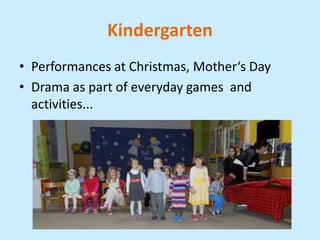
Kindergarten
• Performances at Christmas, Mother‘s Day
• Drama as part of everyday games and
activities...
Drama at Primary school
Not a subject but cross-curricular activity
Subjects dealing with drama:
• Slovak
• English
• Ethics
• Religion
• Citizenship
• Art ...
First year
• learn to read and write
• basics of dramatic expression:
– reproduce and dramatize short texts eg. tales,
often with the support of images
• learn to breathe properly
• look (eye contact)
• use expression
• articulate correctly
• recitation
• dramatize a simple communication situations
with finger puppets
Second year
• develop verbal and non-verbal communication
• dramatize communication situations
– the apology, plea, introduction ...
• become familiar with children's folk games
• develop the presentation of communiqué
• learn dramatized reading
• read texts in the role
• gain first knowledge about film - picture
motion, action, movie characters, costumes
Third year
• pupils already know to reproduce a text, also
reasonably dramatize
• read or verbally reproduce a text, with non-
verbal support in the role
• familiarize with scenario, words: act, scene, ...
• creatively dramatize new endings of famous
fairy tales or stories from children‘s life
• try to create their own scenes and various
puppets
Fourth year
• learn to identify direct speech and introductory
speech in communiqué
• practice interview
• learn words: drama, scenario, dialogue,
monologue, ...
• actively dramatize fairy tale drama
• distinguish between prose and dramatized text
• recognize professions making a film
• arguing
Fifth year
• pupils make their own puppets
• prepare a puppet theatre performance
• rehearsal is in the afternoon after school
(pupils need to learn arranging their time)
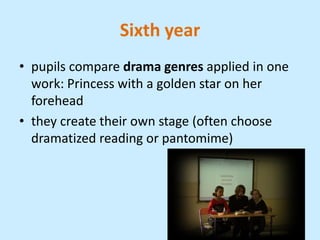
Sixth year
• pupils compare drama genres applied in one
work: Princess with a golden star on her
forehead
• they create their own stage (often choose
dramatized reading or pantomime)
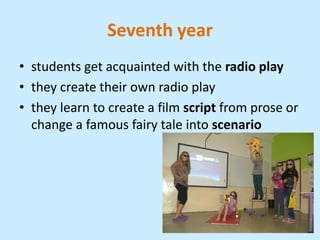
Seventh year
• students get acquainted with the radio play
• they create their own radio play
• they learn to create a film script from prose or
change a famous fairy tale into scenario
Eighth year
• creative theatre - meeting literary characters
• Guess Who?
• Court Hearing
Ninth year
• pupils learn about musical as a hybrid genre
• they express scenes and feelings not only with
words but with gestures, movement, dance
Performances
• Christmas Academy
• Mother‘s Day
• Dubbing first graders – they become school
knights
• Retired People‘s Day Celebration
• School Anniversary Celebration
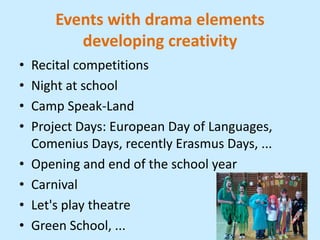
Events with drama elements
developing creativity
• Recital competitions
• Night at school
• Camp Speak-Land
• Project Days: European Day of Languages,
Comenius Days, recently Erasmus Days, ...
• Opening and end of the school year
• Carnival
• Let's play theatre
• Green School, ...
Preparatory exercises
• Breathing exercises
• Articulatory language exercises to practice
tongue, mouth, jaw
• Exercises to practice means of expression:
strenght, height and colour of the voice,
tempo, accent, emphasis and phrasing
(structure of speech) – children‘s favourite
• Movement exercises
• Understanding of content
Story and script/scenario
• Created by pupils
• Created by teachers
• Other sources (library, internet)
Different approaches:
• transform a given text into a play
• finish a given text as drama
• make up the own scripts on a topic
Scenery
• Made by pupils and teachers at school
• Puppets: wayang, glove, sock,
wooden spoon, ...
Costumes
• made by parents
• bought by parents
• made at school
• borrowed from theatre
Visiting theatre
• The Košice State Theatre
• Puppet Theatre
Best practices
Game with a “Substitute Prop“
• students sit in a circle and they gradually shift
a “substitute prop“ = eg. a pencil
without words
• their task is to imagine some another subject
similar to a prop and present its use only
by movement - eg. a flute, conductor's baton,
toothbrush, pen ...
• the more subjects children present, the more
it develops their creativity and sense of drama
feeling and thinking
“Hats“ or “Caps“
• various headgear is needed - cowboy hat,
straw hat, woolen cap, police cap, fire helmet,
cap, cylinder ....
• when pupils put on a headgear they turn into
a person wearing that hat/cap
• they represent the role by gestures,
movement or verbally
• analysis or discussion is important: who, how
and why someone did a good job
“ŠTRONZO“
1. there is a given situation or phenomenon
2. students present the situation or
phenomenon by movement, gestures, facial
expressions
3. after saying the word “Štronzo“ they freeze
4. one of the students can guess what the
situation or phenomenon was
5. or the situation or phenomenon can be
otherwise analyzed together with a teacher
Role Play
• also a crucial part of English teaching
• an example from a competition English Olympiad:
TEACHER
• You are the director of a primary school. When you came, the school had no clear
policy about mobile phones so the first rule you implemented was to ban them for
students in the school building. There are no exceptions. It’s a policy you believe in and
have no intention of changing. Simply put, students should not have mobile phones at
school. One of the students has asked to talk to you about the school’s mobile phone
policy.
• You start: So, what would you like to discuss with me today?
STUDENT
• The school you attend does not allow students to have mobile phones in the school
building. You don’t think that’s right. In fact, you think that there’s nothing wrong with
mobile phones and they can even be used to learn in classes. You’ve decided to talk to
the director of the school and try to persuade him/her to allow phones.
Playing with puppets
very popular
teacher or pupil presents:
• Wayang puppet – easy
• Wooden spoon puppet – easy
• Sock puppet – easy
• Glove puppet - easy
• Finger puppet - easy
• Shadow theatre – medium difficulty
• Marionette theatre – difficult for pupils
Speaking Chain – “Dubbing“
• one group verbally describes what the second
group does on stage
Other methods
• methods using only movement,
eg. Pantomime
• methods using language/speech
• methods using sound/noise
Thank you for your attention
Slovak ERASMUS + team
Želiarska 4, Košice

Dramatization

  • 1.
    Dramatization at Primary Schooland Kindergarten Želiarska 4, Košice
  • 2.
    Kindergarten • Performances atChristmas, Mother‘s Day • Drama as part of everyday games and activities...
  • 3.
    Drama at Primaryschool Not a subject but cross-curricular activity Subjects dealing with drama: • Slovak • English • Ethics • Religion • Citizenship • Art ...
  • 4.
    First year • learnto read and write • basics of dramatic expression: – reproduce and dramatize short texts eg. tales, often with the support of images • learn to breathe properly • look (eye contact) • use expression • articulate correctly • recitation • dramatize a simple communication situations with finger puppets
  • 5.
    Second year • developverbal and non-verbal communication • dramatize communication situations – the apology, plea, introduction ... • become familiar with children's folk games • develop the presentation of communiqué • learn dramatized reading • read texts in the role • gain first knowledge about film - picture motion, action, movie characters, costumes
  • 6.
    Third year • pupilsalready know to reproduce a text, also reasonably dramatize • read or verbally reproduce a text, with non- verbal support in the role • familiarize with scenario, words: act, scene, ... • creatively dramatize new endings of famous fairy tales or stories from children‘s life • try to create their own scenes and various puppets
  • 7.
    Fourth year • learnto identify direct speech and introductory speech in communiqué • practice interview • learn words: drama, scenario, dialogue, monologue, ... • actively dramatize fairy tale drama • distinguish between prose and dramatized text • recognize professions making a film • arguing
  • 9.
    Fifth year • pupilsmake their own puppets • prepare a puppet theatre performance • rehearsal is in the afternoon after school (pupils need to learn arranging their time)
  • 10.
    Sixth year • pupilscompare drama genres applied in one work: Princess with a golden star on her forehead • they create their own stage (often choose dramatized reading or pantomime)
  • 11.
    Seventh year • studentsget acquainted with the radio play • they create their own radio play • they learn to create a film script from prose or change a famous fairy tale into scenario
  • 12.
    Eighth year • creativetheatre - meeting literary characters • Guess Who? • Court Hearing Ninth year • pupils learn about musical as a hybrid genre • they express scenes and feelings not only with words but with gestures, movement, dance
  • 13.
    Performances • Christmas Academy •Mother‘s Day • Dubbing first graders – they become school knights • Retired People‘s Day Celebration • School Anniversary Celebration
  • 14.
    Events with dramaelements developing creativity • Recital competitions • Night at school • Camp Speak-Land • Project Days: European Day of Languages, Comenius Days, recently Erasmus Days, ... • Opening and end of the school year • Carnival • Let's play theatre • Green School, ...
  • 15.
    Preparatory exercises • Breathingexercises • Articulatory language exercises to practice tongue, mouth, jaw • Exercises to practice means of expression: strenght, height and colour of the voice, tempo, accent, emphasis and phrasing (structure of speech) – children‘s favourite • Movement exercises • Understanding of content
  • 16.
    Story and script/scenario •Created by pupils • Created by teachers • Other sources (library, internet) Different approaches: • transform a given text into a play • finish a given text as drama • make up the own scripts on a topic
  • 17.
    Scenery • Made bypupils and teachers at school • Puppets: wayang, glove, sock, wooden spoon, ...
  • 18.
    Costumes • made byparents • bought by parents • made at school • borrowed from theatre
  • 19.
    Visiting theatre • TheKošice State Theatre • Puppet Theatre
  • 20.
  • 21.
    Game with a“Substitute Prop“ • students sit in a circle and they gradually shift a “substitute prop“ = eg. a pencil without words • their task is to imagine some another subject similar to a prop and present its use only by movement - eg. a flute, conductor's baton, toothbrush, pen ... • the more subjects children present, the more it develops their creativity and sense of drama feeling and thinking
  • 22.
    “Hats“ or “Caps“ •various headgear is needed - cowboy hat, straw hat, woolen cap, police cap, fire helmet, cap, cylinder .... • when pupils put on a headgear they turn into a person wearing that hat/cap • they represent the role by gestures, movement or verbally • analysis or discussion is important: who, how and why someone did a good job
  • 23.
    “ŠTRONZO“ 1. there isa given situation or phenomenon 2. students present the situation or phenomenon by movement, gestures, facial expressions 3. after saying the word “Štronzo“ they freeze 4. one of the students can guess what the situation or phenomenon was 5. or the situation or phenomenon can be otherwise analyzed together with a teacher
  • 24.
    Role Play • alsoa crucial part of English teaching • an example from a competition English Olympiad: TEACHER • You are the director of a primary school. When you came, the school had no clear policy about mobile phones so the first rule you implemented was to ban them for students in the school building. There are no exceptions. It’s a policy you believe in and have no intention of changing. Simply put, students should not have mobile phones at school. One of the students has asked to talk to you about the school’s mobile phone policy. • You start: So, what would you like to discuss with me today? STUDENT • The school you attend does not allow students to have mobile phones in the school building. You don’t think that’s right. In fact, you think that there’s nothing wrong with mobile phones and they can even be used to learn in classes. You’ve decided to talk to the director of the school and try to persuade him/her to allow phones.
  • 25.
    Playing with puppets verypopular teacher or pupil presents: • Wayang puppet – easy • Wooden spoon puppet – easy • Sock puppet – easy • Glove puppet - easy • Finger puppet - easy • Shadow theatre – medium difficulty • Marionette theatre – difficult for pupils
  • 26.
    Speaking Chain –“Dubbing“ • one group verbally describes what the second group does on stage Other methods • methods using only movement, eg. Pantomime • methods using language/speech • methods using sound/noise
  • 27.
    Thank you foryour attention Slovak ERASMUS + team Želiarska 4, Košice