Podcasting
What is podcasting?The term “podcasting” is a combination of the words“iPod” and “broadcasting” and refers to the distribution of audiocontent. An audio podcast is similar to a radio broadcast exceptthat listeners don’t have to tune in at a particular time. Instead, users can subscribe to a podcast and automatically receivea downloaded copy of each new episode. Users can listen to a podcast through their computer or through an MP3 player such asan iPod.
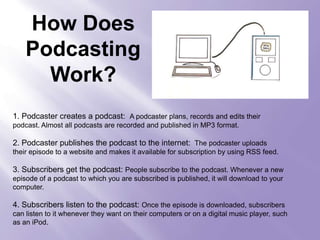
How Does Podcasting Work?1. Podcaster creates a podcast:  A podcaster plans, records and edits theirpodcast. Almost all podcasts are recorded and published in MP3 format.2. Podcaster publishes the podcast to the internet:  The podcaster uploadstheir episode to a website and makes it available for subscription by using RSS feed.3. Subscribers get the podcast: People subscribe to the podcast. Whenever a newepisode of a podcast to which you are subscribed is published, it will download to your computer.4. Subscribers listen to the podcast: Once the episode is downloaded, subscriberscan listen to it whenever they want on their computers or on a digital music player, such as an iPod.
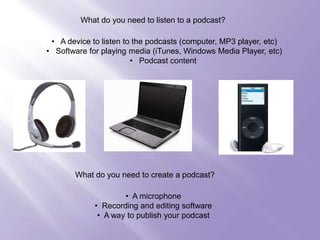
What do you need to listen to a podcast?   A device to listen to the podcasts (computer, MP3 player, etc)
   Software for playing media (iTunes, Windows Media Player, etc)
   Podcast content What do you need to create a podcast?  A microphone
  Recording and editing software
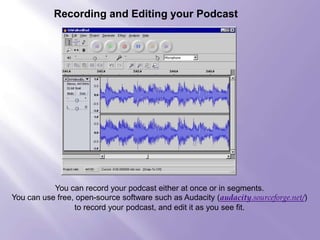
  A way to publish your podcastRecording and Editing your PodcastYou can record your podcast either at once or in segments. You can use free, open-source software such as Audacity (audacity.sourceforge.net/) to record your podcast, and edit it as you see fit.
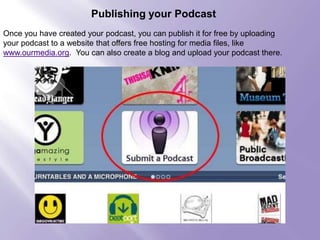
Publishing your PodcastOnce you have created your podcast, you can publish it for free by uploadingyour podcast to a website that offers free hosting for media files, like www.ourmedia.org.  You can also create a blog and upload your podcast there.
How does Podcasting differ from Internet Radio?    Podcasting makes use of the Internet’s Real Simple Syndication (RSS) standard.     Unlike internet radio, podcasts are published and transmittedvia the internet.     Also, instead of a central audio stream, podcasting can sendaudio content directly to an iPod or MP3 player.    Podcasts are also different from traditional or internet radio becausepodcasts give listeners control over when they hear the recording.
What are the benefits of podcasts in education?Podcasts :    Enable portable lectures/education

Podcast presentation

  • 1.
  • 2.
    What is podcasting?Theterm “podcasting” is a combination of the words“iPod” and “broadcasting” and refers to the distribution of audiocontent. An audio podcast is similar to a radio broadcast exceptthat listeners don’t have to tune in at a particular time. Instead, users can subscribe to a podcast and automatically receivea downloaded copy of each new episode. Users can listen to a podcast through their computer or through an MP3 player such asan iPod.
  • 3.
    How Does PodcastingWork?1. Podcaster creates a podcast: A podcaster plans, records and edits theirpodcast. Almost all podcasts are recorded and published in MP3 format.2. Podcaster publishes the podcast to the internet: The podcaster uploadstheir episode to a website and makes it available for subscription by using RSS feed.3. Subscribers get the podcast: People subscribe to the podcast. Whenever a newepisode of a podcast to which you are subscribed is published, it will download to your computer.4. Subscribers listen to the podcast: Once the episode is downloaded, subscriberscan listen to it whenever they want on their computers or on a digital music player, such as an iPod.
  • 4.
    What do youneed to listen to a podcast? A device to listen to the podcasts (computer, MP3 player, etc)
  • 5.
    Software for playing media (iTunes, Windows Media Player, etc)
  • 6.
    Podcast content What do you need to create a podcast? A microphone
  • 7.
    Recordingand editing software
  • 8.
    Away to publish your podcastRecording and Editing your PodcastYou can record your podcast either at once or in segments. You can use free, open-source software such as Audacity (audacity.sourceforge.net/) to record your podcast, and edit it as you see fit.
  • 9.
    Publishing your PodcastOnceyou have created your podcast, you can publish it for free by uploadingyour podcast to a website that offers free hosting for media files, like www.ourmedia.org. You can also create a blog and upload your podcast there.
  • 10.
    How does Podcastingdiffer from Internet Radio? Podcasting makes use of the Internet’s Real Simple Syndication (RSS) standard. Unlike internet radio, podcasts are published and transmittedvia the internet. Also, instead of a central audio stream, podcasting can sendaudio content directly to an iPod or MP3 player. Podcasts are also different from traditional or internet radio becausepodcasts give listeners control over when they hear the recording.
  • 11.
    What are thebenefits of podcasts in education?Podcasts : Enable portable lectures/education