Hypothesis Testing With Python
True Difference or Noise?
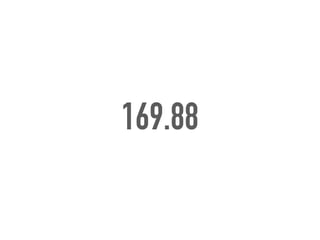
169.61
169.88
Which is better?
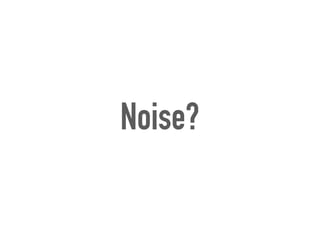
Noise?
That's a question.
Mosky
➤ Python Charmer at Pinkoi.
➤ Has spoken at: PyCons in 

TW, MY, KR, JP, SG, HK,

COSCUPs, and TEDx, etc.
➤ Countless hours 

on teaching Python.
➤ Own the Python packages:
ZIPCodeTW, 

MoSQL, Clime, etc.
➤ http://mosky.tw/
8
Outline
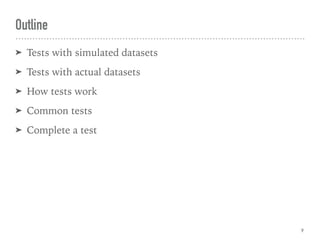
➤ Tests with simulated datasets
➤ Tests with actual datasets
➤ How tests work
➤ Common tests
➤ Complete a test
9
Tests with datasets
Go with the notebooks
➤ 01_tests_with_simulated_datasets.ipynb
➤ 02_tests_with_actual_datasets.ipynb
➤ The notebooks are available on https://github.com/
moskytw/hypothesis-testing-with-python .
11
P-value & α
12
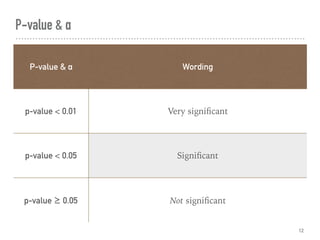
P-value & α Wording
p-value < 0.01 Very significant
p-value < 0.05 Significant
p-value ≥ 0.05 Not significant
How tests work
Seeing is believing
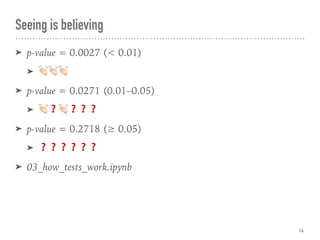
➤ p-value = 0.0027 (< 0.01)
➤ !!!
➤ p-value = 0.0271 (0.01–0.05)
➤ !❓!❓❓❓
➤ p-value = 0.2718 (≥ 0.05)
➤ ❓❓❓❓❓❓
➤ 03_how_tests_work.ipynb
14
Fair coin testing
➤ “The coin is fair.”
➤ Case 1: Toss the coin 100 times, and come up 53 heads.
➤ “Hmmm ... somehow fair.”
➤ Case 2: Toss the coin 100 times, and come up 87 heads.
➤ “Not fair! So extreme!”
15
Hypothesis testing
➤ “The means of two populations are equal.”
➤ Case 1: p-value ≥ 0.05.
➤ “Hmmm ... somehow equal.”
➤ Case 2: p-value < 0.05.
➤ “Not equal! So extreme!”
16
Hypothesis testing in a “null” taste
➤ <null hypothesis>
➤ Case 1: p-value ≥ α.
➤ Can't reject <null hypothesis>.
➤ Case 2: p-value < α.
➤ Reject <null hypothesis>.
17
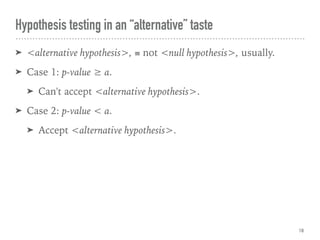
Hypothesis testing in an “alternative” taste
➤ <alternative hypothesis>, ≡ not <null hypothesis>, usually.
➤ Case 1: p-value ≥ α.
➤ Can't accept <alternative hypothesis>.
➤ Case 2: p-value < α.
➤ Accept <alternative hypothesis>.
18
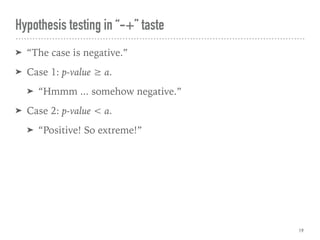
Hypothesis testing in “-+” taste
➤ “The case is negative.”
➤ Case 1: p-value ≥ α.
➤ “Hmmm ... somehow negative.”
➤ Case 2: p-value < α.
➤ “Positive! So extreme!”
19
Common tests
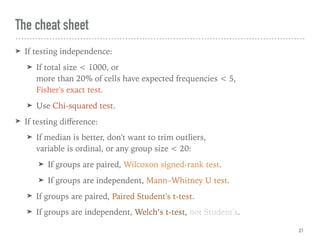
The cheat sheet
➤ If testing independence:
➤ If total size < 1000, or 

more than 20% of cells have expected frequencies < 5, 

Fisher's exact test.
➤ Use Chi-squared test.
➤ If testing difference:
➤ If median is better, don't want to trim outliers, 

variable is ordinal, or any group size < 20:
➤ If groups are paired, Wilcoxon signed-rank test.
➤ If groups are independent, Mann–Whitney U test.
➤ If groups are paired, Paired Student's t-test.
➤ If groups are independent, Welch’s t-test, not Student's.
21
More cheat sheets & references
➤ More cheat sheets:
➤ http://abacus.bates.edu/~ganderso/biology/resources/stats_flow_chart_v2014.pdf
➤ http://www.biostathandbook.com/testchoice.html
➤ https://www.sheffield.ac.uk/mash/what_test
➤ References:
➤ http://www.biostathandbook.com/fishers.html
➤ https://www.ncbi.nlm.nih.gov/pmc/articles/PMC5426219/#__sec5title
➤ http://blog.minitab.com/blog/adventures-in-statistics-2/choosing-between-a-
nonparametric-test-and-a-parametric-test
➤ https://www.sheffield.ac.uk/mash/what_test
➤ https://en.wikipedia.org/wiki/Welch%27s_t-test#Advantages_and_limitations
➤ https://en.wikipedia.org/wiki/Student%27s_t-test#Dependent_t-
test_for_paired_samples
22
The tests in Python
➤ 04_common_tests.ipynb
23
Complete a test
Is p-value enough?
➤ sample size?
➤ alpha?
➤ beta?
➤ effect size?
➤ ❓❓❓❓❓
25
Confusion matrix, where A = 002 = C[0, 0]
26
predicted -
AC
predicted +
BD
actual -
AB
true -
A
false +
B
actual +
CD
false -
C
true +
D
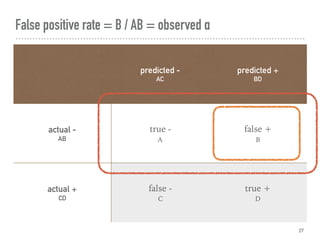
False positive rate = B / AB = observed α
27
predicted -
AC
predicted +
BD
actual -
AB
true -
A
false +
B
actual +
CD
false -
C
true +
D
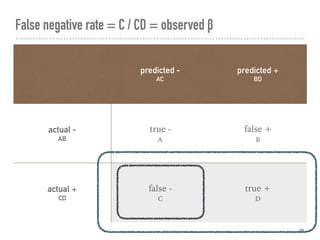
False negative rate = C / CD = observed β
28
predicted -
AC
predicted +
BD
actual -
AB
true -
A
false +
B
actual +
CD
false -
C
true +
D
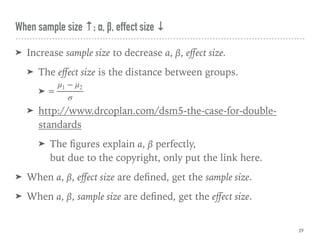
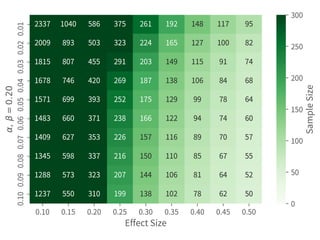
➤ Increase sample size to decrease α, β, effect size.
➤ The effect size is the distance between groups.
➤
➤ http://www.drcoplan.com/dsm5-the-case-for-double-
standards
➤ The figures explain α, β perfectly, 

but due to the copyright, only put the link here.
➤ When α, β, effect size are defined, get the sample size.
➤ When α, β, sample size are defined, get the effect size.
When sample size ↑; α, β, effect size ↓
29
=
μ1 − μ2
σ
False discovery rate
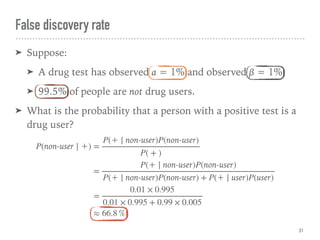
➤ Suppose:
➤ A drug test has observed α = 1% and observed β = 1%.
➤ 99.5% of people are not drug users.
➤ What is the probability that a person with a positive test is a
drug user?
31
P(non-user ∣ +) =
P(+ ∣ non-user)P(non-user)
P( + )
=
P(+ ∣ non-user)P(non-user)
P(+ ∣ non-user)P(non-user) + P(+ ∣ user)P(user)
=
0.01 × 0.995
0.01 × 0.995 + 0.99 × 0.005
≈ 66.8 %
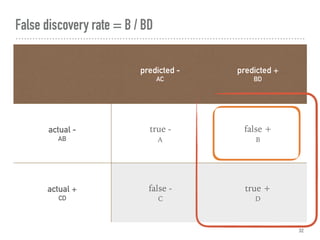
False discovery rate = B / BD
32
predicted -
AC
predicted +
BD
actual -
AB
true -
A
false +
B
actual +
CD
false -
C
true +
D
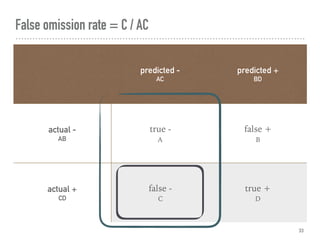
False omission rate = C / AC
33
predicted -
AC
predicted +
BD
actual -
AB
true -
A
false +
B
actual +
CD
false -
C
true +
D
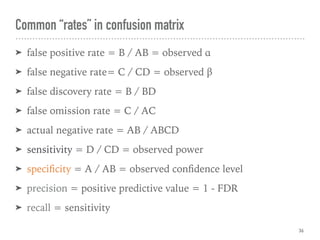
➤ false positive rate = B / AB = observed α
➤ false negative rate= C / CD = observed β
➤ false discovery rate = B / BD
➤ false omission rate = C / AC
➤ actual negative rate = AB / ABCD
➤ sensitivity = D / CD = observed power
➤ specificity = A / AB = observed confidence level
➤ precision = positive predictive value = 1 - FDR
➤ recall = sensitivity
Common “rates” in confusion matrix
36
Most formal steps
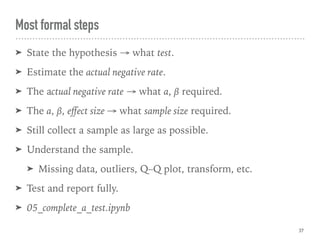
➤ State the hypothesis → what test.
➤ Estimate the actual negative rate.
➤ The actual negative rate → what α, β required.
➤ The α, β, effect size → what sample size required.
➤ Still collect a sample as large as possible.
➤ Understand the sample.
➤ Missing data, outliers, Q–Q plot, transform, etc.
➤ Test and report fully.
➤ 05_complete_a_test.ipynb
37
Other statistical tools
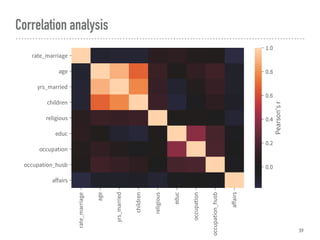
Correlation analysis
39
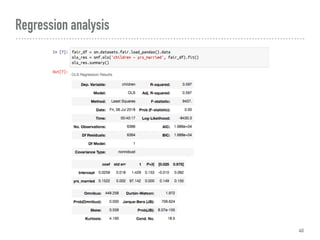
Regression analysis
40
Keep learning
➤ Statistics
➤ Seeing Theory
➤ Biological Statistics
➤ scipy.stats + StatsModels
➤ Research Methods
➤ Machine Learning
➤ Scikit-learn Tutorials
➤ Standford CS229
➤ Hsuan-Tien Lin
41
➤ p-value – the “tail” probability given “actual -”.
➤ confidence interval – the values the middle probability maps to.
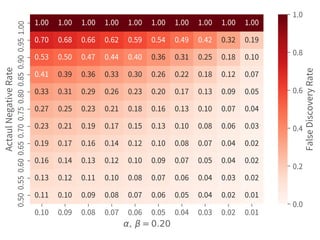
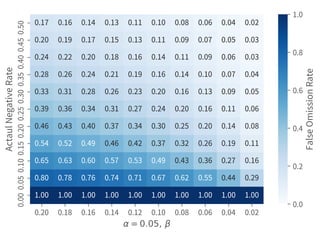
➤ actual negative rate > 0.5 ↑ α ↓
➤ actual negative rate < 0.5 ↓ β ↓
➤ α, β, effect size ↓ sample size ↑
➤ Visualization and simulation do help.
➤ Bonus: a1_figures.ipynb .
➤ Let's identify noise efficiently!
Recap
42

Hypothesis Testing With Python

  • 1.
    Hypothesis Testing WithPython True Difference or Noise?
  • 2.
  • 3.
  • 4.
  • 5.
  • 6.
  • 8.
    Mosky ➤ Python Charmerat Pinkoi. ➤ Has spoken at: PyCons in 
 TW, MY, KR, JP, SG, HK,
 COSCUPs, and TEDx, etc. ➤ Countless hours 
 on teaching Python. ➤ Own the Python packages: ZIPCodeTW, 
 MoSQL, Clime, etc. ➤ http://mosky.tw/ 8
  • 9.
    Outline ➤ Tests withsimulated datasets ➤ Tests with actual datasets ➤ How tests work ➤ Common tests ➤ Complete a test 9
  • 10.
  • 11.
    Go with thenotebooks ➤ 01_tests_with_simulated_datasets.ipynb ➤ 02_tests_with_actual_datasets.ipynb ➤ The notebooks are available on https://github.com/ moskytw/hypothesis-testing-with-python . 11
  • 12.
    P-value & α 12 P-value& α Wording p-value < 0.01 Very significant p-value < 0.05 Significant p-value ≥ 0.05 Not significant
  • 13.
  • 14.
    Seeing is believing ➤p-value = 0.0027 (< 0.01) ➤ !!! ➤ p-value = 0.0271 (0.01–0.05) ➤ !❓!❓❓❓ ➤ p-value = 0.2718 (≥ 0.05) ➤ ❓❓❓❓❓❓ ➤ 03_how_tests_work.ipynb 14
  • 15.
    Fair coin testing ➤“The coin is fair.” ➤ Case 1: Toss the coin 100 times, and come up 53 heads. ➤ “Hmmm ... somehow fair.” ➤ Case 2: Toss the coin 100 times, and come up 87 heads. ➤ “Not fair! So extreme!” 15
  • 16.
    Hypothesis testing ➤ “The means oftwo populations are equal.” ➤ Case 1: p-value ≥ 0.05. ➤ “Hmmm ... somehow equal.” ➤ Case 2: p-value < 0.05. ➤ “Not equal! So extreme!” 16
  • 17.
    Hypothesis testing ina “null” taste ➤ <null hypothesis> ➤ Case 1: p-value ≥ α. ➤ Can't reject <null hypothesis>. ➤ Case 2: p-value < α. ➤ Reject <null hypothesis>. 17
  • 18.
    Hypothesis testing inan “alternative” taste ➤ <alternative hypothesis>, ≡ not <null hypothesis>, usually. ➤ Case 1: p-value ≥ α. ➤ Can't accept <alternative hypothesis>. ➤ Case 2: p-value < α. ➤ Accept <alternative hypothesis>. 18
  • 19.
    Hypothesis testing in“-+” taste ➤ “The case is negative.” ➤ Case 1: p-value ≥ α. ➤ “Hmmm ... somehow negative.” ➤ Case 2: p-value < α. ➤ “Positive! So extreme!” 19
  • 20.
  • 21.
    The cheat sheet ➤If testing independence: ➤ If total size < 1000, or 
 more than 20% of cells have expected frequencies < 5, 
 Fisher's exact test. ➤ Use Chi-squared test. ➤ If testing difference: ➤ If median is better, don't want to trim outliers, 
 variable is ordinal, or any group size < 20: ➤ If groups are paired, Wilcoxon signed-rank test. ➤ If groups are independent, Mann–Whitney U test. ➤ If groups are paired, Paired Student's t-test. ➤ If groups are independent, Welch’s t-test, not Student's. 21
  • 22.
    More cheat sheets& references ➤ More cheat sheets: ➤ http://abacus.bates.edu/~ganderso/biology/resources/stats_flow_chart_v2014.pdf ➤ http://www.biostathandbook.com/testchoice.html ➤ https://www.sheffield.ac.uk/mash/what_test ➤ References: ➤ http://www.biostathandbook.com/fishers.html ➤ https://www.ncbi.nlm.nih.gov/pmc/articles/PMC5426219/#__sec5title ➤ http://blog.minitab.com/blog/adventures-in-statistics-2/choosing-between-a- nonparametric-test-and-a-parametric-test ➤ https://www.sheffield.ac.uk/mash/what_test ➤ https://en.wikipedia.org/wiki/Welch%27s_t-test#Advantages_and_limitations ➤ https://en.wikipedia.org/wiki/Student%27s_t-test#Dependent_t- test_for_paired_samples 22
  • 23.
    The tests inPython ➤ 04_common_tests.ipynb 23
  • 24.
  • 25.
    Is p-value enough? ➤sample size? ➤ alpha? ➤ beta? ➤ effect size? ➤ ❓❓❓❓❓ 25
  • 26.
    Confusion matrix, whereA = 002 = C[0, 0] 26 predicted - AC predicted + BD actual - AB true - A false + B actual + CD false - C true + D
  • 27.
    False positive rate= B / AB = observed α 27 predicted - AC predicted + BD actual - AB true - A false + B actual + CD false - C true + D
  • 28.
    False negative rate= C / CD = observed β 28 predicted - AC predicted + BD actual - AB true - A false + B actual + CD false - C true + D
  • 29.
    ➤ Increase samplesize to decrease α, β, effect size. ➤ The effect size is the distance between groups. ➤ ➤ http://www.drcoplan.com/dsm5-the-case-for-double- standards ➤ The figures explain α, β perfectly, 
 but due to the copyright, only put the link here. ➤ When α, β, effect size are defined, get the sample size. ➤ When α, β, sample size are defined, get the effect size. When sample size ↑; α, β, effect size ↓ 29 = μ1 − μ2 σ
  • 31.
    False discovery rate ➤Suppose: ➤ A drug test has observed α = 1% and observed β = 1%. ➤ 99.5% of people are not drug users. ➤ What is the probability that a person with a positive test is a drug user? 31 P(non-user ∣ +) = P(+ ∣ non-user)P(non-user) P( + ) = P(+ ∣ non-user)P(non-user) P(+ ∣ non-user)P(non-user) + P(+ ∣ user)P(user) = 0.01 × 0.995 0.01 × 0.995 + 0.99 × 0.005 ≈ 66.8 %
  • 32.
    False discovery rate= B / BD 32 predicted - AC predicted + BD actual - AB true - A false + B actual + CD false - C true + D
  • 33.
    False omission rate= C / AC 33 predicted - AC predicted + BD actual - AB true - A false + B actual + CD false - C true + D
  • 36.
    ➤ false positiverate = B / AB = observed α ➤ false negative rate= C / CD = observed β ➤ false discovery rate = B / BD ➤ false omission rate = C / AC ➤ actual negative rate = AB / ABCD ➤ sensitivity = D / CD = observed power ➤ specificity = A / AB = observed confidence level ➤ precision = positive predictive value = 1 - FDR ➤ recall = sensitivity Common “rates” in confusion matrix 36
  • 37.
    Most formal steps ➤State the hypothesis → what test. ➤ Estimate the actual negative rate. ➤ The actual negative rate → what α, β required. ➤ The α, β, effect size → what sample size required. ➤ Still collect a sample as large as possible. ➤ Understand the sample. ➤ Missing data, outliers, Q–Q plot, transform, etc. ➤ Test and report fully. ➤ 05_complete_a_test.ipynb 37
  • 38.
  • 39.
  • 40.
  • 41.
    Keep learning ➤ Statistics ➤Seeing Theory ➤ Biological Statistics ➤ scipy.stats + StatsModels ➤ Research Methods ➤ Machine Learning ➤ Scikit-learn Tutorials ➤ Standford CS229 ➤ Hsuan-Tien Lin 41
  • 42.
    ➤ p-value –the “tail” probability given “actual -”. ➤ confidence interval – the values the middle probability maps to. ➤ actual negative rate > 0.5 ↑ α ↓ ➤ actual negative rate < 0.5 ↓ β ↓ ➤ α, β, effect size ↓ sample size ↑ ➤ Visualization and simulation do help. ➤ Bonus: a1_figures.ipynb . ➤ Let's identify noise efficiently! Recap 42