
Bayesian Learning
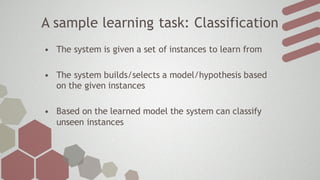
A sample learning task: Classification
• The system is given a set of instances to learn from
• The system builds/selects a model/hypothesis based
on the given instances
• Based on the learned model the system can classify
unseen instances
Reasoning with probabilities
)(
)|()(
)|(
DP
hDPhP
DhP 
Bayes Rule
evidence
likelihoodprior
posterior


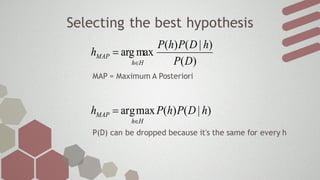
Selecting the best hypothesis
)|()(maxarg hDPhPh
Hh
MAP


)(
)|()(
maxarg
DP
hDPhP
h
Hh
MAP


P(D) can be dropped because it's the same for every h
MAP = Maximum A Posteriori
Probability of Poliposis
008.0)( poliposisP
98.0)|(  poliposisP
0078.0008.098.0)|()(  poliposisPpoliposisP
?)|( poliposisP
Given a medical test is positive what's the probability
we actually have polisposis disease?
prior
likelihood
posterior
Probability of Poliposis
992.0)( poliposisP
03.0)|(  poliposisP
0298.0992.003.0)|()(  poliposisPpoliposisP
?)|( poliposisP
prior
likelihood
posterior
Given a medical test is positive what's the probability
we DON'T have polisposis disease?
Probability of Poliposis
0078.0)|()(  poliposisPpoliposisP
0298.0)|()(  poliposisPpoliposisP
21.0)|( poliposisP
By normalizing we obtain the above probabilities.
It's approximately 4 times more likely we DON'T have polisposis
By comparing the posteriors we find the map hypothesis
79.0)|( poliposisP
Learning from examples
Day Outlook Temp Humidity Wind Play Hacky Sack
1 Sunny Hot High Weak Yes
2 Sunny Hot High Strong No
3 Overcast Hot High Strong Yes
4 Rain Mild High Strong no
5 Rain Cool Normal Strong No
6 Rain Cool Normal Strong No
Naive Bayes classifier
)|()(maxarg hDPhPh
Hh
MAP




i
kik
Kk
NB CxPCPC )|()(maxarg
Called naive because it assumes all attributes are independent
Implicit model
Day Outlook Temp Humidity Wind Class
1 Sunny = 1/2
Hot = 2/2 High = 2/2
Weak = 1/2
Yes= 2/6
3 Overcast= 1/2 Strong = 1/2
2 Sunny = 1/4 Hot = 1/4
High = 2/4
Strong = 4/4 No = 4/6
4
Rain = 3/4
Mild = 1/4
5
Cool = 2/4 Normal = 2/4
6
Classifying an example
333.06/2)(  yesackPlayHackySP
Day Outlook Temp Humidity Wind Play Hacky Sack?
7 Sunny Hot High Strong ?
666.06/4)(  noackPlayHackySP
5.02/1)|(  yesackPlayHackySsunnyOutlookP
25.04/1)|(  noackPlayHackySsunnyOutlookP
12/2)|(  yesackPlayHackyShotTempP
25.04/1)|(  noackPlayHackyShotTempP
12/2)|(  yesackPlayHackyShighHumidityP
5.04/2)|(  noackPlayHackyShighHumidityP
5.02/1)|(  yesackPlayHackySstrongWindP
14/4)|(  noackPlayHackySstrongWindP
prior
likelihood
Result
08325.05.0115.0333.0)|()|()|()|()( yesstrongPyeshighPyeshotPyessunnyPyesP
8.0! yesackPlayHackyS
0208125.015.025.025.0666.0)|()|()|()|()( nostrongPnohighPnohotPnosunnyPnoP
Calculating the MAP hypothesis for class 'yes' & 'no'
Least square error hypothesis
Where the red lines represents the error
Choosing between two hypotheses
red/yellow lines are the error for h1/h2
Maximum Likelihood Hypothesis
)|(maxarg hDPh
Hh
ML




m
i
i
Hh
ML hdPh
1
)|(maxarg
Assuming all data points are independent
Assuming uniform priors
Least square error hypothesis
2
2
))((
2
1
1
2
2
1
maxarg
ii xhdm
iHh
ML eh


 

using a least square error method has a profound theoretical basis


m
i
ii
Hh
ML xhdh
1
2
))((minarg
assuming the noise is normally distributed
Squared error analysis
x error h1 error h2 square e1 square e2
2 -1.5 2 2.25 4
4 4.5 6 20.25 36
6 -1.5 -2 2.25 4
8 1.5 -1 2.25 1
10 6.5 2 42.25 4
product 9745.39 2304
h2 is more likely then h1 since it has a smaller
squared error product
Overfitting
The model found by the learning algorithm is too complex
Model selection
• Usually tested by splitting the data into training and
testing examples
• Do model selection based on different data sets
• Prefer simple hypothesis over more complex ones
(assign lower priors to complex hypothesis)
Minimum Description Length learning
(MDL)
• Encode both hypothesis and data using an optimal
encoding will output the MAP hypothesis.
)|()(minarg 21
hDLhLh CC
Hh
MDL 

MAPMDL hh 
Compression, Probability, Regularity are all closely related!
References
• Tom M. Mitchell (1997) Machine Learning (pp 154-200)

Bayesian learning

  • 1.
  • 2.
    A sample learningtask: Classification • The system is given a set of instances to learn from • The system builds/selects a model/hypothesis based on the given instances • Based on the learned model the system can classify unseen instances
  • 3.
    Reasoning with probabilities )( )|()( )|( DP hDPhP DhP Bayes Rule evidence likelihoodprior posterior  
  • 4.
    Selecting the besthypothesis )|()(maxarg hDPhPh Hh MAP   )( )|()( maxarg DP hDPhP h Hh MAP   P(D) can be dropped because it's the same for every h MAP = Maximum A Posteriori
  • 5.
    Probability of Poliposis 008.0)(poliposisP 98.0)|(  poliposisP 0078.0008.098.0)|()(  poliposisPpoliposisP ?)|( poliposisP Given a medical test is positive what's the probability we actually have polisposis disease? prior likelihood posterior
  • 6.
    Probability of Poliposis 992.0)(poliposisP 03.0)|(  poliposisP 0298.0992.003.0)|()(  poliposisPpoliposisP ?)|( poliposisP prior likelihood posterior Given a medical test is positive what's the probability we DON'T have polisposis disease?
  • 7.
    Probability of Poliposis 0078.0)|()( poliposisPpoliposisP 0298.0)|()(  poliposisPpoliposisP 21.0)|( poliposisP By normalizing we obtain the above probabilities. It's approximately 4 times more likely we DON'T have polisposis By comparing the posteriors we find the map hypothesis 79.0)|( poliposisP
  • 8.
    Learning from examples DayOutlook Temp Humidity Wind Play Hacky Sack 1 Sunny Hot High Weak Yes 2 Sunny Hot High Strong No 3 Overcast Hot High Strong Yes 4 Rain Mild High Strong no 5 Rain Cool Normal Strong No 6 Rain Cool Normal Strong No
  • 9.
    Naive Bayes classifier )|()(maxarghDPhPh Hh MAP     i kik Kk NB CxPCPC )|()(maxarg Called naive because it assumes all attributes are independent
  • 10.
    Implicit model Day OutlookTemp Humidity Wind Class 1 Sunny = 1/2 Hot = 2/2 High = 2/2 Weak = 1/2 Yes= 2/6 3 Overcast= 1/2 Strong = 1/2 2 Sunny = 1/4 Hot = 1/4 High = 2/4 Strong = 4/4 No = 4/6 4 Rain = 3/4 Mild = 1/4 5 Cool = 2/4 Normal = 2/4 6
  • 11.
    Classifying an example 333.06/2)( yesackPlayHackySP Day Outlook Temp Humidity Wind Play Hacky Sack? 7 Sunny Hot High Strong ? 666.06/4)(  noackPlayHackySP 5.02/1)|(  yesackPlayHackySsunnyOutlookP 25.04/1)|(  noackPlayHackySsunnyOutlookP 12/2)|(  yesackPlayHackyShotTempP 25.04/1)|(  noackPlayHackyShotTempP 12/2)|(  yesackPlayHackyShighHumidityP 5.04/2)|(  noackPlayHackyShighHumidityP 5.02/1)|(  yesackPlayHackySstrongWindP 14/4)|(  noackPlayHackySstrongWindP prior likelihood
  • 12.
  • 13.
    Least square errorhypothesis Where the red lines represents the error
  • 14.
    Choosing between twohypotheses red/yellow lines are the error for h1/h2
  • 15.
    Maximum Likelihood Hypothesis )|(maxarghDPh Hh ML     m i i Hh ML hdPh 1 )|(maxarg Assuming all data points are independent Assuming uniform priors
  • 16.
    Least square errorhypothesis 2 2 ))(( 2 1 1 2 2 1 maxarg ii xhdm iHh ML eh      using a least square error method has a profound theoretical basis   m i ii Hh ML xhdh 1 2 ))((minarg assuming the noise is normally distributed
  • 17.
    Squared error analysis xerror h1 error h2 square e1 square e2 2 -1.5 2 2.25 4 4 4.5 6 20.25 36 6 -1.5 -2 2.25 4 8 1.5 -1 2.25 1 10 6.5 2 42.25 4 product 9745.39 2304 h2 is more likely then h1 since it has a smaller squared error product
  • 18.
    Overfitting The model foundby the learning algorithm is too complex
  • 19.
    Model selection • Usuallytested by splitting the data into training and testing examples • Do model selection based on different data sets • Prefer simple hypothesis over more complex ones (assign lower priors to complex hypothesis)
  • 20.
    Minimum Description Lengthlearning (MDL) • Encode both hypothesis and data using an optimal encoding will output the MAP hypothesis. )|()(minarg 21 hDLhLh CC Hh MDL   MAPMDL hh  Compression, Probability, Regularity are all closely related!
  • 21.
    References • Tom M.Mitchell (1997) Machine Learning (pp 154-200)