TESTING OF HYPOTHESES
CHAPTER-12
RESEARCH CONCEPTS AND
D
R
D
E
E
PA
K
C
H
A
W
L
A
D
R
N
E
E
N
A
S
O
N
D
H
I
What is a Hypothesis?
 A hypothesis is an assumption or a statement that may or
may not be true.
 The hypothesis is tested on the basis of information
obtained from a sample.
 Hypothesis tests are widely used in business and industry
for making decisions.
 Instead of asking, for example, what the mean assessed
value of an apartment in a multistoried building is, one may
be interested in knowing whether or not the assessed
value equals some particular value, say Rs 80 lakh.
 Some other examples could be whether a new drug is
more effective than the existing drug based on the sample
data, and whether the proportion of smokers in a class is
different from 0.30.
SLIDE 7-1
RESEARCH CONCEPTS AND
D
R
D
E
E
PA
K
C
H
A
W
L
A
D
R
N
E
E
N
A
S
O
N
D
H
I
SLIDE 12-1
Concepts in Testing of Hypothesis
 Null hypothesis: The hypotheses that are proposed with the
intent of receiving a rejection for them are called null
hypotheses. This requires that we hypothesize the opposite of
what is desired to be proved. For example, if we want to show
that sales and advertisement expenditure are related, we
formulate the null hypothesis that they are not related. Null
hypothesis is denoted by H0.
 Alternative hypothesis: Rejection of null hypotheses leads
to the acceptance of alternative hypotheses. The rejection of
null hypothesis indicates that the relationship between
variables (e.g., sales and advertisement expenditure) or the
difference between means (e.g., wages of skilled workers in
town 1 and town 2) or the difference between proportions
have statistical significance and the acceptance of the null
hypotheses indicates that these differences are due to
chance. Alternative hypothesis is denoted by H1.
SLIDE 7-1
RESEARCH CONCEPTS AND
D
R
D
E
E
PA
K
C
H
A
W
L
A
D
R
N
E
E
N
A
S
O
N
D
H
I
SLIDE 12-2
Concepts in Testing of Hypothesis
 One-tailed and two-tailed tests: A test is called one-sided
(or one-tailed) only if the null hypothesis gets rejected when a
value of the test statistic falls in one specified tail of the
distribution. Further, the test is called two-sided (or two-tailed)
if null hypothesis gets rejected when a value of the test
statistic falls in either one or the other of the two tails of its
sampling distribution.
 Type I and type II error: if the hypothesis H0 is rejected when
it is actually true, the researcher is committing what is called a
type I error. The probability of committing a type I error is
denoted by alpha (α). This is termed as the level of
significance. Similarly, if the null hypothesis H0 when false is
accepted, the researcher is committing an error called Type II
error. The probability of committing a type II error is denoted
by beta (β). The expression 1 – β is called power of test.
SLIDE 7-1
RESEARCH CONCEPTS AND
D
R
D
E
E
PA
K
C
H
A
W
L
A
D
R
N
E
E
N
A
S
O
N
D
H
I
SLIDE 12-3
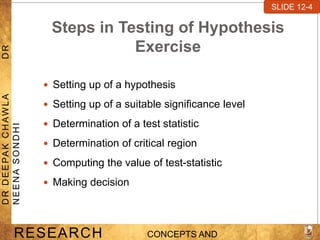
Steps in Testing of Hypothesis
Exercise
 Setting up of a hypothesis
 Setting up of a suitable significance level
 Determination of a test statistic
 Determination of critical region
 Computing the value of test-statistic
 Making decision
SLIDE 7-1
RESEARCH CONCEPTS AND
D
R
D
E
E
PA
K
C
H
A
W
L
A
D
R
N
E
E
N
A
S
O
N
D
H
I
SLIDE 12-4
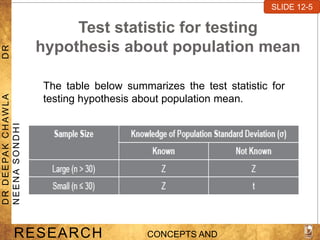
Test statistic for testing
hypothesis about population mean
The table below summarizes the test statistic for
testing hypothesis about population mean.
SLIDE 7-1
RESEARCH CONCEPTS AND
D
R
D
E
E
PA
K
C
H
A
W
L
A
D
R
N
E
E
N
A
S
O
N
D
H
I
SLIDE 12-5
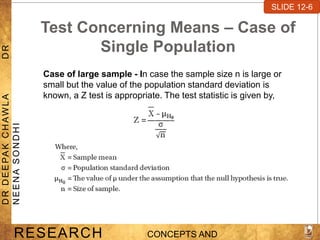
Test Concerning Means – Case of
Single Population
Case of large sample - In case the sample size n is large or
small but the value of the population standard deviation is
known, a Z test is appropriate. The test statistic is given by,
SLIDE 7-1
RESEARCH CONCEPTS AND
D
R
D
E
E
PA
K
C
H
A
W
L
A
D
R
N
E
E
N
A
S
O
N
D
H
I
SLIDE 12-6
Test Concerning Means – Case of
Single Population
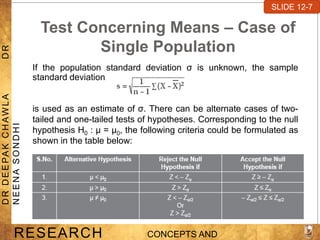
If the population standard deviation σ is unknown, the sample
standard deviation
SLIDE 7-1
RESEARCH CONCEPTS AND
D
R
D
E
E
PA
K
C
H
A
W
L
A
D
R
N
E
E
N
A
S
O
N
D
H
I
SLIDE 12-7
is used as an estimate of σ. There can be alternate cases of two-
tailed and one-tailed tests of hypotheses. Corresponding to the null
hypothesis H0 : μ = μ0, the following criteria could be formulated as
shown in the table below:
Test Concerning Means – Case of
Single Population
 It may be noted that Zα and Zα/2 are Z values such that the area to
the right under the standard normal distribution is α and α/2
respectively.
Case of small sample:
 In case the sample size is small (n ≤ 30) and is drawn from a
population having a normal population with unknown standard
deviation σ, a t test is used to conduct the hypothesis for the test of
mean.
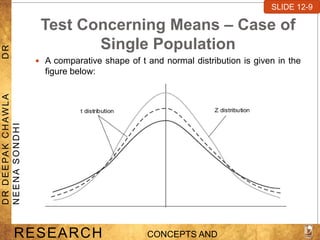
 The t distribution is a symmetrical distribution just like the normal
one.
 However, t distribution is higher at the tail and lower at the peak.
The t distribution is flatter than the normal distribution.
 With an increase in the sample size (and hence degrees of
freedom), t distribution loses its flatness and approaches the normal
distribution whenever n > 30.
SLIDE 7-1
RESEARCH CONCEPTS AND
D
R
D
E
E
PA
K
C
H
A
W
L
A
D
R
N
E
E
N
A
S
O
N
D
H
I
SLIDE 12-8
Test Concerning Means – Case of
Single Population
 A comparative shape of t and normal distribution is given in the
figure below:
SLIDE 7-1
RESEARCH CONCEPTS AND
D
R
D
E
E
PA
K
C
H
A
W
L
A
D
R
N
E
E
N
A
S
O
N
D
H
I
SLIDE 12-9
Test Concerning Means – Case of
Single Population
The null hypothesis to be tested is:
H0 : μ = μ0
The alternative hypothesis could be one-tailed or two-tailed test.
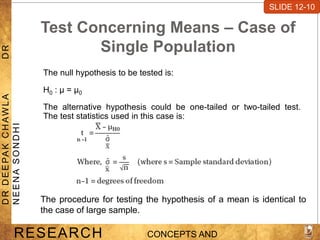
The test statistics used in this case is:
SLIDE 7-1
RESEARCH CONCEPTS AND
D
R
D
E
E
PA
K
C
H
A
W
L
A
D
R
N
E
E
N
A
S
O
N
D
H
I
SLIDE 12-10
The procedure for testing the hypothesis of a mean is identical to
the case of large sample.
Tests for Difference Between Two
Population Means
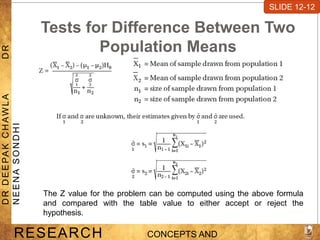
Case of large sample - In case both the sample sizes are
greater than 30, a Z test is used. The hypothesis to be tested
may be written as:
H0 : μ1 = μ2
H1 : μ1 ≠ μ2
Where,
μ1 = mean of population 1
μ2 = mean of population 2
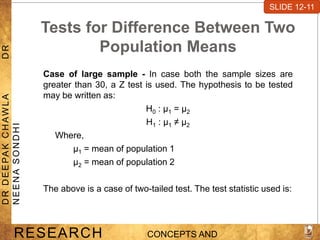
The above is a case of two-tailed test. The test statistic used is:
SLIDE 7-1
RESEARCH CONCEPTS AND
D
R
D
E
E
PA
K
C
H
A
W
L
A
D
R
N
E
E
N
A
S
O
N
D
H
I
SLIDE 12-11
Tests for Difference Between Two
Population Means
SLIDE 7-1
RESEARCH CONCEPTS AND
D
R
D
E
E
PA
K
C
H
A
W
L
A
D
R
N
E
E
N
A
S
O
N
D
H
I
SLIDE 12-12
The Z value for the problem can be computed using the above formula
and compared with the table value to either accept or reject the
hypothesis.
Tests for Difference Between Two
Population Means
Case of small sample - If the size of both the samples
is less than 30 and the population standard deviation is
unknown, the procedure described above to discuss the
equality of two population means is not applicable in the
sense that a t test would be applicable under the
assumptions:
a) Two population variances are equal.
b) Two population variances are not equal.
SLIDE 7-1
RESEARCH CONCEPTS AND
D
R
D
E
E
PA
K
C
H
A
W
L
A
D
R
N
E
E
N
A
S
O
N
D
H
I
SLIDE 12-13
Tests for Difference Between Two
Population Means
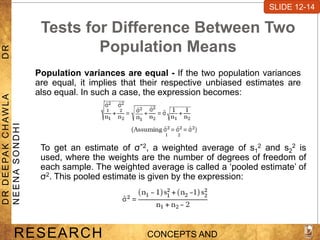
Population variances are equal - If the two population variances
are equal, it implies that their respective unbiased estimates are
also equal. In such a case, the expression becomes:
SLIDE 7-1
RESEARCH CONCEPTS AND
D
R
D
E
E
PA
K
C
H
A
W
L
A
D
R
N
E
E
N
A
S
O
N
D
H
I
SLIDE 12-14
To get an estimate of σˆ2, a weighted average of s1
2 and s2
2 is
used, where the weights are the number of degrees of freedom of
each sample. The weighted average is called a ‘pooled estimate’ of
σ2. This pooled estimate is given by the expression:
Tests for Difference Between Two
Population Means
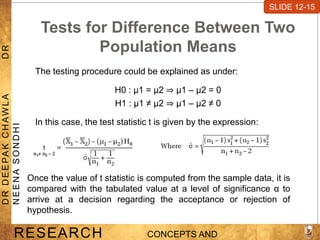
The testing procedure could be explained as under:
H0 : μ1 = μ2 ⇒ μ1 – μ2 = 0
H1 : μ1 ≠ μ2 ⇒ μ1 – μ2 ≠ 0
In this case, the test statistic t is given by the expression:
SLIDE 7-1
RESEARCH CONCEPTS AND
D
R
D
E
E
PA
K
C
H
A
W
L
A
D
R
N
E
E
N
A
S
O
N
D
H
I
SLIDE 12-15
Once the value of t statistic is computed from the sample data, it is
compared with the tabulated value at a level of significance α to
arrive at a decision regarding the acceptance or rejection of
hypothesis.
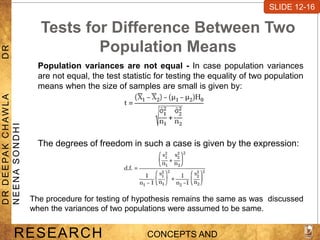
Tests for Difference Between Two
Population Means
Population variances are not equal - In case population variances
are not equal, the test statistic for testing the equality of two population
means when the size of samples are small is given by:
SLIDE 7-1
RESEARCH CONCEPTS AND
D
R
D
E
E
PA
K
C
H
A
W
L
A
D
R
N
E
E
N
A
S
O
N
D
H
I
SLIDE 12-16
The degrees of freedom in such a case is given by the expression:
The procedure for testing of hypothesis remains the same as was discussed
when the variances of two populations were assumed to be same.
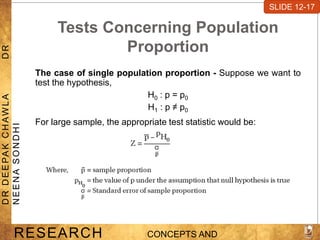
Tests Concerning Population
Proportion
The case of single population proportion - Suppose we want to
test the hypothesis,
H0 : p = p0
H1 : p ≠ p0
For large sample, the appropriate test statistic would be:
SLIDE 7-1
RESEARCH CONCEPTS AND
D
R
D
E
E
PA
K
C
H
A
W
L
A
D
R
N
E
E
N
A
S
O
N
D
H
I
SLIDE 12-17
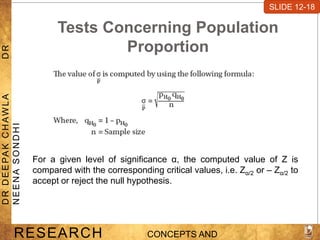
Tests Concerning Population
Proportion
For a given level of significance α, the computed value of Z is
compared with the corresponding critical values, i.e. Zα/2 or – Zα/2 to
accept or reject the null hypothesis.
SLIDE 7-1
RESEARCH CONCEPTS AND
D
R
D
E
E
PA
K
C
H
A
W
L
A
D
R
N
E
E
N
A
S
O
N
D
H
I
SLIDE 12-18
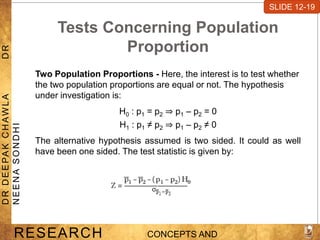
Tests Concerning Population
Proportion
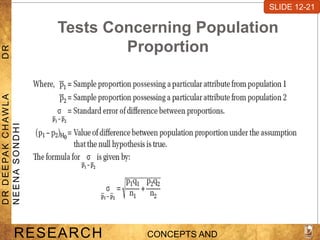
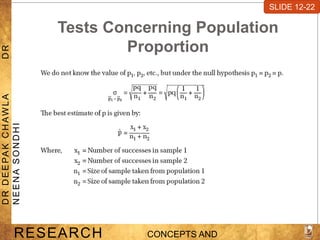
Two Population Proportions - Here, the interest is to test whether
the two population proportions are equal or not. The hypothesis
under investigation is:
H0 : p1 = p2 ⇒ p1 – p2 = 0
H1 : p1 ≠ p2 ⇒ p1 – p2 ≠ 0
The alternative hypothesis assumed is two sided. It could as well
have been one sided. The test statistic is given by:
SLIDE 7-1
RESEARCH CONCEPTS AND
D
R
D
E
E
PA
K
C
H
A
W
L
A
D
R
N
E
E
N
A
S
O
N
D
H
I
SLIDE 12-19
Tests Concerning Population
Proportion
SLIDE 7-1
RESEARCH CONCEPTS AND
D
R
D
E
E
PA
K
C
H
A
W
L
A
D
R
N
E
E
N
A
S
O
N
D
H
I
SLIDE 12-21
Tests Concerning Population
Proportion
SLIDE 7-1
RESEARCH CONCEPTS AND
D
R
D
E
E
PA
K
C
H
A
W
L
A
D
R
N
E
E
N
A
S
O
N
D
H
I
SLIDE 12-22
Tests Concerning Population
Proportion
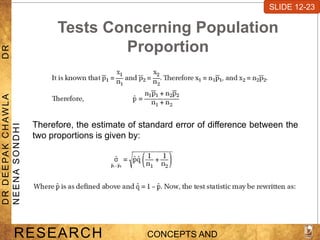
Therefore, the estimate of standard error of difference between the
two proportions is given by:
SLIDE 7-1
RESEARCH CONCEPTS AND
D
R
D
E
E
PA
K
C
H
A
W
L
A
D
R
N
E
E
N
A
S
O
N
D
H
I
SLIDE 12-23
Tests Concerning Population
Proportion
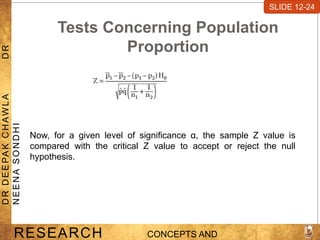
Now, for a given level of significance α, the sample Z value is
compared with the critical Z value to accept or reject the null
hypothesis.
SLIDE 7-1
RESEARCH CONCEPTS AND
D
R
D
E
E
PA
K
C
H
A
W
L
A
D
R
N
E
E
N
A
S
O
N
D
H
I
SLIDE 12-24
END OF CHAPTER
RESEARCH CONCEPTS AND
D
R
D
E
E
PA
K
C
H
A
W
L
A
D
R
N
E
E
N
A
S
O
N
D
H
I

Hypothesis Testing Research Methodology ppt

  • 1.
    TESTING OF HYPOTHESES CHAPTER-12 RESEARCHCONCEPTS AND D R D E E PA K C H A W L A D R N E E N A S O N D H I
  • 2.
    What is aHypothesis?  A hypothesis is an assumption or a statement that may or may not be true.  The hypothesis is tested on the basis of information obtained from a sample.  Hypothesis tests are widely used in business and industry for making decisions.  Instead of asking, for example, what the mean assessed value of an apartment in a multistoried building is, one may be interested in knowing whether or not the assessed value equals some particular value, say Rs 80 lakh.  Some other examples could be whether a new drug is more effective than the existing drug based on the sample data, and whether the proportion of smokers in a class is different from 0.30. SLIDE 7-1 RESEARCH CONCEPTS AND D R D E E PA K C H A W L A D R N E E N A S O N D H I SLIDE 12-1
  • 3.
    Concepts in Testingof Hypothesis  Null hypothesis: The hypotheses that are proposed with the intent of receiving a rejection for them are called null hypotheses. This requires that we hypothesize the opposite of what is desired to be proved. For example, if we want to show that sales and advertisement expenditure are related, we formulate the null hypothesis that they are not related. Null hypothesis is denoted by H0.  Alternative hypothesis: Rejection of null hypotheses leads to the acceptance of alternative hypotheses. The rejection of null hypothesis indicates that the relationship between variables (e.g., sales and advertisement expenditure) or the difference between means (e.g., wages of skilled workers in town 1 and town 2) or the difference between proportions have statistical significance and the acceptance of the null hypotheses indicates that these differences are due to chance. Alternative hypothesis is denoted by H1. SLIDE 7-1 RESEARCH CONCEPTS AND D R D E E PA K C H A W L A D R N E E N A S O N D H I SLIDE 12-2
  • 4.
    Concepts in Testingof Hypothesis  One-tailed and two-tailed tests: A test is called one-sided (or one-tailed) only if the null hypothesis gets rejected when a value of the test statistic falls in one specified tail of the distribution. Further, the test is called two-sided (or two-tailed) if null hypothesis gets rejected when a value of the test statistic falls in either one or the other of the two tails of its sampling distribution.  Type I and type II error: if the hypothesis H0 is rejected when it is actually true, the researcher is committing what is called a type I error. The probability of committing a type I error is denoted by alpha (α). This is termed as the level of significance. Similarly, if the null hypothesis H0 when false is accepted, the researcher is committing an error called Type II error. The probability of committing a type II error is denoted by beta (β). The expression 1 – β is called power of test. SLIDE 7-1 RESEARCH CONCEPTS AND D R D E E PA K C H A W L A D R N E E N A S O N D H I SLIDE 12-3
  • 5.
    Steps in Testingof Hypothesis Exercise  Setting up of a hypothesis  Setting up of a suitable significance level  Determination of a test statistic  Determination of critical region  Computing the value of test-statistic  Making decision SLIDE 7-1 RESEARCH CONCEPTS AND D R D E E PA K C H A W L A D R N E E N A S O N D H I SLIDE 12-4
  • 6.
    Test statistic fortesting hypothesis about population mean The table below summarizes the test statistic for testing hypothesis about population mean. SLIDE 7-1 RESEARCH CONCEPTS AND D R D E E PA K C H A W L A D R N E E N A S O N D H I SLIDE 12-5
  • 7.
    Test Concerning Means– Case of Single Population Case of large sample - In case the sample size n is large or small but the value of the population standard deviation is known, a Z test is appropriate. The test statistic is given by, SLIDE 7-1 RESEARCH CONCEPTS AND D R D E E PA K C H A W L A D R N E E N A S O N D H I SLIDE 12-6
  • 8.
    Test Concerning Means– Case of Single Population If the population standard deviation σ is unknown, the sample standard deviation SLIDE 7-1 RESEARCH CONCEPTS AND D R D E E PA K C H A W L A D R N E E N A S O N D H I SLIDE 12-7 is used as an estimate of σ. There can be alternate cases of two- tailed and one-tailed tests of hypotheses. Corresponding to the null hypothesis H0 : μ = μ0, the following criteria could be formulated as shown in the table below:
  • 9.
    Test Concerning Means– Case of Single Population  It may be noted that Zα and Zα/2 are Z values such that the area to the right under the standard normal distribution is α and α/2 respectively. Case of small sample:  In case the sample size is small (n ≤ 30) and is drawn from a population having a normal population with unknown standard deviation σ, a t test is used to conduct the hypothesis for the test of mean.  The t distribution is a symmetrical distribution just like the normal one.  However, t distribution is higher at the tail and lower at the peak. The t distribution is flatter than the normal distribution.  With an increase in the sample size (and hence degrees of freedom), t distribution loses its flatness and approaches the normal distribution whenever n > 30. SLIDE 7-1 RESEARCH CONCEPTS AND D R D E E PA K C H A W L A D R N E E N A S O N D H I SLIDE 12-8
  • 10.
    Test Concerning Means– Case of Single Population  A comparative shape of t and normal distribution is given in the figure below: SLIDE 7-1 RESEARCH CONCEPTS AND D R D E E PA K C H A W L A D R N E E N A S O N D H I SLIDE 12-9
  • 11.
    Test Concerning Means– Case of Single Population The null hypothesis to be tested is: H0 : μ = μ0 The alternative hypothesis could be one-tailed or two-tailed test. The test statistics used in this case is: SLIDE 7-1 RESEARCH CONCEPTS AND D R D E E PA K C H A W L A D R N E E N A S O N D H I SLIDE 12-10 The procedure for testing the hypothesis of a mean is identical to the case of large sample.
  • 12.
    Tests for DifferenceBetween Two Population Means Case of large sample - In case both the sample sizes are greater than 30, a Z test is used. The hypothesis to be tested may be written as: H0 : μ1 = μ2 H1 : μ1 ≠ μ2 Where, μ1 = mean of population 1 μ2 = mean of population 2 The above is a case of two-tailed test. The test statistic used is: SLIDE 7-1 RESEARCH CONCEPTS AND D R D E E PA K C H A W L A D R N E E N A S O N D H I SLIDE 12-11
  • 13.
    Tests for DifferenceBetween Two Population Means SLIDE 7-1 RESEARCH CONCEPTS AND D R D E E PA K C H A W L A D R N E E N A S O N D H I SLIDE 12-12 The Z value for the problem can be computed using the above formula and compared with the table value to either accept or reject the hypothesis.
  • 14.
    Tests for DifferenceBetween Two Population Means Case of small sample - If the size of both the samples is less than 30 and the population standard deviation is unknown, the procedure described above to discuss the equality of two population means is not applicable in the sense that a t test would be applicable under the assumptions: a) Two population variances are equal. b) Two population variances are not equal. SLIDE 7-1 RESEARCH CONCEPTS AND D R D E E PA K C H A W L A D R N E E N A S O N D H I SLIDE 12-13
  • 15.
    Tests for DifferenceBetween Two Population Means Population variances are equal - If the two population variances are equal, it implies that their respective unbiased estimates are also equal. In such a case, the expression becomes: SLIDE 7-1 RESEARCH CONCEPTS AND D R D E E PA K C H A W L A D R N E E N A S O N D H I SLIDE 12-14 To get an estimate of σˆ2, a weighted average of s1 2 and s2 2 is used, where the weights are the number of degrees of freedom of each sample. The weighted average is called a ‘pooled estimate’ of σ2. This pooled estimate is given by the expression:
  • 16.
    Tests for DifferenceBetween Two Population Means The testing procedure could be explained as under: H0 : μ1 = μ2 ⇒ μ1 – μ2 = 0 H1 : μ1 ≠ μ2 ⇒ μ1 – μ2 ≠ 0 In this case, the test statistic t is given by the expression: SLIDE 7-1 RESEARCH CONCEPTS AND D R D E E PA K C H A W L A D R N E E N A S O N D H I SLIDE 12-15 Once the value of t statistic is computed from the sample data, it is compared with the tabulated value at a level of significance α to arrive at a decision regarding the acceptance or rejection of hypothesis.
  • 17.
    Tests for DifferenceBetween Two Population Means Population variances are not equal - In case population variances are not equal, the test statistic for testing the equality of two population means when the size of samples are small is given by: SLIDE 7-1 RESEARCH CONCEPTS AND D R D E E PA K C H A W L A D R N E E N A S O N D H I SLIDE 12-16 The degrees of freedom in such a case is given by the expression: The procedure for testing of hypothesis remains the same as was discussed when the variances of two populations were assumed to be same.
  • 18.
    Tests Concerning Population Proportion Thecase of single population proportion - Suppose we want to test the hypothesis, H0 : p = p0 H1 : p ≠ p0 For large sample, the appropriate test statistic would be: SLIDE 7-1 RESEARCH CONCEPTS AND D R D E E PA K C H A W L A D R N E E N A S O N D H I SLIDE 12-17
  • 19.
    Tests Concerning Population Proportion Fora given level of significance α, the computed value of Z is compared with the corresponding critical values, i.e. Zα/2 or – Zα/2 to accept or reject the null hypothesis. SLIDE 7-1 RESEARCH CONCEPTS AND D R D E E PA K C H A W L A D R N E E N A S O N D H I SLIDE 12-18
  • 20.
    Tests Concerning Population Proportion TwoPopulation Proportions - Here, the interest is to test whether the two population proportions are equal or not. The hypothesis under investigation is: H0 : p1 = p2 ⇒ p1 – p2 = 0 H1 : p1 ≠ p2 ⇒ p1 – p2 ≠ 0 The alternative hypothesis assumed is two sided. It could as well have been one sided. The test statistic is given by: SLIDE 7-1 RESEARCH CONCEPTS AND D R D E E PA K C H A W L A D R N E E N A S O N D H I SLIDE 12-19
  • 21.
    Tests Concerning Population Proportion SLIDE7-1 RESEARCH CONCEPTS AND D R D E E PA K C H A W L A D R N E E N A S O N D H I SLIDE 12-21
  • 22.
    Tests Concerning Population Proportion SLIDE7-1 RESEARCH CONCEPTS AND D R D E E PA K C H A W L A D R N E E N A S O N D H I SLIDE 12-22
  • 23.
    Tests Concerning Population Proportion Therefore,the estimate of standard error of difference between the two proportions is given by: SLIDE 7-1 RESEARCH CONCEPTS AND D R D E E PA K C H A W L A D R N E E N A S O N D H I SLIDE 12-23
  • 24.
    Tests Concerning Population Proportion Now,for a given level of significance α, the sample Z value is compared with the critical Z value to accept or reject the null hypothesis. SLIDE 7-1 RESEARCH CONCEPTS AND D R D E E PA K C H A W L A D R N E E N A S O N D H I SLIDE 12-24
  • 25.
    END OF CHAPTER RESEARCHCONCEPTS AND D R D E E PA K C H A W L A D R N E E N A S O N D H I