COMPONENTS & OBJECTIVES OF GST
Dr. KAVITHAMANI R
Assistant Professor
PG & Research Department of International Business
Sri Ramakrishna College of Arts & Science
Coimbatore - 641 006
Tamil Nadu, India
1
Goods and Services Tax
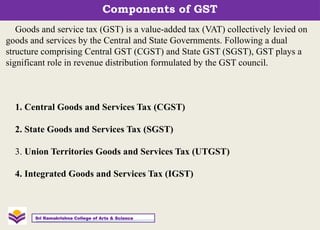
Goods and service tax (GST) is a value-added tax (VAT) collectively levied on
goods and services by the Central and State Governments. Following a dual
structure comprising Central GST (CGST) and State GST (SGST), GST plays a
significant role in revenue distribution formulated by the GST council.
1. Central Goods and Services Tax (CGST)
2. State Goods and Services Tax (SGST)
3. Union Territories Goods and Services Tax (UTGST)
4. Integrated Goods and Services Tax (IGST)
Components of GST
Sri Ramakrishna College of Arts & Science
1. Central Goods and Services Tax (CGST)
• It is levied on the intra-state (within the same state) as well as intra-
UT (within the same UT) supply of goods and services.
• It is levied and collected by the Central Government and its
proceeds go to the Centre.
• It applies to every transaction within a state, alongside the State GST
(SGST).
• For a particular good or service, it is levied at a uniform rate across
the country.
Example: If you buy a shirt from a store in your city, both CGST and
SGST will be levied on the bill. Of these, the CGST component is levied
by the Centre.
• It is levied on the intra-state (within the same state) supply of goods
and services.
• It is levied and collected by the State Governments and its proceeds
go to the concerned State.
• It applies alongside CGST on every intra-state transaction.
• For a particular good or service, its rate may vary from one state to
another.
Example: In the above example, the SGST rate would be specific to the
state concerned.
Sri Ramakrishna College of Arts & Science
2. State Goods and Services Tax (SGST)
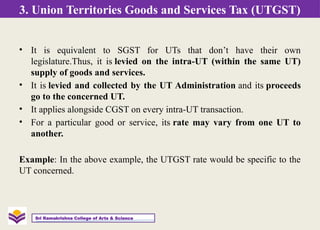
• It is equivalent to SGST for UTs that don’t have their own
legislature.Thus, it is levied on the intra-UT (within the same UT)
supply of goods and services.
• It is levied and collected by the UT Administration and its proceeds
go to the concerned UT.
• It applies alongside CGST on every intra-UT transaction.
• For a particular good or service, its rate may vary from one UT to
another.
Example: In the above example, the UTGST rate would be specific to the
UT concerned.
Sri Ramakrishna College of Arts & Science
3. Union Territories Goods and Services Tax (UTGST)
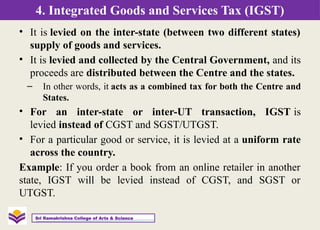
• It is levied on the inter-state (between two different states)
supply of goods and services.
• It is levied and collected by the Central Government, and its
proceeds are distributed between the Centre and the states.
– In other words, it acts as a combined tax for both the Centre and
States.
• For an inter-state or inter-UT transaction, IGST is
levied instead of CGST and SGST/UTGST.
• For a particular good or service, it is levied at a uniform rate
across the country.
Example: If you order a book from an online retailer in another
state, IGST will be levied instead of CGST, and SGST or
UTGST.
Sri Ramakrishna College of Arts & Science
4. Integrated Goods and Services Tax (IGST)
Sri Ramakrishna College of Arts & Science
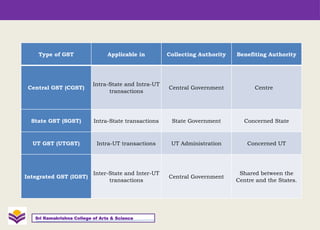
Type of GST Applicable in Collecting Authority Benefiting Authority
Central GST (CGST)
Intra-State and Intra-UT
transactions
Central Government Centre
State GST (SGST) Intra-State transactions State Government Concerned State
UT GST (UTGST) Intra-UT transactions UT Administration Concerned UT
Integrated GST (IGST)
Inter-State and Inter-UT
transactions
Central Government
Shared between the
Centre and the States.
Objectives of GST
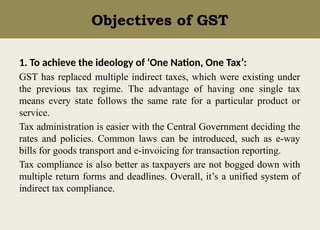
1. To achieve the ideology of ‘One Nation, One Tax’:
GST has replaced multiple indirect taxes, which were existing under
the previous tax regime. The advantage of having one single tax
means every state follows the same rate for a particular product or
service.
Tax administration is easier with the Central Government deciding the
rates and policies. Common laws can be introduced, such as e-way
bills for goods transport and e-invoicing for transaction reporting.
Tax compliance is also better as taxpayers are not bogged down with
multiple return forms and deadlines. Overall, it’s a unified system of
indirect tax compliance.
To subsume a majority of the indirect taxes in India
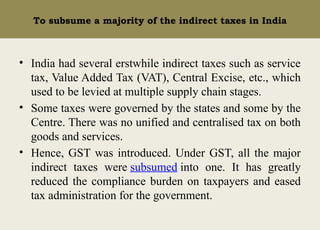
• India had several erstwhile indirect taxes such as service
tax, Value Added Tax (VAT), Central Excise, etc., which
used to be levied at multiple supply chain stages.
• Some taxes were governed by the states and some by the
Centre. There was no unified and centralised tax on both
goods and services.
• Hence, GST was introduced. Under GST, all the major
indirect taxes were subsumed into one. It has greatly
reduced the compliance burden on taxpayers and eased
tax administration for the government.
To eliminate the cascading effect of taxes
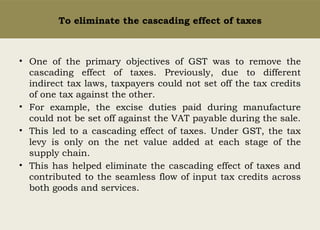
• One of the primary objectives of GST was to remove the
cascading effect of taxes. Previously, due to different
indirect tax laws, taxpayers could not set off the tax credits
of one tax against the other.
• For example, the excise duties paid during manufacture
could not be set off against the VAT payable during the sale.
• This led to a cascading effect of taxes. Under GST, the tax
levy is only on the net value added at each stage of the
supply chain.
• This has helped eliminate the cascading effect of taxes and
contributed to the seamless flow of input tax credits across
both goods and services.
To curb tax evasion
• GST laws in India are far more stringent compared to any
of the erstwhile indirect tax laws. Under GST, taxpayers
can claim an input tax credit only on invoices uploaded
by their respective suppliers. This way, the chances of
claiming input tax credits on fake invoices are minimal.
• The introduction of e-invoicing has further reinforced this
objective. Also, due to GST being a nationwide tax and
having a centralised surveillance system, the clampdown
on defaulters is quicker and far more efficient.
• Hence, GST has curbed tax evasion and minimised tax
fraud from taking place to a large extent.
To increase the taxpayer base
• GST has helped in widening the tax base in India.
Previously, each of the tax laws had a different
threshold limit for registration based on turnover.
• As GST is a consolidated tax levied on both goods
and services both, it has increased tax-registered
businesses.
• Besides, the stricter laws surrounding input tax
credits have helped bring certain unorganised
sectors under the tax net. For example, the
construction industry in India.
Online procedures for ease of doing business
• Previously, taxpayers faced a lot of hardships dealing with
different tax authorities under each tax law. Besides, while
return filing was online, most of the assessment and refund
procedures took place offline.
• Now, GST procedures are carried out almost entirely online.
Everything is done with a click of a button, from registration
to return filing to refunds to e-way bill generation.
• It has contributed to the overall ease of doing business in
India and simplified taxpayer compliance to a massive
extent.
• The government also plans to introduce a centralised portal
soon for all indirect tax compliance such as e-invoicing, e-
way bills and GST return filing.
An improved logistics and distribution system
• A single indirect tax system reduces the need for
multiple documentation for the supply of goods.
• GST minimises transportation cycle times, improves
supply chain and turnaround time, and leads to
warehouse consolidation, among other benefits.
• With the e-way bill system under GST, the removal
of interstate checkpoints is most beneficial to the
sector in improving transit and destination
efficiency.
• Ultimately, it helps in cutting down the high
logistics and warehousing costs.
To promote competitive pricing and
increase consumption
Introducing GST has also led to an increase in
consumption and indirect tax revenues. Due to
the cascading effect of taxes under the previous
regime, the prices of goods in India were higher
than in global markets.
Even between states, the lower VAT rates in
certain states led to an imbalance of purchases in
these states. Having uniform GST rates have
contributed to overall competitive pricing across
India and on the global front.
This has hence increased consumption and led to
higher revenues, which has been another
important objective achieved
GST - Structure or Components & Objectives.pptx

GST - Structure or Components & Objectives.pptx

  • 1.
    COMPONENTS & OBJECTIVESOF GST Dr. KAVITHAMANI R Assistant Professor PG & Research Department of International Business Sri Ramakrishna College of Arts & Science Coimbatore - 641 006 Tamil Nadu, India 1 Goods and Services Tax
  • 2.
    Goods and servicetax (GST) is a value-added tax (VAT) collectively levied on goods and services by the Central and State Governments. Following a dual structure comprising Central GST (CGST) and State GST (SGST), GST plays a significant role in revenue distribution formulated by the GST council. 1. Central Goods and Services Tax (CGST) 2. State Goods and Services Tax (SGST) 3. Union Territories Goods and Services Tax (UTGST) 4. Integrated Goods and Services Tax (IGST) Components of GST Sri Ramakrishna College of Arts & Science
  • 3.
    Sri Ramakrishna Collegeof Arts & Science 1. Central Goods and Services Tax (CGST) • It is levied on the intra-state (within the same state) as well as intra- UT (within the same UT) supply of goods and services. • It is levied and collected by the Central Government and its proceeds go to the Centre. • It applies to every transaction within a state, alongside the State GST (SGST). • For a particular good or service, it is levied at a uniform rate across the country. Example: If you buy a shirt from a store in your city, both CGST and SGST will be levied on the bill. Of these, the CGST component is levied by the Centre.
  • 4.
    • It islevied on the intra-state (within the same state) supply of goods and services. • It is levied and collected by the State Governments and its proceeds go to the concerned State. • It applies alongside CGST on every intra-state transaction. • For a particular good or service, its rate may vary from one state to another. Example: In the above example, the SGST rate would be specific to the state concerned. Sri Ramakrishna College of Arts & Science 2. State Goods and Services Tax (SGST)
  • 5.
    • It isequivalent to SGST for UTs that don’t have their own legislature.Thus, it is levied on the intra-UT (within the same UT) supply of goods and services. • It is levied and collected by the UT Administration and its proceeds go to the concerned UT. • It applies alongside CGST on every intra-UT transaction. • For a particular good or service, its rate may vary from one UT to another. Example: In the above example, the UTGST rate would be specific to the UT concerned. Sri Ramakrishna College of Arts & Science 3. Union Territories Goods and Services Tax (UTGST)
  • 6.
    • It islevied on the inter-state (between two different states) supply of goods and services. • It is levied and collected by the Central Government, and its proceeds are distributed between the Centre and the states. – In other words, it acts as a combined tax for both the Centre and States. • For an inter-state or inter-UT transaction, IGST is levied instead of CGST and SGST/UTGST. • For a particular good or service, it is levied at a uniform rate across the country. Example: If you order a book from an online retailer in another state, IGST will be levied instead of CGST, and SGST or UTGST. Sri Ramakrishna College of Arts & Science 4. Integrated Goods and Services Tax (IGST)
  • 7.
    Sri Ramakrishna Collegeof Arts & Science Type of GST Applicable in Collecting Authority Benefiting Authority Central GST (CGST) Intra-State and Intra-UT transactions Central Government Centre State GST (SGST) Intra-State transactions State Government Concerned State UT GST (UTGST) Intra-UT transactions UT Administration Concerned UT Integrated GST (IGST) Inter-State and Inter-UT transactions Central Government Shared between the Centre and the States.
  • 8.
    Objectives of GST 1.To achieve the ideology of ‘One Nation, One Tax’: GST has replaced multiple indirect taxes, which were existing under the previous tax regime. The advantage of having one single tax means every state follows the same rate for a particular product or service. Tax administration is easier with the Central Government deciding the rates and policies. Common laws can be introduced, such as e-way bills for goods transport and e-invoicing for transaction reporting. Tax compliance is also better as taxpayers are not bogged down with multiple return forms and deadlines. Overall, it’s a unified system of indirect tax compliance.
  • 9.
    To subsume amajority of the indirect taxes in India • India had several erstwhile indirect taxes such as service tax, Value Added Tax (VAT), Central Excise, etc., which used to be levied at multiple supply chain stages. • Some taxes were governed by the states and some by the Centre. There was no unified and centralised tax on both goods and services. • Hence, GST was introduced. Under GST, all the major indirect taxes were subsumed into one. It has greatly reduced the compliance burden on taxpayers and eased tax administration for the government.
  • 10.
    To eliminate thecascading effect of taxes • One of the primary objectives of GST was to remove the cascading effect of taxes. Previously, due to different indirect tax laws, taxpayers could not set off the tax credits of one tax against the other. • For example, the excise duties paid during manufacture could not be set off against the VAT payable during the sale. • This led to a cascading effect of taxes. Under GST, the tax levy is only on the net value added at each stage of the supply chain. • This has helped eliminate the cascading effect of taxes and contributed to the seamless flow of input tax credits across both goods and services.
  • 11.
    To curb taxevasion • GST laws in India are far more stringent compared to any of the erstwhile indirect tax laws. Under GST, taxpayers can claim an input tax credit only on invoices uploaded by their respective suppliers. This way, the chances of claiming input tax credits on fake invoices are minimal. • The introduction of e-invoicing has further reinforced this objective. Also, due to GST being a nationwide tax and having a centralised surveillance system, the clampdown on defaulters is quicker and far more efficient. • Hence, GST has curbed tax evasion and minimised tax fraud from taking place to a large extent.
  • 12.
    To increase thetaxpayer base • GST has helped in widening the tax base in India. Previously, each of the tax laws had a different threshold limit for registration based on turnover. • As GST is a consolidated tax levied on both goods and services both, it has increased tax-registered businesses. • Besides, the stricter laws surrounding input tax credits have helped bring certain unorganised sectors under the tax net. For example, the construction industry in India.
  • 13.
    Online procedures forease of doing business • Previously, taxpayers faced a lot of hardships dealing with different tax authorities under each tax law. Besides, while return filing was online, most of the assessment and refund procedures took place offline. • Now, GST procedures are carried out almost entirely online. Everything is done with a click of a button, from registration to return filing to refunds to e-way bill generation. • It has contributed to the overall ease of doing business in India and simplified taxpayer compliance to a massive extent. • The government also plans to introduce a centralised portal soon for all indirect tax compliance such as e-invoicing, e- way bills and GST return filing.
  • 14.
    An improved logisticsand distribution system • A single indirect tax system reduces the need for multiple documentation for the supply of goods. • GST minimises transportation cycle times, improves supply chain and turnaround time, and leads to warehouse consolidation, among other benefits. • With the e-way bill system under GST, the removal of interstate checkpoints is most beneficial to the sector in improving transit and destination efficiency. • Ultimately, it helps in cutting down the high logistics and warehousing costs.
  • 15.
    To promote competitivepricing and increase consumption Introducing GST has also led to an increase in consumption and indirect tax revenues. Due to the cascading effect of taxes under the previous regime, the prices of goods in India were higher than in global markets. Even between states, the lower VAT rates in certain states led to an imbalance of purchases in these states. Having uniform GST rates have contributed to overall competitive pricing across India and on the global front. This has hence increased consumption and led to higher revenues, which has been another important objective achieved