Diagnosis and management of
Hypertension
ANI GEORGE
STAFF NURSE
Department of Medical and Surgical(3A/B)
King Fahad Hospital,Hofuf.
Hypertension (Silent Killer) is defined as
systolic blood pressure (SBP) of 140 mmHg
or greater, diastolic blood pressure (DBP) of
90 mmHg or greater, or taking
antihypertensive medication.
Types of hypertension
• Essential hypertension
– 95%
– No underlying cause
• Secondary hypertension
– Underlying cause
Causes of
Secondary Hypertension
• Renal
– Parenchymal
– Vascular
– Others
• Endocrine
• Miscellaneous
• Unknown
Different types of high blood
pressure
Primary, or essential, high blood pressure is the
most common type of high blood pressure. It
develops over time as normally people get older.
Secondary high blood pressure is caused by
another medical condition or use of certain
medicines. It usually gets better after been treated
that condition.
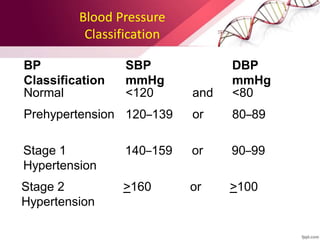
Blood Pressure
Classification
Normal <120 and <80
Prehypertension 120–139 or 80–89
Stage 1
Hypertension
140–159 or 90–99
Stage 2
Hypertension
>160 or >100
BP
Classification
SBP
mmHg
DBP
mmHg
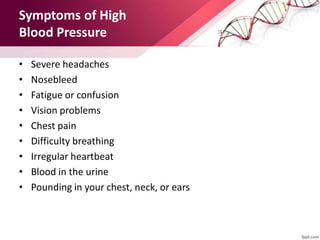
Symptoms of High
Blood Pressure
• Severe headaches
• Nosebleed
• Fatigue or confusion
• Vision problems
• Chest pain
• Difficulty breathing
• Irregular heartbeat
• Blood in the urine
• Pounding in your chest, neck, or ears
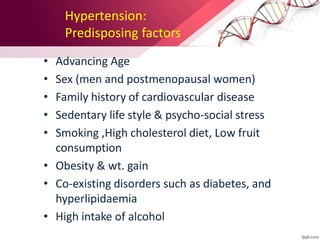
Hypertension:
Predisposing factors
• Advancing Age
• Sex (men and postmenopausal women)
• Family history of cardiovascular disease
• Sedentary life style & psycho-social stress
• Smoking ,High cholesterol diet, Low fruit
consumption
• Obesity & wt. gain
• Co-existing disorders such as diabetes, and
hyperlipidaemia
• High intake of alcohol
Etiology of Systemic
Hypertension
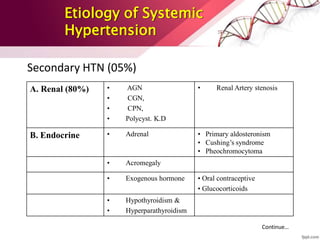
Secondary HTN (05%)
A. Renal (80%) • AGN
• CGN,
• CPN,
• Polycyst. K.D
• Renal Artery stenosis
B. Endocrine • Adrenal • Primary aldosteronism
• Cushing’s syndrome
• Pheochromocytoma
• Acromegaly
• Exogenous hormone • Oral contraceptive
• Glucocorticoids
• Hypothyroidism &
• Hyperparathyroidism
Continue…
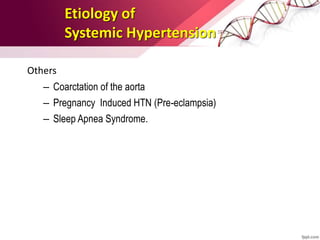
Others
– Coarctation of the aorta
– Pregnancy Induced HTN (Pre-eclampsia)
– Sleep Apnea Syndrome.
Etiology of
Systemic Hypertension
Why to treat ?
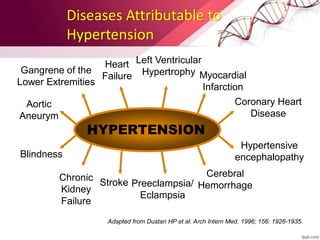
Diseases Attributable to
Hypertension
HYPERTENSION
Gangrene of the
Lower Extremities
Heart
Failure
Left Ventricular
Hypertrophy Myocardial
Infarction
Coronary Heart
Disease
Aortic
Aneurym
Blindness
Chronic
Kidney
Failure
Stroke Preeclampsia/
Eclampsia
Cerebral
Hemorrhage
Hypertensive
encephalopathy
Adapted from Dustan HP et al. Arch Intern Med. 1996; 156: 1926-1935
Target Organ Damage
 Heart
• Left ventricular hypertrophy
• Angina or myocardial infarction
• Heart failure
 Brain
• Stroke or transient ischemic attack
 Chronic kidney disease
 Peripheral arterial disease
 Retinopathy
CVD Risk
 The BP relationship to risk of CVD is continuous,
consistent, and independent of other risk factors.
 Prehypertension signals the need for increased
education to reduce BP in order to prevent
hypertension.
Diagnosis
Clinical manifestations
• No specific complains or manifestations other than
elevated systolic and/or diastolic BP (Silent Killer )
• Morning occipital headache
• Dizziness
• Fatigue
• In severe hypertension, epistaxis or blurred vision
Measuring
Blood Pressure
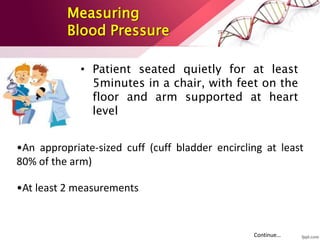
• Patient seated quietly for at least
5minutes in a chair, with feet on the
floor and arm supported at heart
level
•An appropriate-sized cuff (cuff bladder encircling at least
80% of the arm)
•At least 2 measurements
Continue…
• Systolic Blood Pressure is the point at which
the first of 2 or more sounds is heard
• Diastolic Blood Pressure is the point of
disappearance of the sounds (Korotkoff 5th)
Continue…
Measuring
Blood Pressure
• Ambulatory BP Monitoring - information about
BP during daily activities and sleep.
• Correlates better than office measurements
with target-organ injury.
Continue…
Measuring
Blood Pressure
Laboratory Tests
 Routine Tests
• Electrocardiogram
• Urinalysis
• Blood glucose,
• Serum potassium, creatinine, or the corresponding estimated GFR,
and calcium
• Lipid profile, after 9- to 12-hour fast, that includes high-density and
low-density lipoprotein cholesterol, and triglycerides
 Optional tests
• Measurement of urinary albumin excretion or albumin/creatinine
ratio
 More extensive testing for identifiable causes is not generally indicated
unless BP control is not achieved
How to treat ?
Treatment Overview
Goals of therapy
Lifestyle modification
Pharmacologic treatment
 Algorithm for treatment of hypertension
Follow up and monitoring
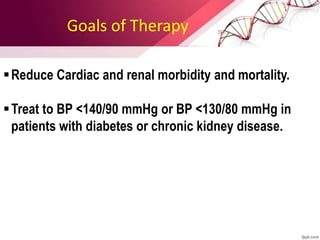
Goals of Therapy
Reduce Cardiac and renal morbidity and mortality.
Treat to BP <140/90 mmHg or BP <130/80 mmHg in
patients with diabetes or chronic kidney disease.
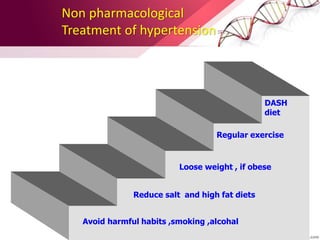
Non pharmacological
Treatment of hypertension
Avoid harmful habits ,smoking ,alcohal
Reduce salt and high fat diets
Loose weight , if obese
Regular exercise
DASH
diet
Life style modifications
• Lose weight, if overweight
• Increase physical activity
• Reduce salt intake
• Stop smoking
• Limit intake of foods rich in fats and
cholesterol
• increase consumption of fruits and
vegetables
• Limit alcohol intake
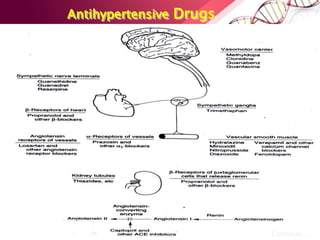
Antihypertensive Drugs
Continue….
AT1 receptor
ARB
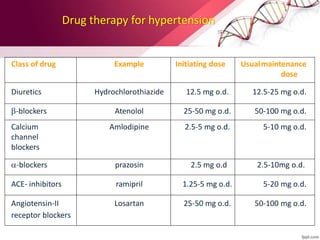
Drug therapy for hypertension
Class of drug Example Initiating dose Usualmaintenance
dose
Diuretics Hydrochlorothiazide 12.5 mg o.d. 12.5-25 mg o.d.
-blockers Atenolol 25-50 mg o.d. 50-100 mg o.d.
Calcium Amlodipine 2.5-5 mg o.d. 5-10 mg o.d.
channel
blockers
-blockers prazosin 2.5 mg o.d 2.5-10mg o.d.
ACE- inhibitors ramipril 1.25-5 mg o.d. 5-20 mg o.d.
Angiotensin-II Losartan 25-50 mg o.d. 50-100 mg o.d.
receptor blockers
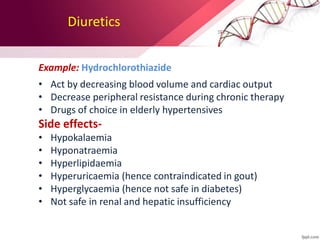
Diuretics
Example: Hydrochlorothiazide
• Act by decreasing blood volume and cardiac output
• Decrease peripheral resistance during chronic therapy
• Drugs of choice in elderly hypertensives
Side effects-
• Hypokalaemia
• Hyponatraemia
• Hyperlipidaemia
• Hyperuricaemia (hence contraindicated in gout)
• Hyperglycaemia (hence not safe in diabetes)
• Not safe in renal and hepatic insufficiency
Beta blockers
Example: Atenolol, Metoprolol, nebivolol,
• Block 1 receptors on the heart
• Block 2 receptors on kidney and inhibit release of renin
• Decrease rate and force of contraction and thus reduce
cardiac output
• Drugs of choice in patients with co-existent coronary
heart disease
Side effects-
• lethargy, impotency, bradycardia
• Not safe in patients with co-existing asthma and
diabetes
• Have an adverse effect on the lipid profile
Calcium channel blockers
Example: Amlodipine
• Block entry of calcium through calcium channels
• Cause vasodilation and reduce peripheral
resistance
• Drugs of choice in elderly hypertensives and
those with co-existing asthma
• Neutral effect on glucose and lipid levels
Side effects
Flushing, headache, Pedal edema
ACE inhibitors
Example: Ramipril, Lisinopril, Enalapril
• Inhibit ACE and formation of angiotensin II
and block its effects
• Drugs of choice in co-existent diabetes
mellitus, Heart failure
Side effects-
dry cough, hypotension, angioedema
Angiotensin II receptor
blockers
Example: Losartan
• Block the angiotensin II receptor and
inhibit effects of angiotensin II
• Drugs of choice in patients with co-
existing diabetes mellitus
Side effects-
safer than ACEI, hypotension,
Alpha blockers
Example: prazosin
• Block -1 receptors and cause vasodilation
• Reduce peripheral resistance and venous
return
• Exert beneficial effects on lipids and insulin
sensitivity
• Drugs of choice in patients with co-existing
BPH
Side effects-
Postural hypotension,
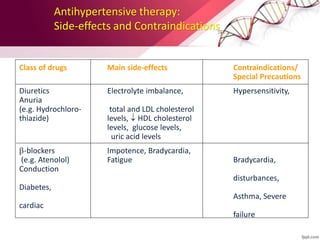
Antihypertensive therapy:
Side-effects and Contraindications
Class of drugs Main side-effects Contraindications/
Special Precautions
Diuretics Electrolyte imbalance, Hypersensitivity,
Anuria
(e.g. Hydrochloro- total and LDL cholesterol
thiazide) levels, HDL cholesterol
levels, glucose levels,
uric acid levels
-blockers Impotence, Bradycardia,
(e.g. Atenolol) Fatigue Bradycardia,
Conduction
disturbances,
Diabetes,
Asthma, Severe
cardiac
failure
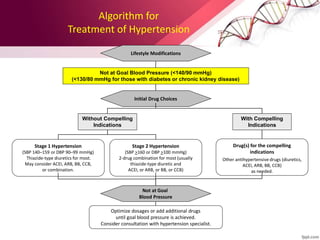
Algorithm for
Treatment of Hypertension
Not at Goal Blood Pressure (<140/90 mmHg)
(<130/80 mmHg for those with diabetes or chronic kidney disease)
Initial Drug Choices
Drug(s) for the compelling
indications
Other antihypertensive drugs (diuretics,
ACEI, ARB, BB, CCB)
as needed.
With Compelling
Indications
Lifestyle Modifications
Stage 2 Hypertension
(SBP >160 or DBP >100 mmHg)
2-drug combination for most (usually
thiazide-type diuretic and
ACEI, or ARB, or BB, or CCB)
Stage 1 Hypertension
(SBP 140–159 or DBP 90–99 mmHg)
Thiazide-type diuretics for most.
May consider ACEI, ARB, BB, CCB,
or combination.
Without Compelling
Indications
Not at Goal
Blood Pressure
Optimize dosages or add additional drugs
until goal blood pressure is achieved.
Consider consultation with hypertension specialist.
Health Education
• Hypertension is a major cause of morbidity and mortality, and
needs to be treated
• It is an extremely common condition; however it is still under-
diagnosed and undertreated
• Hypertension is easy to diagnose and easy to treat
• Aim of the management is to save the target organ from the
deleterious effect
• Besides pharmacology we have other choices and one has to be
acquainted with that choice
• Life style modification should always be encouraged in all
Hypertensive patients
Nursing Diagnosis
• Risk for Decreased Cardiac Output
• Decreased Activity Tolerance
• Acute Pain
• Ineffective Coping
• Overweight
• Deficient Knowledge
Nursing Interventions
1.Provide calm, restful surroundings, minimize environmental
activity and noise.
2. Maintain activity restrictions (bed rest or chair rest)
3. Provide comfort measures (back and neck massage, the
elevation of head).
4. Instruct in relaxation techniques, guided imagery,
distractions.
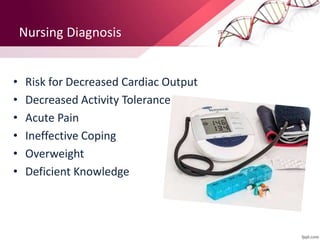
5. Monitor response to medications to control blood pressure.
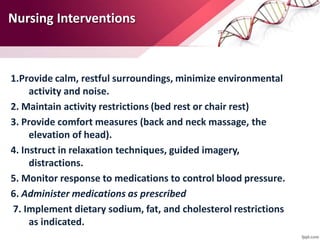
6. Administer medications as prescribed
7. Implement dietary sodium, fat, and cholesterol restrictions
as indicated.
Any questions?

Hypertension

  • 1.
    Diagnosis and managementof Hypertension ANI GEORGE STAFF NURSE Department of Medical and Surgical(3A/B) King Fahad Hospital,Hofuf.
  • 2.
    Hypertension (Silent Killer)is defined as systolic blood pressure (SBP) of 140 mmHg or greater, diastolic blood pressure (DBP) of 90 mmHg or greater, or taking antihypertensive medication.
  • 3.
    Types of hypertension •Essential hypertension – 95% – No underlying cause • Secondary hypertension – Underlying cause
  • 4.
    Causes of Secondary Hypertension •Renal – Parenchymal – Vascular – Others • Endocrine • Miscellaneous • Unknown
  • 5.
    Different types ofhigh blood pressure Primary, or essential, high blood pressure is the most common type of high blood pressure. It develops over time as normally people get older. Secondary high blood pressure is caused by another medical condition or use of certain medicines. It usually gets better after been treated that condition.
  • 6.
    Blood Pressure Classification Normal <120and <80 Prehypertension 120–139 or 80–89 Stage 1 Hypertension 140–159 or 90–99 Stage 2 Hypertension >160 or >100 BP Classification SBP mmHg DBP mmHg
  • 7.
    Symptoms of High BloodPressure • Severe headaches • Nosebleed • Fatigue or confusion • Vision problems • Chest pain • Difficulty breathing • Irregular heartbeat • Blood in the urine • Pounding in your chest, neck, or ears
  • 8.
    Hypertension: Predisposing factors • AdvancingAge • Sex (men and postmenopausal women) • Family history of cardiovascular disease • Sedentary life style & psycho-social stress • Smoking ,High cholesterol diet, Low fruit consumption • Obesity & wt. gain • Co-existing disorders such as diabetes, and hyperlipidaemia • High intake of alcohol
  • 9.
    Etiology of Systemic Hypertension SecondaryHTN (05%) A. Renal (80%) • AGN • CGN, • CPN, • Polycyst. K.D • Renal Artery stenosis B. Endocrine • Adrenal • Primary aldosteronism • Cushing’s syndrome • Pheochromocytoma • Acromegaly • Exogenous hormone • Oral contraceptive • Glucocorticoids • Hypothyroidism & • Hyperparathyroidism Continue…
  • 10.
    Others – Coarctation ofthe aorta – Pregnancy Induced HTN (Pre-eclampsia) – Sleep Apnea Syndrome. Etiology of Systemic Hypertension
  • 11.
  • 12.
    Diseases Attributable to Hypertension HYPERTENSION Gangreneof the Lower Extremities Heart Failure Left Ventricular Hypertrophy Myocardial Infarction Coronary Heart Disease Aortic Aneurym Blindness Chronic Kidney Failure Stroke Preeclampsia/ Eclampsia Cerebral Hemorrhage Hypertensive encephalopathy Adapted from Dustan HP et al. Arch Intern Med. 1996; 156: 1926-1935
  • 13.
    Target Organ Damage Heart • Left ventricular hypertrophy • Angina or myocardial infarction • Heart failure  Brain • Stroke or transient ischemic attack  Chronic kidney disease  Peripheral arterial disease  Retinopathy
  • 14.
    CVD Risk  TheBP relationship to risk of CVD is continuous, consistent, and independent of other risk factors.  Prehypertension signals the need for increased education to reduce BP in order to prevent hypertension.
  • 15.
  • 16.
    Clinical manifestations • Nospecific complains or manifestations other than elevated systolic and/or diastolic BP (Silent Killer ) • Morning occipital headache • Dizziness • Fatigue • In severe hypertension, epistaxis or blurred vision
  • 17.
    Measuring Blood Pressure • Patientseated quietly for at least 5minutes in a chair, with feet on the floor and arm supported at heart level •An appropriate-sized cuff (cuff bladder encircling at least 80% of the arm) •At least 2 measurements Continue…
  • 18.
    • Systolic BloodPressure is the point at which the first of 2 or more sounds is heard • Diastolic Blood Pressure is the point of disappearance of the sounds (Korotkoff 5th) Continue… Measuring Blood Pressure
  • 19.
    • Ambulatory BPMonitoring - information about BP during daily activities and sleep. • Correlates better than office measurements with target-organ injury. Continue… Measuring Blood Pressure
  • 20.
    Laboratory Tests  RoutineTests • Electrocardiogram • Urinalysis • Blood glucose, • Serum potassium, creatinine, or the corresponding estimated GFR, and calcium • Lipid profile, after 9- to 12-hour fast, that includes high-density and low-density lipoprotein cholesterol, and triglycerides  Optional tests • Measurement of urinary albumin excretion or albumin/creatinine ratio  More extensive testing for identifiable causes is not generally indicated unless BP control is not achieved
  • 21.
  • 22.
    Treatment Overview Goals oftherapy Lifestyle modification Pharmacologic treatment  Algorithm for treatment of hypertension Follow up and monitoring
  • 23.
    Goals of Therapy ReduceCardiac and renal morbidity and mortality. Treat to BP <140/90 mmHg or BP <130/80 mmHg in patients with diabetes or chronic kidney disease.
  • 24.
    Non pharmacological Treatment ofhypertension Avoid harmful habits ,smoking ,alcohal Reduce salt and high fat diets Loose weight , if obese Regular exercise DASH diet
  • 25.
    Life style modifications •Lose weight, if overweight • Increase physical activity • Reduce salt intake • Stop smoking • Limit intake of foods rich in fats and cholesterol • increase consumption of fruits and vegetables • Limit alcohol intake
  • 26.
  • 27.
    Drug therapy forhypertension Class of drug Example Initiating dose Usualmaintenance dose Diuretics Hydrochlorothiazide 12.5 mg o.d. 12.5-25 mg o.d. -blockers Atenolol 25-50 mg o.d. 50-100 mg o.d. Calcium Amlodipine 2.5-5 mg o.d. 5-10 mg o.d. channel blockers -blockers prazosin 2.5 mg o.d 2.5-10mg o.d. ACE- inhibitors ramipril 1.25-5 mg o.d. 5-20 mg o.d. Angiotensin-II Losartan 25-50 mg o.d. 50-100 mg o.d. receptor blockers
  • 28.
    Diuretics Example: Hydrochlorothiazide • Actby decreasing blood volume and cardiac output • Decrease peripheral resistance during chronic therapy • Drugs of choice in elderly hypertensives Side effects- • Hypokalaemia • Hyponatraemia • Hyperlipidaemia • Hyperuricaemia (hence contraindicated in gout) • Hyperglycaemia (hence not safe in diabetes) • Not safe in renal and hepatic insufficiency
  • 29.
    Beta blockers Example: Atenolol,Metoprolol, nebivolol, • Block 1 receptors on the heart • Block 2 receptors on kidney and inhibit release of renin • Decrease rate and force of contraction and thus reduce cardiac output • Drugs of choice in patients with co-existent coronary heart disease Side effects- • lethargy, impotency, bradycardia • Not safe in patients with co-existing asthma and diabetes • Have an adverse effect on the lipid profile
  • 30.
    Calcium channel blockers Example:Amlodipine • Block entry of calcium through calcium channels • Cause vasodilation and reduce peripheral resistance • Drugs of choice in elderly hypertensives and those with co-existing asthma • Neutral effect on glucose and lipid levels Side effects Flushing, headache, Pedal edema
  • 31.
    ACE inhibitors Example: Ramipril,Lisinopril, Enalapril • Inhibit ACE and formation of angiotensin II and block its effects • Drugs of choice in co-existent diabetes mellitus, Heart failure Side effects- dry cough, hypotension, angioedema
  • 32.
    Angiotensin II receptor blockers Example:Losartan • Block the angiotensin II receptor and inhibit effects of angiotensin II • Drugs of choice in patients with co- existing diabetes mellitus Side effects- safer than ACEI, hypotension,
  • 33.
    Alpha blockers Example: prazosin •Block -1 receptors and cause vasodilation • Reduce peripheral resistance and venous return • Exert beneficial effects on lipids and insulin sensitivity • Drugs of choice in patients with co-existing BPH Side effects- Postural hypotension,
  • 34.
    Antihypertensive therapy: Side-effects andContraindications Class of drugs Main side-effects Contraindications/ Special Precautions Diuretics Electrolyte imbalance, Hypersensitivity, Anuria (e.g. Hydrochloro- total and LDL cholesterol thiazide) levels, HDL cholesterol levels, glucose levels, uric acid levels -blockers Impotence, Bradycardia, (e.g. Atenolol) Fatigue Bradycardia, Conduction disturbances, Diabetes, Asthma, Severe cardiac failure
  • 35.
    Algorithm for Treatment ofHypertension Not at Goal Blood Pressure (<140/90 mmHg) (<130/80 mmHg for those with diabetes or chronic kidney disease) Initial Drug Choices Drug(s) for the compelling indications Other antihypertensive drugs (diuretics, ACEI, ARB, BB, CCB) as needed. With Compelling Indications Lifestyle Modifications Stage 2 Hypertension (SBP >160 or DBP >100 mmHg) 2-drug combination for most (usually thiazide-type diuretic and ACEI, or ARB, or BB, or CCB) Stage 1 Hypertension (SBP 140–159 or DBP 90–99 mmHg) Thiazide-type diuretics for most. May consider ACEI, ARB, BB, CCB, or combination. Without Compelling Indications Not at Goal Blood Pressure Optimize dosages or add additional drugs until goal blood pressure is achieved. Consider consultation with hypertension specialist.
  • 36.
    Health Education • Hypertensionis a major cause of morbidity and mortality, and needs to be treated • It is an extremely common condition; however it is still under- diagnosed and undertreated • Hypertension is easy to diagnose and easy to treat • Aim of the management is to save the target organ from the deleterious effect • Besides pharmacology we have other choices and one has to be acquainted with that choice • Life style modification should always be encouraged in all Hypertensive patients
  • 37.
    Nursing Diagnosis • Riskfor Decreased Cardiac Output • Decreased Activity Tolerance • Acute Pain • Ineffective Coping • Overweight • Deficient Knowledge
  • 38.
    Nursing Interventions 1.Provide calm,restful surroundings, minimize environmental activity and noise. 2. Maintain activity restrictions (bed rest or chair rest) 3. Provide comfort measures (back and neck massage, the elevation of head). 4. Instruct in relaxation techniques, guided imagery, distractions. 5. Monitor response to medications to control blood pressure. 6. Administer medications as prescribed 7. Implement dietary sodium, fat, and cholesterol restrictions as indicated.
  • 39.