HyperQA: A Framework for Complex Question-Answering
Jinho D. Choi
Emory University
SUMMARY
This abstract describes the overall framework of
our question-answering system designed to answer
various types of complex questions. Our framework
makes heavy use of natural language processing
techniques for the retrieval, ranking, and generation
of correct answers. Our approach has been tested
on answering arithmetic questions requiring logical
reasoning as well as higher-order factoid questions
aggregating information across different documents.
I. INTRODUCTION
Question-Answering has recently gained lots of
interest from both academic and industrial research.
Although this task has been well-explored, several
challenges still remain; the representation of world
knowledge into structured data is complicated and
the aggregation of necessary information for finding
answers is convoluted. In this abstract, we suggest
a framework that processes both a knowledge-base
and a knowledge graph consisting of entity relations
in unstructured data, and extracts information from
this structured data for finding answers for complex
questions (Section 2). Our framework can be used
efficiently to gather information across documents,
and makes it possible to find answers for arithmetic
or higher-order factoid questions (Section 3).
II. Framework
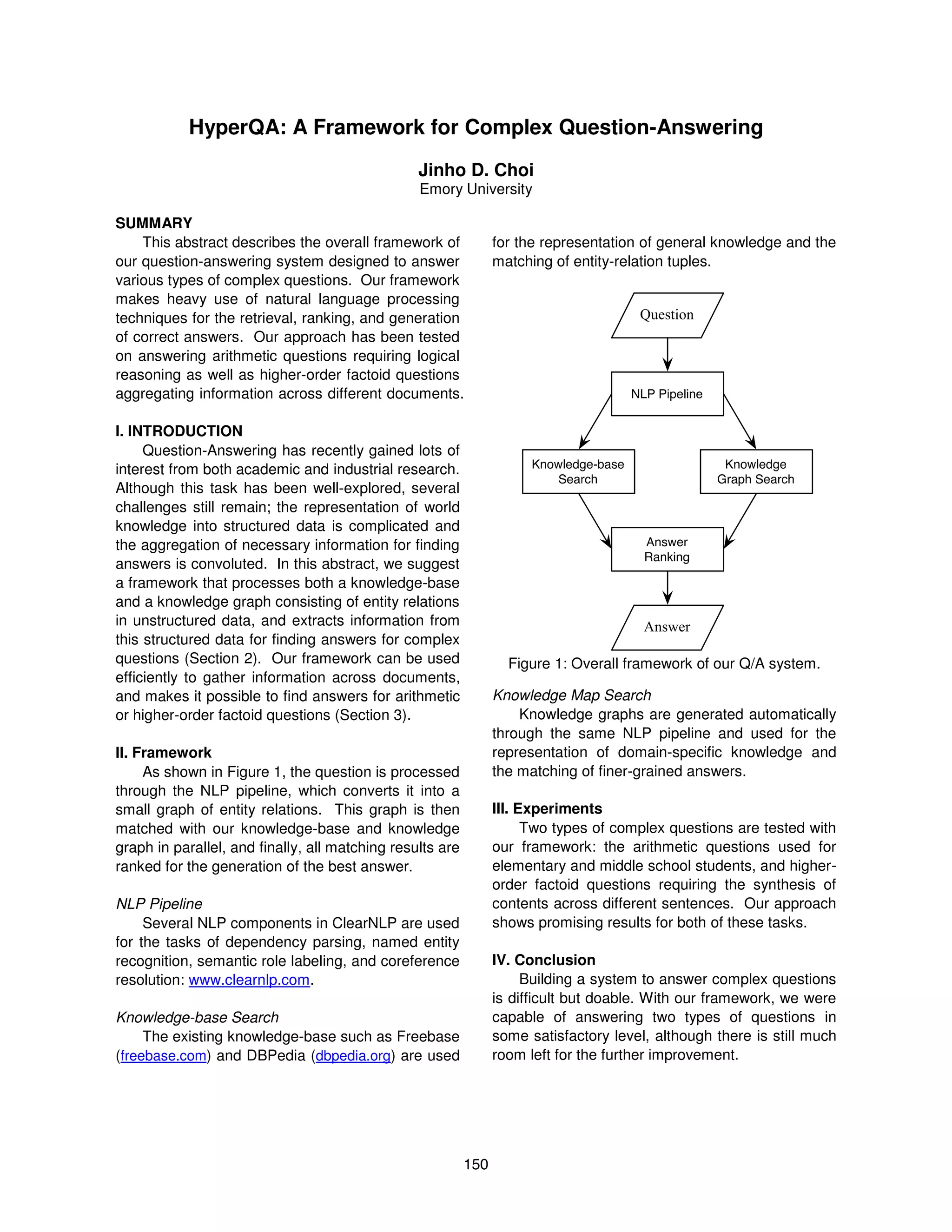
As shown in Figure 1, the question is processed
through the NLP pipeline, which converts it into a
small graph of entity relations. This graph is then
matched with our knowledge-base and knowledge
graph in parallel, and finally, all matching results are
ranked for the generation of the best answer.
NLP Pipeline
Several NLP components in ClearNLP are used
for the tasks of dependency parsing, named entity
recognition, semantic role labeling, and coreference
resolution: www.clearnlp.com.
Knowledge-base Search
The existing knowledge-base such as Freebase
(freebase.com) and DBPedia (dbpedia.org) are used
for the representation of general knowledge and the
matching of entity-relation tuples.
Figure 1: Overall framework of our Q/A system.
Knowledge Map Search
Knowledge graphs are generated automatically
through the same NLP pipeline and used for the
representation of domain-specific knowledge and
the matching of finer-grained answers.
III. Experiments
Two types of complex questions are tested with
our framework: the arithmetic questions used for
elementary and middle school students, and higher-
order factoid questions requiring the synthesis of
contents across different sentences. Our approach
shows promising results for both of these tasks.
IV. Conclusion
Building a system to answer complex questions
is difficult but doable. With our framework, we were
capable of answering two types of questions in
some satisfactory level, although there is still much
room left for the further improvement.
150

HyperQA: A Framework for Complex Question-Answering

  • 1.
    HyperQA: A Frameworkfor Complex Question-Answering Jinho D. Choi Emory University SUMMARY This abstract describes the overall framework of our question-answering system designed to answer various types of complex questions. Our framework makes heavy use of natural language processing techniques for the retrieval, ranking, and generation of correct answers. Our approach has been tested on answering arithmetic questions requiring logical reasoning as well as higher-order factoid questions aggregating information across different documents. I. INTRODUCTION Question-Answering has recently gained lots of interest from both academic and industrial research. Although this task has been well-explored, several challenges still remain; the representation of world knowledge into structured data is complicated and the aggregation of necessary information for finding answers is convoluted. In this abstract, we suggest a framework that processes both a knowledge-base and a knowledge graph consisting of entity relations in unstructured data, and extracts information from this structured data for finding answers for complex questions (Section 2). Our framework can be used efficiently to gather information across documents, and makes it possible to find answers for arithmetic or higher-order factoid questions (Section 3). II. Framework As shown in Figure 1, the question is processed through the NLP pipeline, which converts it into a small graph of entity relations. This graph is then matched with our knowledge-base and knowledge graph in parallel, and finally, all matching results are ranked for the generation of the best answer. NLP Pipeline Several NLP components in ClearNLP are used for the tasks of dependency parsing, named entity recognition, semantic role labeling, and coreference resolution: www.clearnlp.com. Knowledge-base Search The existing knowledge-base such as Freebase (freebase.com) and DBPedia (dbpedia.org) are used for the representation of general knowledge and the matching of entity-relation tuples. Figure 1: Overall framework of our Q/A system. Knowledge Map Search Knowledge graphs are generated automatically through the same NLP pipeline and used for the representation of domain-specific knowledge and the matching of finer-grained answers. III. Experiments Two types of complex questions are tested with our framework: the arithmetic questions used for elementary and middle school students, and higher- order factoid questions requiring the synthesis of contents across different sentences. Our approach shows promising results for both of these tasks. IV. Conclusion Building a system to answer complex questions is difficult but doable. With our framework, we were capable of answering two types of questions in some satisfactory level, although there is still much room left for the further improvement. 150