By: McKenzie Stewart, Amber Graves & Hanna George
 
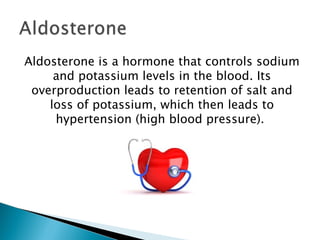
Aldosterone is a hormone that controls sodium and potassium levels in the blood. Its overproduction leads to retention of salt and loss of potassium, which then leads to hypertension (high blood pressure).
 
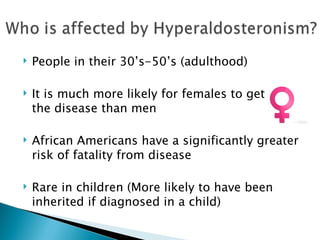
People in their 30’s-50’s (adulthood) It is much more likely for females to get  the disease than men African Americans have a significantly greater risk of fatality from disease Rare in children (More likely to have been inherited if diagnosed in a child)
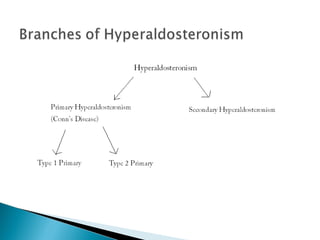
People with primary Hyperaldosteronism have a problem within the adrenal gland that causes it to release too much aldosterone.
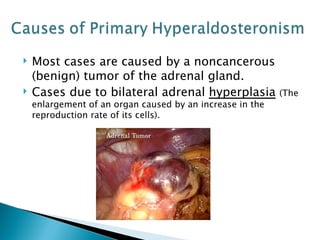
Most cases are caused by a noncancerous (benign) tumor of the adrenal gland. Cases due to bilateral adrenal  hyperplasia   (The enlargement of an organ caused by an increase in the reproduction rate of its cells).
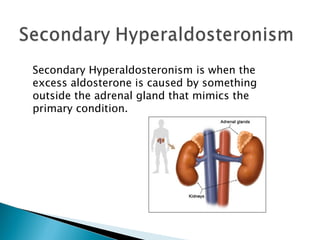
Secondary Hyperaldosteronism is when the excess aldosterone is caused by something outside the adrenal gland that mimics the primary condition.
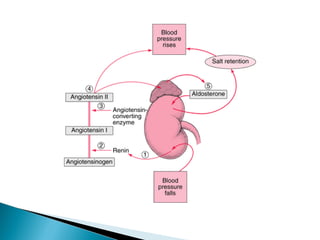
May result from conditions that induce hypertension through increased  renin  production, ingestion of oral contraceptives, and pregnancy. Conditions such as congestive heart failure, liver failure, kidney disease, and dehydration, or caused by certain medicines such as diuretics or fludrocortisone. It is likely that many cases of secondary Hyperaldosteronism are never detected. * Renin  - An enzyme secreted by and stored in the kidney area that stimulates aldosterone and therefore, raises blood pressure
 
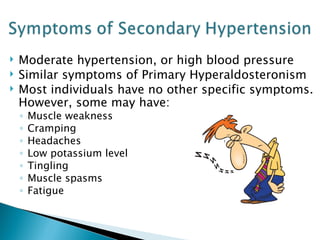
Moderate hypertension, or high blood pressure Similar symptoms of Primary Hyperaldosteronism Most individuals have no other specific symptoms. However, some may have: Muscle weakness Cramping  Headaches  Low potassium level  Tingling  Muscle spasms  Fatigue
Secondary Hyperaldosteronism is treated by treating the underlying cause. Typically medicines and diet (but not surgery) are used to treat secondary Hyperaldosteronism. Untreated Hyperaldosteronism can lead to uncontrolled hypertension (can become a risk factor for stroke or heart disease).
Elevated aldosterone levels can be measured in the blood or urine. A blood test, PRA (Plasma renin activity), is used to distinguish between primary (low PRA) and secondary Hyperaldosteronism (high PRA).
 
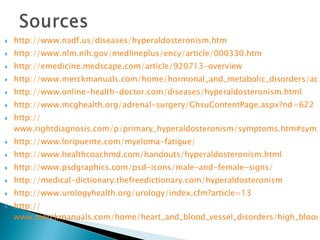
Hyperaldosteronism is relatively uncommon but still accounts for about 0.5% of cases of hypertension in the United States. Secondary Hyperaldosteronism is more common than Primary. Eating excessive amounts of real black licorice can produce a similar syndrome due to a chemical that acts like aldosterone.
http://www.nadf.us/diseases/hyperaldosteronism.htm http://www.nlm.nih.gov/medlineplus/ency/article/000330.htm http://emedicine.medscape.com/article/920713-overview http://www.merckmanuals.com/home/hormonal_and_metabolic_disorders/adrenal_gland_disorders/hyperaldosteronism.html http:// www.online-health-doctor.com/diseases/hyperaldosteronism.html http:// www.mcghealth.org/adrenal-surgery/GhsuContentPage.aspx?nd=622 http:// www.rightdiagnosis.com/p/primary_hyperaldosteronism/symptoms.htm#symptom_list http://www.loripuente.com/myeloma-fatigue / http:// www.healthcoachmd.com/handouts/hyperaldosteronism.html http://www.psdgraphics.com/psd-icons/male-and-female-signs / http:// medical-dictionary.thefreedictionary.com/hyperaldosteronism http:// www.urologyhealth.org/urology/index.cfm?article=13 http:// www.merckmanuals.com/home/heart_and_blood_vessel_disorders/high_blood_pressure/high_blood_pressure.html

Hyperaldosteronism new[1]

  • 1.
    By: McKenzie Stewart,Amber Graves & Hanna George
  • 2.
  • 3.
    Aldosterone is ahormone that controls sodium and potassium levels in the blood. Its overproduction leads to retention of salt and loss of potassium, which then leads to hypertension (high blood pressure).
  • 4.
  • 5.
    People in their30’s-50’s (adulthood) It is much more likely for females to get the disease than men African Americans have a significantly greater risk of fatality from disease Rare in children (More likely to have been inherited if diagnosed in a child)
  • 6.
    People with primaryHyperaldosteronism have a problem within the adrenal gland that causes it to release too much aldosterone.
  • 7.
    Most cases arecaused by a noncancerous (benign) tumor of the adrenal gland. Cases due to bilateral adrenal hyperplasia (The enlargement of an organ caused by an increase in the reproduction rate of its cells).
  • 8.
    Secondary Hyperaldosteronism iswhen the excess aldosterone is caused by something outside the adrenal gland that mimics the primary condition.
  • 9.
    May result fromconditions that induce hypertension through increased renin production, ingestion of oral contraceptives, and pregnancy. Conditions such as congestive heart failure, liver failure, kidney disease, and dehydration, or caused by certain medicines such as diuretics or fludrocortisone. It is likely that many cases of secondary Hyperaldosteronism are never detected. * Renin - An enzyme secreted by and stored in the kidney area that stimulates aldosterone and therefore, raises blood pressure
  • 10.
  • 11.
    Moderate hypertension, orhigh blood pressure Similar symptoms of Primary Hyperaldosteronism Most individuals have no other specific symptoms. However, some may have: Muscle weakness Cramping Headaches Low potassium level Tingling Muscle spasms Fatigue
  • 12.
    Secondary Hyperaldosteronism istreated by treating the underlying cause. Typically medicines and diet (but not surgery) are used to treat secondary Hyperaldosteronism. Untreated Hyperaldosteronism can lead to uncontrolled hypertension (can become a risk factor for stroke or heart disease).
  • 13.
    Elevated aldosterone levelscan be measured in the blood or urine. A blood test, PRA (Plasma renin activity), is used to distinguish between primary (low PRA) and secondary Hyperaldosteronism (high PRA).
  • 14.
  • 15.
    Hyperaldosteronism is relativelyuncommon but still accounts for about 0.5% of cases of hypertension in the United States. Secondary Hyperaldosteronism is more common than Primary. Eating excessive amounts of real black licorice can produce a similar syndrome due to a chemical that acts like aldosterone.
  • 16.
    http://www.nadf.us/diseases/hyperaldosteronism.htm http://www.nlm.nih.gov/medlineplus/ency/article/000330.htm http://emedicine.medscape.com/article/920713-overviewhttp://www.merckmanuals.com/home/hormonal_and_metabolic_disorders/adrenal_gland_disorders/hyperaldosteronism.html http:// www.online-health-doctor.com/diseases/hyperaldosteronism.html http:// www.mcghealth.org/adrenal-surgery/GhsuContentPage.aspx?nd=622 http:// www.rightdiagnosis.com/p/primary_hyperaldosteronism/symptoms.htm#symptom_list http://www.loripuente.com/myeloma-fatigue / http:// www.healthcoachmd.com/handouts/hyperaldosteronism.html http://www.psdgraphics.com/psd-icons/male-and-female-signs / http:// medical-dictionary.thefreedictionary.com/hyperaldosteronism http:// www.urologyhealth.org/urology/index.cfm?article=13 http:// www.merckmanuals.com/home/heart_and_blood_vessel_disorders/high_blood_pressure/high_blood_pressure.html