Primary
Hyperaldosteronism
Dr. Hamad AlAblani
Endocrinology Fellow , F1
Prince Sultan Military Medical City
 Normal physiology of Renin-Angiotensin-Aldoserone system
 Definition of Primary Hyperaldosteronism
 Epidemiology of Primary Hyperaldosteronism
 Etiology
 Diagnosis including screening and confirmatory tests
 Treatment
 Post surgical care
 Prognosis
OUTLINES
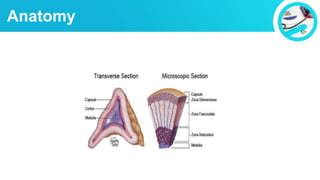
Anatomy
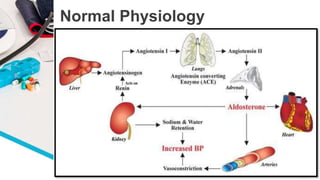
Normal Physiology
DEFINITION of PH
 Inappropriate (renin-independent) overproduction of aldosterone.
 Primary aldosteronism must be distinguished from secondary
aldosteronism, which is appropriate (renin-dependent) increased
production of aldosterone in response to relative hypovolemia as
is seen in renovascular hypertension and with diuretic therapy.
Epidemiology
 The true prevalence of primary aldosteronism is not known.
 Older literature had suggested a low prevalence of of <1% in hypertensive
patients.
 More recent literature suggests a prevalence of up to 12% in hypertensive
patients.
 In one of the largest studies to attempt an estimate on the prevalence of
primary aldosteronism, Monticone and colleagues tested 1672 primary care pati
ents with hypertension for primary aldosteronism. They reported that 6% of their
general hypertensive population had the diagnosis OF PH . 2017
Etiology
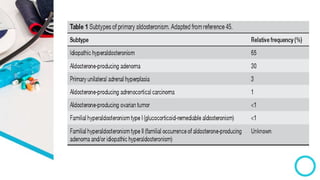
 Aldosterone-producing adenoma (APA) , conn’s syndrome .
 Adrenal gland hyperplasia (uni- or bilateral) .
 Aldosterone-secreting adrenal cortical carcinoma (ACC) .
 Aldosterone-secreting ovarian tumor .
 Familial hyperaldosteronism (FH) glucocorticoid-remediable aldosteronism
(GRA) .
HEALTH OUTCOMES IN PRIMARY
ALDOSTERONISM BEFORE TARGETED
THERAPY
 There is a lot of studies have focused on cardiometabolic outcomes, including
myocardial infarction, heart failure, stroke, atrial fibrillation, diabetes, and
metabolic syndrome.
 They concluded , the cardiometabolic adverse outcomes was higher in patients
with primary aldosteronism before targeted therapy compared with patients
with essential hypertension .
 Other studies have shown that patients with primary aldosteronism before
targeted therapy are also at higher risk for kidney disease, including glomerular hy
perfiltration and albuminuria, as well as death.
The risk of cardiovascular disease and
kidney disease was
NO longer present after appropriate
treatment of the mineralocorticoid
excess.
CLINICAL PRESENTATION
 The classic findings in primary aldosteronism are hypertension and
hypokalemia.
 However, the most common presentation of primary
aldosteronism is normokalemic hypertension.
 Hypertension is usually, but not always, present, but hypokalemia is
present in less than half of confirmed cases.
History
 Symptoms related to hypokalemia, such as muscle weakness and cramping,
can occur. Other symptoms are nonspecific and may include headache,
fatigue, palpitations, and polyuria.
 A careful medication history is important, as many antihypertensives can
interfere with diagnostic testing, as licorice ingestion or chewing tobacco use.
 A family history of early-onset primary aldosteronism, hypertension, or cerebro
vascular events should raise suspicion for FH.
Physical Examination
There are no specific physical findings in primary aldosteronism,
Though hypertension is present in the majority of cases .
 Different series have documented hypokalemia in only 9% to 37% of patie
nts with PA.
 In a large single study published in 2006, almost 50% of patients with APA
had hypokalemia, whereas only 17% of those with IHA did.
 Therefore, normokalemic severe hypertension is the most common
presentation of PA.
Diagnostic Testing
 Screening for renin-independent aldosterone production
 Confirmation of renin-independent aldosterone production
 Localization of aldosterone production
Screening for renin-independent
aldosterone production
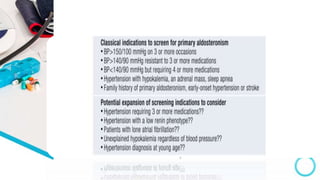
Who to Screen for Primary
Aldosteronism ?
The two tests ordered for biochemical screening for
primary hyperaldosteronism are :
1- The plasma aldosterone concentration (PAC)
and
2- The plasma renin activity (PRA).
A PAC >20 ng/dL and an ARR >30
used together have a 90% sensitivity and specificity for
primary hyperaldosteronism
 The diagnosis of PA is based on the demonstration of inappropriately high
PAC with concomitantly suppressed PRA.
 samples are collected in the morning, with the patient out of
bed for at least 2 hours and seated for 5 to 15 minutes.
 Preparation before ARR testing includes correction of hypokalemia
(as hypokalemia reduces aldosterone secretion), sodium-unrestricted diet, and
withdrawal of mineralocorticoid receptor antagonists, renin inhibitors,
and amiloride 4 to 6 weeks before testing, if clinically feasible .
 Medications do not cause false-positive results for PA .
 medications can cause false-negative results, either by raising
the PRA (most often) or suppressing the PAC .
 Mineralocorticoid receptor antagonists, renin inhibitors, and high-
dose Amiloride ( <5mg ) : 4-6 weeks
 Angiotensin-converting enzyme (ACE) inhibitors, angiotensin rec
eptor blockers (ARBs), and diuretics : 1-2 weeks
What the Risks Are
What Results Mean
What the Test Involves
While inexpensive, the test invo
lves a fair amount of
risk considering that
primary aldosteronism is a salt-
sensitive form of hypertension,
and that the test is not
performed under medical super
vision.
At a minimum, it should be avo
ided in the presence of severe
hypertension and hypokalemia,
kidney impairment, and arrhyth
mia.
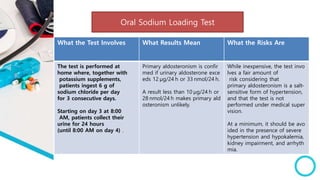
Primary aldosteronism is confir
med if urinary aldosterone exce
eds 12 µg/24 h or 33 nmol/24 h.
A result less than 10 µg/24 h or
28 nmol/24 h makes primary ald
osteronism unlikely.
The test is performed at
home where, together with
potassium supplements,
patients ingest 6 g of
sodium chloride per day
for 3 consecutive days.
Starting on day 3 at 8:00
AM, patients collect their
urine for 24 hours
(until 8:00 AM on day 4) .
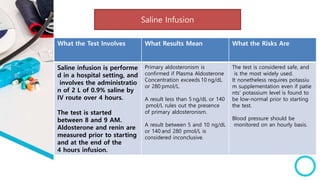
Oral Sodium Loading Test
What the Risks Are
What Results Mean
What the Test Involves
The test is considered safe, and
is the most widely used.
It nonetheless requires potassiu
m supplementation even if patie
nts’ potassium level is found to
be low-normal prior to starting
the test.
Blood pressure should be
monitored on an hourly basis.
Primary aldosteronism is
confirmed if Plasma Aldosterone
Concentration exceeds 10 ng/dL
or 280 pmol/L.
A result less than 5 ng/dL or 140
pmol/L rules out the presence
of primary aldosteronism.
A result between 5 and 10 ng/dL
or 140 and 280 pmol/L is
considered inconclusive.
Saline infusion is performe
d in a hospital setting, and
involves the administratio
n of 2 L of 0.9% saline by
IV route over 4 hours.
The test is started
between 8 and 9 AM.
Aldosterone and renin are
measured prior to starting
and at the end of the
4 hours infusion.
Saline Infusion
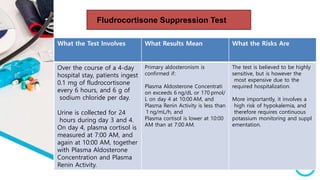
What the Risks Are
What Results Mean
What the Test Involves
The test is believed to be highly
sensitive, but is however the
most expensive due to the
required hospitalization.
More importantly, it involves a
high risk of hypokalemia, and
therefore requires continuous
potassium monitoring and suppl
ementation.
Primary aldosteronism is
confirmed if:
Plasma Aldosterone Concentrati
on exceeds 6 ng/dL or 170 pmol/
L on day 4 at 10:00 AM, and
Plasma Renin Activity is less than
1 ng/mL/h, and
Plasma cortisol is lower at 10:00
AM than at 7:00 AM.
Over the course of a 4-day
hospital stay, patients ingest
0.1 mg of fludrocortisone
every 6 hours, and 6 g of
sodium chloride per day.
Urine is collected for 24
hours during day 3 and 4.
On day 4, plasma cortisol is
measured at 7:00 AM, and
again at 10:00 AM, together
with Plasma Aldosterone
Concentration and Plasma
Renin Activity.
Fludrocortisone Suppression Test
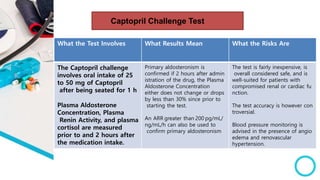
What the Risks Are
What Results Mean
What the Test Involves
The test is fairly inexpensive, is
overall considered safe, and is
well-suited for patients with
compromised renal or cardiac fu
nction.
The test accuracy is however con
troversial.
Blood pressure monitoring is
advised in the presence of angio
edema and renovascular
hypertension.
Primary aldosteronism is
confirmed if 2 hours after admin
istration of the drug, the Plasma
Aldosterone Concentration
either does not change or drops
by less than 30% since prior to
starting the test.
An ARR greater than 200 pg/mL/
ng/mL/h can also be used to
confirm primary aldosteronism
The Captopril challenge
involves oral intake of 25
to 50 mg of Captopril
after being seated for 1 h
Plasma Aldosterone
Concentration, Plasma
Renin Activity, and plasma
cortisol are measured
prior to and 2 hours after
the medication intake.
Captopril Challenge Test
Imaging and Diagnostic
Procedures
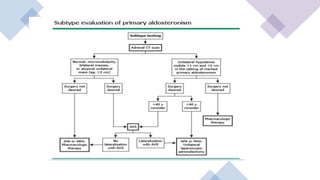
 Localization of aldosterone production is essential to direct therapy in
patients with primary aldosteronism who desire a surgical cure, because only
patients with unilateral disease are likely to derive benefit from surgery.
 As a rule, imaging is not a reliable way to distinguish unilateral from
bilateral disease but should be performed to identify tumors likely to be
Malignant .
 Adrenal vein sampling (AVS) remains the localization procedure of choice
for patients seeking a surgical cure.
Adrenal imaging
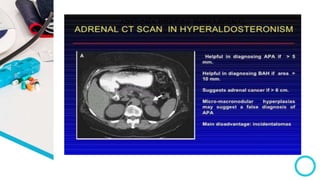
 A computed tomography (CT) of the adrenal glands
should be performed to identify adrenocortical carcinoma, which tends to
be large (>4 cm) and has a characteristic CT appearance.
 A magnetic resonance imaging (MRI) study can be substituted if CT is
contraindicated.
 Imaging should not be used alone to localize aldosterone production
because it cannot reliably distinguish between a unilateral and a bilateral
source. For example, IHA and a nonfunctioning adrenal incidentaloma may
coexist. In these cases, a unilateral adrenal mass would be detected on
imaging, but the source of aldosterone excess would be bilateral.
Conversely, APAs may be too small to be detected by CT. In that situation,
the presence of “normal” adrenal glands might incorrectly imply a bilateral
source of aldosterone excess.
 Concordance between CT and AVS is only approximately 50% .
 AVS is expensive, invasive, and technically difficult, but is 95% sensitive and
100% specific for detection of unilateral disease.
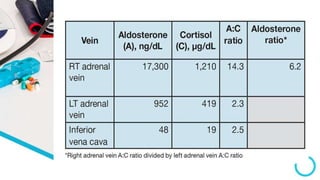
 Catheters are introduced into the left and right adrenal veins and the inferior
vena cava (IVC) .
 A continuous cosyntropin infusion (50 mcg/hr) may be begun 30 minutes
before catheterization and continued throughout the procedure.
 The infusion stimulates aldosterone and cortisol production .
 Blood samples from bilateral adrenal veins and a single peripheral vein are
then obtained for the measurement of plasma aldosterone and cortisol.
 Right and left adrenal aldosterone concentrations should be divided by their
respective cortisol concentrations to correct for dilution effects.
 A lateralization ratio of more than 4:1 is indicative of unilateral aldosteron
excess.
 A ratio of <3:1 suggests a bilateral source.
 A ratio between 3:1 and 4:1 is inconclusive.
When is AVS not needed in patients
with documented PA?
 AVS is not considered necessary when all three of the
following criteria are all met:
• Age Less than 35 years old .
• PAC markedly elevated .
• Unilateral cortical adenoma on CT .
TREATMENT
General Rules
 Surgical resection is the treatment of choice for unilateral
disease.
 Medical therapy is the treatment of choice for bilateral dis
ease or for patients with unilateral disease who are poor s
urgical candidates.
Medical therapy
 Spironolactone (12.5 to 200 mg orally daily)
 Eplerenone (25 to 50 mg orally twice daily)
 Amiloride (5 to 20 mg orally daily) and triamterene
(100 to 150 mg orally twice daily)
Hypokalemia is corrected immediately, whereas
hypertension responds after 4 to 8 weeks .
Surgical Management
 Laparoscopic total adrenalectomy performed by an experienced surgeon is the
treatment of choice for unilateral disease because it may eliminate the need for
antihypertensive medication, reduce the number of antihypertensives needed,
and correct endogenous aldosterone overproduction.
 Preoperative management goals are :
adequate blood pressure control and correction of hypokalemia.
Typically, an aldosterone receptor antagonist is recommended prior to surgery
 Factors that predict an increased chance for surgical
cure includes :
 presence of an APA .
 preoperative response to spironolactone .
 female gender .
 younger age .
 Postoperative management can be guided by PAC, which should be
measured to confirm surgical cure shortly after surgery.
 Serum potassium should be followed, as hypokalemia corrects quickly after
adrenalectomy, and supplements should be discontinued.
 Mineralocorticoid antagonists should be discontinued and other
antihypertensive therapy reduced as tolerated based on blood pressure.
 Maximum improvement in blood pressure is usually achieved in the first 6
months after surgery, but blood pressure can continue to fall for up to 1 year
 Because aldosterone production in the remaining adrenal gland can
initially be suppressed, a sodium-rich diet and weekly monitoring of serum po
tassium levels are recommended for the 1st month after surgery .
 The following are general guidelines for postoperative management
after successful surgical removal of an APA :
 Reduce all blood pressure medications by 50%.
 Stop all medications that can cause hyperkalemia .
 Monitor blood pressure daily.
 Check serum potassium weekly for 4 weeks.
 Start fludrocortisone if serum K 5.2 mEq/L.
 The blood pressure will improves and serum potassium levels will
normalize in most patients with surgically treated primary aldosteronism,
BUT
the presence of pre-existing essential hypertension, end-organ damage,
changes in vascular tone, or nephrosclerosis may contribute to postoperative
hypertension, which persists in between 40% and 70% of patients despite
complete correction of the hyperaldosteronism.
conns primary hyperaldosteronism last .pptx

conns primary hyperaldosteronism last .pptx

  • 1.
    Primary Hyperaldosteronism Dr. Hamad AlAblani EndocrinologyFellow , F1 Prince Sultan Military Medical City
  • 2.
     Normal physiologyof Renin-Angiotensin-Aldoserone system  Definition of Primary Hyperaldosteronism  Epidemiology of Primary Hyperaldosteronism  Etiology  Diagnosis including screening and confirmatory tests  Treatment  Post surgical care  Prognosis OUTLINES
  • 3.
  • 4.
  • 5.
    DEFINITION of PH Inappropriate (renin-independent) overproduction of aldosterone.  Primary aldosteronism must be distinguished from secondary aldosteronism, which is appropriate (renin-dependent) increased production of aldosterone in response to relative hypovolemia as is seen in renovascular hypertension and with diuretic therapy.
  • 7.
    Epidemiology  The trueprevalence of primary aldosteronism is not known.  Older literature had suggested a low prevalence of of <1% in hypertensive patients.  More recent literature suggests a prevalence of up to 12% in hypertensive patients.  In one of the largest studies to attempt an estimate on the prevalence of primary aldosteronism, Monticone and colleagues tested 1672 primary care pati ents with hypertension for primary aldosteronism. They reported that 6% of their general hypertensive population had the diagnosis OF PH . 2017
  • 8.
    Etiology  Aldosterone-producing adenoma(APA) , conn’s syndrome .  Adrenal gland hyperplasia (uni- or bilateral) .  Aldosterone-secreting adrenal cortical carcinoma (ACC) .  Aldosterone-secreting ovarian tumor .  Familial hyperaldosteronism (FH) glucocorticoid-remediable aldosteronism (GRA) .
  • 10.
    HEALTH OUTCOMES INPRIMARY ALDOSTERONISM BEFORE TARGETED THERAPY  There is a lot of studies have focused on cardiometabolic outcomes, including myocardial infarction, heart failure, stroke, atrial fibrillation, diabetes, and metabolic syndrome.  They concluded , the cardiometabolic adverse outcomes was higher in patients with primary aldosteronism before targeted therapy compared with patients with essential hypertension .  Other studies have shown that patients with primary aldosteronism before targeted therapy are also at higher risk for kidney disease, including glomerular hy perfiltration and albuminuria, as well as death.
  • 11.
    The risk ofcardiovascular disease and kidney disease was NO longer present after appropriate treatment of the mineralocorticoid excess.
  • 13.
    CLINICAL PRESENTATION  Theclassic findings in primary aldosteronism are hypertension and hypokalemia.  However, the most common presentation of primary aldosteronism is normokalemic hypertension.  Hypertension is usually, but not always, present, but hypokalemia is present in less than half of confirmed cases.
  • 14.
    History  Symptoms relatedto hypokalemia, such as muscle weakness and cramping, can occur. Other symptoms are nonspecific and may include headache, fatigue, palpitations, and polyuria.  A careful medication history is important, as many antihypertensives can interfere with diagnostic testing, as licorice ingestion or chewing tobacco use.  A family history of early-onset primary aldosteronism, hypertension, or cerebro vascular events should raise suspicion for FH.
  • 15.
    Physical Examination There areno specific physical findings in primary aldosteronism, Though hypertension is present in the majority of cases .
  • 16.
     Different serieshave documented hypokalemia in only 9% to 37% of patie nts with PA.  In a large single study published in 2006, almost 50% of patients with APA had hypokalemia, whereas only 17% of those with IHA did.  Therefore, normokalemic severe hypertension is the most common presentation of PA.
  • 17.
    Diagnostic Testing  Screeningfor renin-independent aldosterone production  Confirmation of renin-independent aldosterone production  Localization of aldosterone production
  • 18.
  • 19.
    Who to Screenfor Primary Aldosteronism ?
  • 21.
    The two testsordered for biochemical screening for primary hyperaldosteronism are : 1- The plasma aldosterone concentration (PAC) and 2- The plasma renin activity (PRA). A PAC >20 ng/dL and an ARR >30 used together have a 90% sensitivity and specificity for primary hyperaldosteronism
  • 22.
     The diagnosisof PA is based on the demonstration of inappropriately high PAC with concomitantly suppressed PRA.  samples are collected in the morning, with the patient out of bed for at least 2 hours and seated for 5 to 15 minutes.  Preparation before ARR testing includes correction of hypokalemia (as hypokalemia reduces aldosterone secretion), sodium-unrestricted diet, and withdrawal of mineralocorticoid receptor antagonists, renin inhibitors, and amiloride 4 to 6 weeks before testing, if clinically feasible .
  • 24.
     Medications donot cause false-positive results for PA .  medications can cause false-negative results, either by raising the PRA (most often) or suppressing the PAC .
  • 26.
     Mineralocorticoid receptorantagonists, renin inhibitors, and high- dose Amiloride ( <5mg ) : 4-6 weeks  Angiotensin-converting enzyme (ACE) inhibitors, angiotensin rec eptor blockers (ARBs), and diuretics : 1-2 weeks
  • 28.
    What the RisksAre What Results Mean What the Test Involves While inexpensive, the test invo lves a fair amount of risk considering that primary aldosteronism is a salt- sensitive form of hypertension, and that the test is not performed under medical super vision. At a minimum, it should be avo ided in the presence of severe hypertension and hypokalemia, kidney impairment, and arrhyth mia. Primary aldosteronism is confir med if urinary aldosterone exce eds 12 µg/24 h or 33 nmol/24 h. A result less than 10 µg/24 h or 28 nmol/24 h makes primary ald osteronism unlikely. The test is performed at home where, together with potassium supplements, patients ingest 6 g of sodium chloride per day for 3 consecutive days. Starting on day 3 at 8:00 AM, patients collect their urine for 24 hours (until 8:00 AM on day 4) . Oral Sodium Loading Test
  • 29.
    What the RisksAre What Results Mean What the Test Involves The test is considered safe, and is the most widely used. It nonetheless requires potassiu m supplementation even if patie nts’ potassium level is found to be low-normal prior to starting the test. Blood pressure should be monitored on an hourly basis. Primary aldosteronism is confirmed if Plasma Aldosterone Concentration exceeds 10 ng/dL or 280 pmol/L. A result less than 5 ng/dL or 140 pmol/L rules out the presence of primary aldosteronism. A result between 5 and 10 ng/dL or 140 and 280 pmol/L is considered inconclusive. Saline infusion is performe d in a hospital setting, and involves the administratio n of 2 L of 0.9% saline by IV route over 4 hours. The test is started between 8 and 9 AM. Aldosterone and renin are measured prior to starting and at the end of the 4 hours infusion. Saline Infusion
  • 30.
    What the RisksAre What Results Mean What the Test Involves The test is believed to be highly sensitive, but is however the most expensive due to the required hospitalization. More importantly, it involves a high risk of hypokalemia, and therefore requires continuous potassium monitoring and suppl ementation. Primary aldosteronism is confirmed if: Plasma Aldosterone Concentrati on exceeds 6 ng/dL or 170 pmol/ L on day 4 at 10:00 AM, and Plasma Renin Activity is less than 1 ng/mL/h, and Plasma cortisol is lower at 10:00 AM than at 7:00 AM. Over the course of a 4-day hospital stay, patients ingest 0.1 mg of fludrocortisone every 6 hours, and 6 g of sodium chloride per day. Urine is collected for 24 hours during day 3 and 4. On day 4, plasma cortisol is measured at 7:00 AM, and again at 10:00 AM, together with Plasma Aldosterone Concentration and Plasma Renin Activity. Fludrocortisone Suppression Test
  • 31.
    What the RisksAre What Results Mean What the Test Involves The test is fairly inexpensive, is overall considered safe, and is well-suited for patients with compromised renal or cardiac fu nction. The test accuracy is however con troversial. Blood pressure monitoring is advised in the presence of angio edema and renovascular hypertension. Primary aldosteronism is confirmed if 2 hours after admin istration of the drug, the Plasma Aldosterone Concentration either does not change or drops by less than 30% since prior to starting the test. An ARR greater than 200 pg/mL/ ng/mL/h can also be used to confirm primary aldosteronism The Captopril challenge involves oral intake of 25 to 50 mg of Captopril after being seated for 1 h Plasma Aldosterone Concentration, Plasma Renin Activity, and plasma cortisol are measured prior to and 2 hours after the medication intake. Captopril Challenge Test
  • 32.
  • 33.
     Localization ofaldosterone production is essential to direct therapy in patients with primary aldosteronism who desire a surgical cure, because only patients with unilateral disease are likely to derive benefit from surgery.  As a rule, imaging is not a reliable way to distinguish unilateral from bilateral disease but should be performed to identify tumors likely to be Malignant .  Adrenal vein sampling (AVS) remains the localization procedure of choice for patients seeking a surgical cure.
  • 34.
    Adrenal imaging  Acomputed tomography (CT) of the adrenal glands should be performed to identify adrenocortical carcinoma, which tends to be large (>4 cm) and has a characteristic CT appearance.  A magnetic resonance imaging (MRI) study can be substituted if CT is contraindicated.
  • 36.
     Imaging shouldnot be used alone to localize aldosterone production because it cannot reliably distinguish between a unilateral and a bilateral source. For example, IHA and a nonfunctioning adrenal incidentaloma may coexist. In these cases, a unilateral adrenal mass would be detected on imaging, but the source of aldosterone excess would be bilateral. Conversely, APAs may be too small to be detected by CT. In that situation, the presence of “normal” adrenal glands might incorrectly imply a bilateral source of aldosterone excess.  Concordance between CT and AVS is only approximately 50% .
  • 39.
     AVS isexpensive, invasive, and technically difficult, but is 95% sensitive and 100% specific for detection of unilateral disease.  Catheters are introduced into the left and right adrenal veins and the inferior vena cava (IVC) .  A continuous cosyntropin infusion (50 mcg/hr) may be begun 30 minutes before catheterization and continued throughout the procedure.  The infusion stimulates aldosterone and cortisol production .
  • 40.
     Blood samplesfrom bilateral adrenal veins and a single peripheral vein are then obtained for the measurement of plasma aldosterone and cortisol.  Right and left adrenal aldosterone concentrations should be divided by their respective cortisol concentrations to correct for dilution effects.  A lateralization ratio of more than 4:1 is indicative of unilateral aldosteron excess.  A ratio of <3:1 suggests a bilateral source.  A ratio between 3:1 and 4:1 is inconclusive.
  • 42.
    When is AVSnot needed in patients with documented PA?  AVS is not considered necessary when all three of the following criteria are all met: • Age Less than 35 years old . • PAC markedly elevated . • Unilateral cortical adenoma on CT .
  • 43.
  • 45.
    General Rules  Surgicalresection is the treatment of choice for unilateral disease.  Medical therapy is the treatment of choice for bilateral dis ease or for patients with unilateral disease who are poor s urgical candidates.
  • 46.
    Medical therapy  Spironolactone(12.5 to 200 mg orally daily)  Eplerenone (25 to 50 mg orally twice daily)  Amiloride (5 to 20 mg orally daily) and triamterene (100 to 150 mg orally twice daily) Hypokalemia is corrected immediately, whereas hypertension responds after 4 to 8 weeks .
  • 47.
    Surgical Management  Laparoscopictotal adrenalectomy performed by an experienced surgeon is the treatment of choice for unilateral disease because it may eliminate the need for antihypertensive medication, reduce the number of antihypertensives needed, and correct endogenous aldosterone overproduction.  Preoperative management goals are : adequate blood pressure control and correction of hypokalemia. Typically, an aldosterone receptor antagonist is recommended prior to surgery
  • 48.
     Factors thatpredict an increased chance for surgical cure includes :  presence of an APA .  preoperative response to spironolactone .  female gender .  younger age .
  • 49.
     Postoperative managementcan be guided by PAC, which should be measured to confirm surgical cure shortly after surgery.  Serum potassium should be followed, as hypokalemia corrects quickly after adrenalectomy, and supplements should be discontinued.  Mineralocorticoid antagonists should be discontinued and other antihypertensive therapy reduced as tolerated based on blood pressure.  Maximum improvement in blood pressure is usually achieved in the first 6 months after surgery, but blood pressure can continue to fall for up to 1 year  Because aldosterone production in the remaining adrenal gland can initially be suppressed, a sodium-rich diet and weekly monitoring of serum po tassium levels are recommended for the 1st month after surgery .
  • 50.
     The followingare general guidelines for postoperative management after successful surgical removal of an APA :  Reduce all blood pressure medications by 50%.  Stop all medications that can cause hyperkalemia .  Monitor blood pressure daily.  Check serum potassium weekly for 4 weeks.  Start fludrocortisone if serum K 5.2 mEq/L.
  • 52.
     The bloodpressure will improves and serum potassium levels will normalize in most patients with surgically treated primary aldosteronism, BUT the presence of pre-existing essential hypertension, end-organ damage, changes in vascular tone, or nephrosclerosis may contribute to postoperative hypertension, which persists in between 40% and 70% of patients despite complete correction of the hyperaldosteronism.