
WHAT ARE GLACIERS?
 Dense ice
 Accumulation of snow exceeds its ablation over many years
 Form only on land
 Change landscapes due to their weight when they flow
through
 Distinct from thinner sea ice and lake ice that form on the
surface of bodies of water
 Cover 10% of world’s land
 99% of glacial ice contained in the polar regions
 Largest reservoir of fresh water on Earth
 Store water as ice during the colder seasons
 Released as warmer summer temperatures cause them to
melt 2
GLACIOLOGY
 Scientific study of glaciers
 Integrates oceanography, geology, climatology,
meteorology, etc.
 Glacial rivers of ice help regulate Earth’s weather
 Relationships between glacial melting and rise in sea
levels
 Determine how strong or long-lasting the green house
effect may come
 Impacts on human and environment
3
APPLICATIONS
 Powerful and efficient method of gathering data about
glaciers.
 Study glaciers usually located in remote, inaccessible and
inhospitable environments.
 Recent advent of GIS and GPS creates effective means by
which the acquired data are analysed for effective monitoring
and mapping of temporal dynamics of glaciers.
 Traditional visible/infrared remote sensing of 2-D glacier
distribution extended to 3-D volume estimation and dynamic
monitoring using radar imagery and GPS.
 Longitudinal variations in glacial extent detected from
multitemporal images in GIS.
4
 Studied from both airborne and space-borne platforms.
 Sensors mounted on these platforms enable glaciers at
various conditions to be captured.
 Launch of Landsat in early 1970s aroused tremendous
interest in applying RS to various sub-fields in glaciology.
 Advent of GIS further facilitates detection of glaciers and
evolution of their spatial extent from multi-temporal
images.
 Speed and accuracy of GPS techniques suitable for
repeated glacier mapping.
5
To detect glacial features
 Spectrally discernible from air or space.
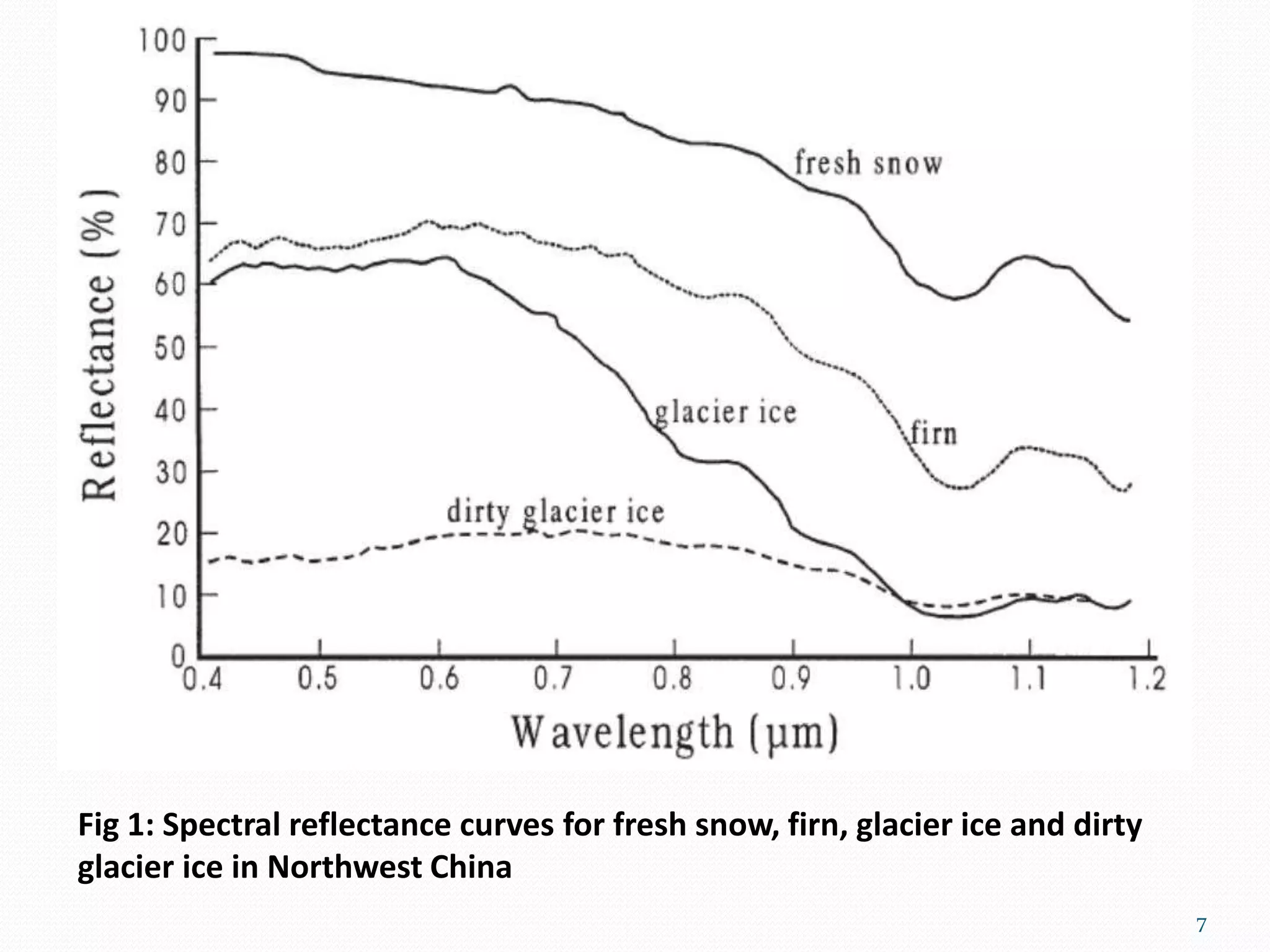
 Spectral reflectance of glacier ice, fresh snow and firn in
the visible and SWIR regions of the spectrum (Fig 1).
 Gradually decreases from 95% to 60% within visible range
while snow is metamorphosed to glacier ice.
6
7
Fig 1: Spectral reflectance curves for fresh snow, firn, glacier ice and dirty
glacier ice in Northwest China
8
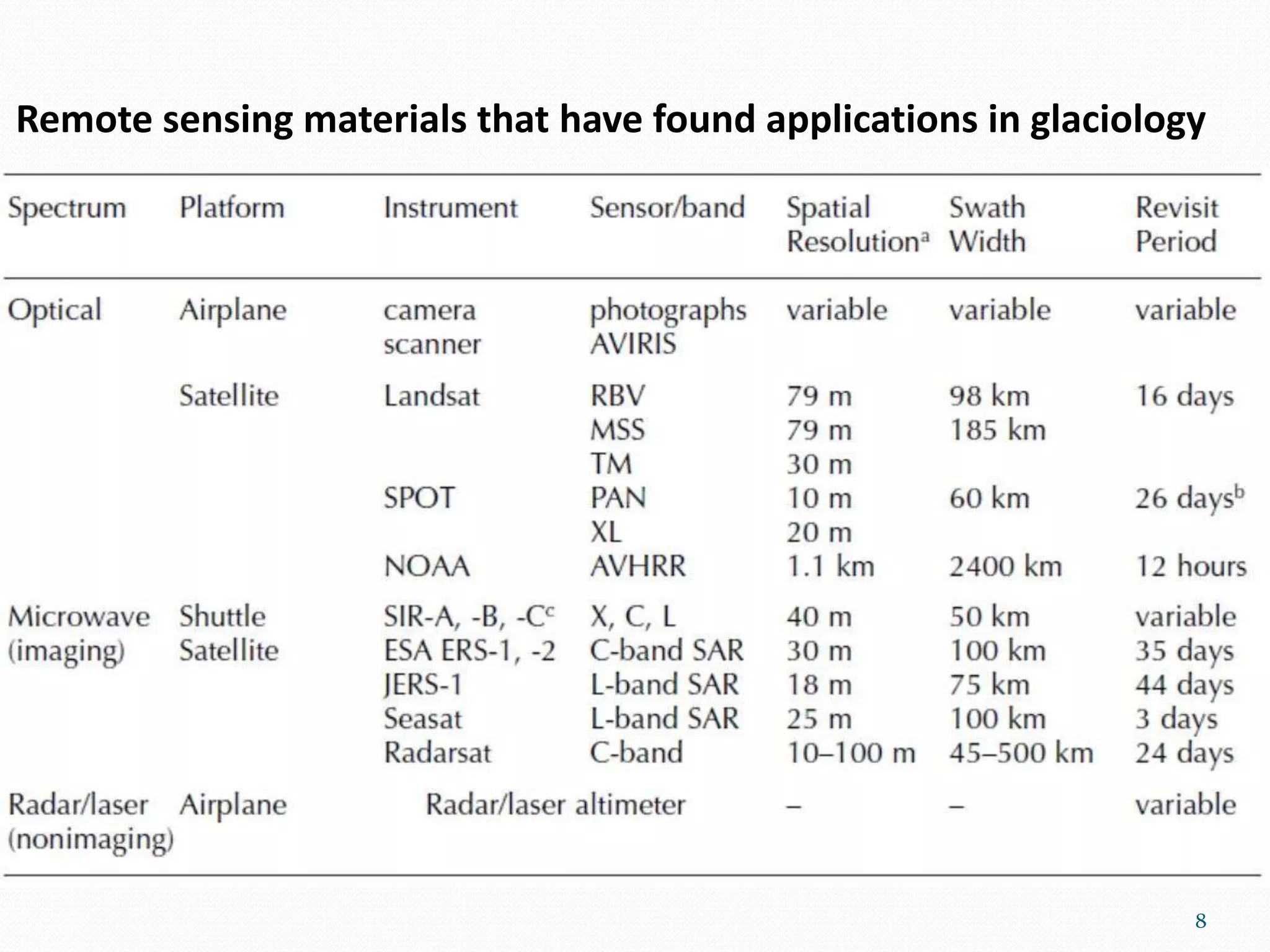
Remote sensing materials that have found applications in glaciology
 VNIR – camera
 Photographs captured by a film mounted in a camera
 Vertical frame aerial photographs have finest spatial resolution
owing to low flight height and long focal lens of aerial cameras.
 Accurate mapping small-scale glaciers interpretion.
 Aerial photographs advantageous in detailed studies
 Delineation of glacier tongues
 Determination of position of glacial termini
 Mapping of snowline
 Detection of spatial fluctuations of glaciers over an area where
satellite imagery is nonexistent.
 Glacier boundaries mapped easily with ptical sensor.
 If taken on repetitive basis, most effective means of
monitoring changes in glaciers
9
VNIR – air-borne scanning
 Sensor mounted in an aeroplane
 Scanner acquire great number of spectral bands of
imagery during one scan.
 An example - Airborne Visible/Infrared Imaging
Spectrometer (AVIRIS) sensor.
 AVIRIS imagery is highly effective at detecting high clouds
over snow- and ice-covered surfaces in the Arctic.
10
VNIR – space-borne scanning
 Record repeatedly over a long period.
 Long-term monitoring of glaciers possible.
 Provides large areal coverage.
 Suitable for mapping glaciers when aerial surveys are
impossible to carry out or where glaciers change rapidly.
 Reveals direction of ice flow that is not possible to detect on
aerial photographs.
 Earth resources satellite imagery such as Landsat and SPOT has
an intermediate spatial resolution on the order of 10 to 79 m.
 Landsat series of satellites with sensors: Return Beam Vidicon
(RBV), Multi-Spectral Scanner (MSS) and Thematic Mapper
(TM).
11
 RBV not widely used in glacier studies.
 Landsat MSS imagery more valuable in glaciology.
 Glacier outlines may be used to update old or inaccurate
maps.
 MSS with 79-m resolution used to identify and classify
glaciers and to detect changes in snow-covered areas.
 MSS too coarse to study small alpine glaciers and identify
glacier boundaries.
12
 TM imagery with 30m spatial resolution and 7 bands
spectral resolution.
 Suitable for snow/cloud discrimination.
 TM images can be used to distinguish between blue ice
and snow.
 Differentiate various types of ice
 In comparison with Landsat data, SPOT imagery has
neither the broad areal coverage nor the high spectral
resolution.
 Consequently, SPOT data have rarely used in glaciology.
13
Microwave remote sensing
 Two broad categories: Imaging and Nonimaging radar.
 Imaging radar: Shuttle Imaging Radar (SIR), European Space
Agency (ESA) ERS-1 and ERS-2, Japanese J-ERS1, Seasat
Synthetic Aperture Radar (SAR) and Canadian Radarsat.
 Spectral bands commonly used in these systems: X, C and L, all
provide glaciological information.
 In particular, X and C bands are used for mapping wet snow
packs.
 SAR data (C-band) can discriminate snow- from nonsnow-
covered areas.
 Together with ERS-1 data, Radarsat imagery monitor retreating
glaciers.
 Nonimaging radar systems such as airborne laser altimeter
(ALA) and radio echo sounding determine ice thickness,
estimate glacier temperature, etc.
14
IDENTIFIABLE GLACIER FEATURES
 Glaciological features successfully studied:
 Mapping of glaciers
 Monitoring of their spatial variations
 Determination of flow velocity
 Estimation of mass balance
 Modelling of snowmelt runoff.
15
Mapping of glaciers
 Glacier inventory provides an estimate of freshwater
storage
 GIS is an efficient tool for analysing current state and
changes in glaciers
Monitoring of spatial variations
 GIS is an efficient tool for analysing current state and
changes in glaciers
16
Determination of glacier velocity
 Compared with sequential satellite images, GPS is more
advantageous.
 On the other hand, GPS is disadvantaged by the problem of
accessibility.
Snow/ice differentiation
 Differentiate various types of ice from Landsat MSS, TM and
SPOT images.
 MSS-5 most useful for depicting snow, firn, clean ice, debris-
covered snow and moraine.
 Microwave RS imagery more capable of differentiating snow
from ice.
 Scree/talus, dry snow, dry snow-covered glacier, wet snow-
covered glacier and rock-covered glacier on the north slope of
Mount Everest can be successfully identified and mapped from
SIR-C images.
17
Snowmelt runoff
 Thickness of polar ice sheets (no liquid water present) can
be determined using conventional air-borne radar.
 Combination of SAR with a co-registered high-resolution
DEM (TOPSAR) provides a promising tool for measuring
glacier change in three dimensions.
18
PROSPECTS OF RS OF GLACIOLOGY
 Launch of NASA’s Earth Observatory Satellites (EOS) Terra
 Enrich availability of quality RS data for studying glaciers from
space.
 Satellite collect data on global scale in 14 spectral bands.
 EOS Terra spacecraft carries a payload of 5 state-of-the-art
sensors
 One of which is Advanced Spaceborne Thermal Emission and
Reflection Radiometer (ASTER).
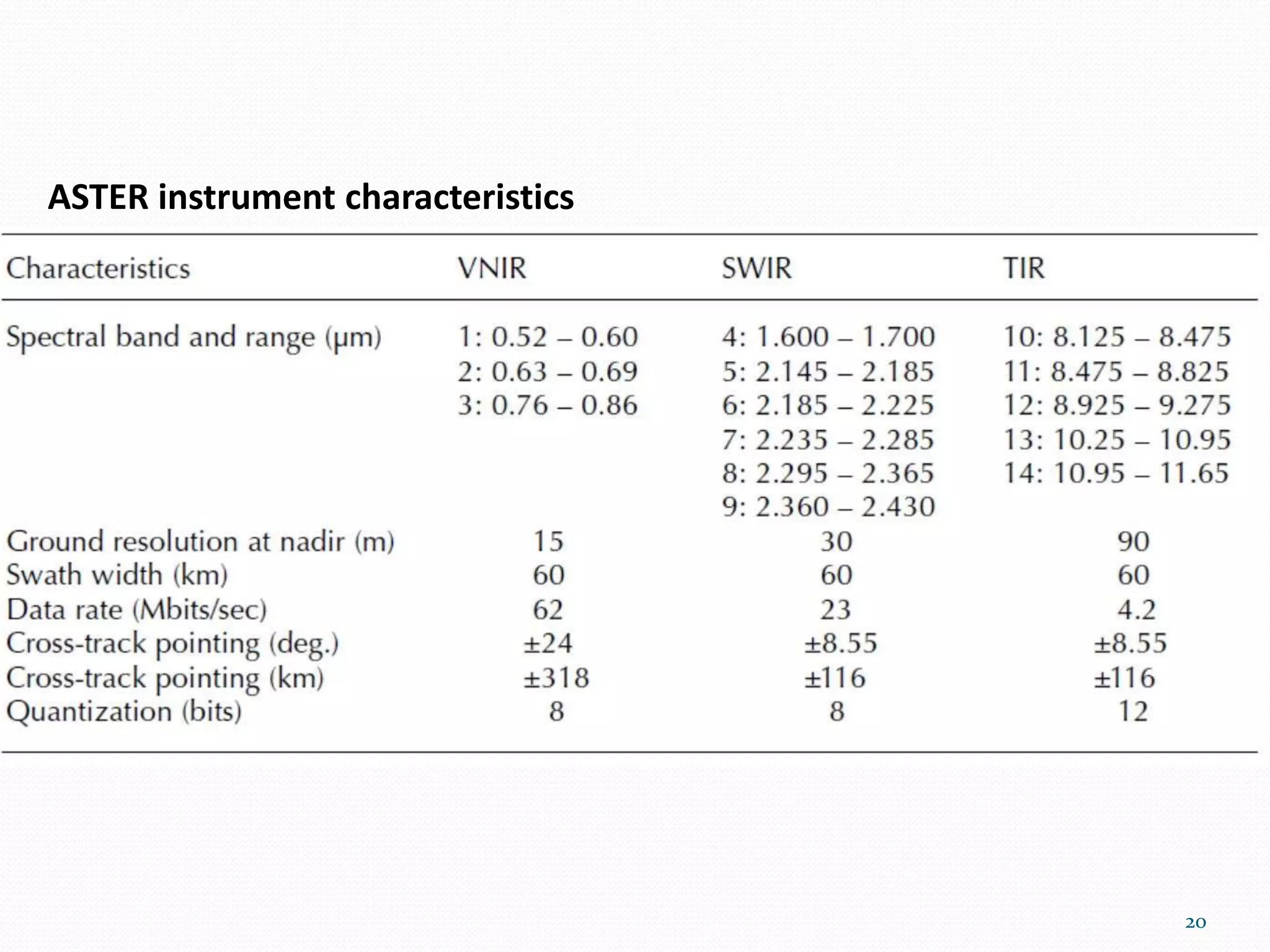
 This sensor collects data at a spatial resolution of 15 m in the
VNIR spectrum.
 Such high spatial resolution and near-global coverage will
enable ASTER to become a vital information source for
monitoring and mapping of the spatial extent, velocity fields
and other parameters of glaciers around the world.
19
20
ASTER instrument characteristics
CONCLUSION
 Aerial photographs used mainly for highly accurate
mapping of glaciers and acquiring detailed glacial
parameters.
 Radar SAR images provide depth information, but are
inadequate for measuring glacier mass balance within a
glacial year alone.
 Integration RS imagery with GIS and GPS make glaciology
more dynamic, analytical, global, exploratory and
predictive.
21
REFERENCES
 Jay Gaoa and Yansui Liub (2001). Applications of remote
sensing, GIS and GPS in glaciology: a review, Progress in
Physical Geography 25,4 (2001) pp. 520–540.
22
THANK YOU
23

Applications of remote sensing in glaciology

  • 2.
    WHAT ARE GLACIERS? Dense ice  Accumulation of snow exceeds its ablation over many years  Form only on land  Change landscapes due to their weight when they flow through  Distinct from thinner sea ice and lake ice that form on the surface of bodies of water  Cover 10% of world’s land  99% of glacial ice contained in the polar regions  Largest reservoir of fresh water on Earth  Store water as ice during the colder seasons  Released as warmer summer temperatures cause them to melt 2
  • 3.
    GLACIOLOGY  Scientific studyof glaciers  Integrates oceanography, geology, climatology, meteorology, etc.  Glacial rivers of ice help regulate Earth’s weather  Relationships between glacial melting and rise in sea levels  Determine how strong or long-lasting the green house effect may come  Impacts on human and environment 3
  • 4.
    APPLICATIONS  Powerful andefficient method of gathering data about glaciers.  Study glaciers usually located in remote, inaccessible and inhospitable environments.  Recent advent of GIS and GPS creates effective means by which the acquired data are analysed for effective monitoring and mapping of temporal dynamics of glaciers.  Traditional visible/infrared remote sensing of 2-D glacier distribution extended to 3-D volume estimation and dynamic monitoring using radar imagery and GPS.  Longitudinal variations in glacial extent detected from multitemporal images in GIS. 4
  • 5.
     Studied fromboth airborne and space-borne platforms.  Sensors mounted on these platforms enable glaciers at various conditions to be captured.  Launch of Landsat in early 1970s aroused tremendous interest in applying RS to various sub-fields in glaciology.  Advent of GIS further facilitates detection of glaciers and evolution of their spatial extent from multi-temporal images.  Speed and accuracy of GPS techniques suitable for repeated glacier mapping. 5
  • 6.
    To detect glacialfeatures  Spectrally discernible from air or space.  Spectral reflectance of glacier ice, fresh snow and firn in the visible and SWIR regions of the spectrum (Fig 1).  Gradually decreases from 95% to 60% within visible range while snow is metamorphosed to glacier ice. 6
  • 7.
    7 Fig 1: Spectralreflectance curves for fresh snow, firn, glacier ice and dirty glacier ice in Northwest China
  • 8.
    8 Remote sensing materialsthat have found applications in glaciology
  • 9.
     VNIR –camera  Photographs captured by a film mounted in a camera  Vertical frame aerial photographs have finest spatial resolution owing to low flight height and long focal lens of aerial cameras.  Accurate mapping small-scale glaciers interpretion.  Aerial photographs advantageous in detailed studies  Delineation of glacier tongues  Determination of position of glacial termini  Mapping of snowline  Detection of spatial fluctuations of glaciers over an area where satellite imagery is nonexistent.  Glacier boundaries mapped easily with ptical sensor.  If taken on repetitive basis, most effective means of monitoring changes in glaciers 9
  • 10.
    VNIR – air-bornescanning  Sensor mounted in an aeroplane  Scanner acquire great number of spectral bands of imagery during one scan.  An example - Airborne Visible/Infrared Imaging Spectrometer (AVIRIS) sensor.  AVIRIS imagery is highly effective at detecting high clouds over snow- and ice-covered surfaces in the Arctic. 10
  • 11.
    VNIR – space-bornescanning  Record repeatedly over a long period.  Long-term monitoring of glaciers possible.  Provides large areal coverage.  Suitable for mapping glaciers when aerial surveys are impossible to carry out or where glaciers change rapidly.  Reveals direction of ice flow that is not possible to detect on aerial photographs.  Earth resources satellite imagery such as Landsat and SPOT has an intermediate spatial resolution on the order of 10 to 79 m.  Landsat series of satellites with sensors: Return Beam Vidicon (RBV), Multi-Spectral Scanner (MSS) and Thematic Mapper (TM). 11
  • 12.
     RBV notwidely used in glacier studies.  Landsat MSS imagery more valuable in glaciology.  Glacier outlines may be used to update old or inaccurate maps.  MSS with 79-m resolution used to identify and classify glaciers and to detect changes in snow-covered areas.  MSS too coarse to study small alpine glaciers and identify glacier boundaries. 12
  • 13.
     TM imagerywith 30m spatial resolution and 7 bands spectral resolution.  Suitable for snow/cloud discrimination.  TM images can be used to distinguish between blue ice and snow.  Differentiate various types of ice  In comparison with Landsat data, SPOT imagery has neither the broad areal coverage nor the high spectral resolution.  Consequently, SPOT data have rarely used in glaciology. 13
  • 14.
    Microwave remote sensing Two broad categories: Imaging and Nonimaging radar.  Imaging radar: Shuttle Imaging Radar (SIR), European Space Agency (ESA) ERS-1 and ERS-2, Japanese J-ERS1, Seasat Synthetic Aperture Radar (SAR) and Canadian Radarsat.  Spectral bands commonly used in these systems: X, C and L, all provide glaciological information.  In particular, X and C bands are used for mapping wet snow packs.  SAR data (C-band) can discriminate snow- from nonsnow- covered areas.  Together with ERS-1 data, Radarsat imagery monitor retreating glaciers.  Nonimaging radar systems such as airborne laser altimeter (ALA) and radio echo sounding determine ice thickness, estimate glacier temperature, etc. 14
  • 15.
    IDENTIFIABLE GLACIER FEATURES Glaciological features successfully studied:  Mapping of glaciers  Monitoring of their spatial variations  Determination of flow velocity  Estimation of mass balance  Modelling of snowmelt runoff. 15
  • 16.
    Mapping of glaciers Glacier inventory provides an estimate of freshwater storage  GIS is an efficient tool for analysing current state and changes in glaciers Monitoring of spatial variations  GIS is an efficient tool for analysing current state and changes in glaciers 16
  • 17.
    Determination of glaciervelocity  Compared with sequential satellite images, GPS is more advantageous.  On the other hand, GPS is disadvantaged by the problem of accessibility. Snow/ice differentiation  Differentiate various types of ice from Landsat MSS, TM and SPOT images.  MSS-5 most useful for depicting snow, firn, clean ice, debris- covered snow and moraine.  Microwave RS imagery more capable of differentiating snow from ice.  Scree/talus, dry snow, dry snow-covered glacier, wet snow- covered glacier and rock-covered glacier on the north slope of Mount Everest can be successfully identified and mapped from SIR-C images. 17
  • 18.
    Snowmelt runoff  Thicknessof polar ice sheets (no liquid water present) can be determined using conventional air-borne radar.  Combination of SAR with a co-registered high-resolution DEM (TOPSAR) provides a promising tool for measuring glacier change in three dimensions. 18
  • 19.
    PROSPECTS OF RSOF GLACIOLOGY  Launch of NASA’s Earth Observatory Satellites (EOS) Terra  Enrich availability of quality RS data for studying glaciers from space.  Satellite collect data on global scale in 14 spectral bands.  EOS Terra spacecraft carries a payload of 5 state-of-the-art sensors  One of which is Advanced Spaceborne Thermal Emission and Reflection Radiometer (ASTER).  This sensor collects data at a spatial resolution of 15 m in the VNIR spectrum.  Such high spatial resolution and near-global coverage will enable ASTER to become a vital information source for monitoring and mapping of the spatial extent, velocity fields and other parameters of glaciers around the world. 19
  • 20.
  • 21.
    CONCLUSION  Aerial photographsused mainly for highly accurate mapping of glaciers and acquiring detailed glacial parameters.  Radar SAR images provide depth information, but are inadequate for measuring glacier mass balance within a glacial year alone.  Integration RS imagery with GIS and GPS make glaciology more dynamic, analytical, global, exploratory and predictive. 21
  • 22.
    REFERENCES  Jay Gaoaand Yansui Liub (2001). Applications of remote sensing, GIS and GPS in glaciology: a review, Progress in Physical Geography 25,4 (2001) pp. 520–540. 22
  • 23.