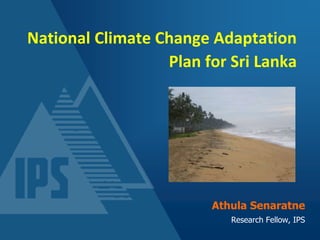
National Climate Change Adaptation
Plan for Sri Lanka
Athula Senaratne
Research Fellow, IPS
Institute of Policy Studies of Sri Lanka
Scope
• NAP Process and Sri Lanka
• An outline of the proposed plan: Purpose, Structure,
Scope and Principles
• Methodological Approach
• Timeline
Institute of Policy Studies of Sri Lanka
NAP Process and Sri Lanka
Institute of Policy Studies of Sri Lanka
NAP process
• UNFCC Guideline
– Identifies NAP as a process to develop the capacity and
knowledge to support decision-making
• Key steps of the process
– Laying the groundwork and identification of gaps: Pre-
planning stage
– Making preparatory activities: Planning stage
– Implementation: Post-planning stage
– Reporting, monitoring and reviewing: Post-planning
activities
• A generalized approach
– Can be customized to specific situation in different
countries
Institute of Policy Studies of Sri Lanka
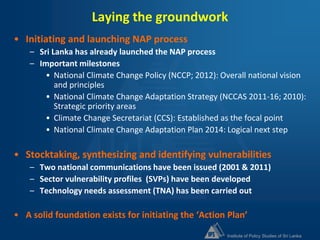
Laying the groundwork
• Initiating and launching NAP process
– Sri Lanka has already launched the NAP process
– Important milestones
• National Climate Change Policy (NCCP; 2012): Overall national vision
and principles
• National Climate Change Adaptation Strategy (NCCAS 2011-16; 2010):
Strategic priority areas
• Climate Change Secretariat (CCS): Established as the focal point
• National Climate Change Adaptation Plan 2014: Logical next step
• Stocktaking, synthesizing and identifying vulnerabilities
– Two national communications have been issued (2001 & 2011)
– Sector vulnerability profiles (SVPs) have been developed
– Technology needs assessment (TNA) has been carried out
• A solid foundation exists for initiating the ‘Action Plan’
Institute of Policy Studies of Sri Lanka
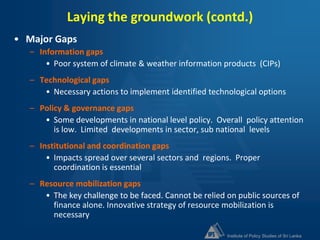
Laying the groundwork (contd.)
• Major Gaps
– Information gaps
• Poor system of climate & weather information products (CIPs)
– Technological gaps
• Necessary actions to implement identified technological options
– Policy & governance gaps
• Some developments in national level policy. Overall policy attention
is low. Limited developments in sector, sub national levels
– Institutional and coordination gaps
• Impacts spread over several sectors and regions. Proper
coordination is essential
– Resource mobilization gaps
• The key challenge to be faced. Cannot be relied on public sources of
finance alone. Innovative strategy of resource mobilization is
necessary
Institute of Policy Studies of Sri Lanka
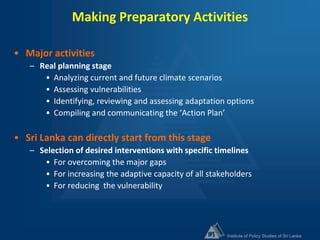
Making Preparatory Activities
• Major activities
– Real planning stage
• Analyzing current and future climate scenarios
• Assessing vulnerabilities
• Identifying, reviewing and assessing adaptation options
• Compiling and communicating the ‘Action Plan’
• Sri Lanka can directly start from this stage
– Selection of desired interventions with specific timelines
• For overcoming the major gaps
• For increasing the adaptive capacity of all stakeholders
• For reducing the vulnerability
Institute of Policy Studies of Sri Lanka
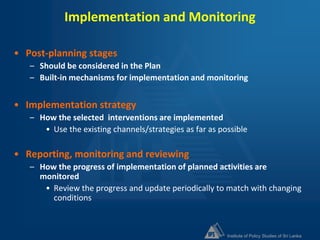
Implementation and Monitoring
• Post-planning stages
– Should be considered in the Plan
– Built-in mechanisms for implementation and monitoring
• Implementation strategy
– How the selected interventions are implemented
• Use the existing channels/strategies as far as possible
• Reporting, monitoring and reviewing
– How the progress of implementation of planned activities are
monitored
• Review the progress and update periodically to match with changing
conditions
Institute of Policy Studies of Sri Lanka
Objectives of the NAP Process
• Identify suitable interventions (adaptation options) that can enhance
adaptive capacity and reduce vulnerability of stakeholders at all levels
• Develop a realistic plan of action with specific timelines and
responsible stakeholders to implement the identified interventions
• Identify suitable implementation strategies to carry out planned
activities by relevant stakeholders (e.g. sectoral, provincial)
• Establish an appropriate institutional mechanism for coordination of
decisions taken at different levels and actions carried out by various
stakeholders
• Devise an effective mechanism for monitoring and reviewing the
progress of implementation and adaptive updating of the plan
Institute of Policy Studies of Sri Lanka
An Outline: Purpose, Structure,
Scope & Principles
Institute of Policy Studies of Sri Lanka
Role and Function
• A rolling plan
• Revised periodically according to changing conditions
• Consisted of a selection of practical interventions
• Identified by relevant stakeholders : Consultative approach
• Useful for overcoming major gaps in efficient manner
• Guided by principles of NCCP
• Consistent with NCCAAS 2011-16 as far as possible
• Provides an outline of priorities
Institute of Policy Studies of Sri Lanka
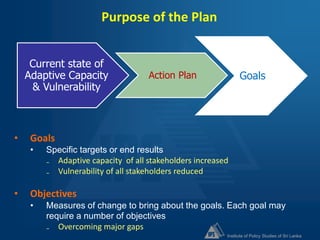
Purpose of the Plan
Current state of
Adaptive Capacity
& Vulnerability
Action Plan Goals
• Goals
• Specific targets or end results
₋ Adaptive capacity of all stakeholders increased
₋ Vulnerability of all stakeholders reduced
• Objectives
• Measures of change to bring about the goals. Each goal may
require a number of objectives
₋ Overcoming major gaps
Institute of Policy Studies of Sri Lanka
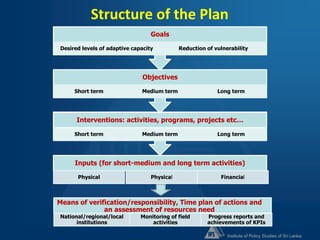
Structure of the Plan
Inputs (for short-medium and long term activities)
Activities/Interventions
Short term Medium term Long term
Objectives
Short term Medium term Long term
Goals
Desired levels of adaptive capacity Reduction of vulnerability
Physical
Progress reports and
achievements of KPIs
Financial
Interventions: activities, programs, projects etc…
Means of verification/responsibility, Time plan of actions and
an assessment of resources need
National/regional/local
institutions
Monitoring of field
activities
Physical
Institute of Policy Studies of Sri Lanka
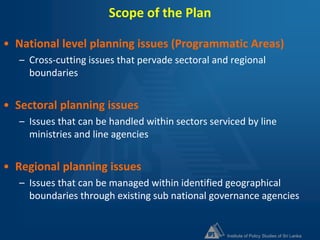
Scope of the Plan
• National level planning issues (Programmatic Areas)
– Cross-cutting issues that pervade sectoral and regional
boundaries
• Sectoral planning issues
– Issues that can be handled within sectors serviced by line
ministries and line agencies
• Regional planning issues
– Issues that can be managed within identified geographical
boundaries through existing sub national governance agencies
Institute of Policy Studies of Sri Lanka
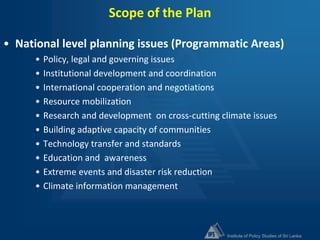
Scope of the Plan
• National level planning issues (Programmatic Areas)
• Policy, legal and governing issues
• Institutional development and coordination
• International cooperation and negotiations
• Resource mobilization
• Research and development on cross-cutting climate issues
• Building adaptive capacity of communities
• Technology transfer and standards
• Education and awareness
• Extreme events and disaster risk reduction
• Climate information management
Institute of Policy Studies of Sri Lanka
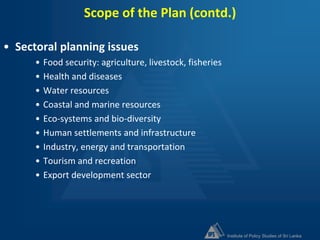
Scope of the Plan (contd.)
• Sectoral planning issues
• Food security: agriculture, livestock, fisheries
• Health and diseases
• Water resources
• Coastal and marine resources
• Eco-systems and bio-diversity
• Human settlements and infrastructure
• Industry, energy and transportation
• Tourism and recreation
• Export development sector
Institute of Policy Studies of Sri Lanka
Scope of the Plan (contd.)
• Regional planning issues
• Provincial
• District
• Local government authorities
Institute of Policy Studies of Sri Lanka
Principles and Approaches
Mainstreaming:
– Comprehensive
– Informed
– Prioritized
– Regularly attended
– Ensured of sufficient resources
– Coordinated
• In practice, ‘mainstreaming’ implies incorporating the decision-
making, implementation and monitoring through established
mechanisms as far as possible
Integrated:
• Take all interrelated issues together when selecting interventions so
that effective, inclusive and efficient outcomes are ensured
Institute of Policy Studies of Sri Lanka
Principles and Approaches (contd.)
Adaptive
• Future is uncertain yet actions cannot be delayed awaiting more
information before it is too late
• Adaptive decision-making
– Interventions should be robust and resilient to a wide range of scenarios
as far possible
– Decision-making should be flexible to make adjustments according to
emerging information
Anticipatory
• Adaptation could be anticipatory and reactive
• Reactive responses could be costly
• Interventions of the plan should take the anticipatory approach
Institute of Policy Studies of Sri Lanka
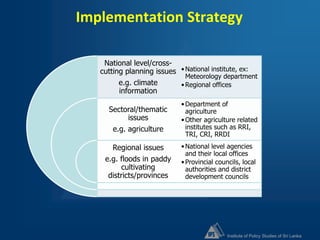
Implementation Strategy
National level/cross-
cutting planning issues
e.g. climate
information
Sectoral/thematic
issues
e.g. agriculture
Regional issues
e.g. floods in paddy
cultivating
districts/provinces
•National institute, ex:
Meteorology department
•Regional offices
•Department of
agriculture
•Other agriculture related
institutes such as RRI,
TRI, CRI, RRDI
•National level agencies
and their local offices
•Provincial councils, local
authorities and district
development councils
Institute of Policy Studies of Sri Lanka
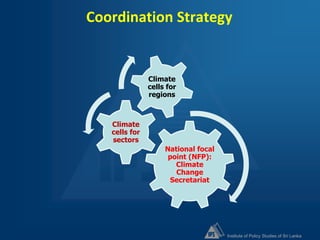
Coordination Strategy
National focal
point (NFP):
Climate
Change
Secretariat
Climate
cells for
sectors
Climate
cells for
regions
Institute of Policy Studies of Sri Lanka
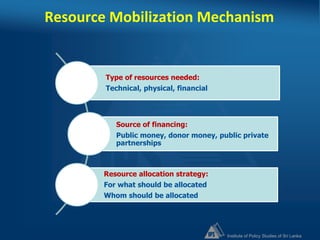
Resource Mobilization Mechanism
Type of resources needed:
Technical, physical, financial
Source of financing:
Public money, donor money, public private
partnerships
Resource allocation strategy:
For what should be allocated
Whom should be allocated
Institute of Policy Studies of Sri Lanka
Methodological Approach
Institute of Policy Studies of Sri Lanka
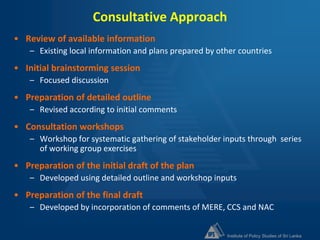
Consultative Approach
• Review of available information
– Existing local information and plans prepared by other countries
• Initial brainstorming session
– Focused discussion
• Preparation of detailed outline
– Revised according to initial comments
• Consultation workshops
– Workshop for systematic gathering of stakeholder inputs through series
of working group exercises
• Preparation of the initial draft of the plan
– Developed using detailed outline and workshop inputs
• Preparation of the final draft
– Developed by incorporation of comments of MERE, CCS and NAC
Institute of Policy Studies of Sri Lanka
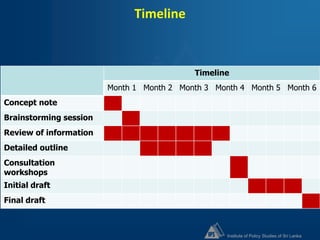
Timeline
Timeline
Month 1 Month 2 Month 3 Month 4 Month 5 Month 6
Concept note
Brainstorming session
Review of information
Detailed outline
Consultation
workshops
Initial draft
Final draft
Institute of Policy Studies of Sri Lanka
Thank You
www.ips.lk

National Climate Change Adaptation Plan for Sri Lanka

  • 1.
    National Climate ChangeAdaptation Plan for Sri Lanka Athula Senaratne Research Fellow, IPS
  • 2.
    Institute of PolicyStudies of Sri Lanka Scope • NAP Process and Sri Lanka • An outline of the proposed plan: Purpose, Structure, Scope and Principles • Methodological Approach • Timeline
  • 3.
    Institute of PolicyStudies of Sri Lanka NAP Process and Sri Lanka
  • 4.
    Institute of PolicyStudies of Sri Lanka NAP process • UNFCC Guideline – Identifies NAP as a process to develop the capacity and knowledge to support decision-making • Key steps of the process – Laying the groundwork and identification of gaps: Pre- planning stage – Making preparatory activities: Planning stage – Implementation: Post-planning stage – Reporting, monitoring and reviewing: Post-planning activities • A generalized approach – Can be customized to specific situation in different countries
  • 5.
    Institute of PolicyStudies of Sri Lanka Laying the groundwork • Initiating and launching NAP process – Sri Lanka has already launched the NAP process – Important milestones • National Climate Change Policy (NCCP; 2012): Overall national vision and principles • National Climate Change Adaptation Strategy (NCCAS 2011-16; 2010): Strategic priority areas • Climate Change Secretariat (CCS): Established as the focal point • National Climate Change Adaptation Plan 2014: Logical next step • Stocktaking, synthesizing and identifying vulnerabilities – Two national communications have been issued (2001 & 2011) – Sector vulnerability profiles (SVPs) have been developed – Technology needs assessment (TNA) has been carried out • A solid foundation exists for initiating the ‘Action Plan’
  • 6.
    Institute of PolicyStudies of Sri Lanka Laying the groundwork (contd.) • Major Gaps – Information gaps • Poor system of climate & weather information products (CIPs) – Technological gaps • Necessary actions to implement identified technological options – Policy & governance gaps • Some developments in national level policy. Overall policy attention is low. Limited developments in sector, sub national levels – Institutional and coordination gaps • Impacts spread over several sectors and regions. Proper coordination is essential – Resource mobilization gaps • The key challenge to be faced. Cannot be relied on public sources of finance alone. Innovative strategy of resource mobilization is necessary
  • 7.
    Institute of PolicyStudies of Sri Lanka Making Preparatory Activities • Major activities – Real planning stage • Analyzing current and future climate scenarios • Assessing vulnerabilities • Identifying, reviewing and assessing adaptation options • Compiling and communicating the ‘Action Plan’ • Sri Lanka can directly start from this stage – Selection of desired interventions with specific timelines • For overcoming the major gaps • For increasing the adaptive capacity of all stakeholders • For reducing the vulnerability
  • 8.
    Institute of PolicyStudies of Sri Lanka Implementation and Monitoring • Post-planning stages – Should be considered in the Plan – Built-in mechanisms for implementation and monitoring • Implementation strategy – How the selected interventions are implemented • Use the existing channels/strategies as far as possible • Reporting, monitoring and reviewing – How the progress of implementation of planned activities are monitored • Review the progress and update periodically to match with changing conditions
  • 9.
    Institute of PolicyStudies of Sri Lanka Objectives of the NAP Process • Identify suitable interventions (adaptation options) that can enhance adaptive capacity and reduce vulnerability of stakeholders at all levels • Develop a realistic plan of action with specific timelines and responsible stakeholders to implement the identified interventions • Identify suitable implementation strategies to carry out planned activities by relevant stakeholders (e.g. sectoral, provincial) • Establish an appropriate institutional mechanism for coordination of decisions taken at different levels and actions carried out by various stakeholders • Devise an effective mechanism for monitoring and reviewing the progress of implementation and adaptive updating of the plan
  • 10.
    Institute of PolicyStudies of Sri Lanka An Outline: Purpose, Structure, Scope & Principles
  • 11.
    Institute of PolicyStudies of Sri Lanka Role and Function • A rolling plan • Revised periodically according to changing conditions • Consisted of a selection of practical interventions • Identified by relevant stakeholders : Consultative approach • Useful for overcoming major gaps in efficient manner • Guided by principles of NCCP • Consistent with NCCAAS 2011-16 as far as possible • Provides an outline of priorities
  • 12.
    Institute of PolicyStudies of Sri Lanka Purpose of the Plan Current state of Adaptive Capacity & Vulnerability Action Plan Goals • Goals • Specific targets or end results ₋ Adaptive capacity of all stakeholders increased ₋ Vulnerability of all stakeholders reduced • Objectives • Measures of change to bring about the goals. Each goal may require a number of objectives ₋ Overcoming major gaps
  • 13.
    Institute of PolicyStudies of Sri Lanka Structure of the Plan Inputs (for short-medium and long term activities) Activities/Interventions Short term Medium term Long term Objectives Short term Medium term Long term Goals Desired levels of adaptive capacity Reduction of vulnerability Physical Progress reports and achievements of KPIs Financial Interventions: activities, programs, projects etc… Means of verification/responsibility, Time plan of actions and an assessment of resources need National/regional/local institutions Monitoring of field activities Physical
  • 14.
    Institute of PolicyStudies of Sri Lanka Scope of the Plan • National level planning issues (Programmatic Areas) – Cross-cutting issues that pervade sectoral and regional boundaries • Sectoral planning issues – Issues that can be handled within sectors serviced by line ministries and line agencies • Regional planning issues – Issues that can be managed within identified geographical boundaries through existing sub national governance agencies
  • 15.
    Institute of PolicyStudies of Sri Lanka Scope of the Plan • National level planning issues (Programmatic Areas) • Policy, legal and governing issues • Institutional development and coordination • International cooperation and negotiations • Resource mobilization • Research and development on cross-cutting climate issues • Building adaptive capacity of communities • Technology transfer and standards • Education and awareness • Extreme events and disaster risk reduction • Climate information management
  • 16.
    Institute of PolicyStudies of Sri Lanka Scope of the Plan (contd.) • Sectoral planning issues • Food security: agriculture, livestock, fisheries • Health and diseases • Water resources • Coastal and marine resources • Eco-systems and bio-diversity • Human settlements and infrastructure • Industry, energy and transportation • Tourism and recreation • Export development sector
  • 17.
    Institute of PolicyStudies of Sri Lanka Scope of the Plan (contd.) • Regional planning issues • Provincial • District • Local government authorities
  • 18.
    Institute of PolicyStudies of Sri Lanka Principles and Approaches Mainstreaming: – Comprehensive – Informed – Prioritized – Regularly attended – Ensured of sufficient resources – Coordinated • In practice, ‘mainstreaming’ implies incorporating the decision- making, implementation and monitoring through established mechanisms as far as possible Integrated: • Take all interrelated issues together when selecting interventions so that effective, inclusive and efficient outcomes are ensured
  • 19.
    Institute of PolicyStudies of Sri Lanka Principles and Approaches (contd.) Adaptive • Future is uncertain yet actions cannot be delayed awaiting more information before it is too late • Adaptive decision-making – Interventions should be robust and resilient to a wide range of scenarios as far possible – Decision-making should be flexible to make adjustments according to emerging information Anticipatory • Adaptation could be anticipatory and reactive • Reactive responses could be costly • Interventions of the plan should take the anticipatory approach
  • 20.
    Institute of PolicyStudies of Sri Lanka Implementation Strategy National level/cross- cutting planning issues e.g. climate information Sectoral/thematic issues e.g. agriculture Regional issues e.g. floods in paddy cultivating districts/provinces •National institute, ex: Meteorology department •Regional offices •Department of agriculture •Other agriculture related institutes such as RRI, TRI, CRI, RRDI •National level agencies and their local offices •Provincial councils, local authorities and district development councils
  • 21.
    Institute of PolicyStudies of Sri Lanka Coordination Strategy National focal point (NFP): Climate Change Secretariat Climate cells for sectors Climate cells for regions
  • 22.
    Institute of PolicyStudies of Sri Lanka Resource Mobilization Mechanism Type of resources needed: Technical, physical, financial Source of financing: Public money, donor money, public private partnerships Resource allocation strategy: For what should be allocated Whom should be allocated
  • 23.
    Institute of PolicyStudies of Sri Lanka Methodological Approach
  • 24.
    Institute of PolicyStudies of Sri Lanka Consultative Approach • Review of available information – Existing local information and plans prepared by other countries • Initial brainstorming session – Focused discussion • Preparation of detailed outline – Revised according to initial comments • Consultation workshops – Workshop for systematic gathering of stakeholder inputs through series of working group exercises • Preparation of the initial draft of the plan – Developed using detailed outline and workshop inputs • Preparation of the final draft – Developed by incorporation of comments of MERE, CCS and NAC
  • 25.
    Institute of PolicyStudies of Sri Lanka Timeline Timeline Month 1 Month 2 Month 3 Month 4 Month 5 Month 6 Concept note Brainstorming session Review of information Detailed outline Consultation workshops Initial draft Final draft
  • 26.
    Institute of PolicyStudies of Sri Lanka Thank You www.ips.lk