SILICONE HYDROGEL
CONTACT LENSES
Optom Muhammed Shareef EK
Bejan Singh Eye Hospital
What is silicone hydrogel CL..??
• Soft contact lenses were made possible in the 1960s
and 1970s These were called "hydrophilic gels" or
simply "hydrogels.
• Silicone Hydrogel contact lenses are literally a breath
of fresh air for eye care patients. Brought onto the
market in 1999,
• Silicone hydrogels are the latest in a line of
developments aimed at increasing the oxygen
permeability (increased comfort, longer wear and
better eye health), wettability (better comfort)
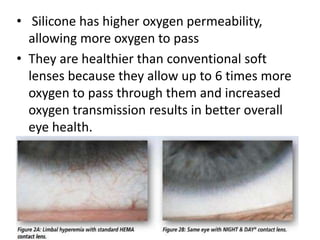
• Silicone has higher oxygen permeability,
allowing more oxygen to pass
• They are healthier than conventional soft
lenses because they allow up to 6 times more
oxygen to pass through them and increased
oxygen transmission results in better overall
eye health.
Characteristics of Silicone Hydrogel
Lenses
1. Modulus
2. Oxygen Permeability
3. Wettability
Modulus
• When we speak about the characteristics of silicone
hydrogel materials, the term, “modulus” is often used.
• It describeshow well a material resists deformation.
• Most silicone hydrogel lenses have a relatively high
modulus compared with hydrogels.
• The ease-of-handling and excellent durability imparted
by the higher modulus of silicone hydrogels make them
a good choice for patients who have had difficulty
inserting hydrogels.
•
Oxygen Permeability
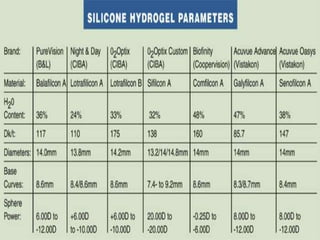
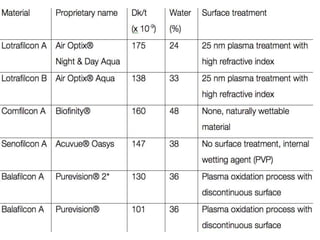
• Hydrogels have a maximum Dk value under 40
• Current silicone hydrogels range from 60 (Dk/t
86) for Vistakon’s ACUVUE® ADVANCE™ to 140
(Dk/t 175) for CIBA Vision’s NIGHT & DAY®.
• All current silicone hydrogel lenses except the
ACUVUE® ADVANCE™ have Dk/t values of at least
100 and are FDA-approved for extended wear.
The ACUVUE® ADVANCE™ lens, with a Dk/t value
of 86, is approved for daily wear only
• Clinical signs of oxygen deficiency with
hydrogel materials include
1. conjunctival injection
2. Limbal redness
3. Neovascularization
4. Corneal edema
Etc….
Types of Silicone Hydrogel Contact
Lenses
• There are three types of silicone hydrogel
lenses available. They are spherical, toric, and
bifocal.
• Patients can choose from daily disposals, six-
day extended wear, two-week daily wear, or
thirty-day continuous and daily wear lenses.
Materials
• These come with technical names such
as
1. Galyfilcon
2. Senofilcon
3. Comfilcon
4. Enfilcon
5. Lotrafilcon
• Silicone hydrogel contact lenses sometimes are
erroneously called silicon hydrogel lenses.
• Silicon is a very common mineral. In fact, ordinary
sand is composed primarily of silicon dioxide.
• Silicone is the name of a group of flexible, plastic-
like materials that contain silicon, carbon, oxygen
and other chemicals.
• In addition to its use to increase the oxygen
permeability of contact lenses, silicone is used to
make breast implants, medical tubing and other
medical devices
Advantages of silicone hydrogel CL..
• More resistance to protein deposits
• Less drying of the lenses
• Lower risk of eye infection
• Easier handling due to increased rigidity of
material
• And much lower incidence of complications
with extended wear use (overnight wear)
Indications
• People who wear their lenses for more than
12 to 14 hours a day.
• Kids and teenagers who tend to routinely over
wear their lenses.
• Since the Focus Night & Day as well as the
PureVision lenses are approved for 30 days of
continuous wear, they can be considered as a
useful alternative for people contemplating
refractive surgery.
• Especially useful in the following types of
patients: people with high prescriptions
• Those whose eyes show signs that they
require more oxygen
• Wearers who experience end of day
discomfort
• Dryness
• Redness with their conventional soft lenses
• All contact lenses reduce the amount of oxygen that
reaches the front surface of the eye to some degree.
• When the cornea's oxygen supply is significantly
reduced — a condition calledhypoxia
• Hypoxia-related eye problems became a significant
issue in the 1990s when extended wear contact
lenses first gained popularity.
• Silicone hydrogel lenses were introduced in hopes of
decreasing hypoxia-related problems and increasing
the safety of both daily wear and extended wear of soft
contact lenses.
Brands..
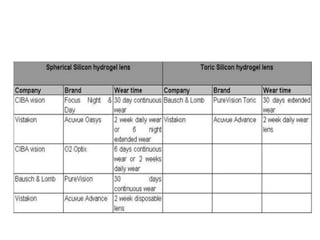
• The current brands of spherical silicone
hydrogel lenses available, in order of highest
oxygen transmissibility to lowest, are:
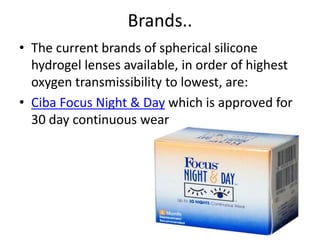
• Ciba Focus Night & Day which is approved for
30 day continuous wear
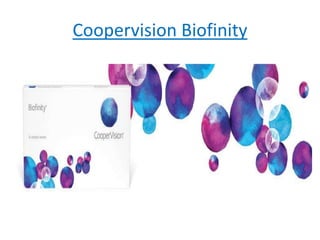
Coopervision Biofinity
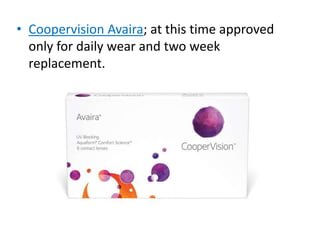
• Coopervision Avaira; at this time approved
only for daily wear and two week
replacement.
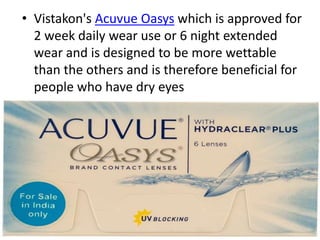
• Vistakon's Acuvue Oasys which is approved for
2 week daily wear use or 6 night extended
wear and is designed to be more wettable
than the others and is therefore beneficial for
people who have dry eyes
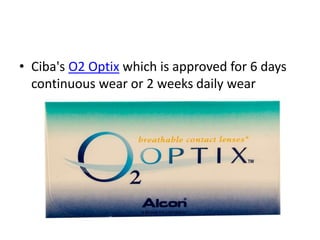
• Ciba's O2 Optix which is approved for 6 days
continuous wear or 2 weeks daily wear
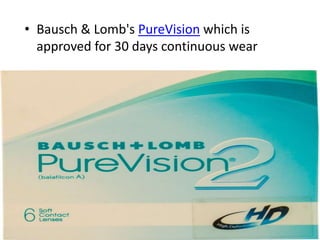
• Bausch & Lomb's PureVision which is
approved for 30 days continuous wear
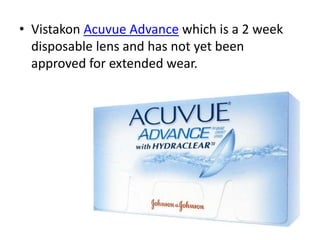
• Vistakon Acuvue Advance which is a 2 week
disposable lens and has not yet been
approved for extended wear.
Toric SH CL
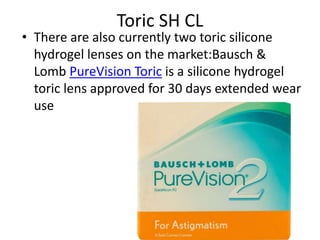
• There are also currently two toric silicone
hydrogel lenses on the market:Bausch &
Lomb PureVision Toric is a silicone hydrogel
toric lens approved for 30 days extended wear
use
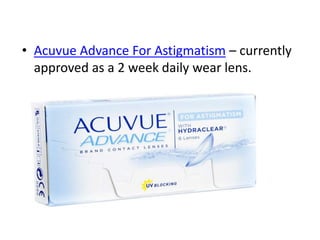
• Acuvue Advance For Astigmatism – currently
approved as a 2 week daily wear lens.
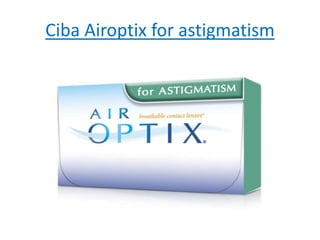
Ciba Airoptix for astigmatism
Contra indication..??
Contra indication
• Silicone hydrogels may not be the lens of
choice for all patients
• These lenses are generally more expensive
than non-silicone lenses
• So a more price conscious consumer may not
prefer this option.
• In some wearers, the silicone material tends
to attract more lipid deposits, which may
cause blurred vision and discomfort
• There are some cases where a patient is not
able to adapt well to the more rigid silicone
material, which may result in some minor
defects to the corneal integrity.
• These complications are rare and generally the
health advantages and increased comfort that
most wearers experience.
Thank You…!!

Silicone Hydrogel contact lens

  • 1.
    SILICONE HYDROGEL CONTACT LENSES OptomMuhammed Shareef EK Bejan Singh Eye Hospital
  • 2.
    What is siliconehydrogel CL..?? • Soft contact lenses were made possible in the 1960s and 1970s These were called "hydrophilic gels" or simply "hydrogels. • Silicone Hydrogel contact lenses are literally a breath of fresh air for eye care patients. Brought onto the market in 1999, • Silicone hydrogels are the latest in a line of developments aimed at increasing the oxygen permeability (increased comfort, longer wear and better eye health), wettability (better comfort)
  • 3.
    • Silicone hashigher oxygen permeability, allowing more oxygen to pass • They are healthier than conventional soft lenses because they allow up to 6 times more oxygen to pass through them and increased oxygen transmission results in better overall eye health.
  • 4.
    Characteristics of SiliconeHydrogel Lenses 1. Modulus 2. Oxygen Permeability 3. Wettability
  • 5.
    Modulus • When wespeak about the characteristics of silicone hydrogel materials, the term, “modulus” is often used. • It describeshow well a material resists deformation. • Most silicone hydrogel lenses have a relatively high modulus compared with hydrogels. • The ease-of-handling and excellent durability imparted by the higher modulus of silicone hydrogels make them a good choice for patients who have had difficulty inserting hydrogels. •
  • 6.
    Oxygen Permeability • Hydrogelshave a maximum Dk value under 40 • Current silicone hydrogels range from 60 (Dk/t 86) for Vistakon’s ACUVUE® ADVANCE™ to 140 (Dk/t 175) for CIBA Vision’s NIGHT & DAY®. • All current silicone hydrogel lenses except the ACUVUE® ADVANCE™ have Dk/t values of at least 100 and are FDA-approved for extended wear. The ACUVUE® ADVANCE™ lens, with a Dk/t value of 86, is approved for daily wear only
  • 7.
    • Clinical signsof oxygen deficiency with hydrogel materials include 1. conjunctival injection 2. Limbal redness 3. Neovascularization 4. Corneal edema Etc….
  • 8.
    Types of SiliconeHydrogel Contact Lenses • There are three types of silicone hydrogel lenses available. They are spherical, toric, and bifocal. • Patients can choose from daily disposals, six- day extended wear, two-week daily wear, or thirty-day continuous and daily wear lenses.
  • 9.
    Materials • These comewith technical names such as 1. Galyfilcon 2. Senofilcon 3. Comfilcon 4. Enfilcon 5. Lotrafilcon
  • 10.
    • Silicone hydrogelcontact lenses sometimes are erroneously called silicon hydrogel lenses. • Silicon is a very common mineral. In fact, ordinary sand is composed primarily of silicon dioxide. • Silicone is the name of a group of flexible, plastic- like materials that contain silicon, carbon, oxygen and other chemicals. • In addition to its use to increase the oxygen permeability of contact lenses, silicone is used to make breast implants, medical tubing and other medical devices
  • 11.
    Advantages of siliconehydrogel CL.. • More resistance to protein deposits • Less drying of the lenses • Lower risk of eye infection • Easier handling due to increased rigidity of material • And much lower incidence of complications with extended wear use (overnight wear)
  • 12.
    Indications • People whowear their lenses for more than 12 to 14 hours a day. • Kids and teenagers who tend to routinely over wear their lenses. • Since the Focus Night & Day as well as the PureVision lenses are approved for 30 days of continuous wear, they can be considered as a useful alternative for people contemplating refractive surgery.
  • 13.
    • Especially usefulin the following types of patients: people with high prescriptions • Those whose eyes show signs that they require more oxygen • Wearers who experience end of day discomfort • Dryness • Redness with their conventional soft lenses
  • 14.
    • All contactlenses reduce the amount of oxygen that reaches the front surface of the eye to some degree. • When the cornea's oxygen supply is significantly reduced — a condition calledhypoxia • Hypoxia-related eye problems became a significant issue in the 1990s when extended wear contact lenses first gained popularity. • Silicone hydrogel lenses were introduced in hopes of decreasing hypoxia-related problems and increasing the safety of both daily wear and extended wear of soft contact lenses.
  • 15.
    Brands.. • The currentbrands of spherical silicone hydrogel lenses available, in order of highest oxygen transmissibility to lowest, are: • Ciba Focus Night & Day which is approved for 30 day continuous wear
  • 16.
  • 17.
    • Coopervision Avaira;at this time approved only for daily wear and two week replacement.
  • 18.
    • Vistakon's AcuvueOasys which is approved for 2 week daily wear use or 6 night extended wear and is designed to be more wettable than the others and is therefore beneficial for people who have dry eyes
  • 19.
    • Ciba's O2Optix which is approved for 6 days continuous wear or 2 weeks daily wear
  • 20.
    • Bausch &Lomb's PureVision which is approved for 30 days continuous wear
  • 21.
    • Vistakon AcuvueAdvance which is a 2 week disposable lens and has not yet been approved for extended wear.
  • 22.
    Toric SH CL •There are also currently two toric silicone hydrogel lenses on the market:Bausch & Lomb PureVision Toric is a silicone hydrogel toric lens approved for 30 days extended wear use
  • 23.
    • Acuvue AdvanceFor Astigmatism – currently approved as a 2 week daily wear lens.
  • 24.
    Ciba Airoptix forastigmatism
  • 28.
  • 29.
    Contra indication • Siliconehydrogels may not be the lens of choice for all patients • These lenses are generally more expensive than non-silicone lenses • So a more price conscious consumer may not prefer this option. • In some wearers, the silicone material tends to attract more lipid deposits, which may cause blurred vision and discomfort
  • 30.
    • There aresome cases where a patient is not able to adapt well to the more rigid silicone material, which may result in some minor defects to the corneal integrity. • These complications are rare and generally the health advantages and increased comfort that most wearers experience.
  • 31.