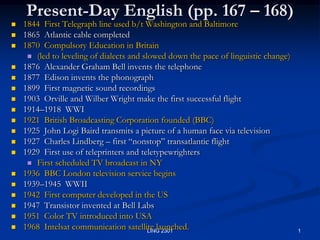
1LING 2301Present-Day English (pp. 167 – 168)1844  First Telegraph line used b/t Washington and Baltimore1865  Atlantic cable completed1870  Compulsory Education in Britain (led to leveling of dialects and slowed down the pace of linguistic change)1876  Alexander Graham Bell invents the telephone1877  Edison invents the phonograph1899  First magnetic sound recordings1903  Orville and Wilber Wright make the first successful flight 1914–1918  WWI1921  British Broadcasting Corporation founded (BBC)1925  John Logi Baird transmits a picture of a human face via television1927  Charles Lindberg – first “nonstop” transatlantic flight 1929  First use of teleprinters and teletypewrightersFirst scheduled TV broadcast in NY1936  BBC London television service begins1939–1945  WWII1942  First computer developed in the US1947  Transistor invented at Bell Labs1951  Color TV introduced into USA1968  Intelsat communication satellite launched.
2LING 2301PDE varies very little from EME.Remnants of the previous case system are limited to the pronouns (I, me, he, him, she, 	her…  the shift from whom to who is currently underway as in "To whom did you send the letter?" vs. "To who did you send the letter")	Currently uses more comparatives and superlatives than inflectional ones (for instance 	shift to more & most over –er & –est) or even double forms the most coolest… .
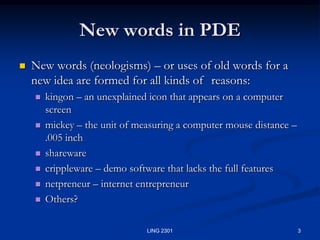
3LING 2301New words in PDENew words (neologisms) – or uses of old words for a new idea are formed for all kinds of 	reasons:kingon – an unexplained icon that appears on a computer screenmickey – the unit of measuring a computer mouse distance – .005 inchshareware crippleware – demo software that lacks the full features netpreneur – internet entrepreneurOthers?
4LING 2301PDE affixationusing affixes in more productive manner un–  un-American, un-English, un-freedom–ee  franchis-ee, contract-ee…–ize  burglarize 	(From the verb to burgle which was a backformation of the older noun burglar by analogy with the –er (one who does) suffix)regularize, hospitalize
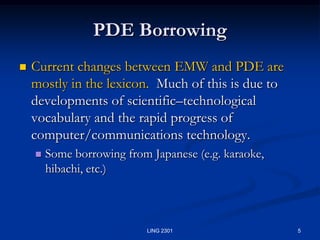
5LING 2301PDE BorrowingCurrent changes between EMW and PDE are mostly in the lexicon.  Much of this is due to developments of scientific–technological vocabulary and the rapid progress of computer/communications technology.  Some borrowing from Japanese (e.g. karaoke, hibachi, etc.)
6LING 2301More focused on Global society:In late 1800s and early 1900 in Britain, the Agricultural Revolution as well as Technological Revolution brought people off the farms and out of rural life into the cities (as few as 22% lived in rural areas by 1911).  The new call was for factory workers and prompted urbanization.   While urbanization "promotes diversity" it also brings cultures and language varieties in to contact leading to "uniformity".  As people come together they tend to accommodate to one another, developing compromise forms of behavior (including language) in order to maximize intelligibility and to achieve the greatest amount of social acceptance by those to whom they are speaking.	Increased communications and social mobility also have the impact of helping to standardize the language and development of rules of English grammar and usage.
7LING 2301On to become a World LanguageTwo major forms of English today are American English, and British English. However there are also many others.  Some 1st language speakers (e.g. Australia, possibly India, Singapore) some 2nd (or more) e.g. Parts of Europe, Countries in the South, East and West of Africa, China, Korea, Japan, etc.(More on that when we get to the Global language section).

Present day english

  • 1.
    1LING 2301Present-Day English(pp. 167 – 168)1844 First Telegraph line used b/t Washington and Baltimore1865 Atlantic cable completed1870 Compulsory Education in Britain (led to leveling of dialects and slowed down the pace of linguistic change)1876 Alexander Graham Bell invents the telephone1877 Edison invents the phonograph1899 First magnetic sound recordings1903 Orville and Wilber Wright make the first successful flight 1914–1918 WWI1921 British Broadcasting Corporation founded (BBC)1925 John Logi Baird transmits a picture of a human face via television1927 Charles Lindberg – first “nonstop” transatlantic flight 1929 First use of teleprinters and teletypewrightersFirst scheduled TV broadcast in NY1936 BBC London television service begins1939–1945 WWII1942 First computer developed in the US1947 Transistor invented at Bell Labs1951 Color TV introduced into USA1968 Intelsat communication satellite launched.
  • 2.
    2LING 2301PDE variesvery little from EME.Remnants of the previous case system are limited to the pronouns (I, me, he, him, she, her… the shift from whom to who is currently underway as in "To whom did you send the letter?" vs. "To who did you send the letter") Currently uses more comparatives and superlatives than inflectional ones (for instance shift to more & most over –er & –est) or even double forms the most coolest… .
  • 3.
    3LING 2301New wordsin PDENew words (neologisms) – or uses of old words for a new idea are formed for all kinds of reasons:kingon – an unexplained icon that appears on a computer screenmickey – the unit of measuring a computer mouse distance – .005 inchshareware crippleware – demo software that lacks the full features netpreneur – internet entrepreneurOthers?
  • 4.
    4LING 2301PDE affixationusingaffixes in more productive manner un– un-American, un-English, un-freedom–ee franchis-ee, contract-ee…–ize burglarize (From the verb to burgle which was a backformation of the older noun burglar by analogy with the –er (one who does) suffix)regularize, hospitalize
  • 5.
    5LING 2301PDE BorrowingCurrentchanges between EMW and PDE are mostly in the lexicon. Much of this is due to developments of scientific–technological vocabulary and the rapid progress of computer/communications technology. Some borrowing from Japanese (e.g. karaoke, hibachi, etc.)
  • 6.
    6LING 2301More focusedon Global society:In late 1800s and early 1900 in Britain, the Agricultural Revolution as well as Technological Revolution brought people off the farms and out of rural life into the cities (as few as 22% lived in rural areas by 1911). The new call was for factory workers and prompted urbanization. While urbanization "promotes diversity" it also brings cultures and language varieties in to contact leading to "uniformity". As people come together they tend to accommodate to one another, developing compromise forms of behavior (including language) in order to maximize intelligibility and to achieve the greatest amount of social acceptance by those to whom they are speaking. Increased communications and social mobility also have the impact of helping to standardize the language and development of rules of English grammar and usage.
  • 7.
    7LING 2301On tobecome a World LanguageTwo major forms of English today are American English, and British English. However there are also many others. Some 1st language speakers (e.g. Australia, possibly India, Singapore) some 2nd (or more) e.g. Parts of Europe, Countries in the South, East and West of Africa, China, Korea, Japan, etc.(More on that when we get to the Global language section).