Hydrocarbon, alcoholic, Ketonic, aldehyde, phenolic,
phenolic ethers, oxides, esters and miscellaneous volatile oils
containing plants.
Classification of
volatile oils
Cubeb oil and turpentine oil
Hydrocarbon volatile oils
• Hydrocarbons occur practically in all volatile oils.
• “Limonene” is considered as most widely distributed of monocyclic
terpenes.
Hydrocarbon volatile oils
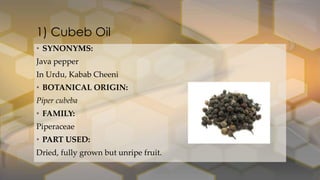
• SYNONYMS:
Java pepper
In Urdu, Kabab Cheeni
• BOTANICAL ORIGIN:
Piper cubeba
• FAMILY:
Piperaceae
• PART USED:
Dried, fully grown but unripe fruit.
1) Cubeb Oil
• ISOLATION OF OIL:
oil is isolated from crushed, dried, unripe fruit by steam distillation.
• CONSTITUENTS:
Volatile oils including:
• Sabinene
• Beta-elemene
• Cubebol
• Epi-cubebol
In addition, it also contains:
• Cubebic acid
• Cubebin
• Cubeb resin
• USES:
i. As mild stimulant, expectorant and carminative.
ii. As a flavoring agent.
iii. To treat gonorrhea.
iv. Smoking cubeb helps to treat nasal catarrh and hay fever.
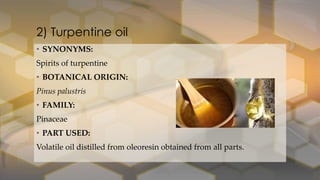
2) Turpentine oil
• SYNONYMS:
Spirits of turpentine
• BOTANICAL ORIGIN:
Pinus palustris
• FAMILY:
Pinaceae
• PART USED:
Volatile oil distilled from oleoresin obtained from all parts.
• Crude oleo resin is obtained by making incision in stem of trees.
• Oleoresin is purified by heating in steam.
• Oil is obtained by water distillation.
• Purified oleo resin is introduced in distilling chamber.
• It is subjected to heat until all volatile matter, both oil and water, are
condensed in condensing chamber.
• It is collected and then separated by separating funnel.
Isolation of oil
• CONSTITUENTS:
• Alpha pinene
• Beta pinene
• Camphene
• Limonene etc
• USES:
i. As counter-irritant and Rubefacient.
ii. Manufacture of insecticides, disinfectants, paints and varnishes
etc
iii. Rectified turpentine oil and turpentine hydrate is used as
expectorant.
Alcoholic volatile oils
Peppermint, coriander and cardamom
• They are classified into:
 Acyclic:
E.g. geraniol, linalool, citronellol etc.
 Monocyclic:
e.g. menthol, alpha-terpineol
 Dicyclic:
e.g. borneol
 Higher aliphatic alcohols:
e.g. zingiberol which is sesquiterpene.
Alcoholic volatile oils
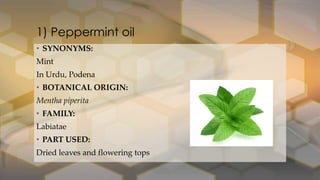
• SYNONYMS:
Mint
In Urdu, Podena
• BOTANICAL ORIGIN:
Mentha piperita
• FAMILY:
Labiatae
• PART USED:
Dried leaves and flowering tops
1) Peppermint oil
• ISOLATION OF OIL:
Oil is obtained by steam distillation of dried leaves or flowering tops.
• CONSTITUENTS:
• Volatile oil with active principle, menthol
• USES:
i. As analgesic, anesthetic, antiseptic, antispasmodic and astringent.
ii. Stimulant, carminative and stomachic properties.
iii. As a flavoring agent in syrups, lozenges, chewing gums, tooth pastes,
mouth washes and candies.
iv. To relieve pain and reduce headache and migraine.
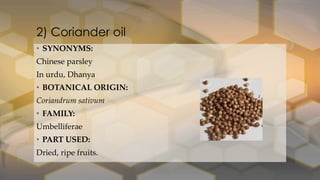
2) Coriander oil
• SYNONYMS:
Chinese parsley
In urdu, Dhanya
• BOTANICAL ORIGIN:
Coriandrum sativum
• FAMILY:
Umbelliferae
• PART USED:
Dried, ripe fruits.
• ISOLATION OF OIL:
Oil is obtained by steam distillation of dried ripe fruits of coriander.
• CONSTITUENTS:
• Coriandrol and pinene
Also contains:
• Cineol
• Cymene
• Terpineol
• Terpinolol
• USES:
i. To relieve mental fatigue, migraine, and nervous weakness.
ii. As carminative and diuretic.
iii. As culinary spice.
iv. As a flavoring agent.
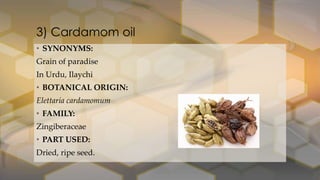
3) Cardamom oil
• SYNONYMS:
Grain of paradise
In Urdu, Ilaychi
• BOTANICAL ORIGIN:
Elettaria cardamomum
• FAMILY:
Zingiberaceae
• PART USED:
Dried, ripe seed.
• ISOLATION OF OIL:
Steam distillation of dried, ripe seed.
• CONSTITUENTS:
Volatile oils containing:
• Cineol
• Terpenyl acetate
• Limonene
Also contains:
• Fixed oils
• starch
• USES:
i. Aromatic, stimulant, stomachic, carminative and diuretic.
ii. Expectorant properties.
iii. As a condiment.
iv. As a flavoring agent in pharmaceutical syrups.

Hydrocarbon and alcoholic volatile oils

  • 1.
    Hydrocarbon, alcoholic, Ketonic,aldehyde, phenolic, phenolic ethers, oxides, esters and miscellaneous volatile oils containing plants. Classification of volatile oils
  • 2.
    Cubeb oil andturpentine oil Hydrocarbon volatile oils
  • 3.
    • Hydrocarbons occurpractically in all volatile oils. • “Limonene” is considered as most widely distributed of monocyclic terpenes. Hydrocarbon volatile oils
  • 4.
    • SYNONYMS: Java pepper InUrdu, Kabab Cheeni • BOTANICAL ORIGIN: Piper cubeba • FAMILY: Piperaceae • PART USED: Dried, fully grown but unripe fruit. 1) Cubeb Oil
  • 5.
    • ISOLATION OFOIL: oil is isolated from crushed, dried, unripe fruit by steam distillation. • CONSTITUENTS: Volatile oils including: • Sabinene • Beta-elemene • Cubebol • Epi-cubebol In addition, it also contains: • Cubebic acid • Cubebin • Cubeb resin • USES: i. As mild stimulant, expectorant and carminative. ii. As a flavoring agent. iii. To treat gonorrhea. iv. Smoking cubeb helps to treat nasal catarrh and hay fever.
  • 6.
    2) Turpentine oil •SYNONYMS: Spirits of turpentine • BOTANICAL ORIGIN: Pinus palustris • FAMILY: Pinaceae • PART USED: Volatile oil distilled from oleoresin obtained from all parts.
  • 7.
    • Crude oleoresin is obtained by making incision in stem of trees. • Oleoresin is purified by heating in steam. • Oil is obtained by water distillation. • Purified oleo resin is introduced in distilling chamber. • It is subjected to heat until all volatile matter, both oil and water, are condensed in condensing chamber. • It is collected and then separated by separating funnel. Isolation of oil
  • 8.
    • CONSTITUENTS: • Alphapinene • Beta pinene • Camphene • Limonene etc • USES: i. As counter-irritant and Rubefacient. ii. Manufacture of insecticides, disinfectants, paints and varnishes etc iii. Rectified turpentine oil and turpentine hydrate is used as expectorant.
  • 9.
  • 10.
    • They areclassified into:  Acyclic: E.g. geraniol, linalool, citronellol etc.  Monocyclic: e.g. menthol, alpha-terpineol  Dicyclic: e.g. borneol  Higher aliphatic alcohols: e.g. zingiberol which is sesquiterpene. Alcoholic volatile oils
  • 11.
    • SYNONYMS: Mint In Urdu,Podena • BOTANICAL ORIGIN: Mentha piperita • FAMILY: Labiatae • PART USED: Dried leaves and flowering tops 1) Peppermint oil
  • 12.
    • ISOLATION OFOIL: Oil is obtained by steam distillation of dried leaves or flowering tops. • CONSTITUENTS: • Volatile oil with active principle, menthol • USES: i. As analgesic, anesthetic, antiseptic, antispasmodic and astringent. ii. Stimulant, carminative and stomachic properties. iii. As a flavoring agent in syrups, lozenges, chewing gums, tooth pastes, mouth washes and candies. iv. To relieve pain and reduce headache and migraine.
  • 13.
    2) Coriander oil •SYNONYMS: Chinese parsley In urdu, Dhanya • BOTANICAL ORIGIN: Coriandrum sativum • FAMILY: Umbelliferae • PART USED: Dried, ripe fruits.
  • 14.
    • ISOLATION OFOIL: Oil is obtained by steam distillation of dried ripe fruits of coriander. • CONSTITUENTS: • Coriandrol and pinene Also contains: • Cineol • Cymene • Terpineol • Terpinolol • USES: i. To relieve mental fatigue, migraine, and nervous weakness. ii. As carminative and diuretic. iii. As culinary spice. iv. As a flavoring agent.
  • 15.
    3) Cardamom oil •SYNONYMS: Grain of paradise In Urdu, Ilaychi • BOTANICAL ORIGIN: Elettaria cardamomum • FAMILY: Zingiberaceae • PART USED: Dried, ripe seed.
  • 16.
    • ISOLATION OFOIL: Steam distillation of dried, ripe seed. • CONSTITUENTS: Volatile oils containing: • Cineol • Terpenyl acetate • Limonene Also contains: • Fixed oils • starch • USES: i. Aromatic, stimulant, stomachic, carminative and diuretic. ii. Expectorant properties. iii. As a condiment. iv. As a flavoring agent in pharmaceutical syrups.