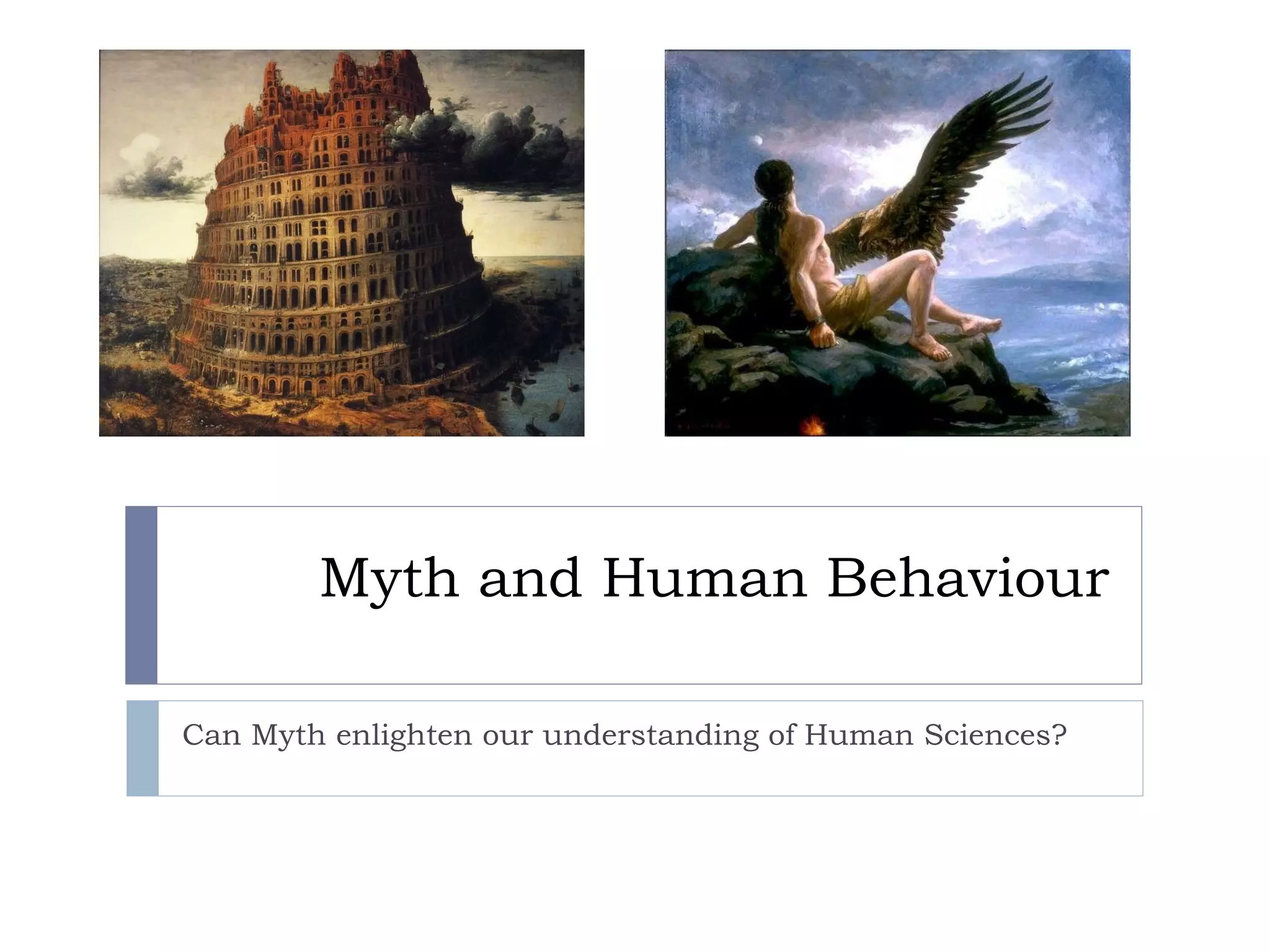
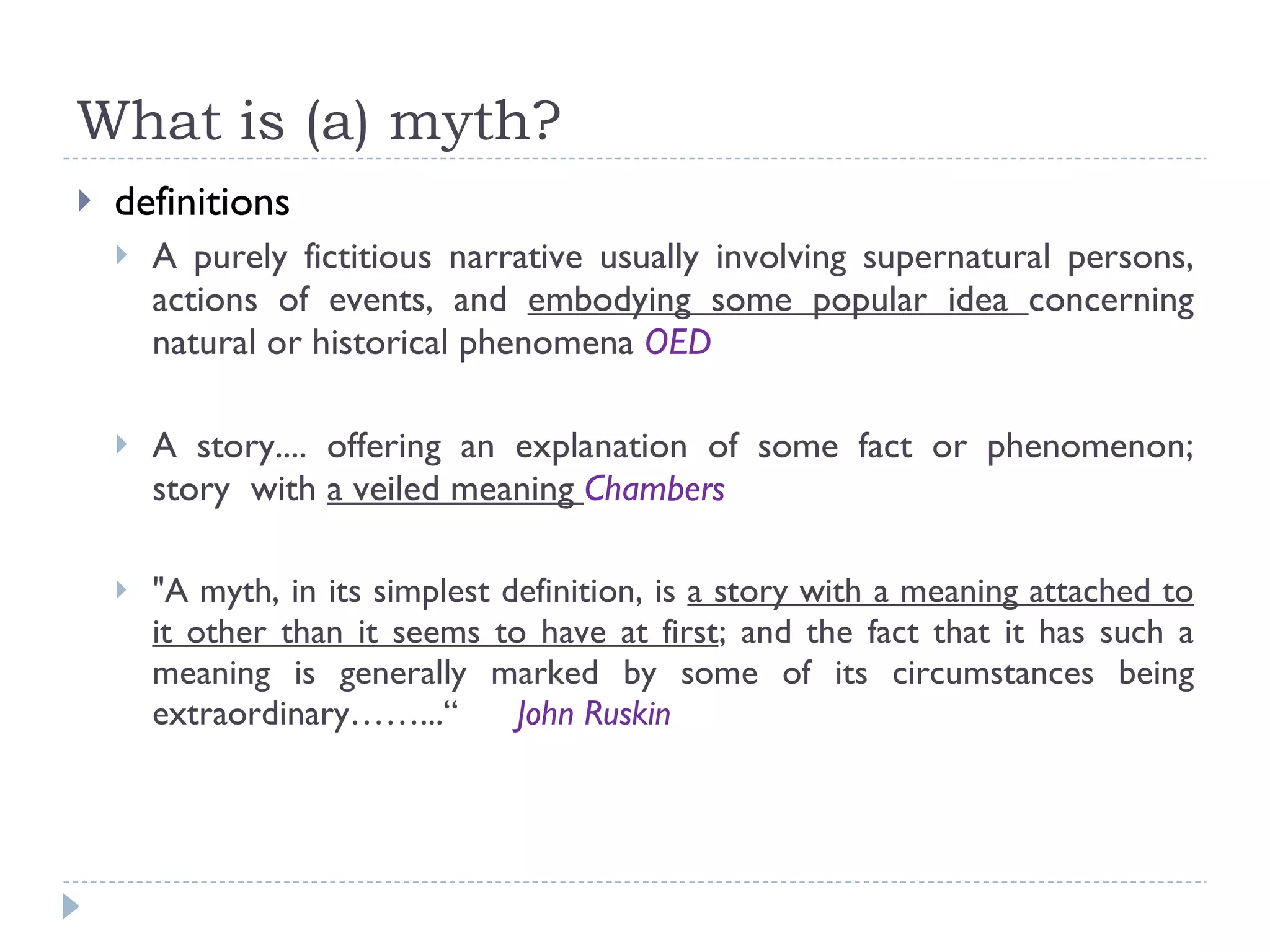
Myth and Human Behaviour Can Myth enlighten our understanding of Human Sciences?
What is (a) myth? definitions A purely fictitious narrative usually involving supernatural persons, actions of events, and  embodying some popular idea  concerning natural or historical phenomena   OED A story.... offering an explanation of some fact or phenomenon; story  with  a veiled meaning  Chambers "A myth, in its simplest definition, is  a story with a meaning attached to it other than it seems to have at first ; and the fact that it has such a meaning is generally marked by some of its circumstances being extraordinary……...“  John Ruskin
Myth (continued) Myth and Anthropology True myth may be defined as the reduction to narrative shorthand of ritual mime performed on public festivals, and in many cases recorded pictorially  Robert Graves Myth and Semiology Can anything be myth?  Yes, I believe so, for the universe is infinitely suggestive.  Each object in the world can pass from a closed, silent existence to a state where it speaks  Roland Barthes,  Mythologies
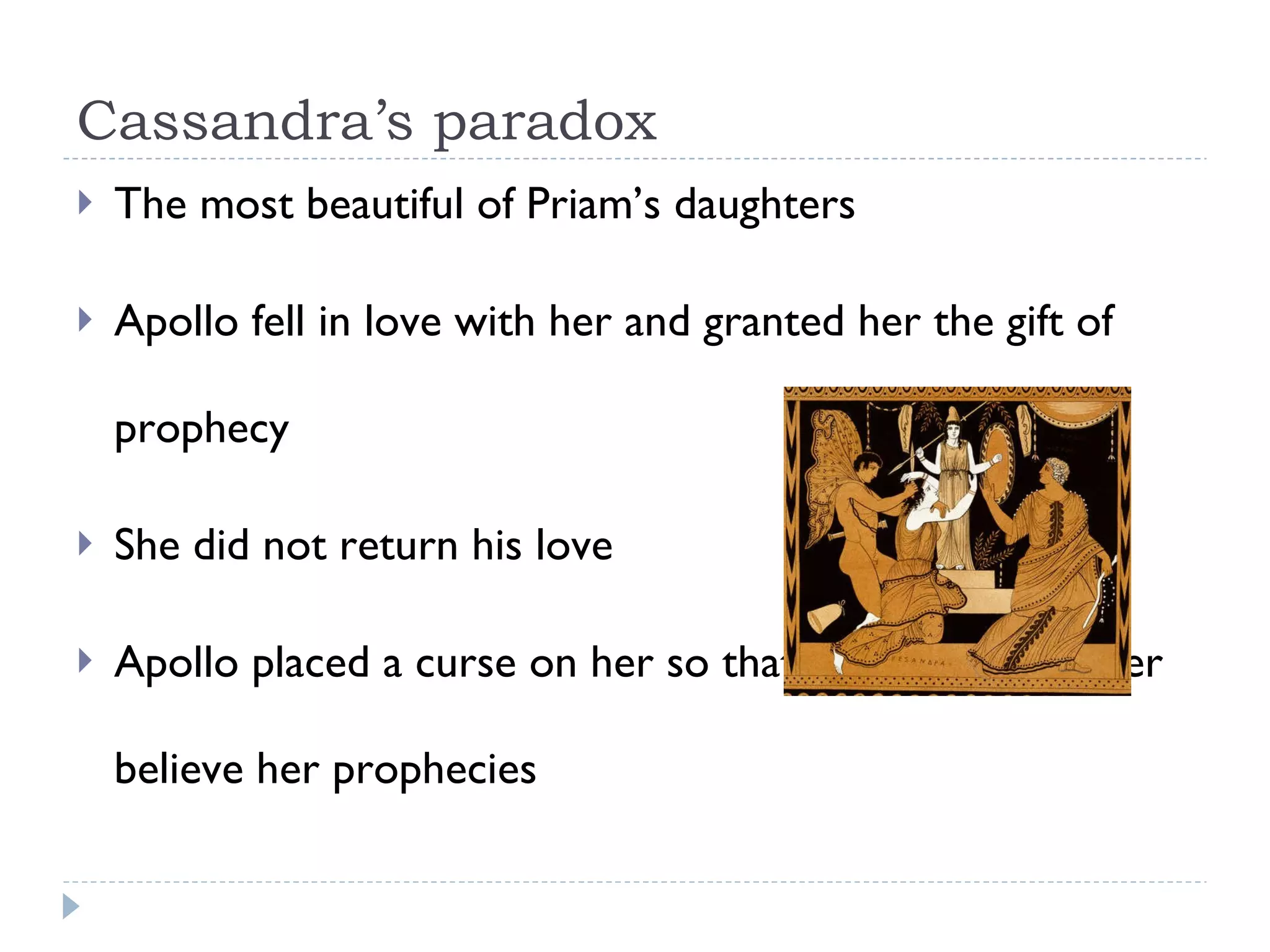
Cassandra’s paradox The most beautiful of Priam’s daughters Apollo fell in love with her and granted her the gift of prophecy She did not return his love Apollo placed a curse on her so that no one would ever believe her prophecies
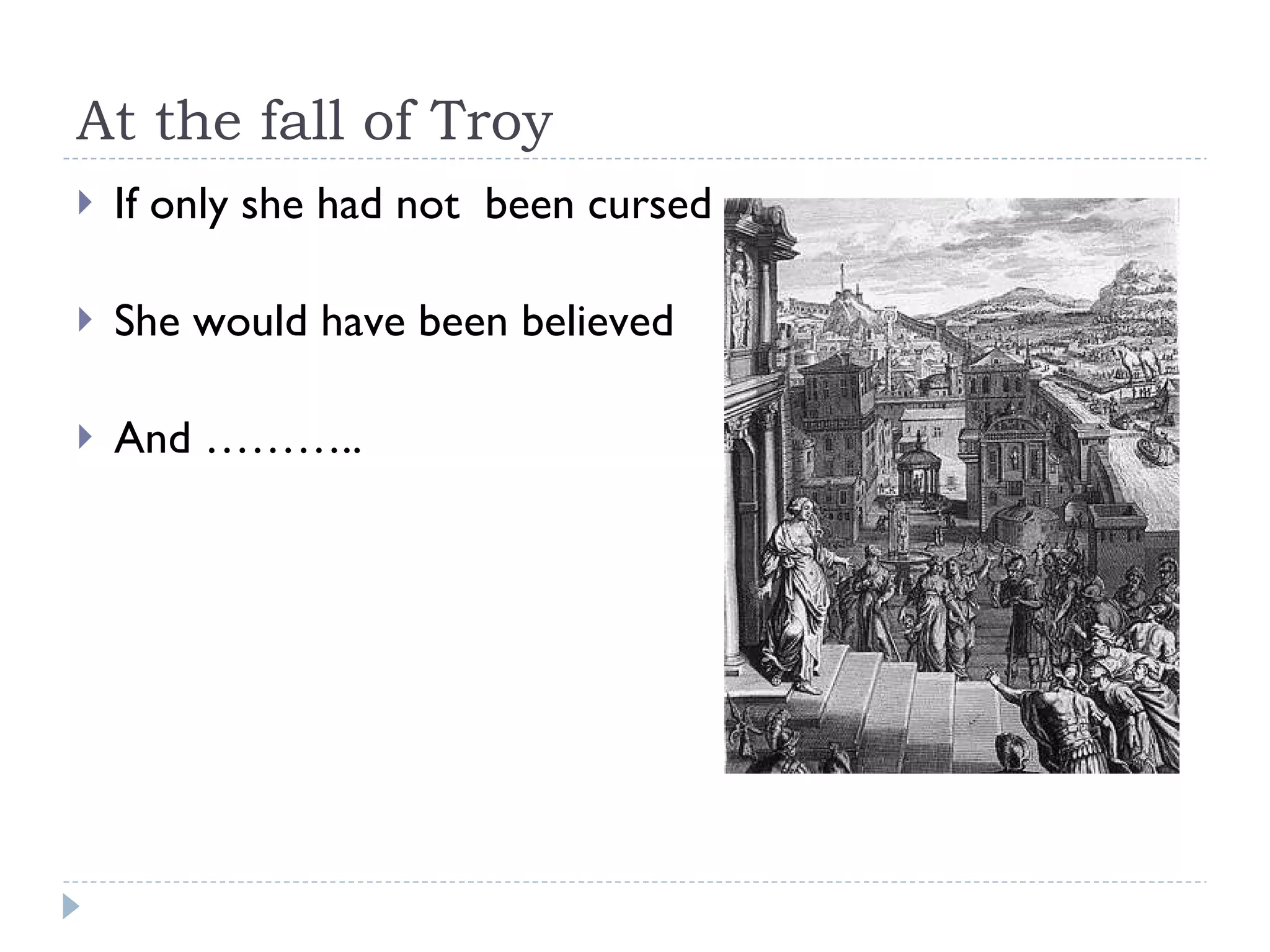
At the fall of Troy If only she had not  been cursed She would have been believed And ………..
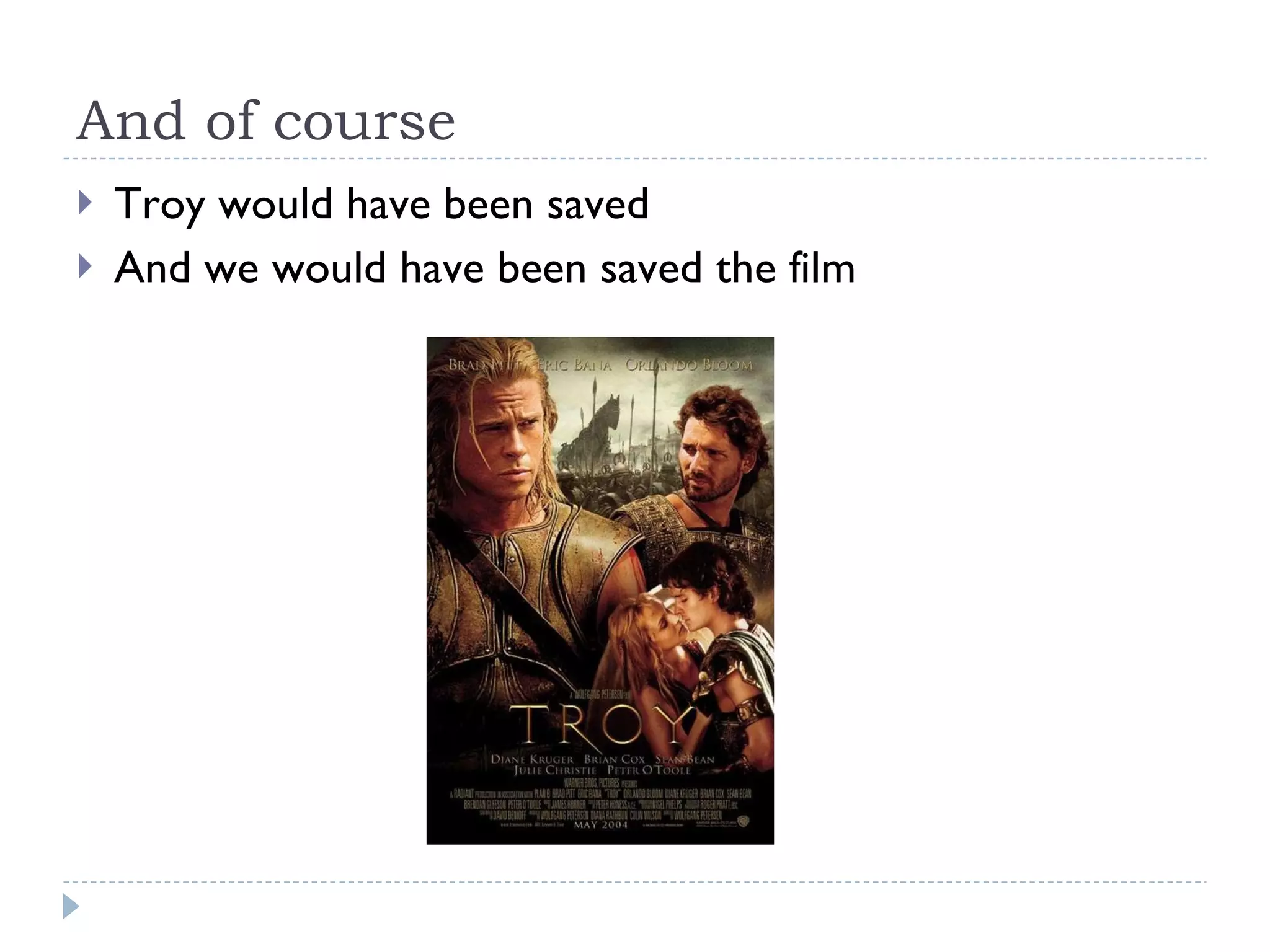
And of course Troy would have been saved And we would have been saved the film
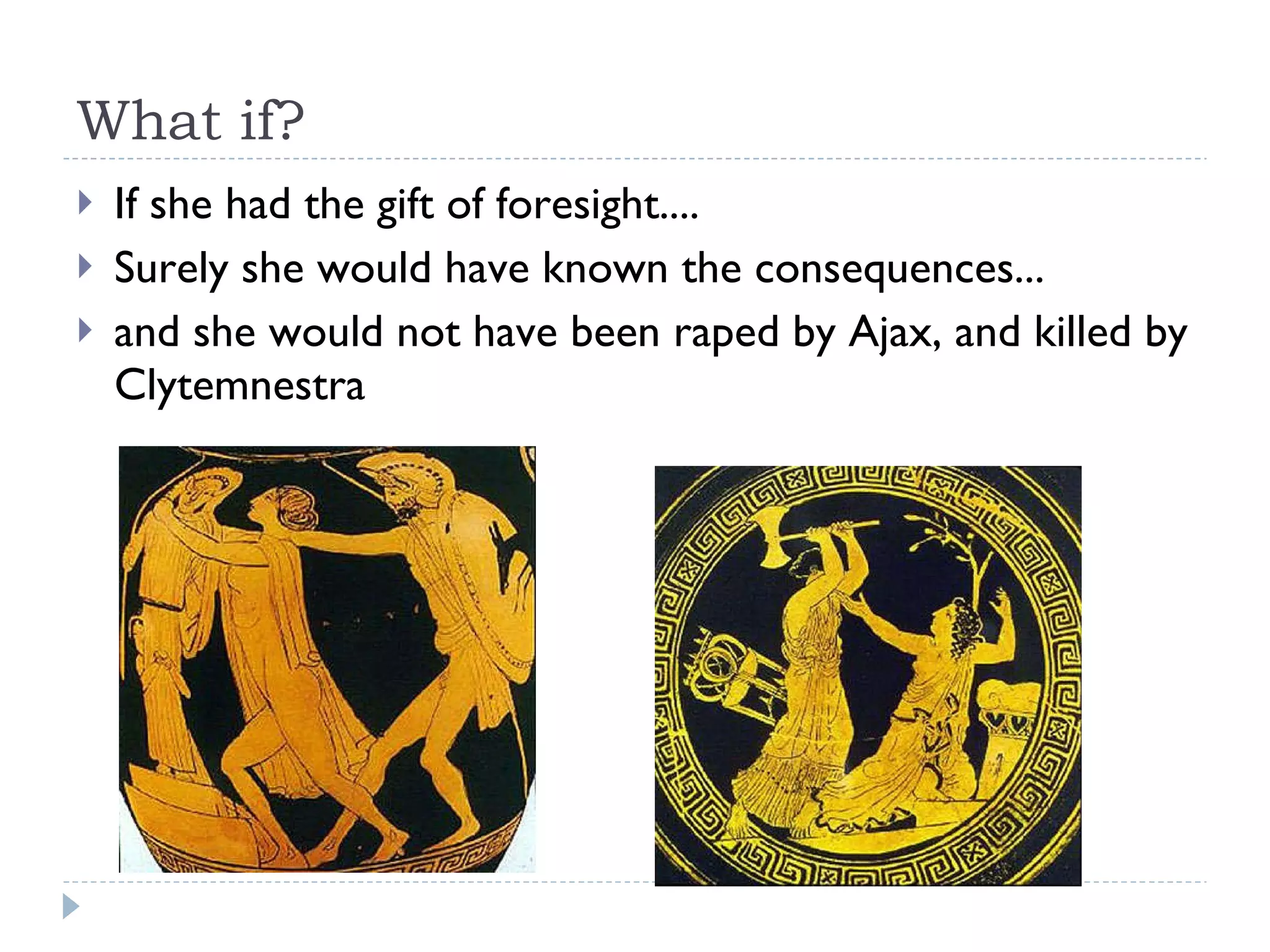
What if? If she had the gift of foresight.... Surely she would have known the consequences... and she would not have been raped by Ajax, and killed by Clytemnestra
But then of course... She knew!  So did she have a choice?
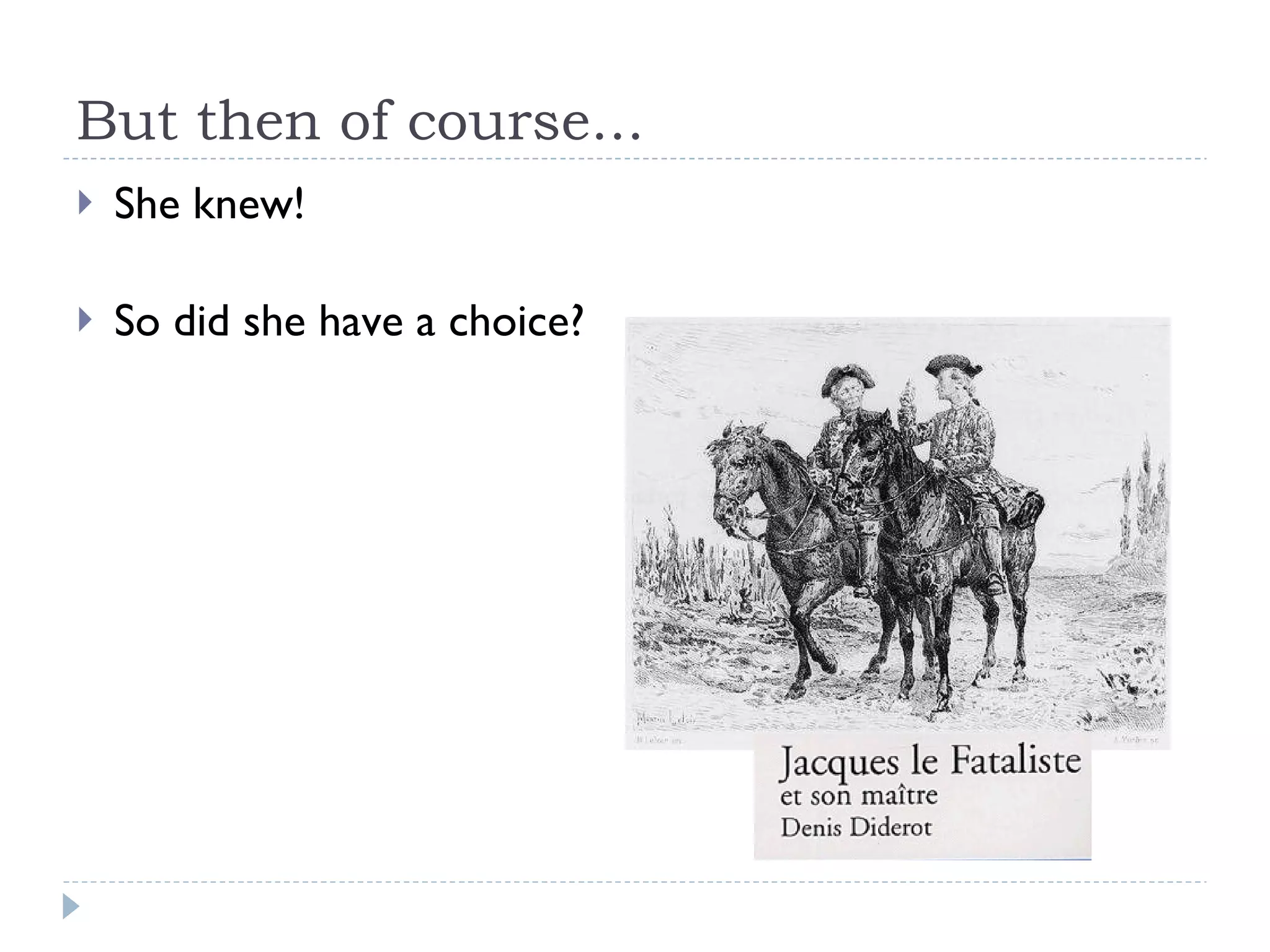
C’est écrit là-haut! How did they meet? By chance, like everyone else. What were they called? What does that matter to you? Where were they coming from? From the nearest place. Where were they going? Who knows where they were going? What were they saying? The master was silent and Jacques was saying that his captain in the army used say that all the good and bad that happens to us down here on earth was already written up there.
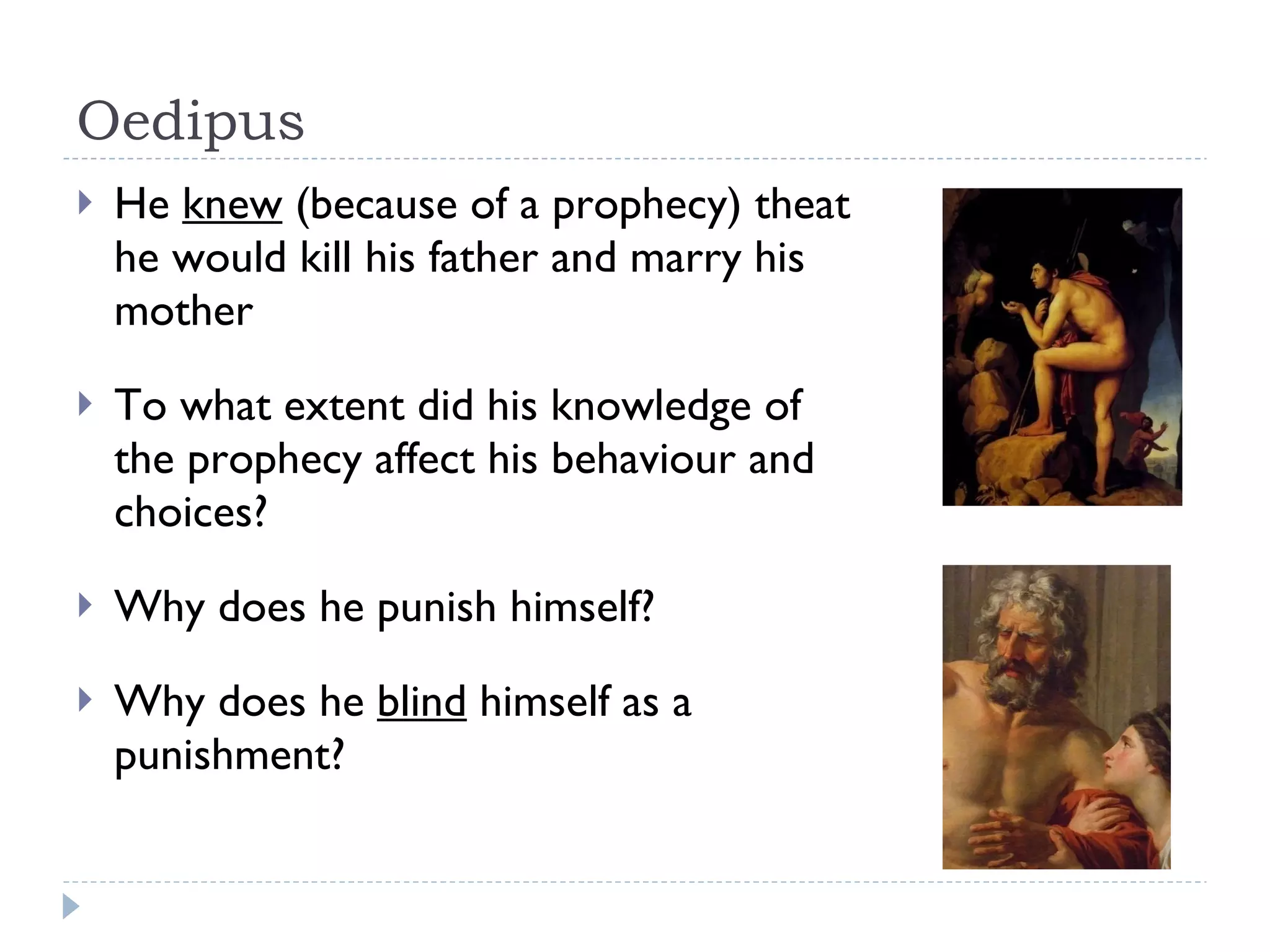
Oedipus He  knew  (because of a prophecy) theat he would kill his father and marry his mother To what extent did his knowledge of the prophecy affect his behaviour and choices? Why does he punish himself? Why does he  blind  himself as a punishment?
The Oedipus effect. “  ……  the oracle played a most important role in the sequence of events which led to the fulfilment of its prophecy. … For a time I thought that the existence of the Oedipus effect distinguished the social from the natural sciences. But in biology, too—even in molecular biology—expectations often play a role in bringing about what has been expected.  ”   Karl Popper
Self fulfilling prophecy -  psychology.  A person who expects people to be friendly, may smile more and thus receive more smiles A person expecting to be lucky, may enter many more competitions and thus increase their chances of winning.  Children randomly allocated to a group labelled ‘bright’ did better in an experiment than a similar group labelled ‘less bright’ BUT  you may also do your utmost to ensure a prediction made by a psychologist does not happen!
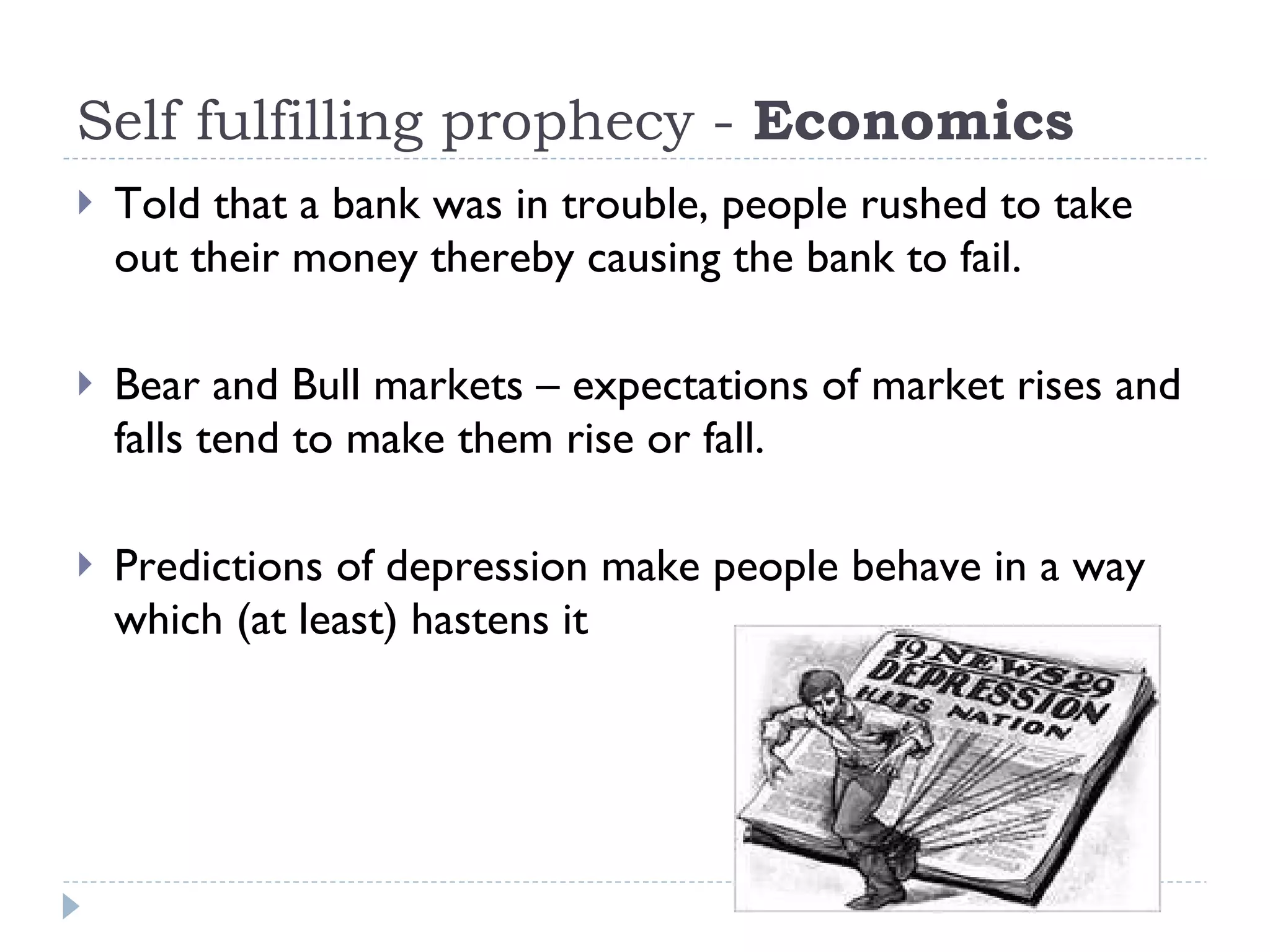
Self fulfilling prophecy -  Economics Told that a bank was in trouble, people rushed to take out their money thereby causing the bank to fail. Bear and Bull markets – expectations of market rises and falls tend to make them rise or fall.  Predictions of depression make people behave in a way which (at least) hastens it
Placebo and Nocebo A patient given a pill expects it to make him better ( placebo ) and often does In a classic  nocebo  experiment conducted in the early 1980s volunteers were told that a mild electrical current would pass through their head, and although no electrical current was used, two-thirds of the volunteers complained of a headache after the experiment.
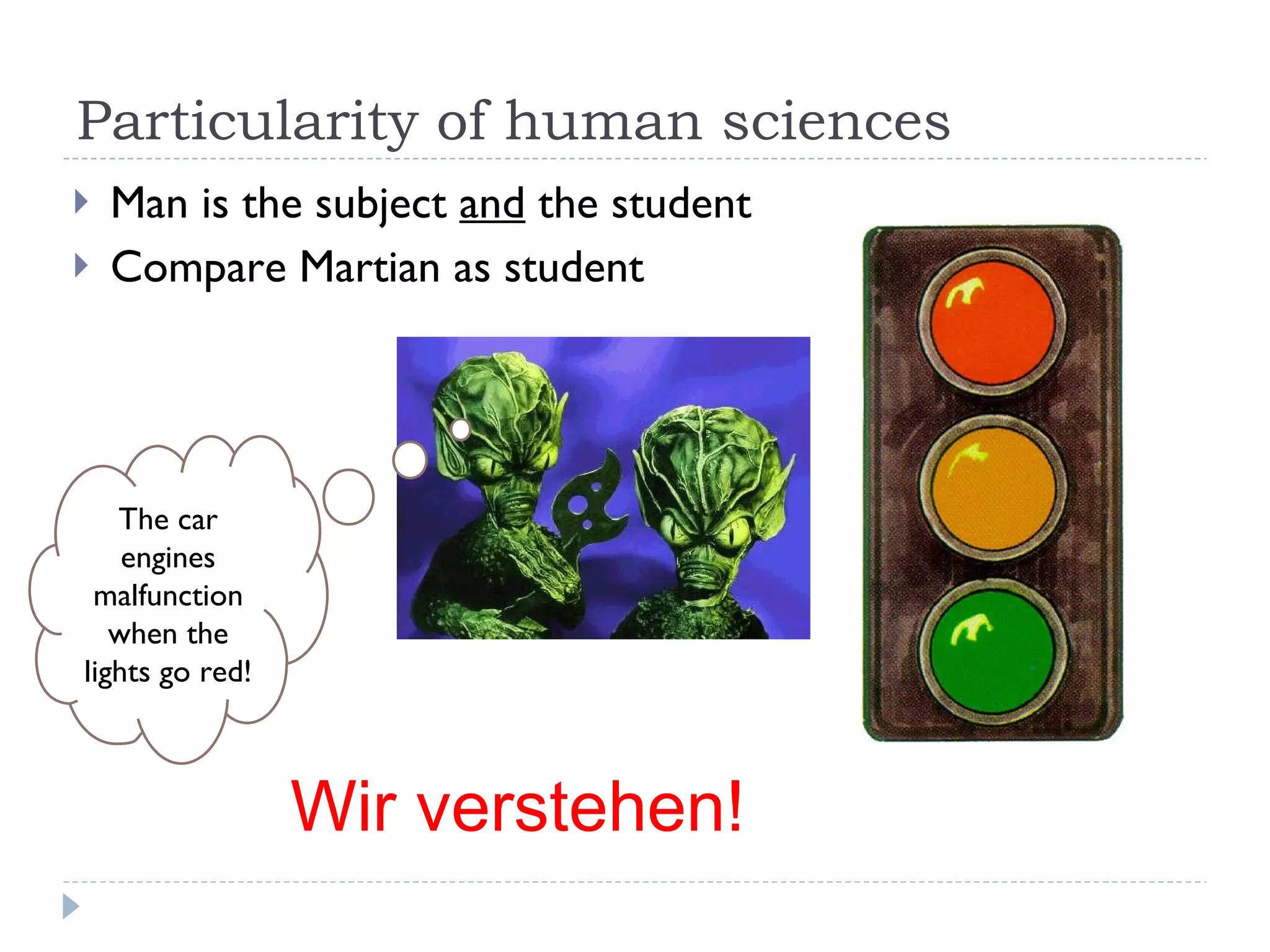
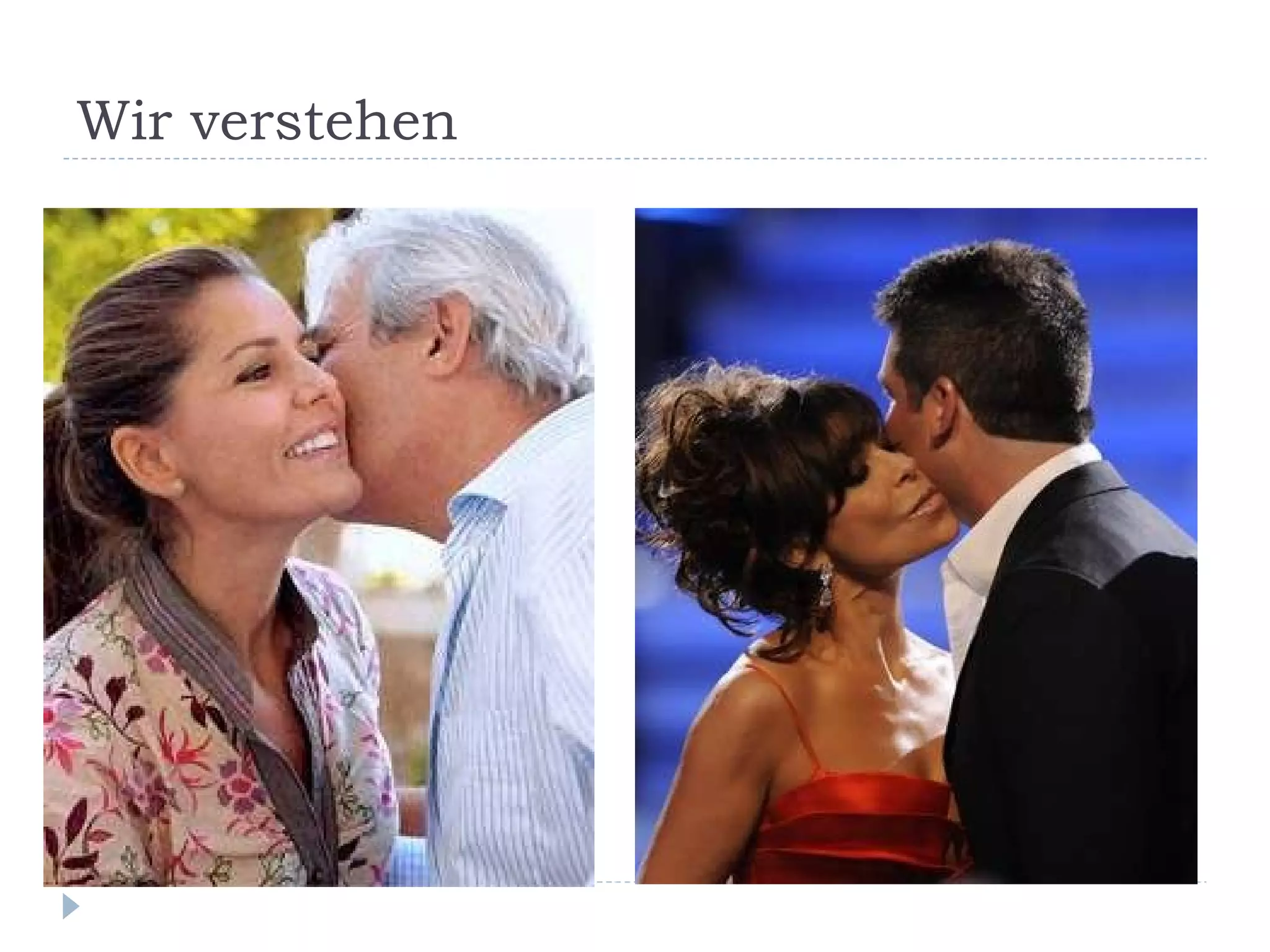
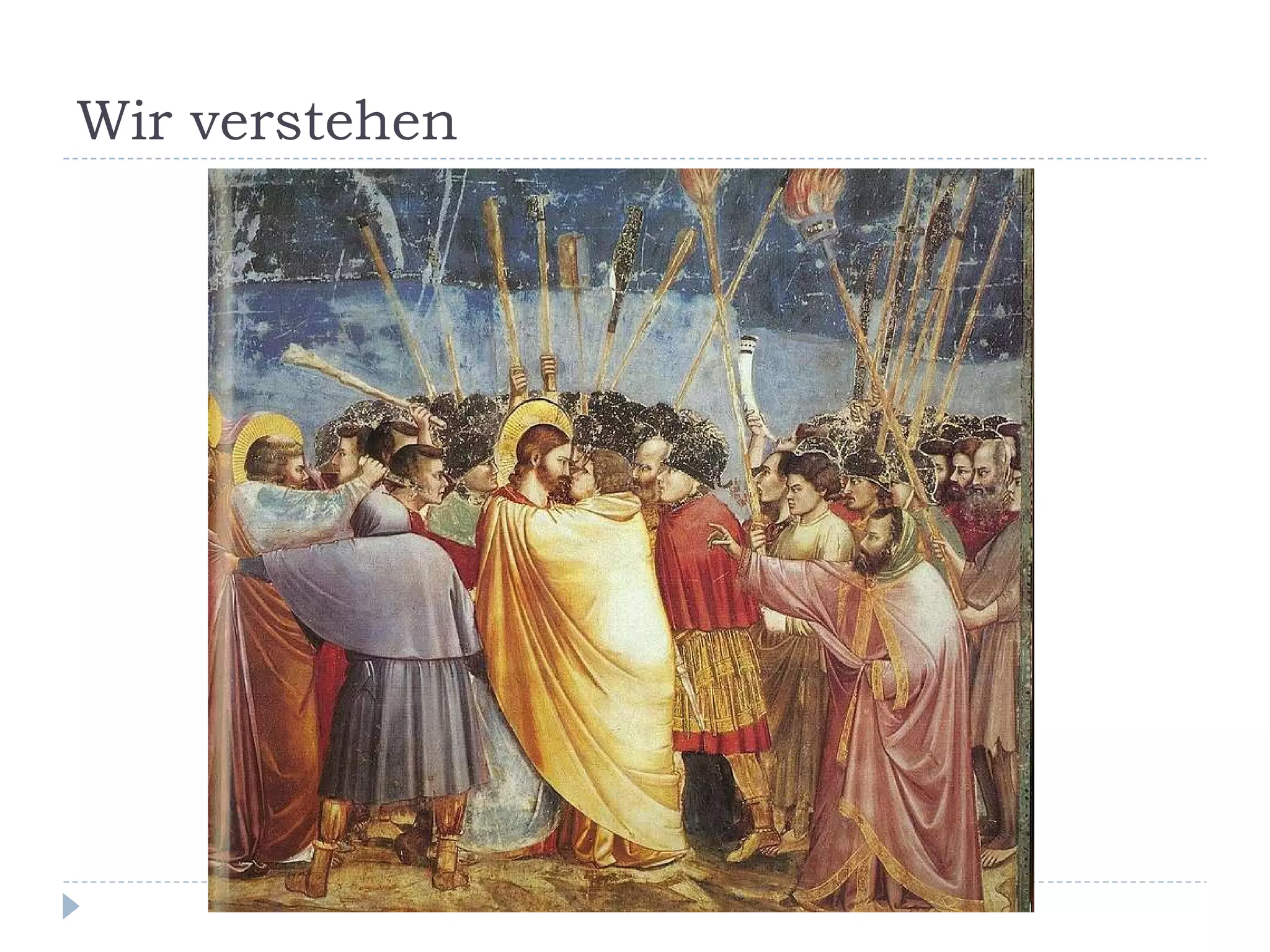
Particularity of human sciences Man is the subject  and  the student Compare Martian as student The car engines malfunction when the lights go red! Wir verstehen!
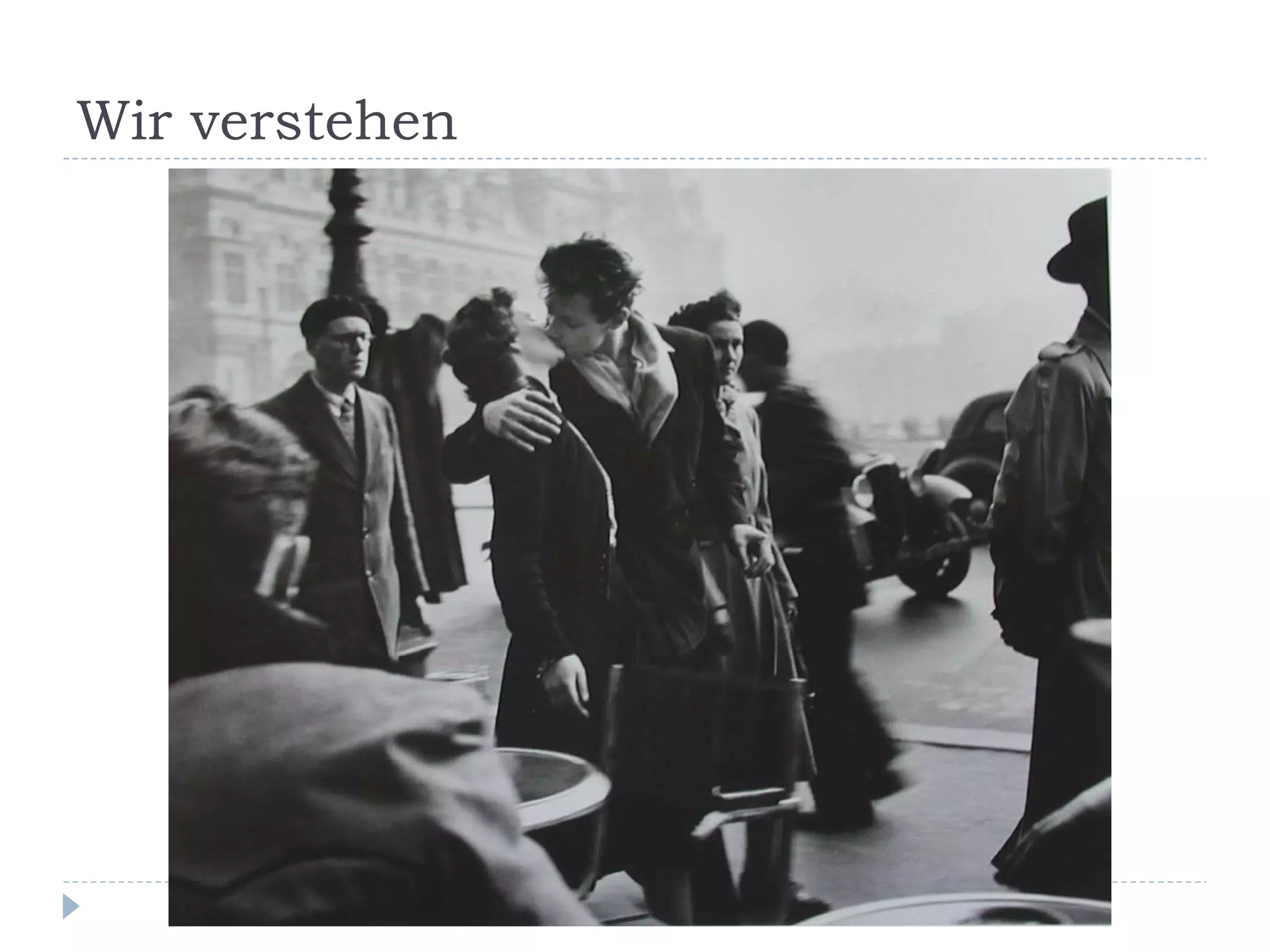
Wir verstehen
Wir verstehen
Wir verstehen
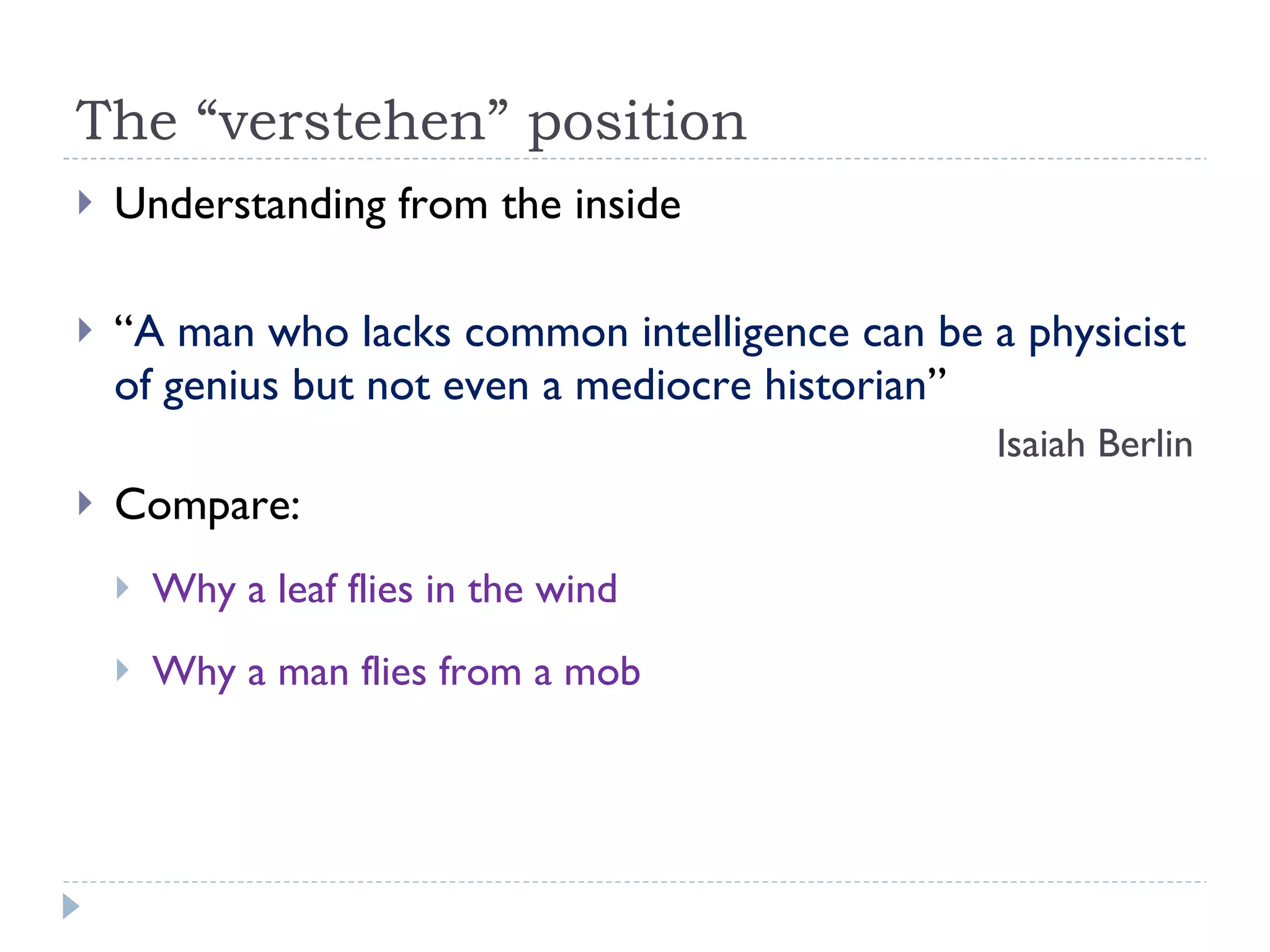
The “verstehen” position Understanding from the inside “ A man who lacks common intelligence can be a physicist of genius but not even a mediocre historian ” Isaiah Berlin Compare: Why a leaf flies in the wind Why a man flies from a mob
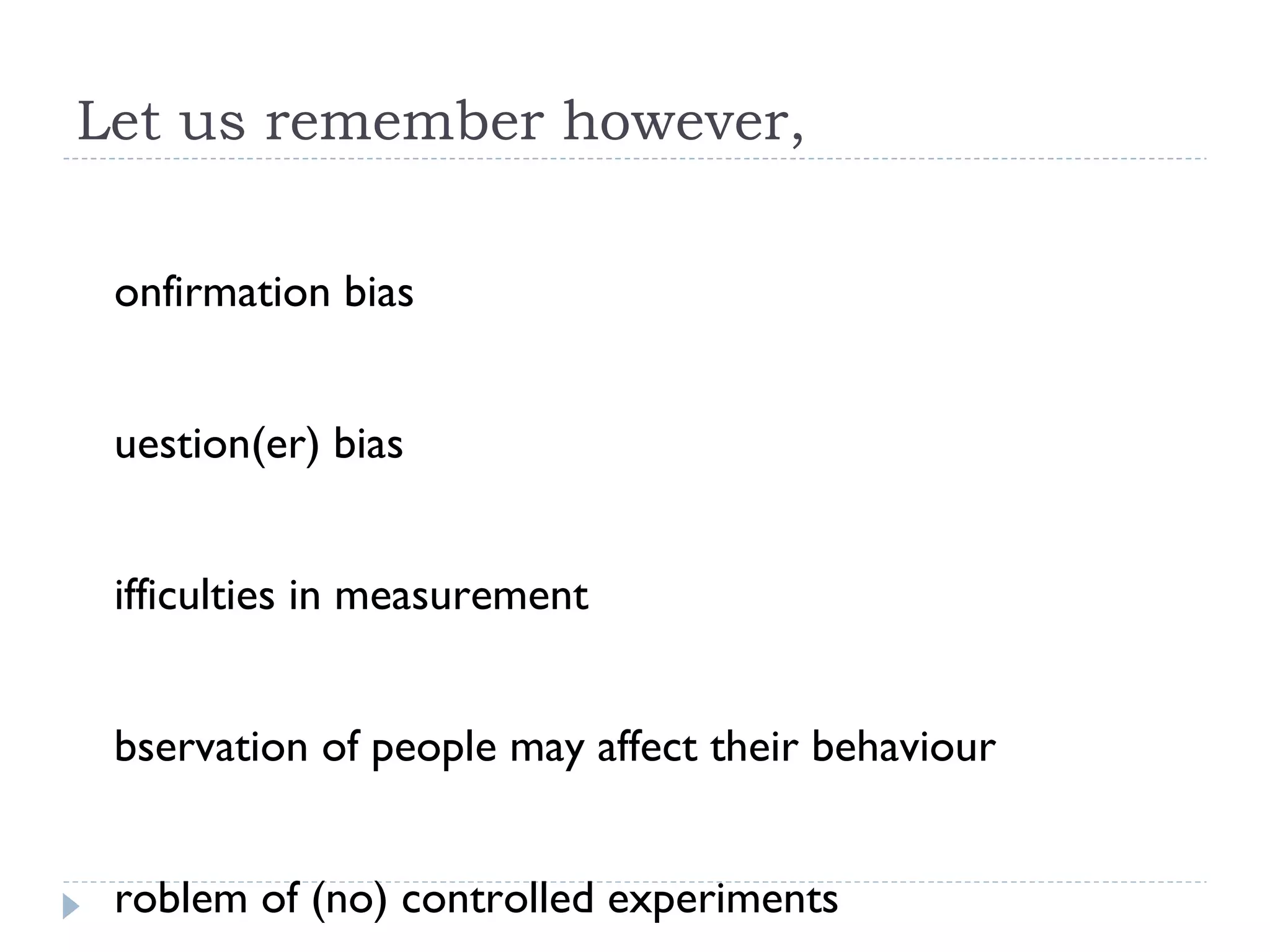
Let us remember however, Confirmation bias Question(er) bias Difficulties in measurement Observation of people may affect their behaviour Problem of (no) controlled experiments Human sciences often affected by moral issues Limitations on willingness to experiment Human science laws suggest the ‘probable’ Uncomfortable with falsification
Do we trust predictions?  If the apple will fall to the ground The weather forecast A forecast of future economic growth The future portrayed in a Sci-Fi novel What I tell you will happen at the end of the lesson
And lastly What decisions do we make and how do we behave faced with predictions?  (Oedipus and Cassandra) You are told you have 6 months to live – what decisions do you take? The prediction turns out to be false........

Cassandra’s paradox

  • 1.
    Myth and HumanBehaviour Can Myth enlighten our understanding of Human Sciences?
  • 2.
    What is (a)myth? definitions A purely fictitious narrative usually involving supernatural persons, actions of events, and embodying some popular idea concerning natural or historical phenomena OED A story.... offering an explanation of some fact or phenomenon; story with a veiled meaning Chambers "A myth, in its simplest definition, is a story with a meaning attached to it other than it seems to have at first ; and the fact that it has such a meaning is generally marked by some of its circumstances being extraordinary……...“ John Ruskin
  • 3.
    Myth (continued) Mythand Anthropology True myth may be defined as the reduction to narrative shorthand of ritual mime performed on public festivals, and in many cases recorded pictorially Robert Graves Myth and Semiology Can anything be myth? Yes, I believe so, for the universe is infinitely suggestive. Each object in the world can pass from a closed, silent existence to a state where it speaks Roland Barthes, Mythologies
  • 4.
    Cassandra’s paradox Themost beautiful of Priam’s daughters Apollo fell in love with her and granted her the gift of prophecy She did not return his love Apollo placed a curse on her so that no one would ever believe her prophecies
  • 5.
    At the fallof Troy If only she had not been cursed She would have been believed And ………..
  • 6.
    And of courseTroy would have been saved And we would have been saved the film
  • 7.
    What if? Ifshe had the gift of foresight.... Surely she would have known the consequences... and she would not have been raped by Ajax, and killed by Clytemnestra
  • 8.
    But then ofcourse... She knew! So did she have a choice?
  • 9.
    C’est écrit là-haut!How did they meet? By chance, like everyone else. What were they called? What does that matter to you? Where were they coming from? From the nearest place. Where were they going? Who knows where they were going? What were they saying? The master was silent and Jacques was saying that his captain in the army used say that all the good and bad that happens to us down here on earth was already written up there.
  • 10.
    Oedipus He knew (because of a prophecy) theat he would kill his father and marry his mother To what extent did his knowledge of the prophecy affect his behaviour and choices? Why does he punish himself? Why does he blind himself as a punishment?
  • 11.
    The Oedipus effect.“ …… the oracle played a most important role in the sequence of events which led to the fulfilment of its prophecy. … For a time I thought that the existence of the Oedipus effect distinguished the social from the natural sciences. But in biology, too—even in molecular biology—expectations often play a role in bringing about what has been expected. ” Karl Popper
  • 12.
    Self fulfilling prophecy- psychology. A person who expects people to be friendly, may smile more and thus receive more smiles A person expecting to be lucky, may enter many more competitions and thus increase their chances of winning. Children randomly allocated to a group labelled ‘bright’ did better in an experiment than a similar group labelled ‘less bright’ BUT you may also do your utmost to ensure a prediction made by a psychologist does not happen!
  • 13.
    Self fulfilling prophecy- Economics Told that a bank was in trouble, people rushed to take out their money thereby causing the bank to fail. Bear and Bull markets – expectations of market rises and falls tend to make them rise or fall. Predictions of depression make people behave in a way which (at least) hastens it
  • 14.
    Placebo and NoceboA patient given a pill expects it to make him better ( placebo ) and often does In a classic nocebo experiment conducted in the early 1980s volunteers were told that a mild electrical current would pass through their head, and although no electrical current was used, two-thirds of the volunteers complained of a headache after the experiment.
  • 15.
    Particularity of humansciences Man is the subject and the student Compare Martian as student The car engines malfunction when the lights go red! Wir verstehen!
  • 16.
  • 17.
  • 18.
  • 19.
    The “verstehen” positionUnderstanding from the inside “ A man who lacks common intelligence can be a physicist of genius but not even a mediocre historian ” Isaiah Berlin Compare: Why a leaf flies in the wind Why a man flies from a mob
  • 20.
    Let us rememberhowever, Confirmation bias Question(er) bias Difficulties in measurement Observation of people may affect their behaviour Problem of (no) controlled experiments Human sciences often affected by moral issues Limitations on willingness to experiment Human science laws suggest the ‘probable’ Uncomfortable with falsification
  • 21.
    Do we trustpredictions? If the apple will fall to the ground The weather forecast A forecast of future economic growth The future portrayed in a Sci-Fi novel What I tell you will happen at the end of the lesson
  • 22.
    And lastly Whatdecisions do we make and how do we behave faced with predictions? (Oedipus and Cassandra) You are told you have 6 months to live – what decisions do you take? The prediction turns out to be false........