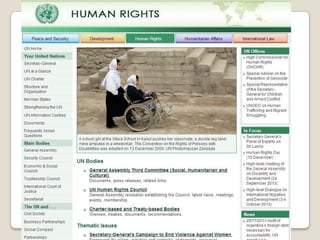
HUMAN RIGHTS
Citizenship

Almudena Corrales Marbán
Social Studies Department
RIGHTS

Right is the capacity of a person to do, to
choose, and also refrain from things. All
human beings own human rights since
they are born, and they are necessary
for our development. These human
rights cannot be won, and any institution
can deprive people from them.
HUMAN RIGHTS THROUGH HISTORY
MESOPOTAMIA
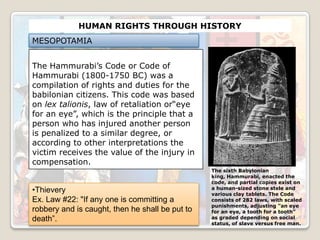
The Hammurabi’s Code or Code of
Hammurabi (1800-1750 BC) was a
compilation of rights and duties for the
babilonian citizens. This code was based
on lex talionis, law of retaliation or“eye
for an eye”, which is the principle that a
person who has injured another person
is penalized to a similar degree, or
according to other interpretations the
victim receives the value of the injury in
compensation.
•Thievery
Ex. Law #22: "If any one is committing a
robbery and is caught, then he shall be put to
death”.

The sixth Babylonian
king, Hammurabi, enacted the
code, and partial copies exist on
a human-sized stone stele and
various clay tablets. The Code
consists of 282 laws, with scaled
punishments, adjusting "an eye
for an eye, a tooth for a tooth"
as graded depending on social
status, of slave versus free man.
CLASSICAL CULTURE
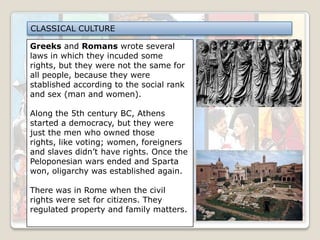
Greeks and Romans wrote several
laws in which they incuded some
rights, but they were not the same for
all people, because they were
stablished according to the social rank
and sex (man and women).
Along the 5th century BC, Athens
started a democracy, but they were
just the men who owned those
rights, like voting; women, foreigners
and slaves didn’t have rights. Once the
Peloponesian wars ended and Sparta
won, oligarchy was established again.
There was in Rome when the civil
rights were set for citizens. They
regulated property and family matters.
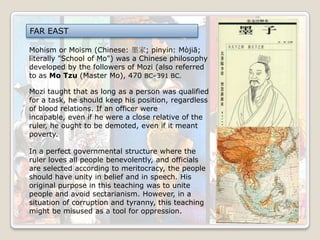
FAR EAST
Mohism or Moism (Chinese: 墨家; pinyin: Mòjiā;
literally "School of Mo") was a Chinese philosophy
developed by the followers of Mozi (also referred
to as Mo Tzu (Master Mo), 470 BC–391 BC.
Mozi taught that as long as a person was qualified
for a task, he should keep his position, regardless
of blood relations. If an officer were
incapable, even if he were a close relative of the
ruler, he ought to be demoted, even if it meant
poverty.
In a perfect governmental structure where the
ruler loves all people benevolently, and officials
are selected according to meritocracy, the people
should have unity in belief and in speech. His
original purpose in this teaching was to unite
people and avoid sectarianism. However, in a
situation of corruption and tyranny, this teaching
might be misused as a tool for oppression.
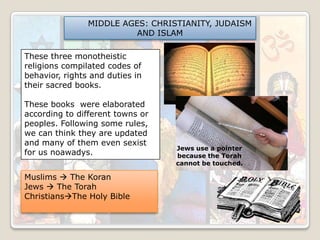
MIDDLE AGES: CHRISTIANITY, JUDAISM
AND ISLAM
These three monotheistic
religions compilated codes of
behavior, rights and duties in
their sacred books.
These books were elaborated
according to different towns or
peoples. Following some rules,
we can think they are updated
and many of them even sexist
for us noawadys.
Muslims  The Koran
Jews  The Torah
ChristiansThe Holy Bible

Jews use a pointer
because the Torah
cannot be touched.
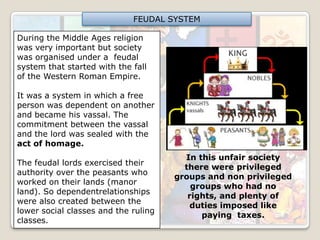
FEUDAL SYSTEM
During the Middle Ages religion
was very important but society
was organised under a feudal
system that started with the fall
of the Western Roman Empire.
It was a system in which a free
person was dependent on another
and became his vassal. The
commitment between the vassal
and the lord was sealed with the
act of homage.

The feudal lords exercised their
authority over the peasants who
worked on their lands (manor
land). So dependentrelationships
were also created between the
lower social classes and the ruling
classes.

In this unfair society
there were privileged
groups and non privileged
groups who had no
rights, and plenty of
duties imposed like
paying taxes.
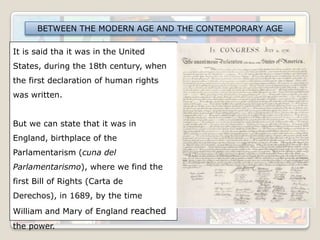
BETWEEN THE MODERN AGE AND THE CONTEMPORARY AGE

It is said tha it was in the United
States, during the 18th century, when
the first declaration of human rights
was written.
But we can state that it was in
England, birthplace of the
Parlamentarism (cuna del
Parlamentarismo), where we find the
first Bill of Rights (Carta de
Derechos), in 1689, by the time
William and Mary of England reached
the power.
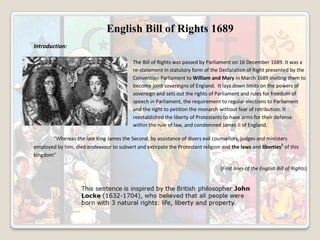
English Bill of Rights 1689
Introduction:
The Bill of Rights was passed by Parliament on 16 December 1689. It was a
re-statement in statutory form of the Declaration of Right presented by the
Convention Parliament to William and Mary in March 1689 inviting them to
become joint sovereigns of England. It lays down limits on the powers of
sovereign and sets out the rights of Parliament and rules for freedom of
speech in Parliament, the requirement to regular elections to Parliament
and the right to petition the monarch without fear of retribution. It
reestablished the liberty of Protestants to have arms for their defense
within the rule of law, and condemned James II of England.
“Whereas the late King James the Second, by assistance of divers evil counsellors, judges and ministers
employed by him, died endeavour to subvert and extirpate the Protestant religion and the laws and liberties1 of this
kingdom”
(First lines of the English Bill of Rights)
The Bill of Rights laid out certain basic rights for (at the time) all Englishmen. These rights continue to apply today, not
only in England and Wales, but in each of the jurisdictions of the Commonwealth realms as well. The Act set out that
there should be:
no royal interference with the law. Though the sovereign remains the fount of justice, he or she cannot
unilaterally establish new courts or act as a judge.
no taxation by Royal Prerogative. The agreement of parliament became necessary for the implementation of
any new taxes.
only civil courts, not Church courts, are legal
freedom to petition the monarch without fear of retribution
no standing army may be maintained during a time of peace without the consent of parliament.
no royal interference in the freedom of the people to have arms for their own defence as suitable to their class
and as allowed by law (simultaneously restoring rights previously taken from Protestants by James II)
no royal interference in the election of members of parliament
the freedom of speech and debates or proceedings in Parliament ought not to be impeached or questioned in
any court or place out of Parliament
"grants and promises of fines or forfeitures" before conviction are void
no excessive bail or "cruel and unusual" punishments may be imposed
United States Declaration of Independence
1776
The Declaration of Independence was a statement adopted by the Continental
Congress on July 4, 1776, which announced that the thirteen American colonies
then at war with Great Britain regarded themselves as independent states, and no
longer a part of the British Empire. John Adams put forth a resolution earlier in the
year which made a formal declaration inevitable. A committee was assembled to
draft the formal declaration, which was to be ready when congress voted on
independence. Adams persuaded the committee to select Thomas Jefferson to
compose the original draft of the document, which congress would edit to produce
the final version. The Declaration was ultimately a formal explanation of why
Congress had voted on July 2 to declare independence from Great Britain, more
than a year after the outbreak of the American Revolutionary War. The birthday of
the United States of America—Independence Day—is celebrated on July 4, the day the wording of the Declaration was
approved by Congress.

The first sentence of the Declaration asserts as a matter of Natural law the ability of a people to assume political
independence, and acknowledges that the grounds for such independence must be reasonable.
When in the Course of human events, it becomes necessary for one people to dissolve the political bands which have
connected them with another, and to assume among the powers of the earth, the separate and equal station to which
the Laws of Nature and of Nature's God entitle them, a decent respect to the opinions of mankind requires that they
should declare the causes which impel them to the separation.

The next section, the famous preamble, includes the ideas and ideals that were principles of the Declaration. It is also
an assertion of what is known as the "right of revolution": that is, people have certain rights, and when a government
violates these rights, the people have the right to "alter or abolish" that government.
We hold these truths to be self-evident, that all men are created equal, that they are endowed by their Creator with
certain unalienable Rights, that among these are Life, Liberty and the pursuit of Happiness.
CONTEMPORARY AGE: FRENCH REVOLUTION
The French Revolution was a period of radical
social and political upheaval in France from 1789
to 1799 that had a fundamental impact on French
history and on modern history worldwide.
Experiencing an economic crisis exacerbated by
the Seven Years' War and the American
Revolutionary War, the common people of France
became increasingly frustrated by the ineptitude
of King Louis XVI and the continued decadence of
the aristocracy. This resentment, coupled with
burgeoning Enlightenment ideals, fueled radical
sentiments and launched the Revolution in 1789
with the convocation of the Estates-General in
May. The first year of the Revolution saw
members of the Third Estate proclaiming the
Tennis Court Oath in June, the assault on the
Bastille in July, the passage of the Declaration of
the Rights of Man and of the Citizen in
August, and an epic march on Versailles that
forced the royal court back to Paris in October.

1789
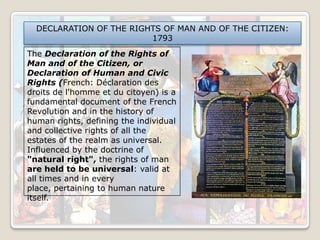
DECLARATION OF THE RIGHTS OF MAN AND OF THE CITIZEN:
1793
The Declaration of the Rights of
Man and of the Citizen, or
Declaration of Human and Civic
Rights (French: Déclaration des
droits de l'homme et du citoyen) is a
fundamental document of the French
Revolution and in the history of
human rights, defining the individual
and collective rights of all the
estates of the realm as universal.
Influenced by the doctrine of
"natural right", the rights of man
are held to be universal: valid at
all times and in every
place, pertaining to human nature
itself.
DECLARATION OF THE RIGHTS OF MAN AND OF THE CITIZEN:
1789
The last article of the Declaration of the
Rights of Man and the Citizen was adopted
on 26 August 1789, by the National
Constituent Assembly, during the period of
the French Revolution, as the first step
toward writing a constitution for France.
Inspired by the Enlightenment, the original
version of the Declaration was discussed by
the representatives on the basis of a 24
article draft proposed by the sixth
bureau,led by Jérôme Champion de Cicé.
The draft was later modified during the
debates. A second and lengthier
declaration, known as the Declaration of
the Rights of Man and Citizen of 1793 was
later adopted
DECLARATION OF THE RIGHTS OF MAN AND OF THE CITIZEN:
1789

The Declaration also asserted
the principles of popular
sovereignty, in contrast to
the divine right of kings
that characterized the French
monarchy, and social equality
among citizens, "All the
citizens, being equal in the
eyes of the law, are equally
admissible to all public
dignities, places, and
employments, according to
their capacity and without
distinction other than that
of their virtues and of their
talents," eliminating the
special rights of the nobility
and clergy.

1. Men are born and remain free and
equal in rights. Social distinctions may be
founded only upon the general good.
4. Liberty consists in the freedom to do
everything which injures no one else;
hence the exercise of the natural rights of
each man has no limits except those
which assure to the other members of the
society the enjoyment of the same rights.
These limits can only be determined by
law.
11. The free communication of ideas and
opinions is one of the most precious of the
rights of man. Every citizen
may, accordingly, speak, write, and print
with freedom, but shall be responsible for
such abuses of this freedom as shall be
defined by law.
WORLD WARS ARFTERMATH: THE UNITED NATIONS

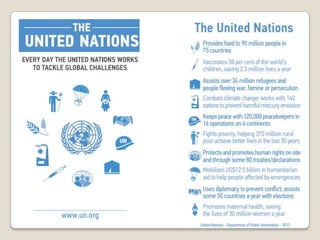
The United Nations is an international
organization founded in 1945 after the
Second World War by 51 countries
committed to maintaining international peace
and security, developing friendly relations
among nations and promoting social
progress, better living standards and human
rights.
Due to its unique international
character, and the powers vested in
its founding Charter, the Organization
can take action on a wide range of
issues, and provide a forum for its
193 Member States to express their
views, through the General
Assembly, the Security Council,
the Economic and Social Council
and other bodies and committees.

The UN has 4 main
purposes
•

To keep peace
throughout the world;

•

To develop friendly
relations among
nations;

•

To help nations work
together to improve the
lives of poor people, to
conquer hunger, disease
and illiteracy, and to
encourage respect for
each other’s rights and
freedoms;

•

To be a centre for
harmonizing the actions
of nations to achieve
these goals.
Useful videos

http://www.humanrights.com/#/what-are-human-rights

Human rights

  • 1.
    HUMAN RIGHTS Citizenship Almudena CorralesMarbán Social Studies Department
  • 2.
    RIGHTS Right is thecapacity of a person to do, to choose, and also refrain from things. All human beings own human rights since they are born, and they are necessary for our development. These human rights cannot be won, and any institution can deprive people from them.
  • 3.
    HUMAN RIGHTS THROUGHHISTORY MESOPOTAMIA The Hammurabi’s Code or Code of Hammurabi (1800-1750 BC) was a compilation of rights and duties for the babilonian citizens. This code was based on lex talionis, law of retaliation or“eye for an eye”, which is the principle that a person who has injured another person is penalized to a similar degree, or according to other interpretations the victim receives the value of the injury in compensation. •Thievery Ex. Law #22: "If any one is committing a robbery and is caught, then he shall be put to death”. The sixth Babylonian king, Hammurabi, enacted the code, and partial copies exist on a human-sized stone stele and various clay tablets. The Code consists of 282 laws, with scaled punishments, adjusting "an eye for an eye, a tooth for a tooth" as graded depending on social status, of slave versus free man.
  • 4.
    CLASSICAL CULTURE Greeks andRomans wrote several laws in which they incuded some rights, but they were not the same for all people, because they were stablished according to the social rank and sex (man and women). Along the 5th century BC, Athens started a democracy, but they were just the men who owned those rights, like voting; women, foreigners and slaves didn’t have rights. Once the Peloponesian wars ended and Sparta won, oligarchy was established again. There was in Rome when the civil rights were set for citizens. They regulated property and family matters.
  • 5.
    FAR EAST Mohism orMoism (Chinese: 墨家; pinyin: Mòjiā; literally "School of Mo") was a Chinese philosophy developed by the followers of Mozi (also referred to as Mo Tzu (Master Mo), 470 BC–391 BC. Mozi taught that as long as a person was qualified for a task, he should keep his position, regardless of blood relations. If an officer were incapable, even if he were a close relative of the ruler, he ought to be demoted, even if it meant poverty. In a perfect governmental structure where the ruler loves all people benevolently, and officials are selected according to meritocracy, the people should have unity in belief and in speech. His original purpose in this teaching was to unite people and avoid sectarianism. However, in a situation of corruption and tyranny, this teaching might be misused as a tool for oppression.
  • 6.
    MIDDLE AGES: CHRISTIANITY,JUDAISM AND ISLAM These three monotheistic religions compilated codes of behavior, rights and duties in their sacred books. These books were elaborated according to different towns or peoples. Following some rules, we can think they are updated and many of them even sexist for us noawadys. Muslims  The Koran Jews  The Torah ChristiansThe Holy Bible Jews use a pointer because the Torah cannot be touched.
  • 7.
    FEUDAL SYSTEM During theMiddle Ages religion was very important but society was organised under a feudal system that started with the fall of the Western Roman Empire. It was a system in which a free person was dependent on another and became his vassal. The commitment between the vassal and the lord was sealed with the act of homage. The feudal lords exercised their authority over the peasants who worked on their lands (manor land). So dependentrelationships were also created between the lower social classes and the ruling classes. In this unfair society there were privileged groups and non privileged groups who had no rights, and plenty of duties imposed like paying taxes.
  • 8.
    BETWEEN THE MODERNAGE AND THE CONTEMPORARY AGE It is said tha it was in the United States, during the 18th century, when the first declaration of human rights was written. But we can state that it was in England, birthplace of the Parlamentarism (cuna del Parlamentarismo), where we find the first Bill of Rights (Carta de Derechos), in 1689, by the time William and Mary of England reached the power.
  • 9.
    English Bill ofRights 1689 Introduction: The Bill of Rights was passed by Parliament on 16 December 1689. It was a re-statement in statutory form of the Declaration of Right presented by the Convention Parliament to William and Mary in March 1689 inviting them to become joint sovereigns of England. It lays down limits on the powers of sovereign and sets out the rights of Parliament and rules for freedom of speech in Parliament, the requirement to regular elections to Parliament and the right to petition the monarch without fear of retribution. It reestablished the liberty of Protestants to have arms for their defense within the rule of law, and condemned James II of England. “Whereas the late King James the Second, by assistance of divers evil counsellors, judges and ministers employed by him, died endeavour to subvert and extirpate the Protestant religion and the laws and liberties1 of this kingdom” (First lines of the English Bill of Rights)
  • 10.
    The Bill ofRights laid out certain basic rights for (at the time) all Englishmen. These rights continue to apply today, not only in England and Wales, but in each of the jurisdictions of the Commonwealth realms as well. The Act set out that there should be: no royal interference with the law. Though the sovereign remains the fount of justice, he or she cannot unilaterally establish new courts or act as a judge. no taxation by Royal Prerogative. The agreement of parliament became necessary for the implementation of any new taxes. only civil courts, not Church courts, are legal freedom to petition the monarch without fear of retribution no standing army may be maintained during a time of peace without the consent of parliament. no royal interference in the freedom of the people to have arms for their own defence as suitable to their class and as allowed by law (simultaneously restoring rights previously taken from Protestants by James II) no royal interference in the election of members of parliament the freedom of speech and debates or proceedings in Parliament ought not to be impeached or questioned in any court or place out of Parliament "grants and promises of fines or forfeitures" before conviction are void no excessive bail or "cruel and unusual" punishments may be imposed
  • 11.
    United States Declarationof Independence 1776 The Declaration of Independence was a statement adopted by the Continental Congress on July 4, 1776, which announced that the thirteen American colonies then at war with Great Britain regarded themselves as independent states, and no longer a part of the British Empire. John Adams put forth a resolution earlier in the year which made a formal declaration inevitable. A committee was assembled to draft the formal declaration, which was to be ready when congress voted on independence. Adams persuaded the committee to select Thomas Jefferson to compose the original draft of the document, which congress would edit to produce the final version. The Declaration was ultimately a formal explanation of why Congress had voted on July 2 to declare independence from Great Britain, more than a year after the outbreak of the American Revolutionary War. The birthday of the United States of America—Independence Day—is celebrated on July 4, the day the wording of the Declaration was approved by Congress. The first sentence of the Declaration asserts as a matter of Natural law the ability of a people to assume political independence, and acknowledges that the grounds for such independence must be reasonable. When in the Course of human events, it becomes necessary for one people to dissolve the political bands which have connected them with another, and to assume among the powers of the earth, the separate and equal station to which the Laws of Nature and of Nature's God entitle them, a decent respect to the opinions of mankind requires that they should declare the causes which impel them to the separation. The next section, the famous preamble, includes the ideas and ideals that were principles of the Declaration. It is also an assertion of what is known as the "right of revolution": that is, people have certain rights, and when a government violates these rights, the people have the right to "alter or abolish" that government. We hold these truths to be self-evident, that all men are created equal, that they are endowed by their Creator with certain unalienable Rights, that among these are Life, Liberty and the pursuit of Happiness.
  • 12.
    CONTEMPORARY AGE: FRENCHREVOLUTION The French Revolution was a period of radical social and political upheaval in France from 1789 to 1799 that had a fundamental impact on French history and on modern history worldwide. Experiencing an economic crisis exacerbated by the Seven Years' War and the American Revolutionary War, the common people of France became increasingly frustrated by the ineptitude of King Louis XVI and the continued decadence of the aristocracy. This resentment, coupled with burgeoning Enlightenment ideals, fueled radical sentiments and launched the Revolution in 1789 with the convocation of the Estates-General in May. The first year of the Revolution saw members of the Third Estate proclaiming the Tennis Court Oath in June, the assault on the Bastille in July, the passage of the Declaration of the Rights of Man and of the Citizen in August, and an epic march on Versailles that forced the royal court back to Paris in October. 1789
  • 13.
    DECLARATION OF THERIGHTS OF MAN AND OF THE CITIZEN: 1793 The Declaration of the Rights of Man and of the Citizen, or Declaration of Human and Civic Rights (French: Déclaration des droits de l'homme et du citoyen) is a fundamental document of the French Revolution and in the history of human rights, defining the individual and collective rights of all the estates of the realm as universal. Influenced by the doctrine of "natural right", the rights of man are held to be universal: valid at all times and in every place, pertaining to human nature itself.
  • 14.
    DECLARATION OF THERIGHTS OF MAN AND OF THE CITIZEN: 1789 The last article of the Declaration of the Rights of Man and the Citizen was adopted on 26 August 1789, by the National Constituent Assembly, during the period of the French Revolution, as the first step toward writing a constitution for France. Inspired by the Enlightenment, the original version of the Declaration was discussed by the representatives on the basis of a 24 article draft proposed by the sixth bureau,led by Jérôme Champion de Cicé. The draft was later modified during the debates. A second and lengthier declaration, known as the Declaration of the Rights of Man and Citizen of 1793 was later adopted
  • 15.
    DECLARATION OF THERIGHTS OF MAN AND OF THE CITIZEN: 1789 The Declaration also asserted the principles of popular sovereignty, in contrast to the divine right of kings that characterized the French monarchy, and social equality among citizens, "All the citizens, being equal in the eyes of the law, are equally admissible to all public dignities, places, and employments, according to their capacity and without distinction other than that of their virtues and of their talents," eliminating the special rights of the nobility and clergy. 1. Men are born and remain free and equal in rights. Social distinctions may be founded only upon the general good. 4. Liberty consists in the freedom to do everything which injures no one else; hence the exercise of the natural rights of each man has no limits except those which assure to the other members of the society the enjoyment of the same rights. These limits can only be determined by law. 11. The free communication of ideas and opinions is one of the most precious of the rights of man. Every citizen may, accordingly, speak, write, and print with freedom, but shall be responsible for such abuses of this freedom as shall be defined by law.
  • 16.
    WORLD WARS ARFTERMATH:THE UNITED NATIONS The United Nations is an international organization founded in 1945 after the Second World War by 51 countries committed to maintaining international peace and security, developing friendly relations among nations and promoting social progress, better living standards and human rights. Due to its unique international character, and the powers vested in its founding Charter, the Organization can take action on a wide range of issues, and provide a forum for its 193 Member States to express their views, through the General Assembly, the Security Council, the Economic and Social Council and other bodies and committees. The UN has 4 main purposes • To keep peace throughout the world; • To develop friendly relations among nations; • To help nations work together to improve the lives of poor people, to conquer hunger, disease and illiteracy, and to encourage respect for each other’s rights and freedoms; • To be a centre for harmonizing the actions of nations to achieve these goals.
  • 19.