BY
INDRAKUMAR R PADWANI
BE MECHANICAL MBA MARKETING
PGDCA
LECTURER IN MECHANICAL ENGG DEPT
GOVERNMENT POLYTECHNIC GODHRA
GUJARAT
 Human resource management is a process of procuring, developing
and retaining the competent people in the organization who
contributes in achieving the organizational goals efficiently and
effectively.
 Any economic activity generally consumes four word i.e is
men , machines, materials and money …among all these
economic resources human resources is important .
 Human resource is a living resource.
 Diversity in ability to work and willingness to work.
 The degree of exacting the obedience and control.
 MANAGERIAL FUNCTIONS
 PLANNING
 ORGANIZING
 DIRECTING
 CONTROLLING
 HARDCORE FUNCTIONS OF HRM
 PROCUREMENT—THIS FUNCTIONS DEALS WITH
SELECTION,TRAINING,INDUCTION AND PLACEMENT ON THE JOB
 DEVELOPMENTAL FUNCTIONS
 COMPENSTION
 INTEGRATION
 MAINTENANCE
 Manpower planning---- Estimation of the human needs based on
employee turnover and growth requirments
 Recruitment , selection and placement----- the process of
identifying the sources of manpower and making appropriate
selection based on successive screening
 Training and development----- the development of human
resource for enhancing their abilities
 Motivation---- to motivate the person for developing the
willingness to work upto the ability to work .
 Rewards and compensation-----the reward system should
encourage the performance and the development of excellence. This
is attained through the bonus , incentives.
 Group dynamics and behavioral management---- to appreciate and
fulfill the psychological needs of the employees.
 Productivity and morale---- the organization should provide
opportunities for improving the productivity and the enhancement of
the work morale
 Industrial relations---- to encourage the formal grouping of the
employees in the form of trade unions.
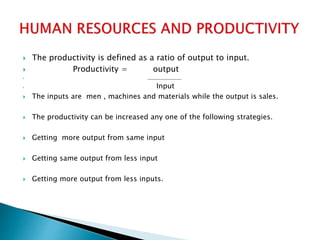
 The productivity is defined as a ratio of output to input.
 Productivity = output
 ___________________
 Input
 The inputs are men , machines and materials while the output is sales.
 The productivity can be increased any one of the following strategies.
 Getting more output from same input
 Getting same output from less input
 Getting more output from less inputs.
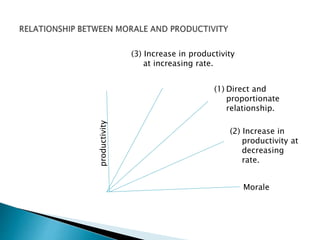
productivity
Morale
(1) Direct and
proportionate
relationship.
(2) Increase in
productivity at
decreasing
rate.
(3) Increase in productivity
at increasing rate.
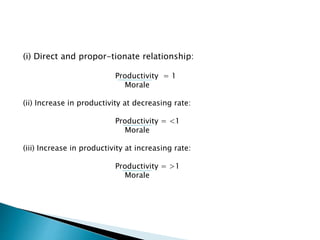
(i) Direct and propor-tionate relationship:
Productivity = 1
Morale
(ii) Increase in productivity at decreasing rate:
Productivity = <1
Morale
(iii) Increase in productivity at increasing rate:
Productivity = >1
Morale
 T he good supervisors role is crucial in a any organization because he is a
trainer , faciliator , mentor and motivator. He is supposed to possess the
following types of skills as well as qualities of a good person
 TECHNICAL SKILL
 TO BE FACILIATOR
 TRAINER
 COMMUNICATOR
 MENTOR
 MOTIVATOR
 HUMANITARIAN APPROACH.
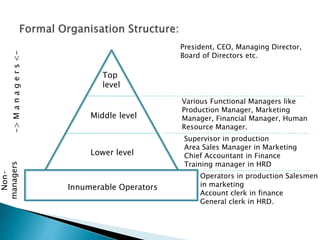
Top
level
Middle level
Lower level
Innumerable Operators
->Managers<-
Non-
managers
President, CEO, Managing Director,
Board of Directors etc.
Various Functional Managers like
Production Manager, Marketing
Manager, Financial Manager, Human
Resource Manager.
Supervisor in production
Area Sales Manager in Marketing
Chief Accountant in Finance
Training manager in HRD
Operators in production Salesmen
in marketing
Account clerk in finance
General clerk in HRD.
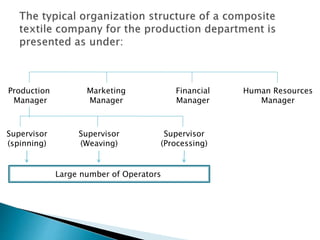
Production
Manager
Marketing
Manager
Financial
Manager
Human Resources
Manager
Supervisor
(spinning)
Supervisor
(Weaving)
Supervisor
(Processing)
Large number of Operators
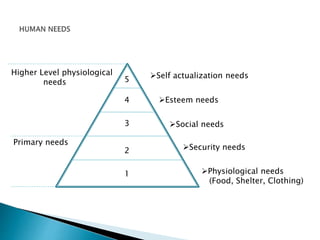
5
4
3
2
1
Self actualization needs
Esteem needs
Social needs
Security needs
Physiological needs
(Food, Shelter, Clothing)
Higher Level physiological
needs
Primary needs
 Every individual first gives importance to the fulfillment of the primary needs.
The primary needs are biological in nature and occurs at lower level.
 The individual possesses a strong motivation to work for fulfilling these
primary needs.
 First the lower level needs are satisfied then only people are motivated for
the attainment of the higher level needs.
 The higher level needs are social needs , esteem needs and self actualization
needs.
 Social needs are the needs arising from a sense of belonging and social
acceptance. These needs are reflected in the behavior like love, friendship ,
affection, social interaction.
 Esteem needs –it shows achievement, prestige, status, ego and power
 The self actualization needs---- it strives to identify the work involving
creativity and innovative opportunities resulting in to personal growth and
attainment of successor and excellence.
 Men or human resources are working in the organization through the
interaction with the other persons. Thus, two or more persons are
performing the activities in a group, then the study and management of
human relations in a group behavior becomes essential .The study of the
interpersonal relations, attitude of the persons towards the work and
towards other co-employees, the mental health of the persons etc are
important to enchance the efficiency and effectiveness of the human
resources.
 Values -----values refers to the permanent desire of a person. Values are
based on the individual perception of a person
 ATTITUDE --- An attitude of an individual in the organization is based on his
values and the resultant perceptions. The attitude of a person could be
positive, negative, committed, carefree or of similar nature depending upon
the individual values and perceptions.
 The value with a positive attitude in the interpersonal relations avails the
following benefits.
 To the company
 It increases productivity of the resources.
 It facilitates coordination of efforts developing warm relations with peers.
 It develops regards for superiors and higher management.
 It develops loyalty and honesty in job performance. It also develops
dedication and commitment towards the organization
 To the employee
 It helps in personal growth and career development.
 To bring up the willingness to work upto the ability to work.
 To seize the opportunities of development and growth.
 To maintain long tenure with the company
 To honour and follow the company philosophy, policy, procedure
and traditions.
 The employee should be committed to the assignment.
 An employee should show active participation in the participate
decisions….
 MISSION
 VISION
 INNOVATIVE CREATIVITY
 INITIATIVE
 ACHIEVEMENT MOTIVATION
 ANALYTICAL FACULTY
 PRESERVANCE
 OPTIMISTIC
 POSITIVE SELF CONCEPT
 MANAGERIAL COMPETENCE
 MATURED DECESION MAKER
 ENTERPRISING NATURE
 EMOTIONAL STABILITY
 POSITIVE OUTLOOK
NEED FOR TRAINING.
 Training primarily involves the development of the abilities of the human
resource. Training develops the skill and knowledge of the employee
which is useful for the job performance.
NEED FOR THE TRAINING
 In the modern competitive world training is considered inevitable. The need
for the training arises due to the following factors
 The human resource is not available in a form needed by accompany. Even
an experience employee can be a new to the new environment. Such gap can
be filled up only through proper training.
 Growth is the natural process in a career path of an employee. The training
fulfils such desire of growth of an employee.
 HIGH PRODUCTIVITY
 COST CONTROL
 COST REDUCTION
 HIGH QUALITY
 REDUCED SUPERVISION
 REDUCTION IN HAZZARDS AND ACCIDENTS
 BALANCED ORGANIZATION STRUCTURE
 IMPROVED MORALE,DISCIPLINE AND PERFORMANCE
STANDARD
 JOB SATISFACTION
 Among all 4 m resources, men resource is the only resource which is
not subject to the rated capacity. Machines,materials and money
have fixed and rated maximum capacity beyond which they cannot
produce excess output. Human resource is the only resource if
handled properly and motivated intelligently can produce miracles in
terms of bringing out their potentialities and excellence in them.
 General behavior of the human being is such that there always exist
a gap between the ability to work and willingness to work upto their
ability.
 Motivational efforts also encourage the people to develop their skills
and abilities through training and development.
 Highly motivated group behaves in a professional manner. People in
the organization performs their jobs in a co-operative and
co-ordinated manner
 Motivational efforts contribute to the job-satisfaction.
 As the oiling and greasing ensures smooth operations of
machines, the counselling and mentoring, fosters smoothness in
interpersonal relations and ensures job satisfaction.
 Counselling and mentoring moulds the human behavior towards
positive outlook and eliminates the misunderstanding and the
resultant conflicts .
 Counselling and mentoring is an interactive process and
improves the mental health of a person.
NEED FOR COUNSELLING
 The counselling is the process of handling the mental
disturbance of a person. In the organizational set up, counselling
becomes necessary due to following
 An employee is facing a problem
 Generation of self-confidence.
 Elimination of misunderstanding
 Elimination of the emotional tension
 Development of matured understanding.
USE OF COUNSELLING AND MENTORING.
 Counselling and Mentoring improve the mental health of the
mentally week employees. It is useful as under.
A SELF-CONTROL AND SATISFACTION
 Control on emotions and sentiments.
 Faces the failures
 Develops the tolerance.
 Becomes light hearted and readily accepts mistakes.
 Rational evaluation of successes and failures
 Accepts the failure
 Develops a self-respect
 Develops self-confidence to meet any sudden and
unexpected developments.
 Develops the satisfied mental state.
B FAVOURABLE INTERACTIONS WITH OTHERS.
 Develops concern for others.
 Develops and maintains long term relations with others.
 Develops confidence in others and makes other develop
confidence in him
 They develop co-ordination and co-operative attitude
towards co-workers and peers.
 C DEVELOPMENT OF COMPETENCE TO MEET THE
CHALLENGES IN LIFE….
 They develop competence to resolve the problems as and when they
arise in life.
 They accepts the responsibilities and acts accordingly.
 They understand the environment under which they are working and
strive their best to adjust with them.
 They look forward and plan accordingly without disturbed by future
uncertainties.
 They always welcome new thoughts.
 They set the targets at a level achievable by them
 They will understand the self and decides accordingly.
 They strive to bring best in them and get satisfied with them….
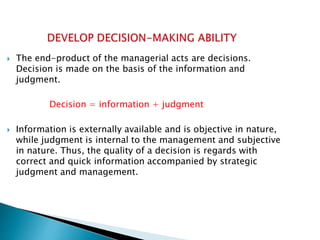
 The end-product of the managerial acts are decisions.
Decision is made on the basis of the information and
judgment.
Decision = information + judgment
 Information is externally available and is objective in nature,
while judgment is internal to the management and subjective
in nature. Thus, the quality of a decision is regards with
correct and quick information accompanied by strategic
judgment and management.
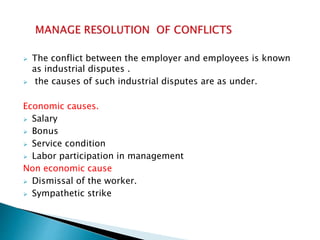
 The conflict between the employer and employees is known
as industrial disputes .
 the causes of such industrial disputes are as under.
Economic causes.
 Salary
 Bonus
 Service condition
 Labor participation in management
Non economic cause
 Dismissal of the worker.
 Sympathetic strike
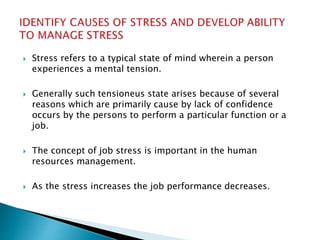
 Stress refers to a typical state of mind wherein a person
experiences a mental tension.
 Generally such tensioneus state arises because of several
reasons which are primarily cause by lack of confidence
occurs by the persons to perform a particular function or a
job.
 The concept of job stress is important in the human
resources management.
 As the stress increases the job performance decreases.
Human resources management

Human resources management

  • 1.
    BY INDRAKUMAR R PADWANI BEMECHANICAL MBA MARKETING PGDCA LECTURER IN MECHANICAL ENGG DEPT GOVERNMENT POLYTECHNIC GODHRA GUJARAT
  • 2.
     Human resourcemanagement is a process of procuring, developing and retaining the competent people in the organization who contributes in achieving the organizational goals efficiently and effectively.  Any economic activity generally consumes four word i.e is men , machines, materials and money …among all these economic resources human resources is important .  Human resource is a living resource.  Diversity in ability to work and willingness to work.  The degree of exacting the obedience and control.
  • 3.
     MANAGERIAL FUNCTIONS PLANNING  ORGANIZING  DIRECTING  CONTROLLING  HARDCORE FUNCTIONS OF HRM  PROCUREMENT—THIS FUNCTIONS DEALS WITH SELECTION,TRAINING,INDUCTION AND PLACEMENT ON THE JOB  DEVELOPMENTAL FUNCTIONS  COMPENSTION  INTEGRATION  MAINTENANCE
  • 4.
     Manpower planning----Estimation of the human needs based on employee turnover and growth requirments  Recruitment , selection and placement----- the process of identifying the sources of manpower and making appropriate selection based on successive screening  Training and development----- the development of human resource for enhancing their abilities  Motivation---- to motivate the person for developing the willingness to work upto the ability to work .
  • 5.
     Rewards andcompensation-----the reward system should encourage the performance and the development of excellence. This is attained through the bonus , incentives.  Group dynamics and behavioral management---- to appreciate and fulfill the psychological needs of the employees.  Productivity and morale---- the organization should provide opportunities for improving the productivity and the enhancement of the work morale  Industrial relations---- to encourage the formal grouping of the employees in the form of trade unions.
  • 6.
     The productivityis defined as a ratio of output to input.  Productivity = output  ___________________  Input  The inputs are men , machines and materials while the output is sales.  The productivity can be increased any one of the following strategies.  Getting more output from same input  Getting same output from less input  Getting more output from less inputs.
  • 7.
    productivity Morale (1) Direct and proportionate relationship. (2)Increase in productivity at decreasing rate. (3) Increase in productivity at increasing rate.
  • 8.
    (i) Direct andpropor-tionate relationship: Productivity = 1 Morale (ii) Increase in productivity at decreasing rate: Productivity = <1 Morale (iii) Increase in productivity at increasing rate: Productivity = >1 Morale
  • 9.
     T hegood supervisors role is crucial in a any organization because he is a trainer , faciliator , mentor and motivator. He is supposed to possess the following types of skills as well as qualities of a good person  TECHNICAL SKILL  TO BE FACILIATOR  TRAINER  COMMUNICATOR  MENTOR  MOTIVATOR  HUMANITARIAN APPROACH.
  • 10.
    Top level Middle level Lower level InnumerableOperators ->Managers<- Non- managers President, CEO, Managing Director, Board of Directors etc. Various Functional Managers like Production Manager, Marketing Manager, Financial Manager, Human Resource Manager. Supervisor in production Area Sales Manager in Marketing Chief Accountant in Finance Training manager in HRD Operators in production Salesmen in marketing Account clerk in finance General clerk in HRD.
  • 11.
  • 12.
    5 4 3 2 1 Self actualization needs Esteemneeds Social needs Security needs Physiological needs (Food, Shelter, Clothing) Higher Level physiological needs Primary needs
  • 13.
     Every individualfirst gives importance to the fulfillment of the primary needs. The primary needs are biological in nature and occurs at lower level.  The individual possesses a strong motivation to work for fulfilling these primary needs.  First the lower level needs are satisfied then only people are motivated for the attainment of the higher level needs.  The higher level needs are social needs , esteem needs and self actualization needs.  Social needs are the needs arising from a sense of belonging and social acceptance. These needs are reflected in the behavior like love, friendship , affection, social interaction.  Esteem needs –it shows achievement, prestige, status, ego and power  The self actualization needs---- it strives to identify the work involving creativity and innovative opportunities resulting in to personal growth and attainment of successor and excellence.
  • 14.
     Men orhuman resources are working in the organization through the interaction with the other persons. Thus, two or more persons are performing the activities in a group, then the study and management of human relations in a group behavior becomes essential .The study of the interpersonal relations, attitude of the persons towards the work and towards other co-employees, the mental health of the persons etc are important to enchance the efficiency and effectiveness of the human resources.  Values -----values refers to the permanent desire of a person. Values are based on the individual perception of a person  ATTITUDE --- An attitude of an individual in the organization is based on his values and the resultant perceptions. The attitude of a person could be positive, negative, committed, carefree or of similar nature depending upon the individual values and perceptions.
  • 15.
     The valuewith a positive attitude in the interpersonal relations avails the following benefits.  To the company  It increases productivity of the resources.  It facilitates coordination of efforts developing warm relations with peers.  It develops regards for superiors and higher management.  It develops loyalty and honesty in job performance. It also develops dedication and commitment towards the organization  To the employee  It helps in personal growth and career development.
  • 16.
     To bringup the willingness to work upto the ability to work.  To seize the opportunities of development and growth.  To maintain long tenure with the company  To honour and follow the company philosophy, policy, procedure and traditions.  The employee should be committed to the assignment.  An employee should show active participation in the participate decisions….
  • 17.
     MISSION  VISION INNOVATIVE CREATIVITY  INITIATIVE  ACHIEVEMENT MOTIVATION  ANALYTICAL FACULTY  PRESERVANCE  OPTIMISTIC  POSITIVE SELF CONCEPT  MANAGERIAL COMPETENCE  MATURED DECESION MAKER  ENTERPRISING NATURE  EMOTIONAL STABILITY  POSITIVE OUTLOOK
  • 18.
    NEED FOR TRAINING. Training primarily involves the development of the abilities of the human resource. Training develops the skill and knowledge of the employee which is useful for the job performance. NEED FOR THE TRAINING  In the modern competitive world training is considered inevitable. The need for the training arises due to the following factors  The human resource is not available in a form needed by accompany. Even an experience employee can be a new to the new environment. Such gap can be filled up only through proper training.  Growth is the natural process in a career path of an employee. The training fulfils such desire of growth of an employee.
  • 19.
     HIGH PRODUCTIVITY COST CONTROL  COST REDUCTION  HIGH QUALITY  REDUCED SUPERVISION  REDUCTION IN HAZZARDS AND ACCIDENTS  BALANCED ORGANIZATION STRUCTURE  IMPROVED MORALE,DISCIPLINE AND PERFORMANCE STANDARD  JOB SATISFACTION
  • 20.
     Among all4 m resources, men resource is the only resource which is not subject to the rated capacity. Machines,materials and money have fixed and rated maximum capacity beyond which they cannot produce excess output. Human resource is the only resource if handled properly and motivated intelligently can produce miracles in terms of bringing out their potentialities and excellence in them.  General behavior of the human being is such that there always exist a gap between the ability to work and willingness to work upto their ability.  Motivational efforts also encourage the people to develop their skills and abilities through training and development.  Highly motivated group behaves in a professional manner. People in the organization performs their jobs in a co-operative and co-ordinated manner  Motivational efforts contribute to the job-satisfaction.
  • 21.
     As theoiling and greasing ensures smooth operations of machines, the counselling and mentoring, fosters smoothness in interpersonal relations and ensures job satisfaction.  Counselling and mentoring moulds the human behavior towards positive outlook and eliminates the misunderstanding and the resultant conflicts .  Counselling and mentoring is an interactive process and improves the mental health of a person. NEED FOR COUNSELLING  The counselling is the process of handling the mental disturbance of a person. In the organizational set up, counselling becomes necessary due to following  An employee is facing a problem  Generation of self-confidence.
  • 22.
     Elimination ofmisunderstanding  Elimination of the emotional tension  Development of matured understanding. USE OF COUNSELLING AND MENTORING.  Counselling and Mentoring improve the mental health of the mentally week employees. It is useful as under. A SELF-CONTROL AND SATISFACTION  Control on emotions and sentiments.  Faces the failures  Develops the tolerance.  Becomes light hearted and readily accepts mistakes.
  • 23.
     Rational evaluationof successes and failures  Accepts the failure  Develops a self-respect  Develops self-confidence to meet any sudden and unexpected developments.  Develops the satisfied mental state. B FAVOURABLE INTERACTIONS WITH OTHERS.  Develops concern for others.  Develops and maintains long term relations with others.  Develops confidence in others and makes other develop confidence in him  They develop co-ordination and co-operative attitude towards co-workers and peers.
  • 24.
     C DEVELOPMENTOF COMPETENCE TO MEET THE CHALLENGES IN LIFE….  They develop competence to resolve the problems as and when they arise in life.  They accepts the responsibilities and acts accordingly.  They understand the environment under which they are working and strive their best to adjust with them.  They look forward and plan accordingly without disturbed by future uncertainties.  They always welcome new thoughts.  They set the targets at a level achievable by them  They will understand the self and decides accordingly.  They strive to bring best in them and get satisfied with them….
  • 25.
     The end-productof the managerial acts are decisions. Decision is made on the basis of the information and judgment. Decision = information + judgment  Information is externally available and is objective in nature, while judgment is internal to the management and subjective in nature. Thus, the quality of a decision is regards with correct and quick information accompanied by strategic judgment and management.
  • 26.
     The conflictbetween the employer and employees is known as industrial disputes .  the causes of such industrial disputes are as under. Economic causes.  Salary  Bonus  Service condition  Labor participation in management Non economic cause  Dismissal of the worker.  Sympathetic strike
  • 27.
     Stress refersto a typical state of mind wherein a person experiences a mental tension.  Generally such tensioneus state arises because of several reasons which are primarily cause by lack of confidence occurs by the persons to perform a particular function or a job.  The concept of job stress is important in the human resources management.  As the stress increases the job performance decreases.