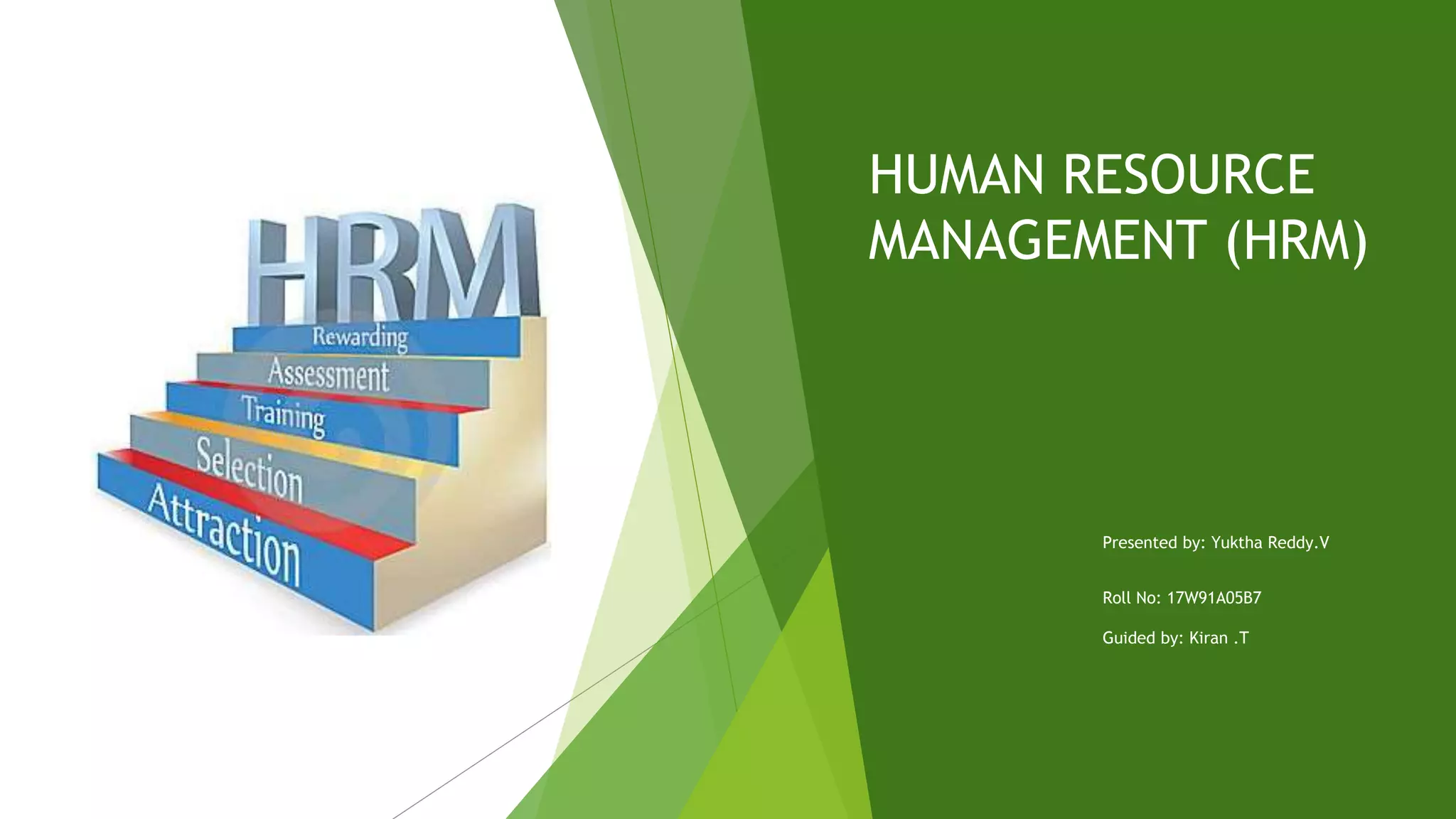
HUMAN RESOURCE
MANAGEMENT (HRM)
Presented by: Yuktha Reddy.V
Roll No: 17W91A05B7
Guided by: Kiran .T
INTRODCTION:
Behind the production of every product or service there is an human mind,
effort and working hours by man.
No product or service can be produced without help of human being. Human
being is the fundamental resource for making or constructing anything.
Today many experts claim that machines and technology are replacing human
resource and minimising their role or effort.
However, indeed, machines and technology are built by the humans ; machines
need to be operated or at least monitored by humans.
Maybe because of this reason, companies have continuously been searching for
talented, skilled and qualified professionals to further develop latest machines
and technology, which again have to be controlled or Monitored by humans to
bring out products
Why name HRM?
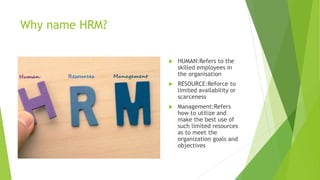
 HUMAN:Refers to the
skilled employees in
the organisation
 RESOURCE:Reforce to
limited availability or
scarceness
 Management:Refers
how to utilize and
make the best use of
such limited resources
as to meet the
organization goals and
objectives
HUMAN RESOURCE DEVELOPMENT:
Human resources development (HRD) refers to the vast field of training and
development provided by organizations to increase the knowledge, skills,
education, and abilities of their employees.
In many organizations, the human resources development process begins
upon the hiring of a new employee and continues throughout that employee's
tenure with the organization.
Many employees come into an organization with only a basic level of skills
and experience and must receive training in order to do their jobs
effectively.
Others may already have the necessary skills to do the job, but don't have
knowledge related to that particular organization.
HR development is designed to give employees the information they need to
adapt to that organization's culture and to do their jobs effectively.
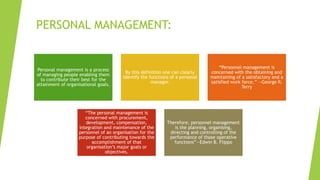
PERSONAL MANAGEMENT:
Personal management is a process
of managing people enabling them
to contribute their best for the
attainment of organisational goals.
By this definition one can clearly
identify the functions of a personal
manager.
“Personnel management is
concerned with the obtaining and
maintaining of a satisfactory and a
satisfied work force.” —George R.
Terry
“The personal management is
concerned with procurement,
development, compensation,
integration and maintenance of the
personnel of an organisation for the
purpose of contributing towards the
accomplishment of that
organisation’s major goals or
objectives.
Therefore, personnel management
is the planning, organising,
directing and controlling of the
performance of those operative
functions”—Edwin B. Flippo
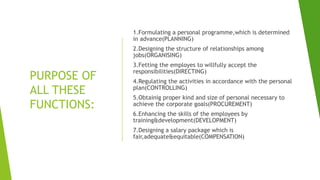
PURPOSE OF
ALL THESE
FUNCTIONS:
1.Formulating a personal programme,which is determined
in advance(PLANNING)
2.Designing the structure of relationships among
jobs(ORGANISING)
3.Fetting the employes to willfully accept the
responsibilities(DIRECTING)
4.Regulating the activities in accordance with the personal
plan(CONTROLLING)
5.Obtainig proper kind and size of personal necessary to
achieve the corporate goals(PROCUREMENT)
6.Enhancing the skills of the employees by
training&development(DEVELOPMENT)
7.Designing a salary package which is
fair,adequate&equitable(COMPENSATION)
FEATURES OF
PERSONAL
MANAGEMENT:
A)It is concerned with employees.
B)It is concerned with personal policies.
C)Creation of cordial environment.
D)It is a continuous nature.
E)It ensures Economical , Social &
Individual satisfaction
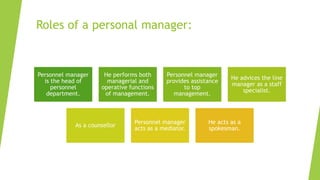
Roles of a personal manager:
Personnel manager
is the head of
personnel
department.
He performs both
managerial and
operative functions
of management.
Personnel manager
provides assistance
to top
management.
He advices the line
manager as a staff
specialist.
As a counsellor
Personnel manager
acts as a mediator.
He acts as a
spokesman.
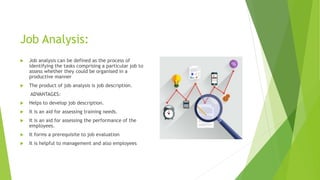
Job Analysis:
 Job analysis can be defined as the process of
identifying the tasks comprising a particular job to
assess whether they could be organised in a
productive manner
 The product of job analysis is job description.
ADVANTAGES:
 Helps to develop job description.
 It is an aid for assessing training needs.
 It is an aid for assessing the performance of the
employees.
 It forms a prerequisite to job evaluation
 It is helpful to management and also employees
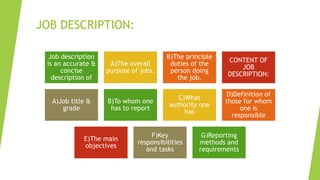
JOB DESCRIPTION:
Job description
is an accurate &
concise
description of
A)The overall
purpose of jobs.
B)The principle
duties of the
person doing
the job.
CONTENT OF
JOB
DESCRIPTION:
A)Job title &
grade
B)To whom one
has to report
C)What
authority one
has
D)Definition of
those for whom
one is
responsible
E)The main
objectives
F)Key
responsibilities
and tasks
G)Reporting
methods and
requirements
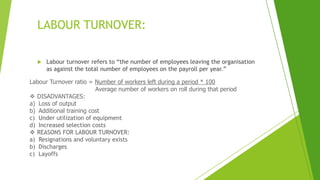
LABOUR TURNOVER:
 Labour turnover refers to “the number of employees leaving the organisation
as against the total number of employees on the payroll per year.”
Labour Turnover ratio = Number of workers left during a period * 100
Average number of workers on roll during that period
 DISADVANTAGES:
a) Loss of output
b) Additional training cost
c) Under utilization of equipment
d) Increased selection costs
 REASONS FOR LABOUR TURNOVER:
a) Resignations and voluntary exists
b) Discharges
c) Layoffs
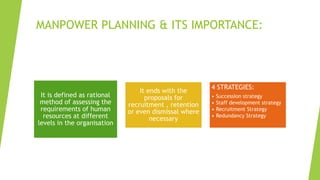
MANPOWER PLANNING & ITS IMPORTANCE:
It is defined as rational
method of assessing the
requirements of human
resources at different
levels in the organisation
It ends with the
proposals for
recruitment , retention
or even dismissal where
necessary
4 STRATEGIES:
• Succession strategy
• Staff development strategy
• Recruitment Strategy
• Redundancy Strategy
SELECTION:
The process of identifying the most suitable persons for the organisation is called selection.
The main purpose of selection is to chose the right person for right job.
Normally the selection process involves the following stages:
A)Initial screening/shortlisting
B)Comprehensive application /biodata screening
C)Aptitude/written tests
D)Group discussion
E)Personal interview
F)Medical examination
G)Employment offer
TRAINING :
 Training It is a short-term process of utilising systematic and organised
procedures by which the staff acquires specific technical knowledge and
functional skills for definite purpose.
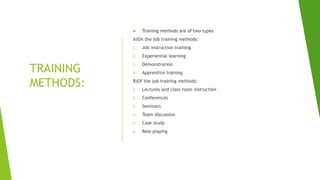
TRAINING
METHODS:
 Training methods are of two types
A)On the job training methods:
1. Job instruction training
2. Experiential learning
3. Demonstration
4. Apprentice training
B)Of the job training methods:
1. Lectures and class room instruction
2. Conferences
3. Seminars
4. Team discussion
5. Case study
6. Role playing
Development:
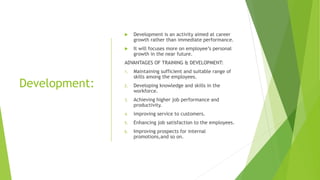
 Development is an activity aimed at career
growth rather than immediate performance.
 It will focuses more on employee’s personal
growth in the near future.
ADVANTAGES OF TRAINING & DEVELOPMENT:
1. Maintaining sufficient and suitable range of
skills among the employees.
2. Developing knowledge and skills in the
workforce.
3. Achieving higher job performance and
productivity.
4. improving service to customers.
5. Enhancing job satisfaction to the employees.
6. Improving prospects for internal
promotions,and so on.
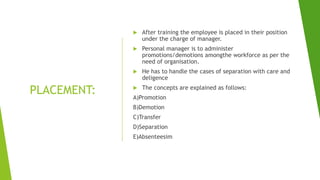
PLACEMENT:
 After training the employee is placed in their position
under the charge of manager.
 Personal manager is to administer
promotions/demotions amongthe workforce as per the
need of organisation.
 He has to handle the cases of separation with care and
deligence
 The concepts are explained as follows:
A)Promotion
B)Demotion
C)Transfer
D)Separation
E)Absenteesim
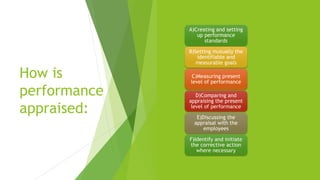
PERFORMANCE APPRAISAL:
How is
performance
appraised:
A)Creating and setting
up performance
standards
B)Setting mutually the
identifiable and
measurable goals
C)Measuring present
level of performance
D)Comparing and
appraising the present
level of performance
E)Discussing the
appraisal with the
employees
F)Identify and initiate
the corrective action
where necessary
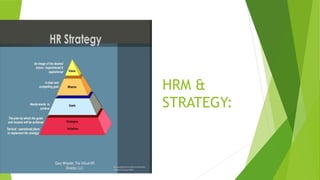
HRM &
STRATEGY:
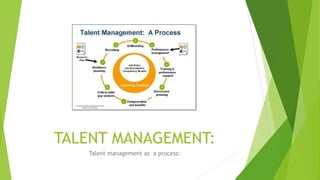
TALENT MANAGEMENT:
Talent management as a process:
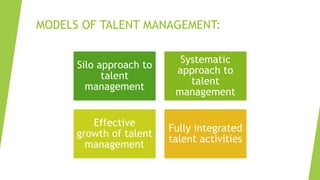
MODELS OF TALENT MANAGEMENT:
Silo approach to
talent
management
Systematic
approach to
talent
management
Effective
growth of talent
management
Fully integrated
talent activities
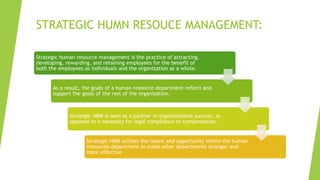
STRATEGIC HUMN RESOUCE MANAGEMENT:
Strategic human resource management is the practice of attracting,
developing, rewarding, and retaining employees for the benefit of
both the employees as individuals and the organization as a whole.
As a result, the goals of a human resource department reflect and
support the goals of the rest of the organization.
Strategic HRM is seen as a partner in organizational success, as
opposed to a necessity for legal compliance or compensation.
Strategic HRM utilizes the talent and opportunity within the human
resources department to make other departments stronger and
more effective
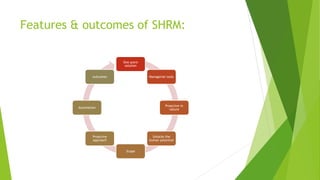
Features & outcomes of SHRM:
One point
solution
Managerial tools
Proactive in
nature
Unlocks the
human potential
Scope
Proactive
approach
Automation
outcomes
HRM

HRM

  • 1.
    HUMAN RESOURCE MANAGEMENT (HRM) Presentedby: Yuktha Reddy.V Roll No: 17W91A05B7 Guided by: Kiran .T
  • 2.
    INTRODCTION: Behind the productionof every product or service there is an human mind, effort and working hours by man. No product or service can be produced without help of human being. Human being is the fundamental resource for making or constructing anything. Today many experts claim that machines and technology are replacing human resource and minimising their role or effort. However, indeed, machines and technology are built by the humans ; machines need to be operated or at least monitored by humans. Maybe because of this reason, companies have continuously been searching for talented, skilled and qualified professionals to further develop latest machines and technology, which again have to be controlled or Monitored by humans to bring out products
  • 3.
    Why name HRM? HUMAN:Refers to the skilled employees in the organisation  RESOURCE:Reforce to limited availability or scarceness  Management:Refers how to utilize and make the best use of such limited resources as to meet the organization goals and objectives
  • 4.
    HUMAN RESOURCE DEVELOPMENT: Humanresources development (HRD) refers to the vast field of training and development provided by organizations to increase the knowledge, skills, education, and abilities of their employees. In many organizations, the human resources development process begins upon the hiring of a new employee and continues throughout that employee's tenure with the organization. Many employees come into an organization with only a basic level of skills and experience and must receive training in order to do their jobs effectively. Others may already have the necessary skills to do the job, but don't have knowledge related to that particular organization. HR development is designed to give employees the information they need to adapt to that organization's culture and to do their jobs effectively.
  • 5.
    PERSONAL MANAGEMENT: Personal managementis a process of managing people enabling them to contribute their best for the attainment of organisational goals. By this definition one can clearly identify the functions of a personal manager. “Personnel management is concerned with the obtaining and maintaining of a satisfactory and a satisfied work force.” —George R. Terry “The personal management is concerned with procurement, development, compensation, integration and maintenance of the personnel of an organisation for the purpose of contributing towards the accomplishment of that organisation’s major goals or objectives. Therefore, personnel management is the planning, organising, directing and controlling of the performance of those operative functions”—Edwin B. Flippo
  • 6.
    PURPOSE OF ALL THESE FUNCTIONS: 1.Formulatinga personal programme,which is determined in advance(PLANNING) 2.Designing the structure of relationships among jobs(ORGANISING) 3.Fetting the employes to willfully accept the responsibilities(DIRECTING) 4.Regulating the activities in accordance with the personal plan(CONTROLLING) 5.Obtainig proper kind and size of personal necessary to achieve the corporate goals(PROCUREMENT) 6.Enhancing the skills of the employees by training&development(DEVELOPMENT) 7.Designing a salary package which is fair,adequate&equitable(COMPENSATION)
  • 7.
    FEATURES OF PERSONAL MANAGEMENT: A)It isconcerned with employees. B)It is concerned with personal policies. C)Creation of cordial environment. D)It is a continuous nature. E)It ensures Economical , Social & Individual satisfaction
  • 8.
    Roles of apersonal manager: Personnel manager is the head of personnel department. He performs both managerial and operative functions of management. Personnel manager provides assistance to top management. He advices the line manager as a staff specialist. As a counsellor Personnel manager acts as a mediator. He acts as a spokesman.
  • 11.
    Job Analysis:  Jobanalysis can be defined as the process of identifying the tasks comprising a particular job to assess whether they could be organised in a productive manner  The product of job analysis is job description. ADVANTAGES:  Helps to develop job description.  It is an aid for assessing training needs.  It is an aid for assessing the performance of the employees.  It forms a prerequisite to job evaluation  It is helpful to management and also employees
  • 12.
    JOB DESCRIPTION: Job description isan accurate & concise description of A)The overall purpose of jobs. B)The principle duties of the person doing the job. CONTENT OF JOB DESCRIPTION: A)Job title & grade B)To whom one has to report C)What authority one has D)Definition of those for whom one is responsible E)The main objectives F)Key responsibilities and tasks G)Reporting methods and requirements
  • 13.
    LABOUR TURNOVER:  Labourturnover refers to “the number of employees leaving the organisation as against the total number of employees on the payroll per year.” Labour Turnover ratio = Number of workers left during a period * 100 Average number of workers on roll during that period  DISADVANTAGES: a) Loss of output b) Additional training cost c) Under utilization of equipment d) Increased selection costs  REASONS FOR LABOUR TURNOVER: a) Resignations and voluntary exists b) Discharges c) Layoffs
  • 14.
    MANPOWER PLANNING &ITS IMPORTANCE: It is defined as rational method of assessing the requirements of human resources at different levels in the organisation It ends with the proposals for recruitment , retention or even dismissal where necessary 4 STRATEGIES: • Succession strategy • Staff development strategy • Recruitment Strategy • Redundancy Strategy
  • 15.
    SELECTION: The process ofidentifying the most suitable persons for the organisation is called selection. The main purpose of selection is to chose the right person for right job. Normally the selection process involves the following stages: A)Initial screening/shortlisting B)Comprehensive application /biodata screening C)Aptitude/written tests D)Group discussion E)Personal interview F)Medical examination G)Employment offer
  • 16.
    TRAINING :  TrainingIt is a short-term process of utilising systematic and organised procedures by which the staff acquires specific technical knowledge and functional skills for definite purpose.
  • 17.
    TRAINING METHODS:  Training methodsare of two types A)On the job training methods: 1. Job instruction training 2. Experiential learning 3. Demonstration 4. Apprentice training B)Of the job training methods: 1. Lectures and class room instruction 2. Conferences 3. Seminars 4. Team discussion 5. Case study 6. Role playing
  • 18.
    Development:  Development isan activity aimed at career growth rather than immediate performance.  It will focuses more on employee’s personal growth in the near future. ADVANTAGES OF TRAINING & DEVELOPMENT: 1. Maintaining sufficient and suitable range of skills among the employees. 2. Developing knowledge and skills in the workforce. 3. Achieving higher job performance and productivity. 4. improving service to customers. 5. Enhancing job satisfaction to the employees. 6. Improving prospects for internal promotions,and so on.
  • 19.
    PLACEMENT:  After trainingthe employee is placed in their position under the charge of manager.  Personal manager is to administer promotions/demotions amongthe workforce as per the need of organisation.  He has to handle the cases of separation with care and deligence  The concepts are explained as follows: A)Promotion B)Demotion C)Transfer D)Separation E)Absenteesim
  • 20.
  • 21.
    How is performance appraised: A)Creating andsetting up performance standards B)Setting mutually the identifiable and measurable goals C)Measuring present level of performance D)Comparing and appraising the present level of performance E)Discussing the appraisal with the employees F)Identify and initiate the corrective action where necessary
  • 22.
  • 23.
  • 24.
    MODELS OF TALENTMANAGEMENT: Silo approach to talent management Systematic approach to talent management Effective growth of talent management Fully integrated talent activities
  • 25.
    STRATEGIC HUMN RESOUCEMANAGEMENT: Strategic human resource management is the practice of attracting, developing, rewarding, and retaining employees for the benefit of both the employees as individuals and the organization as a whole. As a result, the goals of a human resource department reflect and support the goals of the rest of the organization. Strategic HRM is seen as a partner in organizational success, as opposed to a necessity for legal compliance or compensation. Strategic HRM utilizes the talent and opportunity within the human resources department to make other departments stronger and more effective
  • 26.
    Features & outcomesof SHRM: One point solution Managerial tools Proactive in nature Unlocks the human potential Scope Proactive approach Automation outcomes