The concept of HRD was formally introduced by
Leonard Nadler in 1969, in a conference organized by the
American Society for Training and Development.
Leonard Nadler defines HRD as “those learning
experiences which are organized for a specific time and
designed to bring about the possibility of behavioral
change.”
The term learning experience refers to intentional learning
and not incidental learning.
 According to Pulapa Subba Rao, HRD from the
organizational point of view is a process in which the
employees of an organization are helped/motivated to
acquire and develop technical, managerial and behavioral
knowledge, skills and abilities and mould the values,
beliefs and attitudes necessary to perform present and
future roles by realizing the highest human potential with
a view to contribute positively to the organizational,
group, individual and social goals.
Human resources management deals with procurement,
development, compensation, maintenance and utilization of
human resources.
 Recruiting the employees within the dimensions and
possibilities for developing human resources.
 Selecting those employees having potentialities for
development to meet the present and future organizational
needs.
 Analyzing, appraising and developing performance of
employees as individuals, members of group and
organizations with a view to develop them by identifying
the gaps in skills and knowledge.
 Train all the employees in acquiring new technical
skills and knowledge.
 Develop the employees in managerial and
behavioral skills and knowledge.
 Planning for succession and develop the
employees.
 Learning through job rotation, job enrichment and
empowerment.
 Changes in Economic Policies.
 Changing job requirements.
 Need for multi-skilled human resources.
 Organizational viability and transformation
process.
 Technological advances.
 Organizational complexity.
 Human relations.
 To prepare the employees to meet the present and
changing future job requirements.
 To prevent employees obsolescence.
 To develop creative abilities and talents
 To prepare employees for higher level jobs.
 To impart new entrants with basic HRD skills and
knowledge.
 To ensure smooth and efficient working of the
organization.
 To provide comprehensive framework of HRD.
 To enhance organizational capabilities.
1. Performance appraisal
2. Employees training
3. Executive development
4. Career planning and development
5. Succession planning and development
6. Organization change and organizational
development
7. Involvement in social and religious
organizations
8. Involvement in quality circles and
9. Involvement in worker‟s participation in
management.
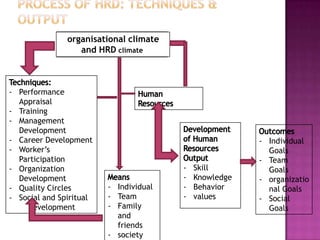
organisational climate
and HRD climate
- Performance
Appraisal
- Training
- Management
Development
- Career Development
- Worker‟s
Participation
- Organization
Development
- Quality Circles
- Social and Spiritual
Development
- Individual
- Team
- Family
and
friends
- society
- Skill
- Knowledge
- Behavior
- values
- Individual
Goals
- Team
Goals
- organizatio
nal Goals
- Social
Goals
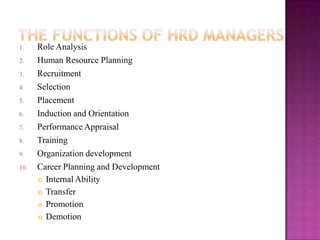
1. Role Analysis
2. Human Resource Planning
3. Recruitment
4. Selection
5. Placement
6. Induction and Orientation
7. Performance Appraisal
8. Training
9. Organization development
10. Career Planning and Development
 Internal Ability
 Transfer
 Promotion
 Demotion
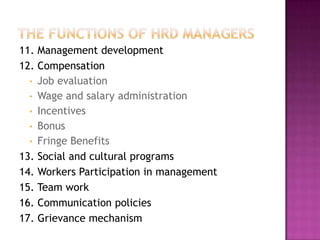
11. Management development
12. Compensation
• Job evaluation
• Wage and salary administration
• Incentives
• Bonus
• Fringe Benefits
13. Social and cultural programs
14. Workers Participation in management
15. Team work
16. Communication policies
17. Grievance mechanism
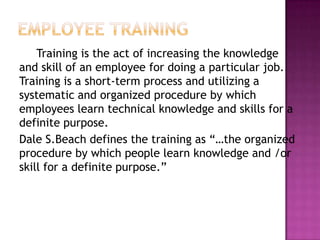
Training is the act of increasing the knowledge
and skill of an employee for doing a particular job.
Training is a short-term process and utilizing a
systematic and organized procedure by which
employees learn technical knowledge and skills for a
definite purpose.
Dale S.Beach defines the training as “…the organized
procedure by which people learn knowledge and /or
skill for a definite purpose.”
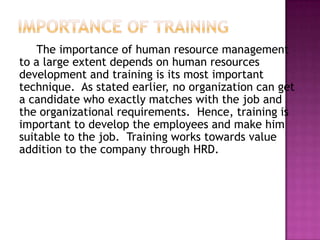
The importance of human resource management
to a large extent depends on human resources
development and training is its most important
technique. As stated earlier, no organization can get
a candidate who exactly matches with the job and
the organizational requirements. Hence, training is
important to develop the employees and make him
suitable to the job. Training works towards value
addition to the company through HRD.
How training Benefits the Organization
 Improves the job knowledge and skills at all level of the
organization.
 Improves the morale of the workforce.
 Helps people identify with organizational goals.
 Helps create a better corporate image.
 Aids in understanding and carrying out organizational
policies.
 Improves labour -management relations.
 Helps employees adjust to change.
 Helps individual in making better decisions and
effective problem solving.
 Aids in encouraging and achieving self-development
and self-confidence.
 Increase job satisfaction and recognition.
 Helps eliminate fear in attempting new tasks.
 Provides information for improving leadership
knowledge, communication skills and attitudes.
Specially, the need for the training arises to the
following reasons:
1. To match the employee specifications with job
requirements and organizational needs.
2. Organizational viability and the transformation
process.
3. Technological Advances.
4. Organizational Complexity
5. Human Relations
6. Change in the Job Assignment.
Generally, line managers ask the personnel manager
to formulate the training policies. The personnel
manager formulates the following training objectives
in keeping with the company‟s goals and objectives:
1. To prepare the employee, both new and old to
meet the present as well as the changing
requirements of the job and the organization.
2. To prevent obsolescence.
3. To prepare employees for higher level tasks.
4. To develop the potentialities of people for the next
level job.
5. To ensure smooth and efficient working of a
department.
6. To assist employees to function more effectively in
their present positions by exposing them to the latest
concepts, information and techniques and developing the
skills they will need in their particular fields.
7. To ensure economical output of required quality.
The following methods are used to assess training needs:
1. Organizational requirements/weakness.
2. Departmental requirements/weaknesses.
3. Job specifications and employee specifications.
4. Identifying specific problems.
5. Anticipating future problems.
6. Management‟s requests.
7. Observation.
8. Interviews.
9. Group conferences.
10. Questionnaire surveys.
11. Test or examinations.
12. Check lists.
13. Performance appraisal.
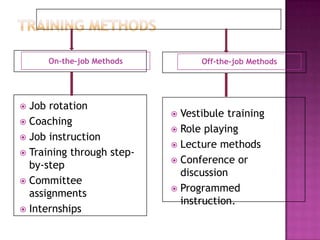
On-the-job Methods Off-the-job Methods
 Job rotation
 Coaching
 Job instruction
 Training through step-
by-step
 Committee
assignments
 Internships
 Vestibule training
 Role playing
 Lecture methods
 Conference or
discussion
 Programmed
instruction.
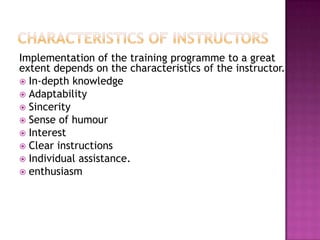
Implementation of the training programme to a great
extent depends on the characteristics of the instructor.
 In-depth knowledge
 Adaptability
 Sincerity
 Sense of humour
 Interest
 Clear instructions
 Individual assistance.
 enthusiasm
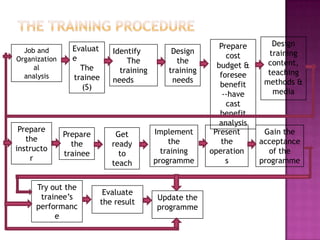
Job and
Organization
al
analysis
Evaluat
e
The
trainee
(S)
Identify
The
training
needs
Design
the
training
needs
Prepare
cost
budget &
foresee
benefit
--have
cast
benefit
analysis
Design
training
content,
teaching
methods &
media
Prepare
the
instructo
r
Prepare
the
trainee
Get
ready
to
teach
Implement
the
training
programme
Present
the
operation
s
Gain the
acceptance
of the
programme
Try out the
trainee‟s
performanc
e
Evaluate
the result
Update the
programme
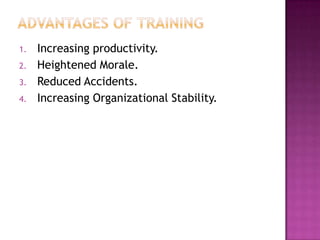
1. Increasing productivity.
2. Heightened Morale.
3. Reduced Accidents.
4. Increasing Organizational Stability.
1. Reactions
2. Learning
3. Job Behavior
4. Organization
5. Ultimate Value
RECENT DEVELOPMENT IN TRAINING
 Employee Self Initiative
 On-line Training
 Audiovisual Methods and E-Training
 Orientation Training
 Basic Skills Training
 reading & writing
 Computing
 speaking &listening
 problem solving
 managing one-self
 knowing how to learn
 Leadership skills
 Team Training
 Diversity Training
A CAREER PERTAINS TO ALL JOBS THAT ARE
HELD DURING ONE‟S WORKING LIFE.
Edwin B. Flippo defined a career as a sequence of
separate but related work activities that provides
continuity, order and meaning in a person‟s life.
Douglas T. Hall defined a career as “an
individually perceived sequence of attitudes and
behaviors associated with work related
experiences and activities over the span of the
person‟s life.”
 To attract competent persons & to retain them in
the organization.
 To provide suitable promotional opportunities.
 To improve motivation and morale.
 To reduce employee dissatisfaction and turnover
 To correct employee placement
 To increase the utilisation of managerial reserves
within an organization.
According to Paul Pigors & Charles A.Myers,
“promotion is advancement of an employee to a better
job-better in terms of greater responsibility, more
prestige of status, greater skill and especially increased
rate of pay or salary.”
TYPES OF PROMOTION:
1. Vertical Promotion
2. Up-gradation
3. Dry Promotion
 To reward committed and loyal employees
 To build loyalty and to boost morale.
 To promote interest in training, development
programmes and in team development areas.
 To promote employee‟s self development and make
them await their turn of promotions. It reduces
labour turnover.
 To utilize the employee‟s skill, knowledge.
Transfer if defined as “a lateral shift causing movement of
individuals from one position to another usually without
involving any marked change in duties, responsibilities, skills
needed or compensation.
REASONS of Transfer:
 To meet the organizational requirements
 To satisfy the employee‟s needs
 To utilise employee‟s skill, knowledge etc.,
 To correct inter-personal conflicts
 To help the employees whose working hours or place of work
is inconvenient to them.
 Production transfer: transfers caused due to changes in
production.
 Replacement transfer: transfers caused due to initiation.
 Rotation transfer: transfers initiated to increase the versatility
of employees.
 Shift transfer: transfers of an employee from one shift to
another.
 Remedial transfer: Transfers initiated to correct the wrong
placements.
 Penal transfer: Transfers initiated as a punishment for in
disciplinary action of employees.
The remaining type of internal mobility is
„demotion‟. It is the opposite of promotion.
Demotion is the reassignment of a lower level job to
an employee with delegation of responsibilities and
authority required to perform that lower level job
and normally with level pay. Organizations use
demotions less frequently as it affects the employee‟s
career prospects and morale.
 Specification of circumstances under which an
employee will be demoted like reduction in operations,
in disciplinary cases.
 Specification of a superior who is authorized &
responsible to initiate a demotion.
 Jobs from & to which demotions will be made &
specifications of lines or ladders of demotions.
 Specification of basis for demotion like length of
service, merit or both.
 It should provide for an open policy rather than a
closed policy.
 It should contain clear cut norms for judging merit &
length of service.

Human resource development

  • 2.
    The concept ofHRD was formally introduced by Leonard Nadler in 1969, in a conference organized by the American Society for Training and Development. Leonard Nadler defines HRD as “those learning experiences which are organized for a specific time and designed to bring about the possibility of behavioral change.” The term learning experience refers to intentional learning and not incidental learning.
  • 3.
     According toPulapa Subba Rao, HRD from the organizational point of view is a process in which the employees of an organization are helped/motivated to acquire and develop technical, managerial and behavioral knowledge, skills and abilities and mould the values, beliefs and attitudes necessary to perform present and future roles by realizing the highest human potential with a view to contribute positively to the organizational, group, individual and social goals.
  • 4.
    Human resources managementdeals with procurement, development, compensation, maintenance and utilization of human resources.  Recruiting the employees within the dimensions and possibilities for developing human resources.  Selecting those employees having potentialities for development to meet the present and future organizational needs.  Analyzing, appraising and developing performance of employees as individuals, members of group and organizations with a view to develop them by identifying the gaps in skills and knowledge.
  • 5.
     Train allthe employees in acquiring new technical skills and knowledge.  Develop the employees in managerial and behavioral skills and knowledge.  Planning for succession and develop the employees.  Learning through job rotation, job enrichment and empowerment.
  • 6.
     Changes inEconomic Policies.  Changing job requirements.  Need for multi-skilled human resources.  Organizational viability and transformation process.  Technological advances.  Organizational complexity.  Human relations.
  • 7.
     To preparethe employees to meet the present and changing future job requirements.  To prevent employees obsolescence.  To develop creative abilities and talents  To prepare employees for higher level jobs.  To impart new entrants with basic HRD skills and knowledge.  To ensure smooth and efficient working of the organization.  To provide comprehensive framework of HRD.  To enhance organizational capabilities.
  • 8.
    1. Performance appraisal 2.Employees training 3. Executive development 4. Career planning and development 5. Succession planning and development 6. Organization change and organizational development 7. Involvement in social and religious organizations 8. Involvement in quality circles and 9. Involvement in worker‟s participation in management.
  • 9.
    organisational climate and HRDclimate - Performance Appraisal - Training - Management Development - Career Development - Worker‟s Participation - Organization Development - Quality Circles - Social and Spiritual Development - Individual - Team - Family and friends - society - Skill - Knowledge - Behavior - values - Individual Goals - Team Goals - organizatio nal Goals - Social Goals
  • 10.
    1. Role Analysis 2.Human Resource Planning 3. Recruitment 4. Selection 5. Placement 6. Induction and Orientation 7. Performance Appraisal 8. Training 9. Organization development 10. Career Planning and Development  Internal Ability  Transfer  Promotion  Demotion
  • 11.
    11. Management development 12.Compensation • Job evaluation • Wage and salary administration • Incentives • Bonus • Fringe Benefits 13. Social and cultural programs 14. Workers Participation in management 15. Team work 16. Communication policies 17. Grievance mechanism
  • 12.
    Training is theact of increasing the knowledge and skill of an employee for doing a particular job. Training is a short-term process and utilizing a systematic and organized procedure by which employees learn technical knowledge and skills for a definite purpose. Dale S.Beach defines the training as “…the organized procedure by which people learn knowledge and /or skill for a definite purpose.”
  • 13.
    The importance ofhuman resource management to a large extent depends on human resources development and training is its most important technique. As stated earlier, no organization can get a candidate who exactly matches with the job and the organizational requirements. Hence, training is important to develop the employees and make him suitable to the job. Training works towards value addition to the company through HRD.
  • 14.
    How training Benefitsthe Organization  Improves the job knowledge and skills at all level of the organization.  Improves the morale of the workforce.  Helps people identify with organizational goals.  Helps create a better corporate image.  Aids in understanding and carrying out organizational policies.  Improves labour -management relations.  Helps employees adjust to change.
  • 15.
     Helps individualin making better decisions and effective problem solving.  Aids in encouraging and achieving self-development and self-confidence.  Increase job satisfaction and recognition.  Helps eliminate fear in attempting new tasks.  Provides information for improving leadership knowledge, communication skills and attitudes.
  • 16.
    Specially, the needfor the training arises to the following reasons: 1. To match the employee specifications with job requirements and organizational needs. 2. Organizational viability and the transformation process. 3. Technological Advances. 4. Organizational Complexity 5. Human Relations 6. Change in the Job Assignment.
  • 17.
    Generally, line managersask the personnel manager to formulate the training policies. The personnel manager formulates the following training objectives in keeping with the company‟s goals and objectives: 1. To prepare the employee, both new and old to meet the present as well as the changing requirements of the job and the organization. 2. To prevent obsolescence. 3. To prepare employees for higher level tasks.
  • 18.
    4. To developthe potentialities of people for the next level job. 5. To ensure smooth and efficient working of a department. 6. To assist employees to function more effectively in their present positions by exposing them to the latest concepts, information and techniques and developing the skills they will need in their particular fields. 7. To ensure economical output of required quality.
  • 19.
    The following methodsare used to assess training needs: 1. Organizational requirements/weakness. 2. Departmental requirements/weaknesses. 3. Job specifications and employee specifications. 4. Identifying specific problems. 5. Anticipating future problems. 6. Management‟s requests. 7. Observation. 8. Interviews. 9. Group conferences. 10. Questionnaire surveys. 11. Test or examinations. 12. Check lists. 13. Performance appraisal.
  • 20.
    On-the-job Methods Off-the-jobMethods  Job rotation  Coaching  Job instruction  Training through step- by-step  Committee assignments  Internships  Vestibule training  Role playing  Lecture methods  Conference or discussion  Programmed instruction.
  • 21.
    Implementation of thetraining programme to a great extent depends on the characteristics of the instructor.  In-depth knowledge  Adaptability  Sincerity  Sense of humour  Interest  Clear instructions  Individual assistance.  enthusiasm
  • 22.
    Job and Organization al analysis Evaluat e The trainee (S) Identify The training needs Design the training needs Prepare cost budget & foresee benefit --have cast benefit analysis Design training content, teaching methods& media Prepare the instructo r Prepare the trainee Get ready to teach Implement the training programme Present the operation s Gain the acceptance of the programme Try out the trainee‟s performanc e Evaluate the result Update the programme
  • 23.
    1. Increasing productivity. 2.Heightened Morale. 3. Reduced Accidents. 4. Increasing Organizational Stability.
  • 24.
    1. Reactions 2. Learning 3.Job Behavior 4. Organization 5. Ultimate Value RECENT DEVELOPMENT IN TRAINING  Employee Self Initiative  On-line Training  Audiovisual Methods and E-Training
  • 25.
     Orientation Training Basic Skills Training  reading & writing  Computing  speaking &listening  problem solving  managing one-self  knowing how to learn  Leadership skills  Team Training  Diversity Training
  • 26.
    A CAREER PERTAINSTO ALL JOBS THAT ARE HELD DURING ONE‟S WORKING LIFE. Edwin B. Flippo defined a career as a sequence of separate but related work activities that provides continuity, order and meaning in a person‟s life. Douglas T. Hall defined a career as “an individually perceived sequence of attitudes and behaviors associated with work related experiences and activities over the span of the person‟s life.”
  • 27.
     To attractcompetent persons & to retain them in the organization.  To provide suitable promotional opportunities.  To improve motivation and morale.  To reduce employee dissatisfaction and turnover  To correct employee placement  To increase the utilisation of managerial reserves within an organization.
  • 28.
    According to PaulPigors & Charles A.Myers, “promotion is advancement of an employee to a better job-better in terms of greater responsibility, more prestige of status, greater skill and especially increased rate of pay or salary.” TYPES OF PROMOTION: 1. Vertical Promotion 2. Up-gradation 3. Dry Promotion
  • 29.
     To rewardcommitted and loyal employees  To build loyalty and to boost morale.  To promote interest in training, development programmes and in team development areas.  To promote employee‟s self development and make them await their turn of promotions. It reduces labour turnover.  To utilize the employee‟s skill, knowledge.
  • 30.
    Transfer if definedas “a lateral shift causing movement of individuals from one position to another usually without involving any marked change in duties, responsibilities, skills needed or compensation. REASONS of Transfer:  To meet the organizational requirements  To satisfy the employee‟s needs  To utilise employee‟s skill, knowledge etc.,  To correct inter-personal conflicts  To help the employees whose working hours or place of work is inconvenient to them.
  • 31.
     Production transfer:transfers caused due to changes in production.  Replacement transfer: transfers caused due to initiation.  Rotation transfer: transfers initiated to increase the versatility of employees.  Shift transfer: transfers of an employee from one shift to another.  Remedial transfer: Transfers initiated to correct the wrong placements.  Penal transfer: Transfers initiated as a punishment for in disciplinary action of employees.
  • 32.
    The remaining typeof internal mobility is „demotion‟. It is the opposite of promotion. Demotion is the reassignment of a lower level job to an employee with delegation of responsibilities and authority required to perform that lower level job and normally with level pay. Organizations use demotions less frequently as it affects the employee‟s career prospects and morale.
  • 33.
     Specification ofcircumstances under which an employee will be demoted like reduction in operations, in disciplinary cases.  Specification of a superior who is authorized & responsible to initiate a demotion.  Jobs from & to which demotions will be made & specifications of lines or ladders of demotions.  Specification of basis for demotion like length of service, merit or both.  It should provide for an open policy rather than a closed policy.  It should contain clear cut norms for judging merit & length of service.