Contents
Introduction
Basic Premises
Need
Assumptions
Objectives
Advantages
Limitations
Cost of human resource
Methods of valuation
HRA practicing companies in India
It means that the value of men (human resources) is not
measured and reflected in the accounts of business enterprise.
Although the success of the business to a greater extent
depends upon the abilities, efficiencies and power of these
people who actually run the business.
INTRODUCTION
Human Resource Accounting (HRA) means to measure the cost and
value of the people (i.e. of employees and managers) in the
organization. It measures the cost incurred to recruit, hire, train and
develop employees and managers.
HRA also finds out the present economic value of its employees and
managers. After measuring the cost and value of its employees and
managers, the organization prepares a report. This report is
called HRA Report. It is shown to the top level management . It can
also be shown to the employees, managers and outside investors.
Definition:
‘HRA is a process of identifying and measuring data about human
resources and communicating this information to interested
parties’.
- American Association of Accountants
‘HRA is the measurement and quantification of human
organizational inputs such as recruiting, training, experience and
commitment’.
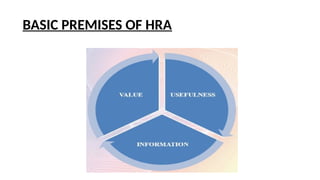
BASIC PREMISES OF HRA
• People are valuable resources of an organization.
• Usefulness of manpower is determined by the way it is managed.
• Information on investment and value of human resource is useful
for decision making.
Need for HRA
 Under conventional accounting, no information is made
available about the human resources employed in an
organization, and without people the financial and physical
resources cannot be operationally effective.
The expenses related to the human organization are charged
to current revenue instead of being treated as investments, to
be amortized over a period of time, with the result that
magnitude of net income is significantly distorted. This
makes the assessment of firm and inter-firm comparison
difficult.
 If the value of human resources is not duly reported in profit
and loss account and balance sheet, the important act of
management on human assets cannot be perceived.
Expenses on recruitment, training, etc. are treated as
expenses and written off against revenue under conventional
accounting. All expenses on human resources are to be
treated as investments, since the benefits are accrued over a
period of time.
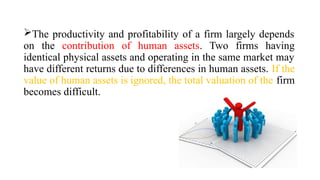
The productivity and profitability of a firm largely depends
on the contribution of human assets. Two firms having
identical physical assets and operating in the same market may
have different returns due to differences in human assets. If the
value of human assets is ignored, the total valuation of the firm
becomes difficult.
Assumptions of Human
Resource Accounting
1. Human resources provide benefits to an organization in a fashion
similar to the manner in which financial and physical resources provide
benefits.
2. The benefits associated with both conventional assets and human
resources have value to the organization because these benefits contribute
in some way to the accomplishment of the organizational goals.
3. The acquisition of human resources typically involves an
economic cost and the benefits associated with such resources can
personally be expected to contribute to the economic effectiveness.
It follows, therefore, that these benefits are essentially economic in
nature and are subject to measurement in financial terms.
4. Since the usual accounting definition of an asset involves the
right to receive economic benefits in the future, human assets are
appropriately classified as accounting assets.
5. It is theoretically possible to identify and measure human
resource cost and benefits within an organization.
6. Information with respect to human resource costs and benefits
should be useful in the process of planning, controlling, evaluating
and predicting organizational performance.
OBJECTIVES
 Providing cost value information about acquiring, developing,
allocating and maintaining human resources.
Enabling management to monitor the use of human resources.
 Finding depreciation or appreciation among human resources.
 Assisting in developing effective management practices.
 Increasing managerial awareness of the value of human resources.
 For better human resource planning.
 For better decisions about people, based on improved information
system.
 Assisting in effective utilization of manpower.
ADVANTAGES
1. Information for manpower planning
HRA provides useful information about the cost and value of
human resources. It shows the strengths and weakness of the
human resources. All this information helps the managers in
planning and making the right decisions about human
resources. Thus, it provides useful information for Manpower
Planning and Decision Making.
2. Information for making personnel policies
HRA provides useful information for making suitable personnel policies
about promotion, favorable working environment, job satisfaction of
employees, etc.
3. Utilization of human resources
HRA helps the organization to make the best utilization of human resources.
4. Proper placements
HRA helps the organization to place the right man in the right post
depending on his skills and abilities.
5. Increases morale and motivation
HRA shows that the organization cares about the employees and their welfare. This
increases their morale and it motivates them to work hard and achieve the
objectives of the organization.
6. Attracts best human resources
Only reputed organizations conduct HRA. So, competent and capable people want
to join these organizations. Therefore, it attracts the best employees and managers
to the organization.
7. Designing training and development programs
HRA helps the organization to design (make) a suitable training and development
program for its employees and managers.
8. Valuable information to investors
HRA provides valuable information to present and future
investors. They can use this information to select the best
company for investing their money.
Limitations
 There is no proper clear-cut and specific procedure or guidelines for
finding cost and value of human resources of an organization. The
systems which are being adopted have certain drawbacks.
 The period of existence of human resource is uncertain and hence
valuing them under uncertainty in future seems to be unrealistic.
 There is a fear that HRA may dehumanize and manipulate employees.
 As human resources are not capable of being owned, retained and
utilized, unlike the physical assets, there is problem for the
management to treat them as assets in the strict sense.
 There are no specific and clear cut guidelines for 'cost' and 'value' of
human resources of an organization. The present valuation systems
have many limitations.
 In spite of all its significance and necessity, tax laws do not
recognize human beings as assets.
 There is no universally accepted method of human asset valuation.
COST OF HUMAN RESOURCES
1.Acquisition Cost
2.Training and Development Cost
3.Welfare Cost
4.Other Cost
ACQUISITION COST
It refers to the cost incurred in acquiring the right man for the
right job at the right time in a right quantity.
a)Recruitment Cost:-
ex: cost of recruiting material, administrative expenses,
advertising costs, agency fees, recruiters salary and travel and
outside cost.
b) Selection Cost:-
ex: cost of application banks, administrative cost of processing
applications, conducting tests and interviews, medical
examinations and salaries.
c)Placement Cost:-
ex: depends upon the placement, individuals ability and attitude.
TRAINING & DEVELOPMENT COST
It refers to the sacrifice that must be made to train a person either to provide
expected level of performance or to enrich individuals skills.
a) Formal Training Cost:
Refers to the cost incurred in conventional training for the orientation of an
individual.
b) On the Job Training Cost:
Once the employee is placed on the job, he must be trained to do job
efficiently and effectively.
C) Special Training Cost:
To achieve the performance standards sometimes special training
programmers may be devised.
d) Development Programs:
Employees may be allowed to participate in development
programs may range from ordinary lectures to international
conferences and seminars. Involves cost such as delegated fees,
travel cost, loss output etc.
WELFARE COST
A vital function of an employer to provide an atmosphere to the
employees to perform their work in healthy, congenial climate
conducive to good health and high morale.
•Example :
1.Providing subsidized or free meals to employees through canteens
or meal vouchers.
2.Offering medical facilities, insurance coverage, and wellness
programs to ensure employees' health and well-being.
a)Welfare Amenities Within The Organization:
ex: rest shelters and canteens, washing and bathing facilities,
drinking water and occupational safety etc.
b)Welfare Outside The Organization:
ex: Social insurance measures, maternity benefits, medical
facilities, educational facilities, housing, holiday homes and
leave , travel facilities etc.
OTHER COSTS
In India, Factories Act 1948 has made statutory provisions with
regard to employees health, safety and welfare as follows:
I. Health Of Workers:
• Cleanliness, disposal of waste and effluents
• Ventilation and temperature
• Dust and fumes
• Over crowding
• Lighting
• Drinking water
• Latrines and urinals
II.Safety Of Workers:
• Fencing of machinery
• Hoist and lifts
• Pressure plant
• Precaution against danger fumes.
III.Welfare of Workers:
• Washing facilities
• Facilities for storing and drying clothing
• First aid appliances
• Canteens
• Welfare officers
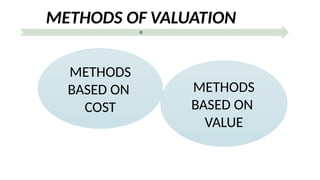
METHODS OF VALUATION
METHODS
BASED ON
COST
METHODS
BASED ON
VALUE
COST BASED
APPROACHES
Cost-based pricing is a straightforward strategy where businesses establish a
selling price by incorporating production, manufacturing, and distribution costs.
Often also known as 'markup pricing' it is based on the fundamental idea of
selling something for more than you spent creating it
HISTORICAL COST APPROACH
Brumnet, Flamholtz and Pyle have developed this method.
It is on the basis of actual cost incurred on human resources. Such a cost
may be of two types- acquisition cost and learning cost.
Under this approach actual cost incurred towards recruitment, hiring,
training and developing human resources of the organization are
capitalized and amortized over the future expected useful life of the
human resources.
The historical cost of human resource is almost similar to the book value
of the other physical assets.
two types- acquisition cost and learning cost
• Acquisition cost refers to an amount paid for fixed assets,
for expenses related to the acquisition of a new customer, or
for the takeover of a competitor.
• The cost of learning is the amount of time, money, and
effort that you invest in acquiring new knowledge and skills
Advantages-
1. Simple to understand.
2. Easy to implement.
3. Provide a basis of evaluating a company’s return on its investment in
human resources.
Limitations-
1. Amount to be amortized is not fixed.
2. It is difficult to estimate the number of years over which the capitalized
expenditure is to be amortized.
3. It takes into account a part of the employees acquisition costs and thus
ignores the aggregate value of their potential services.
This approach was first suggested by Rensis Likert, and was developed by
Eric G. Flamholtz on the basis of concept of replacement cost.
Under this approach, one takes into account how much it costs to replace
a firm’s existing resources and thus represents a current value approach.
Under this method, historic cost is adjusted according to the current
market conditions.
Advantages-
1. This approach is more realistic.
2. It is more representative and logical.
REPLACEMENT COST APPROACH
Limitations-
1. There may be no similar replacement for a similar certain existing asset.
It is really difficult to find identical replacement of the existing human
resource in actual practice.
2. The determination of a replacement value is affected by the subjective
considerations to a marked extent and therefore, the value is likely to
differ from man to man.
Heckiman and Jones first advocated this approach. This is also known as
“Market Value Method”.
This method of measuring the value of human resources is based on the
economist’s concept of ‘opportunity cost’. The value of an employee
would be high if he has several alternative uses for employment in the
various division of an enterprise.
This method can work for some of the people at shop floor and middle
order management. Moreover, the authors of this approach believe that a
bidding process such as this is a promising approach towards more
optional allocation or personnel and a quantitative base for planning,
evaluating and developing human assets of the firm.
OPPORTUNITY COST APPROACH
Advantages-
1. This method ensures optional allocation of human resources.
2. It provides a quantitative base for planning, evaluating and developing
human resources of an organization.
Limitations-
2. It would be difficult to identify the alternative use of an employee in
the organization.
3. The total valuation of human resources on the competitive bid price
may be misleading or inaccurate.
STANDARD COST APPROACH
David Watson has suggested this approach. Instead of using historical or
replacement cost, many companies use standard cost for the valuation of
human assets just as it is used for physical and financial assets. For using
standard cost, employees of an organization are categorized into different
groups based on their hierarchical positions.
Standard cost is fixed for each category of employees and their value is
calculated. This method is simple but does not take into account
differences in employees put in the same group. In many cases, these
differences may be quite vital.
According to this approach, standard costs of recruiting, hiring, training and
developing per grade of employees are determined year after year. The
standard cost so arrived at for all human beings employed in the organization
are the value of human resources for accounting purposes.
The approach is easy to explain and can work as a suitable basis for control
purposes through the technique of variance analysis. However, determination
of the standard cost for each grade of employee is a ticklish issue.
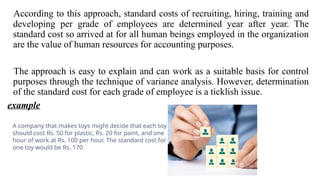
example
A company that makes toys might decide that each toy
should cost Rs. 50 for plastic, Rs. 20 for paint, and one
hour of work at Rs. 100 per hour. The standard cost for
one toy would be Rs. 170
VALUE BASED
APPROACHES
THE LEV AND SCHWARTZ APPROACH
This model has been developed by Lev and Schwartz (1971). According
to this model, the value of human resources is ascertained as follows –
1. All employees are classified in specific groups according to their age and
skill.
2. Average annual earnings are determined for various ranges of age.
3. The total earnings which each group will get upto retirement age are
calculated.
4. The total earnings calculated as above are discounted at the rate of cost
of capital. The value thus arrived at will be the value of human
resources/assets.
MORSE MODEL (NET BENEFIT APPROACH)
This approach has been suggested by Morse (1973).
According to this approach, the value of human resources is
equivalent to the present value of net benefits derived by the
organization from the service of its employees.
PEKIN OGAN (CERTAINITY EQUIVALENT
NET BENEFIT MODEL)
This approach has been suggested by Pekin Ogan (1976). This, as
a matter of fact, is an extension of “Net benefit approach” as
suggested by Morse.
According to this approach, the certainty with which the net
benefits in future will accrue should also be taken into account,
while determining the value of human resources.
Human Resource Accounting Practicing
Companies In India
Even though, many benefits have contributed by HRA, yet its
development and application in different industries has not been
encouraging. Because Indian companies act 1956, does not provide
any scope for showing any information about human resources in
financial statement. Due to the development of business and
industries, some of the Indian companies, both public and private,
value their human resources and report this information in their
annual report. The companies, who are presently reporting human
assets valuation, include:
1. Bharat heavy Electrical Ltd (BHEL).
2. Steel Authority of India Ltd (SAIL)
3. Oil and Natural Gas Commissioning (ONGC)
4. Oil India Ltd
5. Project and Equipment corporation of India.(PEC).
6. Engineers India limited
7. Mineral and Metal trading Corporation of India.(MMTC).
8. Electrical India Ltd.
9. Hindustan Shipyard Ltd.
10. Cement corporation of India. (CCI).
11. Infosys Technologies Ltd.
12. Tata Engineering and Locomotive Works
13. Southern Petrochemicals Industries Corporation Ltd SPIC).
14. Associated Cement Company Ltd ACC).
15. National Thermal Power Corporation Ltd (NTPC)
HUMAN RESOURSES ACCOUNTINGzbdbddsgsdgsgs.pptx

HUMAN RESOURSES ACCOUNTINGzbdbddsgsdgsgs.pptx

  • 2.
    Contents Introduction Basic Premises Need Assumptions Objectives Advantages Limitations Cost ofhuman resource Methods of valuation HRA practicing companies in India
  • 4.
    It means thatthe value of men (human resources) is not measured and reflected in the accounts of business enterprise. Although the success of the business to a greater extent depends upon the abilities, efficiencies and power of these people who actually run the business.
  • 5.
    INTRODUCTION Human Resource Accounting(HRA) means to measure the cost and value of the people (i.e. of employees and managers) in the organization. It measures the cost incurred to recruit, hire, train and develop employees and managers. HRA also finds out the present economic value of its employees and managers. After measuring the cost and value of its employees and managers, the organization prepares a report. This report is called HRA Report. It is shown to the top level management . It can also be shown to the employees, managers and outside investors.
  • 6.
    Definition: ‘HRA is aprocess of identifying and measuring data about human resources and communicating this information to interested parties’. - American Association of Accountants ‘HRA is the measurement and quantification of human organizational inputs such as recruiting, training, experience and commitment’.
  • 7.
  • 8.
    • People arevaluable resources of an organization. • Usefulness of manpower is determined by the way it is managed. • Information on investment and value of human resource is useful for decision making.
  • 9.
    Need for HRA Under conventional accounting, no information is made available about the human resources employed in an organization, and without people the financial and physical resources cannot be operationally effective. The expenses related to the human organization are charged to current revenue instead of being treated as investments, to be amortized over a period of time, with the result that magnitude of net income is significantly distorted. This makes the assessment of firm and inter-firm comparison difficult.
  • 10.
     If thevalue of human resources is not duly reported in profit and loss account and balance sheet, the important act of management on human assets cannot be perceived. Expenses on recruitment, training, etc. are treated as expenses and written off against revenue under conventional accounting. All expenses on human resources are to be treated as investments, since the benefits are accrued over a period of time.
  • 11.
    The productivity andprofitability of a firm largely depends on the contribution of human assets. Two firms having identical physical assets and operating in the same market may have different returns due to differences in human assets. If the value of human assets is ignored, the total valuation of the firm becomes difficult.
  • 12.
    Assumptions of Human ResourceAccounting 1. Human resources provide benefits to an organization in a fashion similar to the manner in which financial and physical resources provide benefits. 2. The benefits associated with both conventional assets and human resources have value to the organization because these benefits contribute in some way to the accomplishment of the organizational goals.
  • 13.
    3. The acquisitionof human resources typically involves an economic cost and the benefits associated with such resources can personally be expected to contribute to the economic effectiveness. It follows, therefore, that these benefits are essentially economic in nature and are subject to measurement in financial terms. 4. Since the usual accounting definition of an asset involves the right to receive economic benefits in the future, human assets are appropriately classified as accounting assets.
  • 14.
    5. It istheoretically possible to identify and measure human resource cost and benefits within an organization. 6. Information with respect to human resource costs and benefits should be useful in the process of planning, controlling, evaluating and predicting organizational performance.
  • 15.
    OBJECTIVES  Providing costvalue information about acquiring, developing, allocating and maintaining human resources. Enabling management to monitor the use of human resources.  Finding depreciation or appreciation among human resources.
  • 16.
     Assisting indeveloping effective management practices.  Increasing managerial awareness of the value of human resources.  For better human resource planning.  For better decisions about people, based on improved information system.  Assisting in effective utilization of manpower.
  • 17.
    ADVANTAGES 1. Information formanpower planning HRA provides useful information about the cost and value of human resources. It shows the strengths and weakness of the human resources. All this information helps the managers in planning and making the right decisions about human resources. Thus, it provides useful information for Manpower Planning and Decision Making.
  • 18.
    2. Information formaking personnel policies HRA provides useful information for making suitable personnel policies about promotion, favorable working environment, job satisfaction of employees, etc. 3. Utilization of human resources HRA helps the organization to make the best utilization of human resources. 4. Proper placements HRA helps the organization to place the right man in the right post depending on his skills and abilities.
  • 19.
    5. Increases moraleand motivation HRA shows that the organization cares about the employees and their welfare. This increases their morale and it motivates them to work hard and achieve the objectives of the organization. 6. Attracts best human resources Only reputed organizations conduct HRA. So, competent and capable people want to join these organizations. Therefore, it attracts the best employees and managers to the organization. 7. Designing training and development programs HRA helps the organization to design (make) a suitable training and development program for its employees and managers.
  • 20.
    8. Valuable informationto investors HRA provides valuable information to present and future investors. They can use this information to select the best company for investing their money.
  • 21.
    Limitations  There isno proper clear-cut and specific procedure or guidelines for finding cost and value of human resources of an organization. The systems which are being adopted have certain drawbacks.  The period of existence of human resource is uncertain and hence valuing them under uncertainty in future seems to be unrealistic.  There is a fear that HRA may dehumanize and manipulate employees.
  • 22.
     As humanresources are not capable of being owned, retained and utilized, unlike the physical assets, there is problem for the management to treat them as assets in the strict sense.  There are no specific and clear cut guidelines for 'cost' and 'value' of human resources of an organization. The present valuation systems have many limitations.  In spite of all its significance and necessity, tax laws do not recognize human beings as assets.  There is no universally accepted method of human asset valuation.

  • 23.
    COST OF HUMANRESOURCES 1.Acquisition Cost 2.Training and Development Cost 3.Welfare Cost 4.Other Cost
  • 24.
    ACQUISITION COST It refersto the cost incurred in acquiring the right man for the right job at the right time in a right quantity. a)Recruitment Cost:- ex: cost of recruiting material, administrative expenses, advertising costs, agency fees, recruiters salary and travel and outside cost.
  • 25.
    b) Selection Cost:- ex:cost of application banks, administrative cost of processing applications, conducting tests and interviews, medical examinations and salaries. c)Placement Cost:- ex: depends upon the placement, individuals ability and attitude.
  • 26.
    TRAINING & DEVELOPMENTCOST It refers to the sacrifice that must be made to train a person either to provide expected level of performance or to enrich individuals skills. a) Formal Training Cost: Refers to the cost incurred in conventional training for the orientation of an individual. b) On the Job Training Cost: Once the employee is placed on the job, he must be trained to do job efficiently and effectively.
  • 27.
    C) Special TrainingCost: To achieve the performance standards sometimes special training programmers may be devised.
  • 28.
    d) Development Programs: Employeesmay be allowed to participate in development programs may range from ordinary lectures to international conferences and seminars. Involves cost such as delegated fees, travel cost, loss output etc.
  • 29.
    WELFARE COST A vitalfunction of an employer to provide an atmosphere to the employees to perform their work in healthy, congenial climate conducive to good health and high morale. •Example : 1.Providing subsidized or free meals to employees through canteens or meal vouchers. 2.Offering medical facilities, insurance coverage, and wellness programs to ensure employees' health and well-being.
  • 30.
    a)Welfare Amenities WithinThe Organization: ex: rest shelters and canteens, washing and bathing facilities, drinking water and occupational safety etc. b)Welfare Outside The Organization: ex: Social insurance measures, maternity benefits, medical facilities, educational facilities, housing, holiday homes and leave , travel facilities etc.
  • 31.
    OTHER COSTS In India,Factories Act 1948 has made statutory provisions with regard to employees health, safety and welfare as follows: I. Health Of Workers: • Cleanliness, disposal of waste and effluents • Ventilation and temperature • Dust and fumes • Over crowding • Lighting • Drinking water • Latrines and urinals
  • 32.
    II.Safety Of Workers: •Fencing of machinery • Hoist and lifts • Pressure plant • Precaution against danger fumes. III.Welfare of Workers: • Washing facilities • Facilities for storing and drying clothing • First aid appliances • Canteens • Welfare officers
  • 33.
    METHODS OF VALUATION METHODS BASEDON COST METHODS BASED ON VALUE
  • 34.
    COST BASED APPROACHES Cost-based pricingis a straightforward strategy where businesses establish a selling price by incorporating production, manufacturing, and distribution costs. Often also known as 'markup pricing' it is based on the fundamental idea of selling something for more than you spent creating it
  • 35.
    HISTORICAL COST APPROACH Brumnet,Flamholtz and Pyle have developed this method. It is on the basis of actual cost incurred on human resources. Such a cost may be of two types- acquisition cost and learning cost. Under this approach actual cost incurred towards recruitment, hiring, training and developing human resources of the organization are capitalized and amortized over the future expected useful life of the human resources. The historical cost of human resource is almost similar to the book value of the other physical assets.
  • 36.
    two types- acquisitioncost and learning cost • Acquisition cost refers to an amount paid for fixed assets, for expenses related to the acquisition of a new customer, or for the takeover of a competitor. • The cost of learning is the amount of time, money, and effort that you invest in acquiring new knowledge and skills
  • 37.
    Advantages- 1. Simple tounderstand. 2. Easy to implement. 3. Provide a basis of evaluating a company’s return on its investment in human resources. Limitations- 1. Amount to be amortized is not fixed. 2. It is difficult to estimate the number of years over which the capitalized expenditure is to be amortized. 3. It takes into account a part of the employees acquisition costs and thus ignores the aggregate value of their potential services.
  • 38.
    This approach wasfirst suggested by Rensis Likert, and was developed by Eric G. Flamholtz on the basis of concept of replacement cost. Under this approach, one takes into account how much it costs to replace a firm’s existing resources and thus represents a current value approach. Under this method, historic cost is adjusted according to the current market conditions. Advantages- 1. This approach is more realistic. 2. It is more representative and logical. REPLACEMENT COST APPROACH
  • 39.
    Limitations- 1. There maybe no similar replacement for a similar certain existing asset. It is really difficult to find identical replacement of the existing human resource in actual practice. 2. The determination of a replacement value is affected by the subjective considerations to a marked extent and therefore, the value is likely to differ from man to man.
  • 40.
    Heckiman and Jonesfirst advocated this approach. This is also known as “Market Value Method”. This method of measuring the value of human resources is based on the economist’s concept of ‘opportunity cost’. The value of an employee would be high if he has several alternative uses for employment in the various division of an enterprise. This method can work for some of the people at shop floor and middle order management. Moreover, the authors of this approach believe that a bidding process such as this is a promising approach towards more optional allocation or personnel and a quantitative base for planning, evaluating and developing human assets of the firm. OPPORTUNITY COST APPROACH
  • 41.
    Advantages- 1. This methodensures optional allocation of human resources. 2. It provides a quantitative base for planning, evaluating and developing human resources of an organization. Limitations- 2. It would be difficult to identify the alternative use of an employee in the organization. 3. The total valuation of human resources on the competitive bid price may be misleading or inaccurate.
  • 42.
    STANDARD COST APPROACH DavidWatson has suggested this approach. Instead of using historical or replacement cost, many companies use standard cost for the valuation of human assets just as it is used for physical and financial assets. For using standard cost, employees of an organization are categorized into different groups based on their hierarchical positions. Standard cost is fixed for each category of employees and their value is calculated. This method is simple but does not take into account differences in employees put in the same group. In many cases, these differences may be quite vital.
  • 43.
    According to thisapproach, standard costs of recruiting, hiring, training and developing per grade of employees are determined year after year. The standard cost so arrived at for all human beings employed in the organization are the value of human resources for accounting purposes. The approach is easy to explain and can work as a suitable basis for control purposes through the technique of variance analysis. However, determination of the standard cost for each grade of employee is a ticklish issue. example A company that makes toys might decide that each toy should cost Rs. 50 for plastic, Rs. 20 for paint, and one hour of work at Rs. 100 per hour. The standard cost for one toy would be Rs. 170
  • 44.
  • 45.
    THE LEV ANDSCHWARTZ APPROACH This model has been developed by Lev and Schwartz (1971). According to this model, the value of human resources is ascertained as follows – 1. All employees are classified in specific groups according to their age and skill. 2. Average annual earnings are determined for various ranges of age. 3. The total earnings which each group will get upto retirement age are calculated. 4. The total earnings calculated as above are discounted at the rate of cost of capital. The value thus arrived at will be the value of human resources/assets.
  • 46.
    MORSE MODEL (NETBENEFIT APPROACH) This approach has been suggested by Morse (1973). According to this approach, the value of human resources is equivalent to the present value of net benefits derived by the organization from the service of its employees.
  • 47.
    PEKIN OGAN (CERTAINITYEQUIVALENT NET BENEFIT MODEL) This approach has been suggested by Pekin Ogan (1976). This, as a matter of fact, is an extension of “Net benefit approach” as suggested by Morse. According to this approach, the certainty with which the net benefits in future will accrue should also be taken into account, while determining the value of human resources.
  • 48.
    Human Resource AccountingPracticing Companies In India Even though, many benefits have contributed by HRA, yet its development and application in different industries has not been encouraging. Because Indian companies act 1956, does not provide any scope for showing any information about human resources in financial statement. Due to the development of business and industries, some of the Indian companies, both public and private, value their human resources and report this information in their annual report. The companies, who are presently reporting human assets valuation, include:
  • 49.
    1. Bharat heavyElectrical Ltd (BHEL). 2. Steel Authority of India Ltd (SAIL) 3. Oil and Natural Gas Commissioning (ONGC) 4. Oil India Ltd 5. Project and Equipment corporation of India.(PEC). 6. Engineers India limited 7. Mineral and Metal trading Corporation of India.(MMTC). 8. Electrical India Ltd. 9. Hindustan Shipyard Ltd. 10. Cement corporation of India. (CCI). 11. Infosys Technologies Ltd.
  • 50.
    12. Tata Engineeringand Locomotive Works 13. Southern Petrochemicals Industries Corporation Ltd SPIC). 14. Associated Cement Company Ltd ACC). 15. National Thermal Power Corporation Ltd (NTPC)