Human Resource Accounting
By
Trilochan Sharma
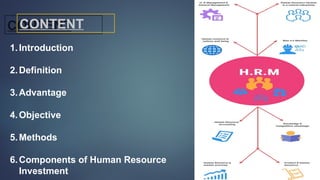
CONTENT
CONTENT
1.Introduction
2.Definition
3.Advantage
4.Objective
5.Methods
6.Components of Human Resource
Investment
INTRODUCTION
“One assets is omitted & its worth
I
know
That assets is the value of man
Who
the show”
 Human resources are considered as important assets and
are different from the physical assets.
Human resource accounting is the process of identifying and
reporting investments made in the human resources of an
organization.
HRA is an extension of standard accounting principles.
The terms “Human Resource Management” and “Human Resource” (HR) have
largely replaced the term “Personnel management" as a description of the
processes involved in managing people in organization, but it still continues to
be used as a synonym.
DEFINITION
1. (AAA) defines HRA as follows: “is a process of identifying and measuring data
about human resources and communicating this information to interested
parties”
- American Association of Accountants(1973)
2. “accounting for people as an organizational resource. It involves measuring
the costs incurred by organizations to recruit, select, hire, train, and develop
human assets”
- Eric Flamholtz (1974)
3. “HRA is the measurement and quantification of human
organizational inputs such as recruiting, training, experience and
commitment”
- Stephen Knauf (1983)
4. “Human Resource Accounting involves measuring the costs
incurred by business firms and other organizations to recruit,
select, hire, train and develop human assets. It also involves
measuring the economic value of people to the organization”.
- Palanivelu, R.P (2007)
 ADVANTAGE
Information for manpower planning
Proper Placement
Attracts best human resources
Increases morale and motivation
Utilization of human resources
Information for making personnel policies
Valuable in formation to investors
 LIMITATIONS
 It is a difficult task to value human asset
 Human Resource Accounting is full of measurement problems
 Employees and unions may not like the ideas
 The life of a human being is uncertain. So its value is also uncertain
 It lacks empirical evidence
OBJECTIVE
 For better human resource
planning
 Assisting in developing
effective management
practices
 Assisting in effective
utilization of manpower
 Finding depreciation among
human resources
 Enable management to
monitor the use of human
 METHODS
 Historical Cost Method
 Replacement Cost Method
 Opportunity Cost Method
 Standard Cost Method
 Economic Valuation Method
1. Historical Cost Method
Historical cost is based on actual cost incurred on human
resources. Such a cost may be of two types – acquisition
cost and learning cost. Acquisition cost is the expense
incurred on training and development. This method is very
simple in its application but it does not reflect the true value
of human assets.
2. Replacement Cost Method
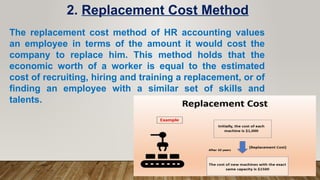
The replacement cost method of HR accounting values
an employee in terms of the amount it would cost the
company to replace him. This method holds that the
economic worth of a worker is equal to the estimated
cost of recruiting, hiring and training a replacement, or of
finding an employee with a similar set of skills and
talents.
3. Opportunity Cost Method
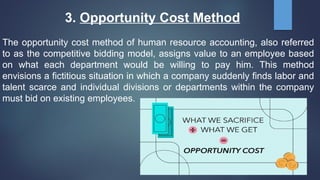
The opportunity cost method of human resource accounting, also referred
to as the competitive bidding model, assigns value to an employee based
on what each department would be willing to pay him. This method
envisions a fictitious situation in which a company suddenly finds labor and
talent scarce and individual divisions or departments within the company
must bid on existing employees.
The standard cost method of human resource accounting
involves determining the total cost of recruiting and hiring
each employee, as well as the cost of any training or
development. According to the standard cost method, the
economic value of an employee is the total of these
expenditures, and the annual economic value of the entire
workforce is equal to the total amount of money spent on
recruiting, hiring, training and developing all employees
during the year.
4. Standard Cost Method
The economic value model of human
resource accounting involves estimating
the total inflow of cash that will be
produced by an employee over the course
of his service to the company. Subtract the
total cost of hiring, training, developing
and paying an employee from the estimate
of the cash he will generate for the
company, and you have arrived at his net
worth according to the economic value
method of HR accounting.
5. Economic Valuation Method
 COMPONENTS OF HUMAN RESOURCE
INVESTMENT
 Expenditure on advertisement for recruitment
 Workforce planning cost
 Cost of selection
 Training and development cost
 On the job training cost
 Skill management cost
 Cost of Induction, orientation and on boarding
 Personnel administration cost
 Contribution to provident fund
 Compensation in wage/salary
 Educational tour expenses
 Medical expenses
 Ex-gratia payments
 Employees' welfare fund
 Subsistence allowance
THAN
K YOU

Accounting

  • 1.
  • 3.
  • 4.
    INTRODUCTION “One assets isomitted & its worth I know That assets is the value of man Who the show”  Human resources are considered as important assets and are different from the physical assets. Human resource accounting is the process of identifying and reporting investments made in the human resources of an organization.
  • 5.
    HRA is anextension of standard accounting principles. The terms “Human Resource Management” and “Human Resource” (HR) have largely replaced the term “Personnel management" as a description of the processes involved in managing people in organization, but it still continues to be used as a synonym.
  • 7.
    DEFINITION 1. (AAA) definesHRA as follows: “is a process of identifying and measuring data about human resources and communicating this information to interested parties” - American Association of Accountants(1973) 2. “accounting for people as an organizational resource. It involves measuring the costs incurred by organizations to recruit, select, hire, train, and develop human assets” - Eric Flamholtz (1974)
  • 8.
    3. “HRA isthe measurement and quantification of human organizational inputs such as recruiting, training, experience and commitment” - Stephen Knauf (1983) 4. “Human Resource Accounting involves measuring the costs incurred by business firms and other organizations to recruit, select, hire, train and develop human assets. It also involves measuring the economic value of people to the organization”. - Palanivelu, R.P (2007)
  • 9.
     ADVANTAGE Information formanpower planning Proper Placement Attracts best human resources Increases morale and motivation Utilization of human resources Information for making personnel policies Valuable in formation to investors
  • 10.
     LIMITATIONS  Itis a difficult task to value human asset  Human Resource Accounting is full of measurement problems  Employees and unions may not like the ideas  The life of a human being is uncertain. So its value is also uncertain  It lacks empirical evidence
  • 11.
    OBJECTIVE  For betterhuman resource planning  Assisting in developing effective management practices  Assisting in effective utilization of manpower  Finding depreciation among human resources  Enable management to monitor the use of human
  • 12.
     METHODS  HistoricalCost Method  Replacement Cost Method  Opportunity Cost Method  Standard Cost Method  Economic Valuation Method
  • 13.
    1. Historical CostMethod Historical cost is based on actual cost incurred on human resources. Such a cost may be of two types – acquisition cost and learning cost. Acquisition cost is the expense incurred on training and development. This method is very simple in its application but it does not reflect the true value of human assets.
  • 14.
    2. Replacement CostMethod The replacement cost method of HR accounting values an employee in terms of the amount it would cost the company to replace him. This method holds that the economic worth of a worker is equal to the estimated cost of recruiting, hiring and training a replacement, or of finding an employee with a similar set of skills and talents.
  • 15.
    3. Opportunity CostMethod The opportunity cost method of human resource accounting, also referred to as the competitive bidding model, assigns value to an employee based on what each department would be willing to pay him. This method envisions a fictitious situation in which a company suddenly finds labor and talent scarce and individual divisions or departments within the company must bid on existing employees.
  • 16.
    The standard costmethod of human resource accounting involves determining the total cost of recruiting and hiring each employee, as well as the cost of any training or development. According to the standard cost method, the economic value of an employee is the total of these expenditures, and the annual economic value of the entire workforce is equal to the total amount of money spent on recruiting, hiring, training and developing all employees during the year. 4. Standard Cost Method
  • 17.
    The economic valuemodel of human resource accounting involves estimating the total inflow of cash that will be produced by an employee over the course of his service to the company. Subtract the total cost of hiring, training, developing and paying an employee from the estimate of the cash he will generate for the company, and you have arrived at his net worth according to the economic value method of HR accounting. 5. Economic Valuation Method
  • 18.
     COMPONENTS OFHUMAN RESOURCE INVESTMENT  Expenditure on advertisement for recruitment  Workforce planning cost  Cost of selection  Training and development cost  On the job training cost  Skill management cost  Cost of Induction, orientation and on boarding
  • 19.
     Personnel administrationcost  Contribution to provident fund  Compensation in wage/salary  Educational tour expenses  Medical expenses  Ex-gratia payments  Employees' welfare fund  Subsistence allowance
  • 21.