THE DIGESTIVE AND
RESPIRATORY SYSTEMS


       Autora: Marta García T.
HUMAN NUTRITION
   NUTRITION is the set of processes that allows the
    body to obtain from food the substances (nutrients)
    needed to live, transport them through the body, and
    eliminate the toxic substances produced by our cells
    when using those nutrients.


                     Autora: Marta García T.
SYSTEMS INVOLVED IN NUTRITION


          Autora: Marta García T.
Autora: Marta García T.
SYSTEMS INVOLVED IN NUTRITION
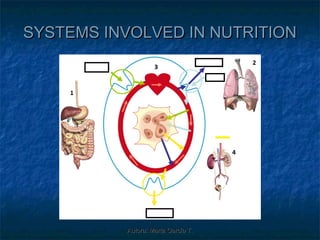
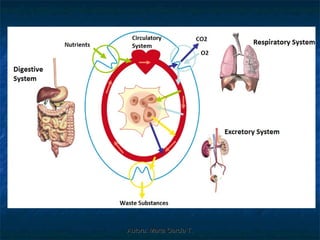
   Digestive System: transforms food into nutrients which
    can be used by our cells.

   Respiratory System: captures oxygen and eliminates
    carbon dioxide.

   Circulatory System: transports substances through the
    body.

   Excretory System: eliminates                waste   susbtances
    produced by our cells.
                      Autora: Marta García T.
DIGESTIVE SYSTEM


     Autora: Marta García T.
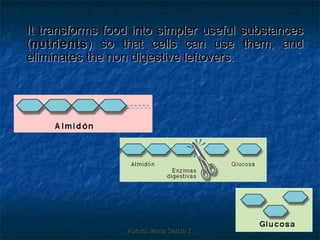
It transforms food into simpler useful substances
(nutrients ) so that cells can use them, and
eliminates the non digestive leftovers.


                 Autora: Marta García T.
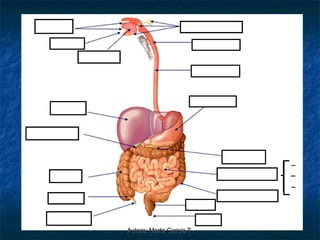
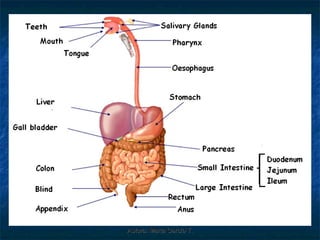
Elements of the Digestive System
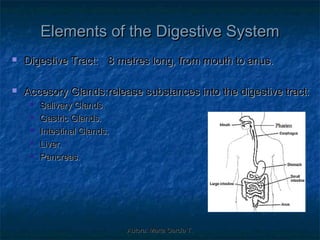
   Digestive Tract: 8 metres long, from mouth to anus.

   Accesory Glands: release substances into the digestive tract:
        Salivary Glands.
        Gastric Glands.
        Intestinal Glands.
        Liver.
        Pancreas.


                              Autora: Marta García T.
Autora: Marta García T.
DIGESTIVE PROCESSES
   Ingestion: taking in food. Mouth.
   Digestion: decomposing food into simpler
    substances (nutrient) which can be used by our
    cells. Mouth, stomach, small intestine. It can be:

       Mechanical Digestion.
       Chemical Digestion.

   Absorption: nutrients pass to the blood. Small
    intestine.
   Egestion: expelling non-digested susbtances.
    Large intestine.
                        Autora: Marta García T.
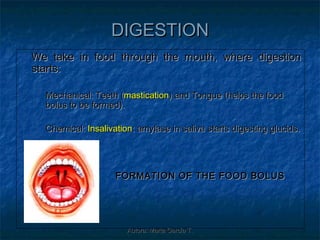
DIGESTION
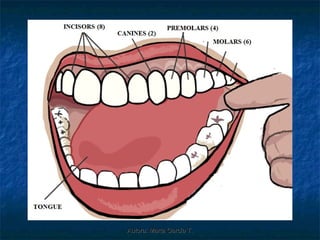
We take in food through the mouth, where digestion
starts:

-   Mechanical: Teeth (mastication) and Tongue (helps the food
    bolus to be formed).

-   Chemical: Insalivation: amylase in saliva starts digesting glucids.


                      FORMATION OF THE FOOD BOLUS


                         Autora: Marta García T.
Autora: Marta García T.
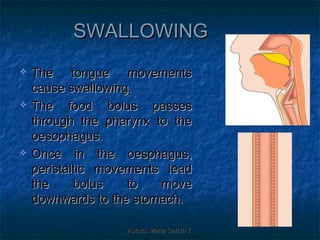
SWALLOWING
   The tongue movements
    cause swallowing.
   The food bolus passes
    through the pharynx to the
    oesophagus.
   Once in the oesphagus,
    peristaltic movements lead
    the     bolus   to   move
    downwards to the stomach.

                   Autora: Marta García T.
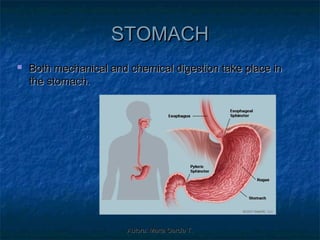
STOMACH
   Both mechanical and chemical digestion take place in
    the stomach.


                        Autora: Marta García T.
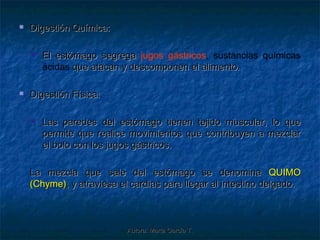
   Digestión Química:

       El estómago segrega jugos gástricos, sustancias químicas
        ácidas que atacan y descomponen el alimento.

   Digestión Física:

       Las paredes del estómago tienen tejido muscular, lo que
        permite que realice movimientos que contribuyen a mezclar
        el bolo con los jugos gástricos.

    La mezcla que sale del estómago se denomina QUIMO
    (Chyme), y atraviesa el cardias para llegar al intestino delgado.


                           Autora: Marta García T.
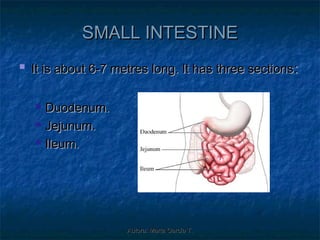
SMALL INTESTINE
   It is about 6-7 metres long. It has three sections :

       Duodenum.
       Jejunum.
       Ileum.


                      Autora: Marta García T.
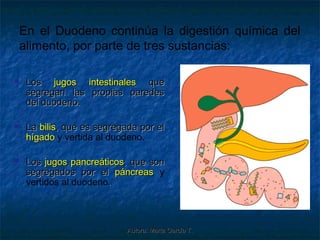
En el Duodeno continúa la digestión química del
    alimento, por parte de tres sustancias:

    Los jugos intestinales que
     segregan las propias paredes
     del duodeno.

    La bilis, que es segregada por el
     hígado y vertida al duodeno.

    Los jugos pancreáticos, que son
     segregados por el páncreas y
     vertidos al duodeno.


                             Autora: Marta García T.
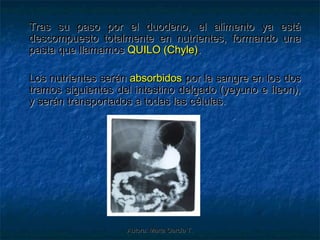
Tras su paso por el duodeno, el alimento ya está
descompuesto totalmente en nutrientes, formando una
pasta que llamamos QUILO (Chyle).

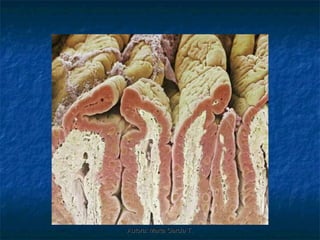
Los nutrientes serán absorbidos por la sangre en los dos
tramos siguientes del intestino delgado (yeyuno e íleon),
y serán transportados a todas las células.


                    Autora: Marta García T.
Autora: Marta García T.
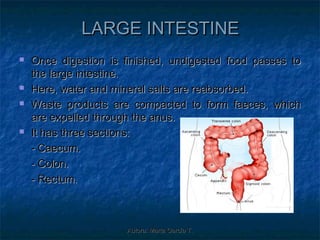
LARGE INTESTINE
   Once digestion is finished, undigested food passes to
    the large intestine.
   Here, water and mineral salts are reabsorbed.
   Waste products are compacted to form faeces, which
    are expelled through the anus.
   It has three sections:
    - Caecum.
    - Colon.
    - Rectum.


                      Autora: Marta García T.
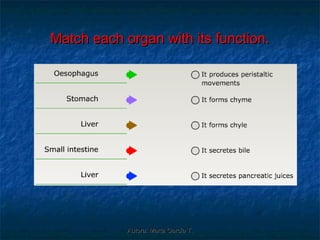
Match each organ with its function.


            Autora: Marta García T.
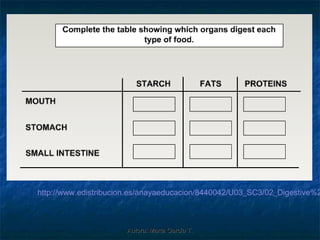
http://www.edistribucion.es/anayaeducacion/8440042/U03_SC3/02_Digestive%2


                       Autora: Marta García T.
RESPIRATORY SYSTEM


       Autora: Marta García T.
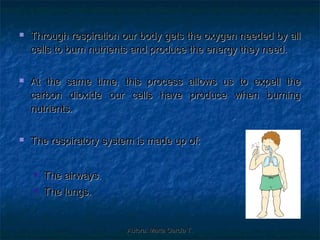
   Through respiration our body gets the oxygen needed by all
    cells to burn nutrients and produce the energy they need.

   At the same time, this process allows us to expell the
    carbon dioxide our cells have produce when burning
    nutrients.

   The respiratory system is made up of:


       The airways.
       The lungs.


                         Autora: Marta García T.
Autora: Marta García T.
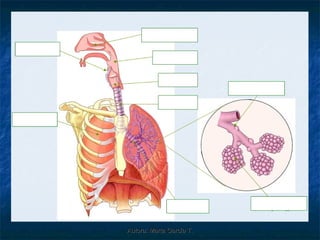
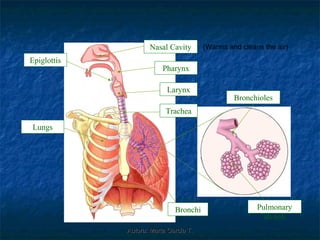
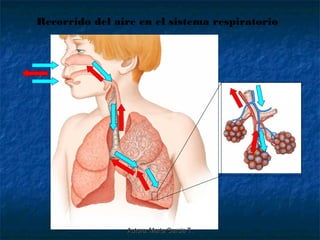
Nasal Cavity       (Warms and cleans the air)
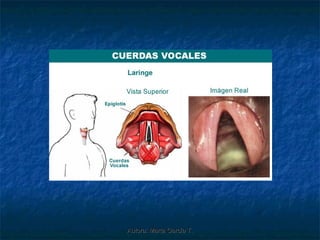
Epiglottis
                         Pharynx

                          Larynx
                                                Bronchioles
                          Trachea

Lungs


                             Bronchi                   Pulmonary
                                                         alveoli
             Autora: Marta García T.
Autora: Marta García T.
Recorrido del aire en el sistema respiratorio


                Autora: Marta García T.
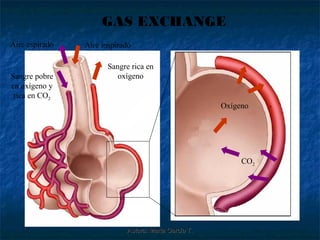
GAS EXCHANGE
Aire espirado   Aire inspirado

                       Sangre rica en
Sangre pobre              oxígeno
en oxígeno y
 rica en CO2
                                                      Oxígeno


                                                           CO2


                            Autora: Marta García T.
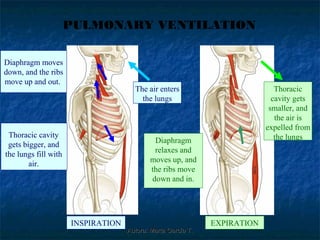
PULMONARY VENTILATION

Diaphragm moves
down, and the ribs
move up and out.
                                      The air enters                          Thoracic
                                        the lungs                            cavity gets
                                                                            smaller, and
                                                                              the air is
                                                                           expelled from
 Thoracic cavity                                                              the lungs
                                             Diaphragm
 gets bigger, and
                                             relaxes and
the lungs fill with
                                            moves up, and
        air.
                                            the ribs move
                                            down and in.


                      INSPIRATION                             EXPIRATION
                                    Autora: Marta García T.
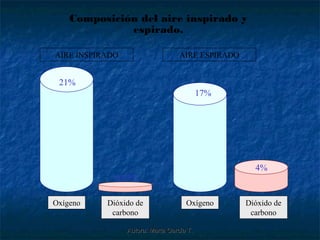
Composición del aire inspirado y
              espirado.

AIRE INSPIRADO                     AIRE ESPIRADO


 21%
                                           17%


                                                     4%
             0.03%

Oxígeno    Dióxido de                Oxígeno       Dióxido de
            carbono                                 carbono

                 Autora: Marta García T.

Digestrespir

  • 1.
    THE DIGESTIVE AND RESPIRATORYSYSTEMS Autora: Marta García T.
  • 2.
    HUMAN NUTRITION  NUTRITION is the set of processes that allows the body to obtain from food the substances (nutrients) needed to live, transport them through the body, and eliminate the toxic substances produced by our cells when using those nutrients. Autora: Marta García T.
  • 3.
    SYSTEMS INVOLVED INNUTRITION Autora: Marta García T.
  • 4.
  • 5.
    SYSTEMS INVOLVED INNUTRITION  Digestive System: transforms food into nutrients which can be used by our cells.  Respiratory System: captures oxygen and eliminates carbon dioxide.  Circulatory System: transports substances through the body.  Excretory System: eliminates waste susbtances produced by our cells. Autora: Marta García T.
  • 6.
    DIGESTIVE SYSTEM Autora: Marta García T.
  • 7.
    It transforms foodinto simpler useful substances (nutrients ) so that cells can use them, and eliminates the non digestive leftovers. Autora: Marta García T.
  • 8.
    Elements of theDigestive System  Digestive Tract: 8 metres long, from mouth to anus.  Accesory Glands: release substances into the digestive tract:  Salivary Glands.  Gastric Glands.  Intestinal Glands.  Liver.  Pancreas. Autora: Marta García T.
  • 9.
  • 10.
  • 11.
    DIGESTIVE PROCESSES  Ingestion: taking in food. Mouth.  Digestion: decomposing food into simpler substances (nutrient) which can be used by our cells. Mouth, stomach, small intestine. It can be:  Mechanical Digestion.  Chemical Digestion.  Absorption: nutrients pass to the blood. Small intestine.  Egestion: expelling non-digested susbtances. Large intestine. Autora: Marta García T.
  • 12.
    DIGESTION We take infood through the mouth, where digestion starts: - Mechanical: Teeth (mastication) and Tongue (helps the food bolus to be formed). - Chemical: Insalivation: amylase in saliva starts digesting glucids. FORMATION OF THE FOOD BOLUS Autora: Marta García T.
  • 13.
  • 14.
    SWALLOWING  The tongue movements cause swallowing.  The food bolus passes through the pharynx to the oesophagus.  Once in the oesphagus, peristaltic movements lead the bolus to move downwards to the stomach. Autora: Marta García T.
  • 15.
    STOMACH  Both mechanical and chemical digestion take place in the stomach. Autora: Marta García T.
  • 16.
    Digestión Química:  El estómago segrega jugos gástricos, sustancias químicas ácidas que atacan y descomponen el alimento.  Digestión Física:  Las paredes del estómago tienen tejido muscular, lo que permite que realice movimientos que contribuyen a mezclar el bolo con los jugos gástricos. La mezcla que sale del estómago se denomina QUIMO (Chyme), y atraviesa el cardias para llegar al intestino delgado. Autora: Marta García T.
  • 17.
    SMALL INTESTINE  It is about 6-7 metres long. It has three sections :  Duodenum.  Jejunum.  Ileum. Autora: Marta García T.
  • 18.
    En el Duodenocontinúa la digestión química del alimento, por parte de tres sustancias:  Los jugos intestinales que segregan las propias paredes del duodeno.  La bilis, que es segregada por el hígado y vertida al duodeno.  Los jugos pancreáticos, que son segregados por el páncreas y vertidos al duodeno. Autora: Marta García T.
  • 19.
    Tras su pasopor el duodeno, el alimento ya está descompuesto totalmente en nutrientes, formando una pasta que llamamos QUILO (Chyle). Los nutrientes serán absorbidos por la sangre en los dos tramos siguientes del intestino delgado (yeyuno e íleon), y serán transportados a todas las células. Autora: Marta García T.
  • 20.
  • 21.
    LARGE INTESTINE  Once digestion is finished, undigested food passes to the large intestine.  Here, water and mineral salts are reabsorbed.  Waste products are compacted to form faeces, which are expelled through the anus.  It has three sections: - Caecum. - Colon. - Rectum. Autora: Marta García T.
  • 22.
    Match each organwith its function. Autora: Marta García T.
  • 23.
  • 24.
    RESPIRATORY SYSTEM Autora: Marta García T.
  • 25.
    Through respiration our body gets the oxygen needed by all cells to burn nutrients and produce the energy they need.  At the same time, this process allows us to expell the carbon dioxide our cells have produce when burning nutrients.  The respiratory system is made up of:  The airways.  The lungs. Autora: Marta García T.
  • 26.
  • 27.
    Nasal Cavity (Warms and cleans the air) Epiglottis Pharynx Larynx Bronchioles Trachea Lungs Bronchi Pulmonary alveoli Autora: Marta García T.
  • 28.
  • 29.
    Recorrido del aireen el sistema respiratorio Autora: Marta García T.
  • 30.
    GAS EXCHANGE Aire espirado Aire inspirado Sangre rica en Sangre pobre oxígeno en oxígeno y rica en CO2 Oxígeno CO2 Autora: Marta García T.
  • 31.
    PULMONARY VENTILATION Diaphragm moves down,and the ribs move up and out. The air enters Thoracic the lungs cavity gets smaller, and the air is expelled from Thoracic cavity the lungs Diaphragm gets bigger, and relaxes and the lungs fill with moves up, and air. the ribs move down and in. INSPIRATION EXPIRATION Autora: Marta García T.
  • 32.
    Composición del aireinspirado y espirado. AIRE INSPIRADO AIRE ESPIRADO 21% 17% 4% 0.03% Oxígeno Dióxido de Oxígeno Dióxido de carbono carbono Autora: Marta García T.