' The Human-Environment
Systems (HES) in the social
sciences is an interdisciplinary
approach in the social
sciences. it bridges the gap
between, and integrate
knowledge from, the social and
the natural sciences within one
frameworkin thestudy of
environmental and social
issues.
• interaction of
human systems
with
corresponding
environmental or
or technological
systems (Scholz
and Binder).
Human-
Environment
System
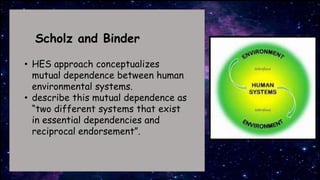
• HES approach conceptualizes
mutual dependence between human
environmental systems.
• describe this mutual dependence as
“two different systems that exist
in essential dependencies and
reciprocal endorsement”.
Scholz and Binder
Lui ,J.et al.(2007) made a clear articulation of the reason why
an integration of the three aspects is necessary. They argued
that “such integration is needed to tackle the increased
complexity and to help prevent the dreadful consequences
that may occur due to the fundamentally new and rapid
changes, because the magnitude, extent, and rate of changes
in human - natural couplings have been unprecedented in the
past several decades , and the accelerating human impacts on
natural systems may lead to degradation and collapse of
natural systems which in turn compromise the adaptive
capacity of human system”
To understand and appreciate the human-
environment system (HES) approach in the social
sciences, the following discussion outlines three
areas or fields of inquiry where the HES approach is
relevant and necessary both as an analytic tool and
framework
the study of the human causes of environmental change not only
proximate causes, such as burning coal, releasing heavy metals into
rivers, and clearing forests,that immediately change a part of the
environment but especially indirect causes or driving forces, such as
population growth,economic development , technological change, and
alterations in social institution and human values that must be
understood to forecast trends in environmentally destructive human
activity and if necessary to change those trends.
A second field of inquiry concerns the effect of
environmental change on things people value both proximate
effects, such as on growing seasons and rainfall agricultural
areas, endangered species, and so on, an indirect effects,
such as on population migrations, international conflict,
agricultural markets, and government policies.
2
3
The third field is the study of the feedback between
humanity and the environment the ways individuals,
organizations, and governments act on the basis of
experienced or anticipated environmental change to manage
human activity and preserve environmental values. These
feedback provide the greatest challenge of scientist and
policy makers, partly because there are so many ways people
can intervene in the system (Stern 1993, 1897)
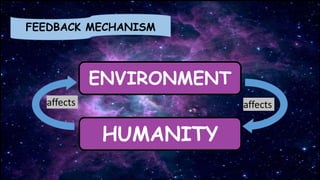
FEEDBACK MECHANISM
ENVIRONMENT
HUMANITY
affects affects
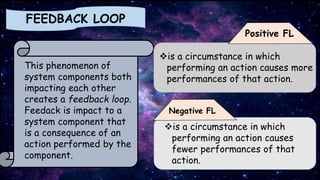
FEEDBACK LOOP
This phenomenon of
system components both
impacting each other
creates a feedback loop.
Feedack is impact to a
system component that
is a consequence of an
action performed by the
component.
is a circumstance in which
performing an action causes more
performances of that action.
is a circumstance in which
performing an action causes
fewer performances of that
action.
Positive FL
Negative FL
Scholz and Binder
It is important to understand
that for feedback loops, the terms
positive and negative o not mean
good and bad. A positive feedback
loop can be a bad thing, and a
negative feedback loop can be a
good thing, or vice versa.
LANDSCAPE
The cocept of landscape has for
quite a long time been important
to geographers and other
environmental scientists in
undersanding HES. It has been
used since the 1800s to focus on
human -environment interactions
and continues to evolve and be in
widespread use. A landscape, in
this context, is not just the
scenery that you view from a
scenic lookout point.
 Landscape include physical features
like streams, oceans, forests, and
soils as well as human-constructed
buildings, trails, fences, and mines.
 Landscapes refers to both human
and non-human phenomena
Clearly, Humans and the
Environment are inseparably
part of the landscape. in other
words, the human part and
the environment part are
closely coupled.
Scholz and Binder
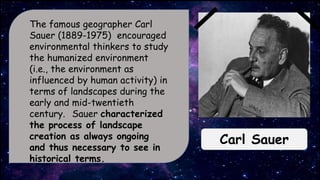
The famous geographer Carl
Sauer (1889-1975) encouraged
environmental thinkers to study
the humanized environment
(i.e., the environment as
influenced by human activity) in
terms of landscapes during the
early and mid-twentieth
century. Sauer characterized
the process of landscape
creation as always ongoing
and thus necessary to see in
historical terms.
Carl Sauer
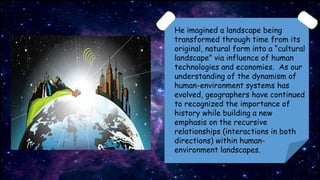
He imagined a landscape being
transformed through time from its
original, natural form into a “cultural
landscape” via influence of human
technologies and economies. As our
understanding of the dynamism of
human-environment systems has
evolved, geographers have continued
to recognized the importance of
history while building a new
emphasis on the recursive
relationships (interactions in both
directions) within human-
environment landscapes.
One final important feature of a
landscape-based approach is the emphasis
on perception.
“Landscapes aren't just “out there”
waiting for us to interact with and learn
from them. Instead, our interpretations
of landscapes are shaped by our own
preferences, needs, and experiences.
To date the significant studies on the studies on
the many problems of human-environment interaction
have been undertaken. For example, “in understanding
how people perceive and judge environmental risks ;
how societies create institutions for managing common
property resources, such as fisheries, grassland and
the atmosphere ; what brought about anthropogenic
environmental changes in the past; the dynamics of
public concern about the environment; and the
economic forces affecting natural resource availability”
However, the field of
inquiry of human-
environmental
interaction has achieved
modest progress
only.Stern (1993, 1898)
identified both
scientific and
institutional reasons
that explain such
modest outcome.
HUMAN ENVIRONMENT SYSTEM APPROACH/ES PPT

HUMAN ENVIRONMENT SYSTEM APPROACH/ES PPT

  • 2.
    ' The Human-Environment Systems(HES) in the social sciences is an interdisciplinary approach in the social sciences. it bridges the gap between, and integrate knowledge from, the social and the natural sciences within one frameworkin thestudy of environmental and social issues. • interaction of human systems with corresponding environmental or or technological systems (Scholz and Binder). Human- Environment System
  • 3.
    • HES approachconceptualizes mutual dependence between human environmental systems. • describe this mutual dependence as “two different systems that exist in essential dependencies and reciprocal endorsement”. Scholz and Binder
  • 4.
    Lui ,J.et al.(2007)made a clear articulation of the reason why an integration of the three aspects is necessary. They argued that “such integration is needed to tackle the increased complexity and to help prevent the dreadful consequences that may occur due to the fundamentally new and rapid changes, because the magnitude, extent, and rate of changes in human - natural couplings have been unprecedented in the past several decades , and the accelerating human impacts on natural systems may lead to degradation and collapse of natural systems which in turn compromise the adaptive capacity of human system”
  • 5.
    To understand andappreciate the human- environment system (HES) approach in the social sciences, the following discussion outlines three areas or fields of inquiry where the HES approach is relevant and necessary both as an analytic tool and framework the study of the human causes of environmental change not only proximate causes, such as burning coal, releasing heavy metals into rivers, and clearing forests,that immediately change a part of the environment but especially indirect causes or driving forces, such as population growth,economic development , technological change, and alterations in social institution and human values that must be understood to forecast trends in environmentally destructive human activity and if necessary to change those trends.
  • 6.
    A second fieldof inquiry concerns the effect of environmental change on things people value both proximate effects, such as on growing seasons and rainfall agricultural areas, endangered species, and so on, an indirect effects, such as on population migrations, international conflict, agricultural markets, and government policies. 2 3 The third field is the study of the feedback between humanity and the environment the ways individuals, organizations, and governments act on the basis of experienced or anticipated environmental change to manage human activity and preserve environmental values. These feedback provide the greatest challenge of scientist and policy makers, partly because there are so many ways people can intervene in the system (Stern 1993, 1897)
  • 7.
  • 8.
    FEEDBACK LOOP This phenomenonof system components both impacting each other creates a feedback loop. Feedack is impact to a system component that is a consequence of an action performed by the component. is a circumstance in which performing an action causes more performances of that action. is a circumstance in which performing an action causes fewer performances of that action. Positive FL Negative FL
  • 9.
    Scholz and Binder Itis important to understand that for feedback loops, the terms positive and negative o not mean good and bad. A positive feedback loop can be a bad thing, and a negative feedback loop can be a good thing, or vice versa.
  • 10.
    LANDSCAPE The cocept oflandscape has for quite a long time been important to geographers and other environmental scientists in undersanding HES. It has been used since the 1800s to focus on human -environment interactions and continues to evolve and be in widespread use. A landscape, in this context, is not just the scenery that you view from a scenic lookout point.  Landscape include physical features like streams, oceans, forests, and soils as well as human-constructed buildings, trails, fences, and mines.  Landscapes refers to both human and non-human phenomena Clearly, Humans and the Environment are inseparably part of the landscape. in other words, the human part and the environment part are closely coupled.
  • 11.
    Scholz and Binder Thefamous geographer Carl Sauer (1889-1975) encouraged environmental thinkers to study the humanized environment (i.e., the environment as influenced by human activity) in terms of landscapes during the early and mid-twentieth century. Sauer characterized the process of landscape creation as always ongoing and thus necessary to see in historical terms. Carl Sauer
  • 12.
    He imagined alandscape being transformed through time from its original, natural form into a “cultural landscape” via influence of human technologies and economies. As our understanding of the dynamism of human-environment systems has evolved, geographers have continued to recognized the importance of history while building a new emphasis on the recursive relationships (interactions in both directions) within human- environment landscapes.
  • 13.
    One final importantfeature of a landscape-based approach is the emphasis on perception. “Landscapes aren't just “out there” waiting for us to interact with and learn from them. Instead, our interpretations of landscapes are shaped by our own preferences, needs, and experiences.
  • 14.
    To date thesignificant studies on the studies on the many problems of human-environment interaction have been undertaken. For example, “in understanding how people perceive and judge environmental risks ; how societies create institutions for managing common property resources, such as fisheries, grassland and the atmosphere ; what brought about anthropogenic environmental changes in the past; the dynamics of public concern about the environment; and the economic forces affecting natural resource availability”
  • 15.
    However, the fieldof inquiry of human- environmental interaction has achieved modest progress only.Stern (1993, 1898) identified both scientific and institutional reasons that explain such modest outcome.