A PRESENTATION ON THE
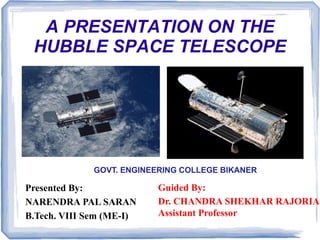
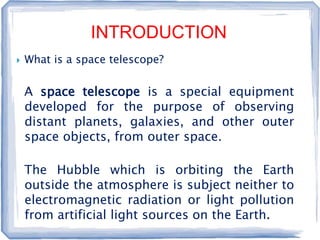
HUBBLE SPACE TELESCOPE
Guided By:
Dr. CHANDRA SHEKHAR RAJORIA
Assistant Professor
Presented By:
NARENDRA PAL SARAN
B.Tech. VIII Sem (ME-I)
GOVT. ENGINEERING COLLEGE BIKANER
INTRODUCTION
 What is a space telescope?
A space telescope is a special equipment
developed for the purpose of observing
distant planets, galaxies, and other outer
space objects, from outer space.
The Hubble which is orbiting the Earth
outside the atmosphere is subject neither to
electromagnetic radiation or light pollution
from artificial light sources on the Earth.
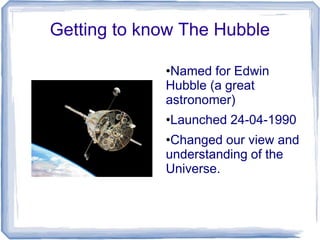
•Named for Edwin
Hubble (a great
astronomer)
•Launched 24-04-1990
•Changed our view and
understanding of the
Universe.
Getting to know The Hubble
Hubble Facts
Hubble orbits 400 mi above the Earth
Orbits the Earth every 95.6 minute
Launch mass 11.11 tons
Size 13.2 m × 4.2 m
Velocity 7160 m/s
Launched by Space Shuttle Discovery
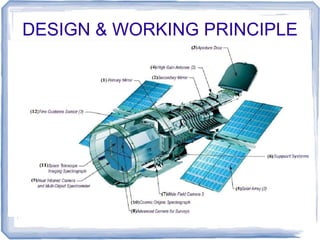
DESIGN & WORKING PRINCIPLE
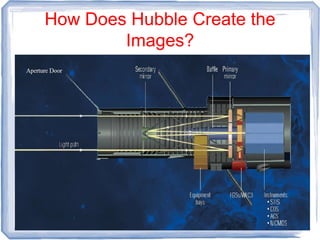
1. PRIMARY MIRROR
Hubble’s 2.4 meter-diameter primary mirror is
made of a special glass coated with aluminum
and a compound that reflects ultraviolet light. It
collects light from the telescope’s targets and
reflects it to the secondary mirror.
2. SECONDARY MIRROR
Like the primary mirror, Hubble’s secondary
mirror is made of special glass coated with
aluminum and a compound to reflect ultraviolet
light. It is 0.33 meters in diameter and reflects the
light back through a hole in the primary mirror
and into the instruments.
3. APERTURE DOOR
Hubble’s aperture door can close, if necessary, to
prevent light from the Sun from entering the
telescope.
4. COMMUNICATION ANTENNAS
Data stored in Hubble’s solid-state recorder is
converted to radio waves and then beamed
through one of the spacecraft’s high-gain antennas
to a NASA communications satellite, which relays it
to the ground.
5. SOLAR PANELS
To operate in space, the HST needs a power
supply, communications equipment, computers,
and a control system.
Power is supplied by two 25-foot-long solar panels,
each containing 48,760 individual photo cells.
Together, the two panels are capable of generating
2,800 W. The power generated by the panels is
also used to charge six nickel-hydrogen batteries
that provide power to the spacecraft for about
twenty-five minutes per orbit while Hubble flies
through the earth's shadow.
6. SUPPORT SYSTEMS
Essential support systems such as computers,
batteries, gyroscopes, reaction wheels, and
electronics are contained in these areas.
7. Wide Field Camera 3 (WFC3)
WFC3 sees three different kinds of light: near-
ultraviolet, visible and near-infrared, though not
simultaneously. Its resolution and field of view are
much greater than that of Hubble's other
instruments. It will be used to study dark energy
and dark matter, the formation of individual stars
and the discovery of extremely remote galaxies
previously beyond Hubble's vision.
8. ACS
The Advanced Camera for Surveys is designed
primarily for wide-field imagery in the visible
wavelengths, though it also sees in ultraviolet and
near infrared.
9. NICMOS
The Near Infrared Camera and Multi-Object
Spectrometer is an instrument for near-infrared
imaging and spectroscopic observations of many
types of astronomical targets.
10. Cosmic Origins Spectrograph (COS)
Astronauts installed the Cosmic Origins
Spectrograph during SM4 in place of the
Corrective Optics Space Telescope Axial
Replacement (COSTAR). The most powerful
ultraviolet spectrograph ever flown, COS measures
the structure and composition of the ordinary
matter concentrated in the “cosmic web.” It also
studies how galaxies, stars, and planets formed
and evolved, and is helping determine how
elements needed for life first formed.
Its main function is spectroscopy—the separation
of light into its component colors (or wavelengths)
to reveal information about an object’s chemical
content, temperature, density, and motion. STIS
also performs imaging, covering most of the
ultraviolet bands, the entire optical wavelength
band, and some wavelengths extending into the
near-infrared.
11. Space Telescope Imaging Spectrograph(STIS)
12. FGS
Hubble has three Fine Guidance Sensors. Two
are needed to point and lock the telescope on the
target and the third can be used for stellar
position measurements, known as astrometry.
During SM4, spacewalking astronauts
exchanged one of these optical sensors with a
refurbished unit that has enhanced, on-orbit
alignment capability.
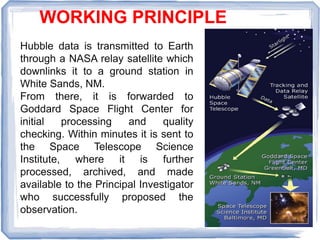
Hubble data is transmitted to Earth
through a NASA relay satellite which
downlinks it to a ground station in
White Sands, NM.
From there, it is forwarded to
Goddard Space Flight Center for
initial processing and quality
checking. Within minutes it is sent to
the Space Telescope Science
Institute, where it is further
processed, archived, and made
available to the Principal Investigator
who successfully proposed the
observation.
WORKING PRINCIPLE
How Does Hubble Create the
Images?
How Does Hubble Create the
Images?
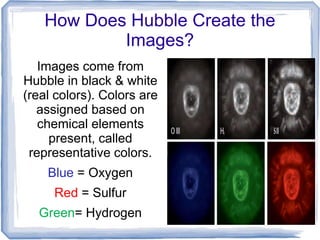
Images come from
Hubble in black & white
(real colors). Colors are
assigned based on
chemical elements
present, called
representative colors.
Blue = Oxygen
Red = Sulfur
Green= Hydrogen
Hubble’s Accomplishments
 NASA now knows that the universe is 13.7
billion years old, thank to Hubble
 Hubble showed NASA how plants born
 HST suggests the universe started increasing
it’s speed recently
 Hubble sensed the first organic molecule on a
planet outside our solar system
Conclusion
In conclusion the Hubble space
telescope has been a major help in
the discovery of the secrets of the
universe. It is unfortunate that it will
out of commission by 2014 but we
will have it’s legacy.
The James Webb Space Telescope
(JWST), is scheduled for launch in
2018.
THANKS FOR YOUR ATTENTION

Hubble space telescope

  • 1.
    A PRESENTATION ONTHE HUBBLE SPACE TELESCOPE Guided By: Dr. CHANDRA SHEKHAR RAJORIA Assistant Professor Presented By: NARENDRA PAL SARAN B.Tech. VIII Sem (ME-I) GOVT. ENGINEERING COLLEGE BIKANER
  • 2.
    INTRODUCTION  What isa space telescope? A space telescope is a special equipment developed for the purpose of observing distant planets, galaxies, and other outer space objects, from outer space. The Hubble which is orbiting the Earth outside the atmosphere is subject neither to electromagnetic radiation or light pollution from artificial light sources on the Earth.
  • 3.
    •Named for Edwin Hubble(a great astronomer) •Launched 24-04-1990 •Changed our view and understanding of the Universe. Getting to know The Hubble
  • 4.
    Hubble Facts Hubble orbits400 mi above the Earth Orbits the Earth every 95.6 minute Launch mass 11.11 tons Size 13.2 m × 4.2 m Velocity 7160 m/s Launched by Space Shuttle Discovery
  • 5.
  • 6.
    1. PRIMARY MIRROR Hubble’s2.4 meter-diameter primary mirror is made of a special glass coated with aluminum and a compound that reflects ultraviolet light. It collects light from the telescope’s targets and reflects it to the secondary mirror. 2. SECONDARY MIRROR Like the primary mirror, Hubble’s secondary mirror is made of special glass coated with aluminum and a compound to reflect ultraviolet light. It is 0.33 meters in diameter and reflects the light back through a hole in the primary mirror and into the instruments.
  • 7.
    3. APERTURE DOOR Hubble’saperture door can close, if necessary, to prevent light from the Sun from entering the telescope. 4. COMMUNICATION ANTENNAS Data stored in Hubble’s solid-state recorder is converted to radio waves and then beamed through one of the spacecraft’s high-gain antennas to a NASA communications satellite, which relays it to the ground.
  • 8.
    5. SOLAR PANELS Tooperate in space, the HST needs a power supply, communications equipment, computers, and a control system. Power is supplied by two 25-foot-long solar panels, each containing 48,760 individual photo cells. Together, the two panels are capable of generating 2,800 W. The power generated by the panels is also used to charge six nickel-hydrogen batteries that provide power to the spacecraft for about twenty-five minutes per orbit while Hubble flies through the earth's shadow.
  • 9.
    6. SUPPORT SYSTEMS Essentialsupport systems such as computers, batteries, gyroscopes, reaction wheels, and electronics are contained in these areas. 7. Wide Field Camera 3 (WFC3) WFC3 sees three different kinds of light: near- ultraviolet, visible and near-infrared, though not simultaneously. Its resolution and field of view are much greater than that of Hubble's other instruments. It will be used to study dark energy and dark matter, the formation of individual stars and the discovery of extremely remote galaxies previously beyond Hubble's vision.
  • 10.
    8. ACS The AdvancedCamera for Surveys is designed primarily for wide-field imagery in the visible wavelengths, though it also sees in ultraviolet and near infrared. 9. NICMOS The Near Infrared Camera and Multi-Object Spectrometer is an instrument for near-infrared imaging and spectroscopic observations of many types of astronomical targets.
  • 11.
    10. Cosmic OriginsSpectrograph (COS) Astronauts installed the Cosmic Origins Spectrograph during SM4 in place of the Corrective Optics Space Telescope Axial Replacement (COSTAR). The most powerful ultraviolet spectrograph ever flown, COS measures the structure and composition of the ordinary matter concentrated in the “cosmic web.” It also studies how galaxies, stars, and planets formed and evolved, and is helping determine how elements needed for life first formed.
  • 12.
    Its main functionis spectroscopy—the separation of light into its component colors (or wavelengths) to reveal information about an object’s chemical content, temperature, density, and motion. STIS also performs imaging, covering most of the ultraviolet bands, the entire optical wavelength band, and some wavelengths extending into the near-infrared. 11. Space Telescope Imaging Spectrograph(STIS)
  • 13.
    12. FGS Hubble hasthree Fine Guidance Sensors. Two are needed to point and lock the telescope on the target and the third can be used for stellar position measurements, known as astrometry. During SM4, spacewalking astronauts exchanged one of these optical sensors with a refurbished unit that has enhanced, on-orbit alignment capability.
  • 14.
    Hubble data istransmitted to Earth through a NASA relay satellite which downlinks it to a ground station in White Sands, NM. From there, it is forwarded to Goddard Space Flight Center for initial processing and quality checking. Within minutes it is sent to the Space Telescope Science Institute, where it is further processed, archived, and made available to the Principal Investigator who successfully proposed the observation. WORKING PRINCIPLE
  • 15.
    How Does HubbleCreate the Images?
  • 16.
    How Does HubbleCreate the Images? Images come from Hubble in black & white (real colors). Colors are assigned based on chemical elements present, called representative colors. Blue = Oxygen Red = Sulfur Green= Hydrogen
  • 17.
    Hubble’s Accomplishments  NASAnow knows that the universe is 13.7 billion years old, thank to Hubble  Hubble showed NASA how plants born  HST suggests the universe started increasing it’s speed recently  Hubble sensed the first organic molecule on a planet outside our solar system
  • 18.
    Conclusion In conclusion theHubble space telescope has been a major help in the discovery of the secrets of the universe. It is unfortunate that it will out of commission by 2014 but we will have it’s legacy. The James Webb Space Telescope (JWST), is scheduled for launch in 2018.
  • 19.