
Hubble ruimte telescoop (HST)


  Jongerenwerking
  De Kometen
Orbiting the Earth for over two decades, Hubble has
 helped to answer some of the most compelling
 astronomical questions of our time – and
 uncovered mysteries we never knew existed.
 Investigating everything from black holes to
 planets around other stars, Hubble has changed the
 face of astronomy, ushering in a new chapter of
 humanity’s exploration of the universe
Hubble's Name
NASA named the world's first space-based optical
 telescope after American astronomer Edwin P.
 Hubble (1889—1953). Dr. Hubble confirmed an
 "expanding" universe, which provided the
 foundation for the Big Bang theory.
Mission
Launch: April 24, 1990 from space shuttle Discovery
  (STS-31)
Deployment: April 25, 1990
Mission Duration: Up to 20 years
Servicing Mission 1: December 1993
Servicing Mission 2: February 1997
Servicing Mission 3A: December 1999
Servicing Mission 3B: February 2002
Size
Length: 43.5 ft (13.2 m)
Weight: 24,500 lb (11,110 kg)
Maximum Diameter: 14 ft (4.2 m)


Cost at Launch
$1.5 billion
Spaceflight Statistics
Orbit: At an altitude of 307 nautical miles (569 km,
 or 353 miles), inclined 28.5 degrees to the equator
 (low-Earth orbit)
Time to Complete One Orbit: 97 minutes
Every 97 minutes, Hubble completes a spin around
 Earth, moving at the speed of about five miles per
 second (8 km per second) — fast enough to travel
 across the United States in about 10 minutes. As it
 travels, Hubble's mirror captures light and directs it
 into its several science instruments.
Hubble is a type of telescope known as a Cassegrain reflector. Light hits the
  telescope's main mirror, or primary mirror. It bounces off the primary
  mirror and encounters a secondary mirror. The secondary mirror focuses
  the light through a hole in the center of the primary mirror that leads to the
  telescope's science instruments.
People often mistakenly believe that a telescope's
  power lies in its ability to magnify objects.
  Telescopes actually work by collecting more light
  than the human eye can capture on its own. The
  larger a telescope's mirror, the more light it can
  collect, and the better its vision. Hubble's primary
  mirror is 94.5 inches (2.4 m) in diameter. This
  mirror is small compared with those of current
  ground-based telescopes, which can be 400 inches
  (1,000 cm) and up, but Hubble's location beyond
  the atmosphere gives it remarkable clarity.
Once the mirror captures the light, Hubble's science instruments work together or individually to provide the observation. Each instrument is designed to
     examine the universe in a different way.

The Wide Field Camera 3 (WFC3) sees three different kinds of light: near-ultraviolet, visible and near-infrared, though not simultaneously. Its resolution
     and field of view are much greater than that of Hubble's other instruments. WFC3 is one of Hubble's two newest instruments, and will be used to
     study dark energy and dark matter, the formation of individual stars and the discovery of extremely remote galaxies previously beyond Hubble's
     vision.

The Cosmic Origins Spectrograph (COS), Hubble's other new instrument, is a spectrograph that sees exclusively in ultraviolet light. Spectrographs acts
     something like prisms, separating light from the cosmos into its component colors. This provides a wavelength "fingerprint" of the object being
     observed, which tells us about its temperature, chemical composition, density, and motion. COS will improve Hubble's ultraviolet sensitivity at least
     10 times, and up to 70 times when observing extremely faint objects.

The Advanced Camera for Surveys (ACS) sees visible light, and is designed to study some of the earliest activity in the universe. ACS helps map the
     distribution of dark matter, detects the most distant objects in the universe, searches for massive planets, and studies the evolution of clusters of
     galaxies. ACS partially stopped working in 2007 due to an electrical short, but was repaired during Servicing Mission 4 in May 2009.

The Space Telescope Imaging Spectrograph (STIS) is a spectrograph that sees ultraviolet, visible and near-infrared light, and is known for its ability to hunt
     black holes. While COS works best with small sources of light, such as stars or quasars, STIS can map out larger objects like galaxies. STIS stopped
     working due to a technical failure on August 3, 2004, but was also repaired during Servicing Mission 4.

The Near Infrared Camera and Multi-Object Spectrometer (NICMOS) is Hubble's heat sensor. Its sensitivity to infrared light — perceived by humans as
     heat — lets it observe objects hidden by interstellar dust, like stellar birth sites, and gaze into deepest space.


Finally, the Fine Guidance Sensors (FGS) are devices that lock onto "guide stars" and keep Hubble pointed in the right direction. They can be used to
      precisely measure the distance between stars, and their relative motions .
All of Hubble's functions are powered by sunlight.
 Hubble sports solar arrays that convert sunlight
 directly into electricity. Some of that electricity is
 stored in batteries that keep the telescope running
 when it's in Earth's shadow, blocked from the Sun's
 rays.
Ontdekkingen

Kosmologie
Planeten wetenschap
Melkweg wetenschap
Kosmologie: babyfoto's vh heelal

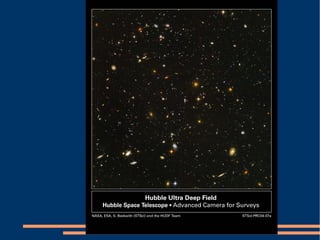
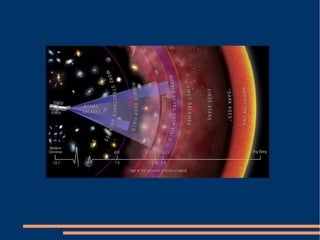
When we look out at space, we are looking back in time: billions light years

The most distant galaxies look strange – smaller, irregular, lacking clearly defined shapes.

No telescope before Hubble had the resolution to see these distant galaxies. Intrigued, astronomers turned Hubble on what appeared to be a
     nearly empty patch of sky and let it soak up all the light it could for 10 days. They were taking a risk – most Hubble observations take just
     hours, and the time being eaten up could have been used for more concrete needs. It was possible the objects the astronomers were
     looking for would be too faint or small for even Hubble to see.


But the results turned up a treasure trove: 3,000 galaxies, large and small, shapely and amorphous, burning in the depths of space. The stunning
      image was called the Hubble Deep Field
Planeet wetenschap

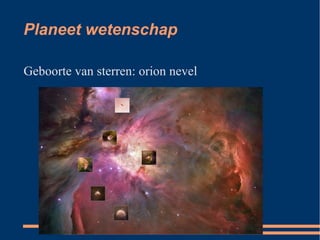
Geboorte van sterren: orion nevel
planeetwetenschap

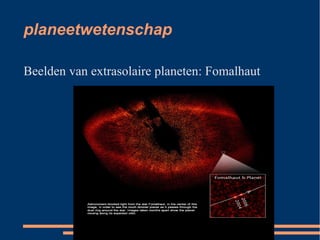
Beelden van extrasolaire planeten: Fomalhaut
Planeetwetenschap

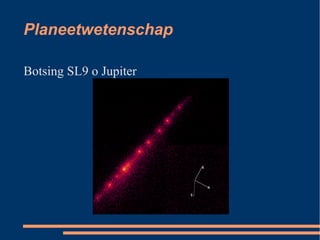
Botsing SL9 o Jupiter
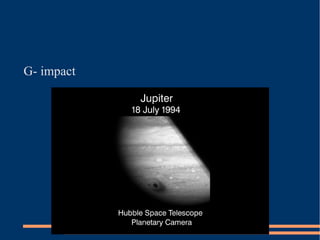
G- impact
Hubble Space telescope

Hubble Space telescope

  • 1.
    Hubble ruimte telescoop(HST) Jongerenwerking De Kometen
  • 2.
    Orbiting the Earthfor over two decades, Hubble has helped to answer some of the most compelling astronomical questions of our time – and uncovered mysteries we never knew existed. Investigating everything from black holes to planets around other stars, Hubble has changed the face of astronomy, ushering in a new chapter of humanity’s exploration of the universe
  • 3.
    Hubble's Name NASA namedthe world's first space-based optical telescope after American astronomer Edwin P. Hubble (1889—1953). Dr. Hubble confirmed an "expanding" universe, which provided the foundation for the Big Bang theory.
  • 4.
    Mission Launch: April 24,1990 from space shuttle Discovery (STS-31) Deployment: April 25, 1990 Mission Duration: Up to 20 years Servicing Mission 1: December 1993 Servicing Mission 2: February 1997 Servicing Mission 3A: December 1999 Servicing Mission 3B: February 2002
  • 5.
    Size Length: 43.5 ft(13.2 m) Weight: 24,500 lb (11,110 kg) Maximum Diameter: 14 ft (4.2 m) Cost at Launch $1.5 billion
  • 6.
    Spaceflight Statistics Orbit: Atan altitude of 307 nautical miles (569 km, or 353 miles), inclined 28.5 degrees to the equator (low-Earth orbit) Time to Complete One Orbit: 97 minutes
  • 7.
    Every 97 minutes,Hubble completes a spin around Earth, moving at the speed of about five miles per second (8 km per second) — fast enough to travel across the United States in about 10 minutes. As it travels, Hubble's mirror captures light and directs it into its several science instruments.
  • 8.
    Hubble is atype of telescope known as a Cassegrain reflector. Light hits the telescope's main mirror, or primary mirror. It bounces off the primary mirror and encounters a secondary mirror. The secondary mirror focuses the light through a hole in the center of the primary mirror that leads to the telescope's science instruments.
  • 9.
    People often mistakenlybelieve that a telescope's power lies in its ability to magnify objects. Telescopes actually work by collecting more light than the human eye can capture on its own. The larger a telescope's mirror, the more light it can collect, and the better its vision. Hubble's primary mirror is 94.5 inches (2.4 m) in diameter. This mirror is small compared with those of current ground-based telescopes, which can be 400 inches (1,000 cm) and up, but Hubble's location beyond the atmosphere gives it remarkable clarity.
  • 10.
    Once the mirrorcaptures the light, Hubble's science instruments work together or individually to provide the observation. Each instrument is designed to examine the universe in a different way. The Wide Field Camera 3 (WFC3) sees three different kinds of light: near-ultraviolet, visible and near-infrared, though not simultaneously. Its resolution and field of view are much greater than that of Hubble's other instruments. WFC3 is one of Hubble's two newest instruments, and will be used to study dark energy and dark matter, the formation of individual stars and the discovery of extremely remote galaxies previously beyond Hubble's vision. The Cosmic Origins Spectrograph (COS), Hubble's other new instrument, is a spectrograph that sees exclusively in ultraviolet light. Spectrographs acts something like prisms, separating light from the cosmos into its component colors. This provides a wavelength "fingerprint" of the object being observed, which tells us about its temperature, chemical composition, density, and motion. COS will improve Hubble's ultraviolet sensitivity at least 10 times, and up to 70 times when observing extremely faint objects. The Advanced Camera for Surveys (ACS) sees visible light, and is designed to study some of the earliest activity in the universe. ACS helps map the distribution of dark matter, detects the most distant objects in the universe, searches for massive planets, and studies the evolution of clusters of galaxies. ACS partially stopped working in 2007 due to an electrical short, but was repaired during Servicing Mission 4 in May 2009. The Space Telescope Imaging Spectrograph (STIS) is a spectrograph that sees ultraviolet, visible and near-infrared light, and is known for its ability to hunt black holes. While COS works best with small sources of light, such as stars or quasars, STIS can map out larger objects like galaxies. STIS stopped working due to a technical failure on August 3, 2004, but was also repaired during Servicing Mission 4. The Near Infrared Camera and Multi-Object Spectrometer (NICMOS) is Hubble's heat sensor. Its sensitivity to infrared light — perceived by humans as heat — lets it observe objects hidden by interstellar dust, like stellar birth sites, and gaze into deepest space. Finally, the Fine Guidance Sensors (FGS) are devices that lock onto "guide stars" and keep Hubble pointed in the right direction. They can be used to precisely measure the distance between stars, and their relative motions .
  • 11.
    All of Hubble'sfunctions are powered by sunlight. Hubble sports solar arrays that convert sunlight directly into electricity. Some of that electricity is stored in batteries that keep the telescope running when it's in Earth's shadow, blocked from the Sun's rays.
  • 13.
  • 14.
    Kosmologie: babyfoto's vhheelal When we look out at space, we are looking back in time: billions light years The most distant galaxies look strange – smaller, irregular, lacking clearly defined shapes. No telescope before Hubble had the resolution to see these distant galaxies. Intrigued, astronomers turned Hubble on what appeared to be a nearly empty patch of sky and let it soak up all the light it could for 10 days. They were taking a risk – most Hubble observations take just hours, and the time being eaten up could have been used for more concrete needs. It was possible the objects the astronomers were looking for would be too faint or small for even Hubble to see. But the results turned up a treasure trove: 3,000 galaxies, large and small, shapely and amorphous, burning in the depths of space. The stunning image was called the Hubble Deep Field
  • 17.
    Planeet wetenschap Geboorte vansterren: orion nevel
  • 18.
  • 19.
  • 20.