UKSEDS Space Conference 23rd February 2013
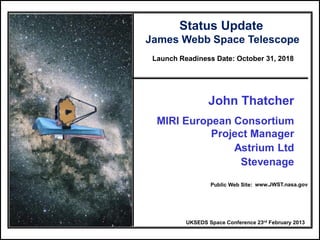
Status Update
James Webb Space Telescope
Launch Readiness Date: October 31, 2018
Public Web Site: www.JWST.nasa.gov
John Thatcher
MIRI European Consortium
Project Manager
Astrium Ltd
Stevenage
Outline
 Introduction & Overview
 Status – the ‘bits’
 Launch and Deployment
 Observations from an Oldie
JWST Key Points
 JWST is the successor to the Hubble Space Telescope
 It is a joint mission by NASA, ESA (European Space Agency) &
CSA (Canadian Space Agency)
 JWST is named after the 2nd NASA Administrator (1961-1968)
who drove the Apollo program whilst ensuring the future of
space science missions
 The Observatory is optimized for infrared observations (0.6 – 28
microns) for looking a long way back in space and time in order
to study the origin and evolution of galaxies, stars and
planetary systems
 The telescope & instruments operate at cryogenic temperatures
to get the necessary infrared performance to deliver that
science:
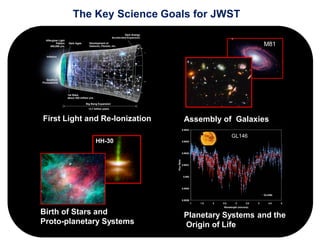
The Key Science Goals for JWST
First Light and Re-Ionization Assembly of Galaxies
Birth of Stars and
Proto-planetary Systems
Planetary Systems and the
Origin of Life
GL146
HH-30
M81
European Scientists’ View on JWST
(After Project’s Near-Death Experience in 2011)
• It is not “just hype” to say that ‘JWST is so scientifically powerful
and able to address the key outstanding questions that it will
transform astrophysics and cosmology’
• JWST is also technically audacious
• The JWST project is working hard to meet the 2018 launch date
• The associated lifetime cost of $8.7 billion is “public knowledge”…
• …but that is still significantly less than one dollar per light year of
looking back in space and time!
5
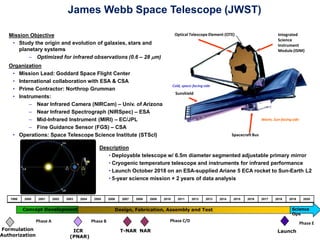
Mission Objective
• Study the origin and evolution of galaxies, stars and
planetary systems
– Optimized for infrared observations (0.6 – 28 µm)
Organization
• Mission Lead: Goddard Space Flight Center
• International collaboration with ESA & CSA
• Prime Contractor: Northrop Grumman
• Instruments:
– Near Infrared Camera (NIRCam) – Univ. of Arizona
– Near Infrared Spectrograph (NIRSpec) – ESA
– Mid-Infrared Instrument (MIRI) – EC/JPL
– Fine Guidance Sensor (FGS) – CSA
• Operations: Space Telescope Science Institute (STScI)
Description
• Deployable telescope w/ 6.5m diameter segmented adjustable primary mirror
• Cryogenic temperature telescope and instruments for infrared performance
• Launch October 2018 on an ESA-supplied Ariane 5 ECA rocket to Sun-Earth L2
• 5-year science mission + 2 years of data analysis
Warm, Sun-facing side
Cold, space-facing side
Integrated
Science
Instrument
Module (ISIM)
Optical Telescope Element (OTE)
Sunshield
Spacecraft Bus
Phase A Phase B Phase C/D
Phase E
Concept Development Design, Fabrication, Assembly and Test
Formulation
Authorization
T-NAR Launch
Science
Ops
ICR
(PNAR)
NAR
Integrated
Science
Instrument
Module (ISIM)
1999 2000 2001 2002 2003 2004 2005 2006 2007 2008 2009 2010 2011 2012 2013 2014 2015 2016 2017 2018 2019 2020
James Webb Space Telescope (JWST)
Major Design Drivers
• Need a big primary mirror for sensitivity – 6.5m diameter minimum
– So needs to be lightweight and deployable to fit in rocket fairing
• Need to be cold (to detect light shifted to the infrared)
– This is where the science is!
– Cannot then sensibly be in Earth orbit – need to go to L2 with a
big sunshield so telescope/instruments at ~40 Kelvin (-233 C)
• Need precision pointing, stability, wavefront sensing & control and
state of the art optics and detectors
• Hence:
– Need a big spacecraft (6.5 tonnes at launch)
– Need big test equipment & facilities
– Need a lot of money! ($8.7 billion+) and time
– Need large collaboration of countries, agencies & institutes
– Plus need at least the usual ‘one miracle per major project’…
– …along with strong nerves and a thick skin.
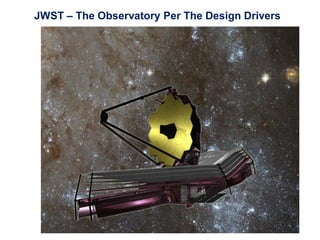
JWST – The Observatory Per The Design Drivers
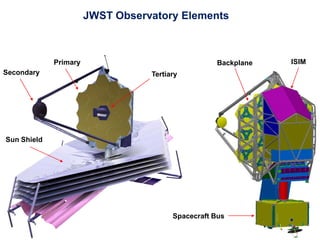
JWST Observatory Elements
Primary
Sun Shield
Spacecraft Bus
Secondary
ISIMBackplane
Tertiary
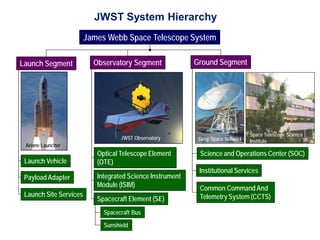
JWST System Hierarchy
James Webb Space Telescope System
Launch Segment Observatory Segment Ground Segment
Integrated Science Instrument
Module (ISIM)
Optical Telescope Element
(OTE)
Spacecraft Element (SE)
Launch Vehicle
PayloadAdapter
Launch Site Services
Science and Operations Center (SOC)
Common CommandAnd
Telemetry System (CCTS)
Institutional Services
Spacecraft Bus
Sunshield
Ariane Launcher
JWST Observatory Deep Space Network
Space Telescope Science
Institute
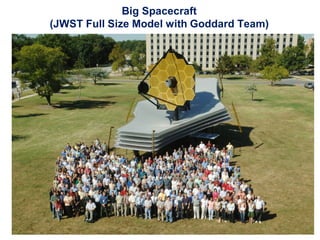
Big Spacecraft
(JWST Full Size Model with Goddard Team)
1
2
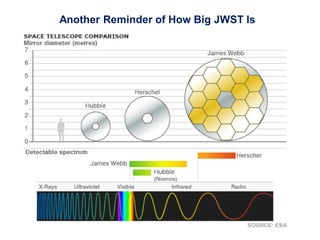
Another Reminder of How Big JWST Is
Outline
 Introduction & overview
 Status – the ‘bits’ (major ones)
 Launch and deployment
 Observations from an Oldie
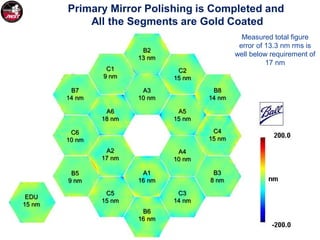
A2
17 nm
A4
10 nm
A1
16 nm
C3
14 nm
B6
16 nm
A5
15 nm
B3
8 nm
C5
15 nm
A6
18 nm
B5
9 nm
B8
14 nm
EDU
15 nm
C4
15 nm
C6
10 nm
C2
15 nm
A3
10 nm
B2
13 nm
C1
9 nm
B7
14 nm
Primary Mirror Polishing is Completed and
All the Segments are Gold Coated
Measured total figure
error of 13.3 nm rms is
well below requirement of
17 nm
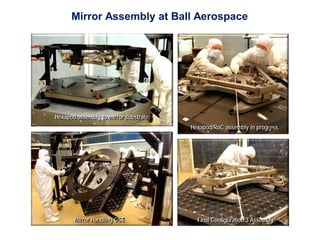
Mirror Assembly at Ball Aerospace
Final Configuration 3 Assembly
Hexapod assembly to mirror substrate
Mirror Handling GSE
Hexapod/RoC assembly in progress
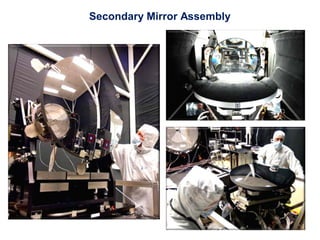
Secondary Mirror Assembly
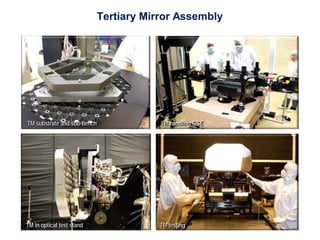
Tertiary Mirror Assembly
TM substrate and sub-bench TM handling GSE
TM in optical test stand TM testing
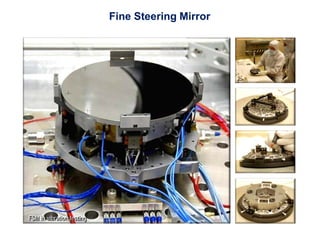
Fine Steering Mirror
FSM in vibration testing
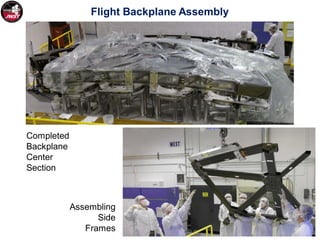
Completed
Backplane
Center
Section
Flight Backplane Assembly
Assembling
Side
Frames
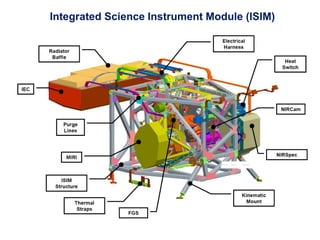
Integrated Science Instrument Module (ISIM)
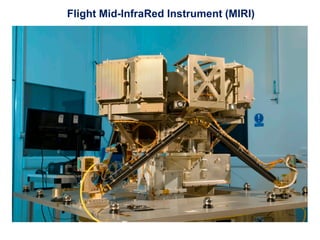
Flight Mid-InfraRed Instrument (MIRI)
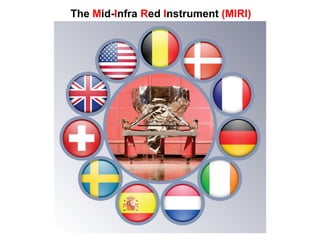
The Mid-Infra Red Instrument (MIRI)
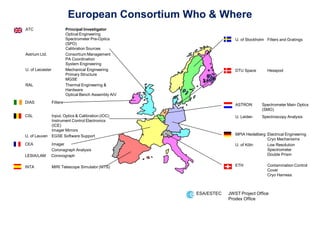
European Consortium Who & Where
ESA/ESTEC JWST Project Office
Prodex Office
DTU Space Hexapod
ETH Contamination Control
Cover
Cryo Harness
INTA MIRI Telescope Simulator (MTS)
CEA Imager
Coronagraph Analysis
LESIA/LAM Coronograph
CSL Input, Optics & Calibration (IOC)
Instrument Control Electronics
(ICE)
Imager Mirrors
U. of Leuven EGSE Software Support
DIAS Filters
ATC Principal Investigator
Optical Engineering
Spectrometer Pre-Optics
(SPO)
Calibration Sources
Astrium Ltd. Consortium Management
PA Coordination
System Engineering
U. of Leicester Mechanical Engineering
Primary Structure
MGSE
RAL Thermal Engineering &
Hardware
Optical Bench Assembly AIV
MPIA Heidelberg Electrical Engineering
Cryo Mechanisms
U. of Köln Low Resolution
Spectrometer
Double Prism
ASTRON Spectrometer Main Optics
(SMO)
U. Leiden Spectroscopy Analysis
U. of Stockholm Filters and Gratings
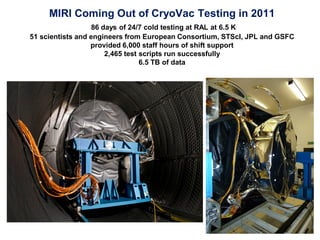
MIRI Coming Out of CryoVac Testing in 2011
86 days of 24/7 cold testing at RAL at 6.5 K
51 scientists and engineers from European Consortium, STScI, JPL and GSFC
provided 6,000 staff hours of shift support
2,465 test scripts run successfully
6.5 TB of data
2
5
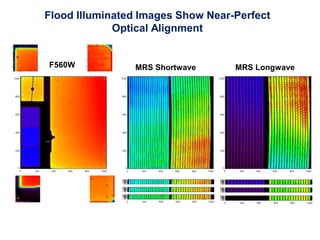
Flood Illuminated Images Show Near-Perfect
Optical Alignment
F560W MRS LongwaveMRS Shortwave
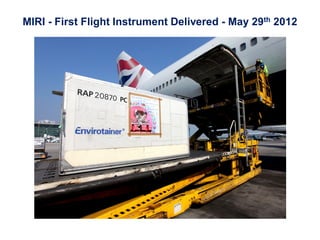
MIRI - First Flight Instrument Delivered - May 29th 2012
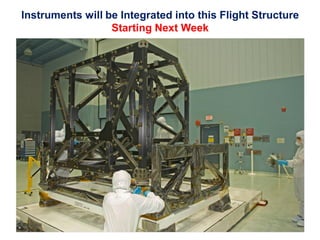
Instruments will be Integrated into this Flight Structure
Starting Next Week
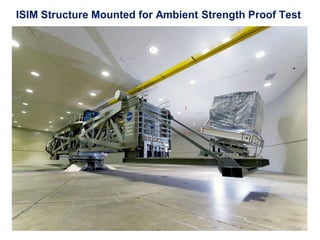
ISIM Structure Mounted for Ambient Strength Proof Test
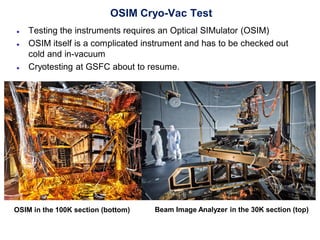
OSIM Cryo-Vac Test
● Testing the instruments requires an Optical SIMulator (OSIM)
● OSIM itself is a complicated instrument and has to be checked out
cold and in-vacuum
● Cryotesting at GSFC about to resume.
Beam Image Analyzer in the 30K section (top)OSIM in the 100K section (bottom)
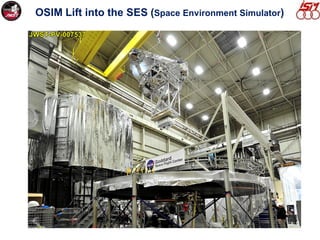
OSIM Lift into the SES (Space Environment Simulator)
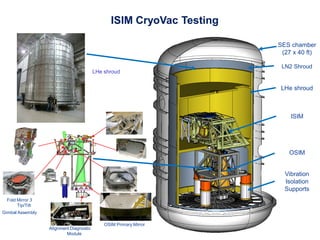
ISIM CryoVac Testing
SES chamber
(27 x 40 ft)
LN2 Shroud
LHe shroud
ISIM
OSIM
Vibration
Isolation
Supports
OSIM Primary Mirror
Alignment Diagnostic
Module
Fold Mirror 3
Tip/Tilt
Gimbal Assembly
LHe shroud
Outline
 Introduction & overview
 Status – the ‘bits’
 Launch and deployment
 Observations from an Oldie
 Launch and deployment videos can be found on
the JWST website at: www.jwst.nasa.gov
Outline
 Introduction & overview
 Status – the ‘bits’
 Launch and deployment
 Observations from an Oldie
Some Observations Based on 30 Years ‘In Space’ - 1
 It’s a great career! – spacecraft, rockets, international
collaboration, the physics of the universe – and they pay you to
do it – and it’s fun!
 A constant learning experience – you can never know all there
is to know about the subject
 There is no need for Europeans to be over-awed by NASA
 JWST could well be the last of the really big observatories for a
very long time…
 …but more, smaller, faster missions offer lots of opportunities
 The UK is in a great position after the Council of Ministers
meeting thanks to a lot of preparation work by many in
government, industry and academia
 This requires mind-set changes, particularly in ESA, to get
more bang for the buck (another long story).
Some Observations Based on 30 Years ‘In Space’ - 2
 Especially in the multi-national context, you would do well to
remember Mart’s 3 laws of space engineering (Charles Martin
was an old-school chief designer and space enthusiast)
 Politics first
 Finance second
 Engineering third
 Finally, at a personal level:
 Your career path is in your own hands, do not trust others to
arrange it for you or assume they will do it
 Always be prepared to seize an opportunity so keep your eyes
and ears open
 Don’t be afraid of decisions – you will never have all the
information you need to make the ideal one
 Finally, to quote Bill Boeing, this is not a bad mantra:
‘Act, move forward, get things done’.

MIRI & the James Webb Space Telescope

  • 1.
    UKSEDS Space Conference23rd February 2013 Status Update James Webb Space Telescope Launch Readiness Date: October 31, 2018 Public Web Site: www.JWST.nasa.gov John Thatcher MIRI European Consortium Project Manager Astrium Ltd Stevenage
  • 2.
    Outline  Introduction &Overview  Status – the ‘bits’  Launch and Deployment  Observations from an Oldie
  • 3.
    JWST Key Points JWST is the successor to the Hubble Space Telescope  It is a joint mission by NASA, ESA (European Space Agency) & CSA (Canadian Space Agency)  JWST is named after the 2nd NASA Administrator (1961-1968) who drove the Apollo program whilst ensuring the future of space science missions  The Observatory is optimized for infrared observations (0.6 – 28 microns) for looking a long way back in space and time in order to study the origin and evolution of galaxies, stars and planetary systems  The telescope & instruments operate at cryogenic temperatures to get the necessary infrared performance to deliver that science:
  • 4.
    The Key ScienceGoals for JWST First Light and Re-Ionization Assembly of Galaxies Birth of Stars and Proto-planetary Systems Planetary Systems and the Origin of Life GL146 HH-30 M81
  • 5.
    European Scientists’ Viewon JWST (After Project’s Near-Death Experience in 2011) • It is not “just hype” to say that ‘JWST is so scientifically powerful and able to address the key outstanding questions that it will transform astrophysics and cosmology’ • JWST is also technically audacious • The JWST project is working hard to meet the 2018 launch date • The associated lifetime cost of $8.7 billion is “public knowledge”… • …but that is still significantly less than one dollar per light year of looking back in space and time! 5
  • 6.
    Mission Objective • Studythe origin and evolution of galaxies, stars and planetary systems – Optimized for infrared observations (0.6 – 28 µm) Organization • Mission Lead: Goddard Space Flight Center • International collaboration with ESA & CSA • Prime Contractor: Northrop Grumman • Instruments: – Near Infrared Camera (NIRCam) – Univ. of Arizona – Near Infrared Spectrograph (NIRSpec) – ESA – Mid-Infrared Instrument (MIRI) – EC/JPL – Fine Guidance Sensor (FGS) – CSA • Operations: Space Telescope Science Institute (STScI) Description • Deployable telescope w/ 6.5m diameter segmented adjustable primary mirror • Cryogenic temperature telescope and instruments for infrared performance • Launch October 2018 on an ESA-supplied Ariane 5 ECA rocket to Sun-Earth L2 • 5-year science mission + 2 years of data analysis Warm, Sun-facing side Cold, space-facing side Integrated Science Instrument Module (ISIM) Optical Telescope Element (OTE) Sunshield Spacecraft Bus Phase A Phase B Phase C/D Phase E Concept Development Design, Fabrication, Assembly and Test Formulation Authorization T-NAR Launch Science Ops ICR (PNAR) NAR Integrated Science Instrument Module (ISIM) 1999 2000 2001 2002 2003 2004 2005 2006 2007 2008 2009 2010 2011 2012 2013 2014 2015 2016 2017 2018 2019 2020 James Webb Space Telescope (JWST)
  • 7.
    Major Design Drivers •Need a big primary mirror for sensitivity – 6.5m diameter minimum – So needs to be lightweight and deployable to fit in rocket fairing • Need to be cold (to detect light shifted to the infrared) – This is where the science is! – Cannot then sensibly be in Earth orbit – need to go to L2 with a big sunshield so telescope/instruments at ~40 Kelvin (-233 C) • Need precision pointing, stability, wavefront sensing & control and state of the art optics and detectors • Hence: – Need a big spacecraft (6.5 tonnes at launch) – Need big test equipment & facilities – Need a lot of money! ($8.7 billion+) and time – Need large collaboration of countries, agencies & institutes – Plus need at least the usual ‘one miracle per major project’… – …along with strong nerves and a thick skin.
  • 8.
    JWST – TheObservatory Per The Design Drivers
  • 9.
    JWST Observatory Elements Primary SunShield Spacecraft Bus Secondary ISIMBackplane Tertiary
  • 10.
    JWST System Hierarchy JamesWebb Space Telescope System Launch Segment Observatory Segment Ground Segment Integrated Science Instrument Module (ISIM) Optical Telescope Element (OTE) Spacecraft Element (SE) Launch Vehicle PayloadAdapter Launch Site Services Science and Operations Center (SOC) Common CommandAnd Telemetry System (CCTS) Institutional Services Spacecraft Bus Sunshield Ariane Launcher JWST Observatory Deep Space Network Space Telescope Science Institute
  • 11.
    Big Spacecraft (JWST FullSize Model with Goddard Team)
  • 12.
    1 2 Another Reminder ofHow Big JWST Is
  • 13.
    Outline  Introduction &overview  Status – the ‘bits’ (major ones)  Launch and deployment  Observations from an Oldie
  • 14.
    A2 17 nm A4 10 nm A1 16nm C3 14 nm B6 16 nm A5 15 nm B3 8 nm C5 15 nm A6 18 nm B5 9 nm B8 14 nm EDU 15 nm C4 15 nm C6 10 nm C2 15 nm A3 10 nm B2 13 nm C1 9 nm B7 14 nm Primary Mirror Polishing is Completed and All the Segments are Gold Coated Measured total figure error of 13.3 nm rms is well below requirement of 17 nm
  • 16.
    Mirror Assembly atBall Aerospace Final Configuration 3 Assembly Hexapod assembly to mirror substrate Mirror Handling GSE Hexapod/RoC assembly in progress
  • 17.
  • 18.
    Tertiary Mirror Assembly TMsubstrate and sub-bench TM handling GSE TM in optical test stand TM testing
  • 19.
    Fine Steering Mirror FSMin vibration testing
  • 20.
  • 21.
  • 22.
  • 23.
    The Mid-Infra RedInstrument (MIRI)
  • 24.
    European Consortium Who& Where ESA/ESTEC JWST Project Office Prodex Office DTU Space Hexapod ETH Contamination Control Cover Cryo Harness INTA MIRI Telescope Simulator (MTS) CEA Imager Coronagraph Analysis LESIA/LAM Coronograph CSL Input, Optics & Calibration (IOC) Instrument Control Electronics (ICE) Imager Mirrors U. of Leuven EGSE Software Support DIAS Filters ATC Principal Investigator Optical Engineering Spectrometer Pre-Optics (SPO) Calibration Sources Astrium Ltd. Consortium Management PA Coordination System Engineering U. of Leicester Mechanical Engineering Primary Structure MGSE RAL Thermal Engineering & Hardware Optical Bench Assembly AIV MPIA Heidelberg Electrical Engineering Cryo Mechanisms U. of Köln Low Resolution Spectrometer Double Prism ASTRON Spectrometer Main Optics (SMO) U. Leiden Spectroscopy Analysis U. of Stockholm Filters and Gratings
  • 25.
    MIRI Coming Outof CryoVac Testing in 2011 86 days of 24/7 cold testing at RAL at 6.5 K 51 scientists and engineers from European Consortium, STScI, JPL and GSFC provided 6,000 staff hours of shift support 2,465 test scripts run successfully 6.5 TB of data 2 5
  • 26.
    Flood Illuminated ImagesShow Near-Perfect Optical Alignment F560W MRS LongwaveMRS Shortwave
  • 27.
    MIRI - FirstFlight Instrument Delivered - May 29th 2012
  • 28.
    Instruments will beIntegrated into this Flight Structure Starting Next Week
  • 29.
    ISIM Structure Mountedfor Ambient Strength Proof Test
  • 30.
    OSIM Cryo-Vac Test ●Testing the instruments requires an Optical SIMulator (OSIM) ● OSIM itself is a complicated instrument and has to be checked out cold and in-vacuum ● Cryotesting at GSFC about to resume. Beam Image Analyzer in the 30K section (top)OSIM in the 100K section (bottom)
  • 31.
    OSIM Lift intothe SES (Space Environment Simulator)
  • 32.
    ISIM CryoVac Testing SESchamber (27 x 40 ft) LN2 Shroud LHe shroud ISIM OSIM Vibration Isolation Supports OSIM Primary Mirror Alignment Diagnostic Module Fold Mirror 3 Tip/Tilt Gimbal Assembly LHe shroud
  • 33.
    Outline  Introduction &overview  Status – the ‘bits’  Launch and deployment  Observations from an Oldie
  • 34.
     Launch anddeployment videos can be found on the JWST website at: www.jwst.nasa.gov
  • 35.
    Outline  Introduction &overview  Status – the ‘bits’  Launch and deployment  Observations from an Oldie
  • 36.
    Some Observations Basedon 30 Years ‘In Space’ - 1  It’s a great career! – spacecraft, rockets, international collaboration, the physics of the universe – and they pay you to do it – and it’s fun!  A constant learning experience – you can never know all there is to know about the subject  There is no need for Europeans to be over-awed by NASA  JWST could well be the last of the really big observatories for a very long time…  …but more, smaller, faster missions offer lots of opportunities  The UK is in a great position after the Council of Ministers meeting thanks to a lot of preparation work by many in government, industry and academia  This requires mind-set changes, particularly in ESA, to get more bang for the buck (another long story).
  • 37.
    Some Observations Basedon 30 Years ‘In Space’ - 2  Especially in the multi-national context, you would do well to remember Mart’s 3 laws of space engineering (Charles Martin was an old-school chief designer and space enthusiast)  Politics first  Finance second  Engineering third  Finally, at a personal level:  Your career path is in your own hands, do not trust others to arrange it for you or assume they will do it  Always be prepared to seize an opportunity so keep your eyes and ears open  Don’t be afraid of decisions – you will never have all the information you need to make the ideal one  Finally, to quote Bill Boeing, this is not a bad mantra: ‘Act, move forward, get things done’.