Kunal Datta
 The word environment is derived from the French
word ‘environner’ (surround or encircle).
 So it is a Surrounding in which we are living.
 It includes all those things (Living components & Non
living components)
 Thus our environment can be defined as “the Social,
Cultural and Physical conditions that surround, affect
and influence the survival, growth and development
of people, animals and plants.
Environment consists of four segments.
 Atmosphere- Blanket of gases surrounding the earth.
 Hydrosphere- Various water bodies present on the earth.
 Lithosphere- Contains various types of soils and rocks
on the earth.
 Biosphere- Composed of all living organisms and their
interactions with the environment.
 The Environment studies is a multi-disciplinary science because It
consists of various branches of studies like chemistry, Physics ,Biology,
Medical sciences etc.
 It utilizes information's from different streams of science to deals with
various environmental problems.
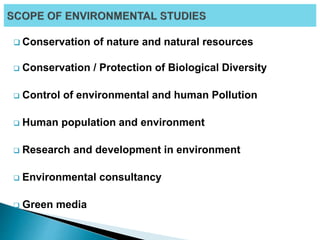
 Conservation of nature and natural resources
 Conservation / Protection of Biological Diversity
 Control of environmental and human Pollution
 Human population and environment
 Research and development in environment
 Environmental consultancy
 Green media
All things which are available in nature which can be
used are called Natural Resources.
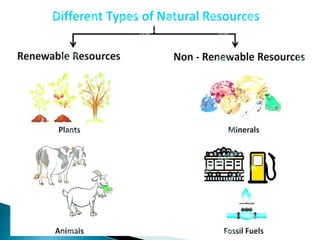
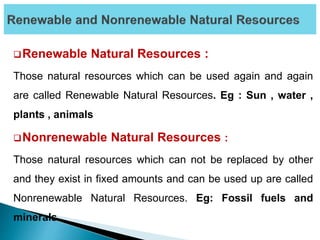
Renewable Natural Resources :
Those natural resources which can be used again and again
are called Renewable Natural Resources. Eg : Sun , water ,
plants , animals
Nonrenewable Natural Resources :
Those natural resources which can not be replaced by other
and they exist in fixed amounts and can be used up are called
Nonrenewable Natural Resources. Eg: Fossil fuels and
minerals.
The natural resources are as follows :
 Forest resources
 Water resources
 Land /Soil Resources
 Mineral Resources
 Energy Resources
 Forest is an important renewable resources.
 Forest can contribute economical development in any
country.
 Plants along with trees cover large areas, produce variety of
products and provide food for living organisms, and also
important to save the environment.
 It performs very important function to both human and
nature.
 They are habitats to millions of plants, animals and wild life.
 They recycle rain water.
 They remove pollutant from air.
 They control water quality.
 They moderate temperature and weather.
 They influence soil condition and prevent soil erosion.
 Commercial uses :
 Wood – used as a fuel
 Supply wood for various industries – Raw materials as pulp, paper,
furniture timber etc.
 Minor forest products – gum, dyes, resins etc.
 Many plants – Medicines
 Supply variety of animal products – honey. Ivory, horns etc.
 Many forest lands are used for - Mining, grazing, for dams and
recreation.
 Ecological uses :
Forest provides number of environmental services :
 Production of oxygen
 Reducing global warming
 Soil conservation
 Regulation of hydrological cycle
 Pollution moderators
 Wild life habitat
 In India the minimum area of forest required to maintain good ecological balance
is about 33% of total area. But at present it is only about 12%.
 OVER EXPLOITATION OF FOREST :
Due to over population, there is an increased demand for medicine, shelter,
wood and fuel. Hence exploitation of forest materials is going on increasing.
 Cause of over exploitation:
1. Increasing agricultural production
2. Increasing agricultural activities
3. Increase in demand of wood resources
 DEFORESTATION:
It is process of removal of forest resources due to natural or manmade
activities (i.e.) destruction of forests.
 Causes of deforestation:
1. Developmental projects
2. Mining operations
3. Raw materials for industries
4. Forest fires
5. Over grazing
6. Shifting cultivation
7. Fuel requirement
 Conservation of forest is a national problem, thus it should be
tackled with perfect coordination between concerned
government departments.
 People should be made aware of importance of forest and
involved in forest conservation activities.
 The cutting of trees in the forests for timber should be stopped.
 A forestation programmes should be launched.
 Over grazing by cattle must be controlled.
 Forest fire must be controlled by modern techniques.
 Forest pests can be controlled by spraying pesticides by using
aero planes.
 Economic loss
 Loss of biodiversity
 Destructs the habitats of various species
 Reduction in stream flow
 Increases the rate of global warming
 Disruption of weather patterns and global climate
 Degradation of soil and acceleration of the rate of soil
erosion.
 Induces and accelerates mass movement / land slides.
 Increases flood frequency
 Breaks the water cycle
 Breaks the nutrient cycle
 Wood used for engineering purposes like
building houses, making furniture is called
timber.
 Timber extraction results in deforestation.
 It harms valuable species of trees, birds and wild
animals.
 During the extraction of timber, cutting, felling
and handling should be done selectively,
carefully and in a planned manner, in order to
save the remaining forests and biodiversity.
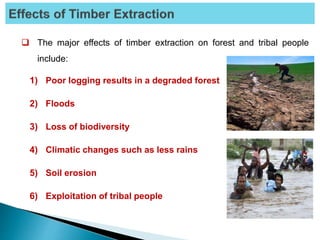
 The major effects of timber extraction on forest and tribal people
include:
1) Poor logging results in a degraded forest
2) Floods
3) Loss of biodiversity
4) Climatic changes such as less rains
5) Soil erosion
6) Exploitation of tribal people
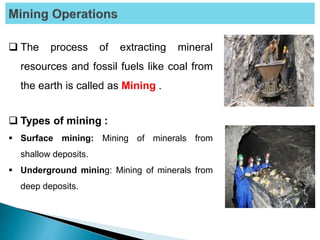
 The process of extracting mineral
resources and fossil fuels like coal from
the earth is called as Mining .
 Types of mining :
 Surface mining: Mining of minerals from
shallow deposits.
 Underground mining: Mining of minerals from
deep deposits.
 Effects of mining :
 Pollute soil, water and air
 Produces noise pollution
 Increased risk of landslides
 Vibrations cause earth quakes
 contaminates the ground water
 Steps involved in mining:
 Exploration
 Development
 Exploitation
 Ore processing
 Extraction and purification of minerals
 Water resources are natural resources of water that are
potentially useful.
 97% of the water on the Earth is salt water and only 3% is
fresh water.
 Natural sources of fresh water include surface water, under
river flow, groundwater and frozen water.
 Water is required in large amounts for industrial and domestic
consumption.
 Water is essential for all forms of life.
 Many uses of water include agricultural, industrial,
household, recreational and environmental activities.
Virtually, all of these human uses, require fresh water.
 No plant or animal species can survive without water. If water
in our body drops by 1% we feel thirst, if it drops by 10% we
face death.
 Surface water
 Under river flow
 Groundwater
 Frozen water
 Surface water is water located on top of the Earth's surface
such as rivers, creeks, and wetlands.
 This may also be referred to as blue water.
 There are three major types of surface water:
Permanent surface waters (rivers, swamps, and lakes)
Semi-permanent surface water (creeks, lagoons, and
waterholes)
Man made surface water (lakes, dams, and artificial
swamps)
 Groundwater is the water present beneath Earth's surface in
rock and soil pore spaces and in the fractures of rock
formations.
 Groundwater is also often withdrawn for agricultural,
municipal, and industrial use by constructing and operating
extraction wells.
 The natural input to groundwater is seepage from surface
water.
 The natural outputs from groundwater are springs and
seepage to the oceans.
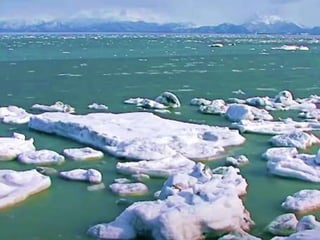
 Several schemes have been proposed to make use of
icebergs as a water source, however to date this has only
been done for research purposes.
 Glacier runoff is considered to be Frozen water.
 The Himalayas, which are often called "The Roof of the
World", contain some of the most extensive and rough high
altitude areas on Earth as well as the greatest area of
glaciers and permafrost outside of the poles.
 Population explosion
 Overutilization of Surface and Groundwater
 Deforestation
 Hydropower generation
 Dams
 Rain fall
 India’s increasing demand for water for intensive
irrigated agriculture, for generating electricity
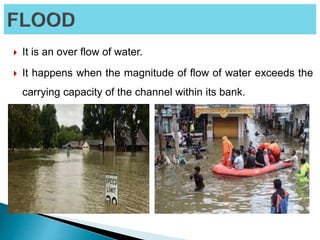
 It is an over flow of water.
 It happens when the magnitude of flow of water exceeds the
carrying capacity of the channel within its bank.
 Heavy rainfall, melting of snow and sudden release
of water from dams. (Flash floods)
 Reduction in the carrying capacity of the channel.
 Deforestation, mining and over grazing increase the
runoff from rains and the level of flood raises.
 Water spreads in the surrounding area and
submerges them.
 Cultivated land gets affected.
 Extinction of civilization.
 Dams and Reservoirs
 Channel improvement
 Drainage improvement
 Flood forecasting
 Afforestation
 Public relief
 Diversion of flood rivers
Drought is nothing but scarcity of water.
Lack of water for the needs of agriculture, livestock, industry or
human population may be termed as a drought.
Drought causes serious damages to plants, animals and human life
which occurs due to :
Inadequate rain fall
Late arrival of rain fall
Excessive withdrawal of ground water
 When annual rain fall is below normal and less than
evaporation, drought is created.
 High population
 Intensive cropping pattern
◦ Ex: Maharashtra - There has been no recovery from drought for
the last 30 years due to over exploitation of water by sugarcane
crop.
 Drought causes hunger, malnutrition and scarcity of drinking water
an also changes the quality of water.
 Drought causes widespread crop failure leading to acute shortage of
food and adversely affects human and live stock population.
 Worst situation of drought causes desertification.
 Raw materials of agro based industries are critically affected during
drought time, hence industrial and commercial growth decreases.
 Drought increases the degradation of natural resources.
 Drought causes large migration of people and urbanization.
1. Indigenous knowledge is essential.
2. Rain water harvesting system.
3. Construction of reservoirs to improve ground water level.
4. Modern irrigation technology (drip irrigation) very useful to conserve
water.
5. Afforestation activities also improve the potential of water in the
drought area.
6. Crop mixing and dry forming are the suitable methods which
minimize the risk of crop failures in dry area.
• Naturally occurring inorganic crystalline solids with uniform
chemical composition are called as minerals.
• Minerals provide the material used to make most of the things of
industrial- based society; roads, cars, computers, fertilizers, etc.
• Demand for minerals is increasing world wide as the population
increases and the consumption demands of individual people
increase.
• A mineral is a pure inorganic substance that occurs naturally in the
earth’s crust.
• All of the Earth’s crust, except the rather small proportion of the
crust that contains organic material, is made up of minerals. Some
minerals consist of a single element such as gold, silver, diamond
(carbon), and sulphur.
• More than two-thousand minerals have been identified and most of
these contain inorganic compounds formed by various
combinations of the eight elements (O, Si, Al, Fe, Ca, Na, K, and Mg)
that make up 98.5% of the Earth’s crust.
• Mineral resources are non-renewable and include metals (e.g. iron,
copper, and aluminum), and non-metals (e.g. salt, gypsum, clay,
sand, phosphates).
• Minerals in general have been categorized into three
classes:
Fuel
Metallic
Non-metallic.
• Fuel minerals like coal, oil and natural gas have been
given prime importance as they account for nearly 87%
of the value of mineral production whereas metallic and
non-metallic constitutes 6 to 7%.
1. Development of industrial plants and machinery. - Fe, Al & Cu
2. Construction work – Fe, Al &Ni
3. Generation of energy - coal, lignite, uranium
4. Designing defense equipment's like weapons and ornaments
5. Agricultural purposes – fertilizers and fungicides – Zn & Mn
6. Jewellery –Au, Ag & Pt
7. Making alloys for various purposes
8. Communication purposes – telephone, wires, cables and electronic
devices
9. Medicinal purposes, particularly in Ayurveda system
1. Devegetation:
 Topsoil and vegetation get removed
 Deforestation leads to several ecological losses
 Land scape gets badly affected
2. Ground water contamination: Mining pollutes ground water; sulphur
is converted into sulphuric acid which enters into the soil.
3. Surface water pollution: Radioactive wastes and other acidic
impurities affect the surface water, which kills many aquatic animals.
4. Air pollution: Smelting and roasting are done to purify the metal
which emits air pollutants and damage the nearby vegetation. It causes
many health problems.
5. Subsidence of land: Mainly underground mining results in cracks in
houses, tilting of buildings and bending of rail tracks.
1. Rapid depletion of mineral deposits
2. Wastage
3. Environmental pollution
4. Needs heavy energy requirements.
1. The efficient use and protection of mineral resources.
2. Modernization of mining industries
3. Search for new deposit
4. Reuse and recycling of the metals.
5. Environmental impacts can be minimized by adopting
eco friendly mining technology.

HU 282 ENVIRONMENTAL SCIENCES Lectures 1.pptx

  • 1.
  • 2.
     The wordenvironment is derived from the French word ‘environner’ (surround or encircle).  So it is a Surrounding in which we are living.  It includes all those things (Living components & Non living components)  Thus our environment can be defined as “the Social, Cultural and Physical conditions that surround, affect and influence the survival, growth and development of people, animals and plants.
  • 3.
    Environment consists offour segments.  Atmosphere- Blanket of gases surrounding the earth.  Hydrosphere- Various water bodies present on the earth.  Lithosphere- Contains various types of soils and rocks on the earth.  Biosphere- Composed of all living organisms and their interactions with the environment.
  • 4.
     The Environmentstudies is a multi-disciplinary science because It consists of various branches of studies like chemistry, Physics ,Biology, Medical sciences etc.  It utilizes information's from different streams of science to deals with various environmental problems.
  • 5.
     Conservation ofnature and natural resources  Conservation / Protection of Biological Diversity  Control of environmental and human Pollution  Human population and environment  Research and development in environment  Environmental consultancy  Green media
  • 6.
    All things whichare available in nature which can be used are called Natural Resources.
  • 8.
    Renewable Natural Resources: Those natural resources which can be used again and again are called Renewable Natural Resources. Eg : Sun , water , plants , animals Nonrenewable Natural Resources : Those natural resources which can not be replaced by other and they exist in fixed amounts and can be used up are called Nonrenewable Natural Resources. Eg: Fossil fuels and minerals.
  • 9.
    The natural resourcesare as follows :  Forest resources  Water resources  Land /Soil Resources  Mineral Resources  Energy Resources
  • 10.
     Forest isan important renewable resources.  Forest can contribute economical development in any country.  Plants along with trees cover large areas, produce variety of products and provide food for living organisms, and also important to save the environment.
  • 11.
     It performsvery important function to both human and nature.  They are habitats to millions of plants, animals and wild life.  They recycle rain water.  They remove pollutant from air.  They control water quality.  They moderate temperature and weather.  They influence soil condition and prevent soil erosion.
  • 12.
     Commercial uses:  Wood – used as a fuel  Supply wood for various industries – Raw materials as pulp, paper, furniture timber etc.  Minor forest products – gum, dyes, resins etc.  Many plants – Medicines  Supply variety of animal products – honey. Ivory, horns etc.  Many forest lands are used for - Mining, grazing, for dams and recreation.
  • 13.
     Ecological uses: Forest provides number of environmental services :  Production of oxygen  Reducing global warming  Soil conservation  Regulation of hydrological cycle  Pollution moderators  Wild life habitat
  • 14.
     In Indiathe minimum area of forest required to maintain good ecological balance is about 33% of total area. But at present it is only about 12%.  OVER EXPLOITATION OF FOREST : Due to over population, there is an increased demand for medicine, shelter, wood and fuel. Hence exploitation of forest materials is going on increasing.  Cause of over exploitation: 1. Increasing agricultural production 2. Increasing agricultural activities 3. Increase in demand of wood resources
  • 15.
     DEFORESTATION: It isprocess of removal of forest resources due to natural or manmade activities (i.e.) destruction of forests.  Causes of deforestation: 1. Developmental projects 2. Mining operations 3. Raw materials for industries 4. Forest fires 5. Over grazing 6. Shifting cultivation 7. Fuel requirement
  • 16.
     Conservation offorest is a national problem, thus it should be tackled with perfect coordination between concerned government departments.  People should be made aware of importance of forest and involved in forest conservation activities.  The cutting of trees in the forests for timber should be stopped.  A forestation programmes should be launched.  Over grazing by cattle must be controlled.  Forest fire must be controlled by modern techniques.  Forest pests can be controlled by spraying pesticides by using aero planes.
  • 17.
     Economic loss Loss of biodiversity  Destructs the habitats of various species  Reduction in stream flow  Increases the rate of global warming  Disruption of weather patterns and global climate  Degradation of soil and acceleration of the rate of soil erosion.  Induces and accelerates mass movement / land slides.  Increases flood frequency  Breaks the water cycle  Breaks the nutrient cycle
  • 18.
     Wood usedfor engineering purposes like building houses, making furniture is called timber.  Timber extraction results in deforestation.  It harms valuable species of trees, birds and wild animals.  During the extraction of timber, cutting, felling and handling should be done selectively, carefully and in a planned manner, in order to save the remaining forests and biodiversity.
  • 19.
     The majoreffects of timber extraction on forest and tribal people include: 1) Poor logging results in a degraded forest 2) Floods 3) Loss of biodiversity 4) Climatic changes such as less rains 5) Soil erosion 6) Exploitation of tribal people
  • 20.
     The processof extracting mineral resources and fossil fuels like coal from the earth is called as Mining .  Types of mining :  Surface mining: Mining of minerals from shallow deposits.  Underground mining: Mining of minerals from deep deposits.
  • 21.
     Effects ofmining :  Pollute soil, water and air  Produces noise pollution  Increased risk of landslides  Vibrations cause earth quakes  contaminates the ground water  Steps involved in mining:  Exploration  Development  Exploitation  Ore processing  Extraction and purification of minerals
  • 23.
     Water resourcesare natural resources of water that are potentially useful.  97% of the water on the Earth is salt water and only 3% is fresh water.  Natural sources of fresh water include surface water, under river flow, groundwater and frozen water.
  • 24.
     Water isrequired in large amounts for industrial and domestic consumption.  Water is essential for all forms of life.  Many uses of water include agricultural, industrial, household, recreational and environmental activities. Virtually, all of these human uses, require fresh water.  No plant or animal species can survive without water. If water in our body drops by 1% we feel thirst, if it drops by 10% we face death.
  • 25.
     Surface water Under river flow  Groundwater  Frozen water
  • 26.
     Surface wateris water located on top of the Earth's surface such as rivers, creeks, and wetlands.  This may also be referred to as blue water.  There are three major types of surface water: Permanent surface waters (rivers, swamps, and lakes) Semi-permanent surface water (creeks, lagoons, and waterholes) Man made surface water (lakes, dams, and artificial swamps)
  • 28.
     Groundwater isthe water present beneath Earth's surface in rock and soil pore spaces and in the fractures of rock formations.  Groundwater is also often withdrawn for agricultural, municipal, and industrial use by constructing and operating extraction wells.  The natural input to groundwater is seepage from surface water.  The natural outputs from groundwater are springs and seepage to the oceans.
  • 30.
     Several schemeshave been proposed to make use of icebergs as a water source, however to date this has only been done for research purposes.  Glacier runoff is considered to be Frozen water.  The Himalayas, which are often called "The Roof of the World", contain some of the most extensive and rough high altitude areas on Earth as well as the greatest area of glaciers and permafrost outside of the poles.
  • 32.
     Population explosion Overutilization of Surface and Groundwater  Deforestation  Hydropower generation  Dams  Rain fall  India’s increasing demand for water for intensive irrigated agriculture, for generating electricity
  • 33.
     It isan over flow of water.  It happens when the magnitude of flow of water exceeds the carrying capacity of the channel within its bank.
  • 34.
     Heavy rainfall,melting of snow and sudden release of water from dams. (Flash floods)  Reduction in the carrying capacity of the channel.  Deforestation, mining and over grazing increase the runoff from rains and the level of flood raises.
  • 35.
     Water spreadsin the surrounding area and submerges them.  Cultivated land gets affected.  Extinction of civilization.
  • 36.
     Dams andReservoirs  Channel improvement  Drainage improvement  Flood forecasting  Afforestation  Public relief  Diversion of flood rivers
  • 37.
    Drought is nothingbut scarcity of water. Lack of water for the needs of agriculture, livestock, industry or human population may be termed as a drought. Drought causes serious damages to plants, animals and human life which occurs due to : Inadequate rain fall Late arrival of rain fall Excessive withdrawal of ground water
  • 39.
     When annualrain fall is below normal and less than evaporation, drought is created.  High population  Intensive cropping pattern ◦ Ex: Maharashtra - There has been no recovery from drought for the last 30 years due to over exploitation of water by sugarcane crop.
  • 40.
     Drought causeshunger, malnutrition and scarcity of drinking water an also changes the quality of water.  Drought causes widespread crop failure leading to acute shortage of food and adversely affects human and live stock population.  Worst situation of drought causes desertification.  Raw materials of agro based industries are critically affected during drought time, hence industrial and commercial growth decreases.  Drought increases the degradation of natural resources.  Drought causes large migration of people and urbanization.
  • 41.
    1. Indigenous knowledgeis essential. 2. Rain water harvesting system. 3. Construction of reservoirs to improve ground water level. 4. Modern irrigation technology (drip irrigation) very useful to conserve water. 5. Afforestation activities also improve the potential of water in the drought area. 6. Crop mixing and dry forming are the suitable methods which minimize the risk of crop failures in dry area.
  • 43.
    • Naturally occurringinorganic crystalline solids with uniform chemical composition are called as minerals. • Minerals provide the material used to make most of the things of industrial- based society; roads, cars, computers, fertilizers, etc. • Demand for minerals is increasing world wide as the population increases and the consumption demands of individual people increase. • A mineral is a pure inorganic substance that occurs naturally in the earth’s crust. • All of the Earth’s crust, except the rather small proportion of the crust that contains organic material, is made up of minerals. Some minerals consist of a single element such as gold, silver, diamond (carbon), and sulphur.
  • 44.
    • More thantwo-thousand minerals have been identified and most of these contain inorganic compounds formed by various combinations of the eight elements (O, Si, Al, Fe, Ca, Na, K, and Mg) that make up 98.5% of the Earth’s crust. • Mineral resources are non-renewable and include metals (e.g. iron, copper, and aluminum), and non-metals (e.g. salt, gypsum, clay, sand, phosphates).
  • 45.
    • Minerals ingeneral have been categorized into three classes: Fuel Metallic Non-metallic. • Fuel minerals like coal, oil and natural gas have been given prime importance as they account for nearly 87% of the value of mineral production whereas metallic and non-metallic constitutes 6 to 7%.
  • 46.
    1. Development ofindustrial plants and machinery. - Fe, Al & Cu 2. Construction work – Fe, Al &Ni 3. Generation of energy - coal, lignite, uranium 4. Designing defense equipment's like weapons and ornaments 5. Agricultural purposes – fertilizers and fungicides – Zn & Mn 6. Jewellery –Au, Ag & Pt 7. Making alloys for various purposes 8. Communication purposes – telephone, wires, cables and electronic devices 9. Medicinal purposes, particularly in Ayurveda system
  • 47.
    1. Devegetation:  Topsoiland vegetation get removed  Deforestation leads to several ecological losses  Land scape gets badly affected 2. Ground water contamination: Mining pollutes ground water; sulphur is converted into sulphuric acid which enters into the soil. 3. Surface water pollution: Radioactive wastes and other acidic impurities affect the surface water, which kills many aquatic animals. 4. Air pollution: Smelting and roasting are done to purify the metal which emits air pollutants and damage the nearby vegetation. It causes many health problems. 5. Subsidence of land: Mainly underground mining results in cracks in houses, tilting of buildings and bending of rail tracks.
  • 48.
    1. Rapid depletionof mineral deposits 2. Wastage 3. Environmental pollution 4. Needs heavy energy requirements.
  • 49.
    1. The efficientuse and protection of mineral resources. 2. Modernization of mining industries 3. Search for new deposit 4. Reuse and recycling of the metals. 5. Environmental impacts can be minimized by adopting eco friendly mining technology.