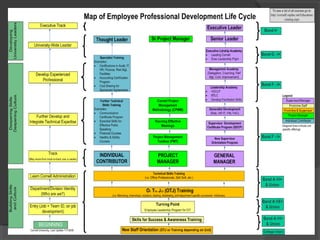
Performanc
e
Manageme
nt Process
(PMP)
A comprehensive
approach to managing
effective performance
Training Agenda and
Objectives
○ Overview
○ Goal-Setting
○ Assessing Performance
○ Delivering Feedback
○ Creating an Individual Development Plan
○ Talent Discussion
○ Close
Effective Performance
ManagementA comprehensive process maximizing
engagement, development, and performance of
all employees in the employment lifecycle by:
• Proactively focusing on employee development, talent and
succession management
• Aligning employee work to department goals and objectives
(line of sight), defining and communicating performance
expectations regularly
• Linking performance to compensation, recognition, and
rewards
• Remaining flexible, efficient, measurable, fair, and transparent
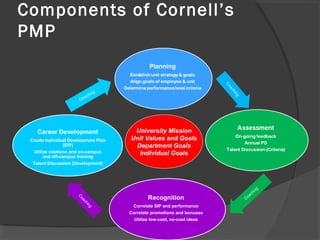
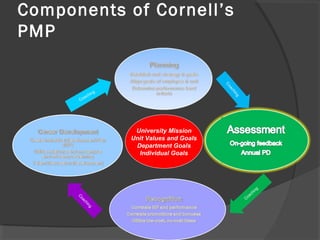
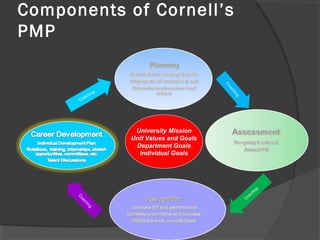
University Mission
Unit Values and Goals
Department Goals
Individual Goals
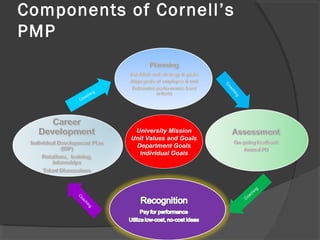
Components of Cornell’s
PMP
Coaching
Recognition
Correlate SIP and performance
Correlate promotions and bonuses
Utilize low-cost, no-cost ideas
C
oaching
Career Development
Create Individual Development Plan
(IDP)
Utilize rotations and on-campus
and off-campus training
Talent Discussion (Development)
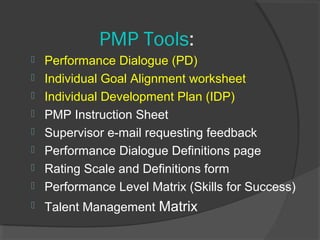
PMP Tools:
 Performance Dialogue (PD)
 Individual Goal Alignment worksheet
 Individual Development Plan (IDP)
 PMP Instruction Sheet
 Supervisor e-mail requesting feedback
 Performance Dialogue Definitions page
 Rating Scale and Definitions form
 Performance Level Matrix (Skills for Success)
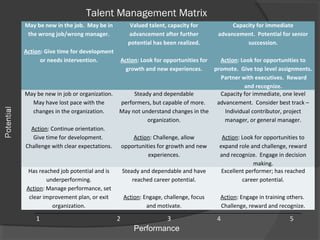
 Talent Management Matrix
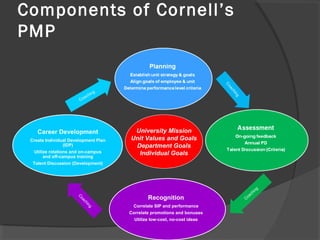
University Mission
Unit Values and Goals
Department Goals
Individual Goals
Components of Cornell’s
PMP
Coaching
Recognition
Correlate SIP and performance
Correlate promotions and bonuses
Utilize low-cost, no-cost ideas
C
oaching
Career Development
Create Individual Development Plan
(IDP)
Utilize rotations and on-campus
and off-campus training
Talent Discussion (Development)
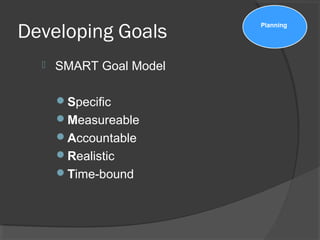
Developing Goals
 SMART Goal Model
Specific
Measureable
Accountable
Realistic
Time-bound
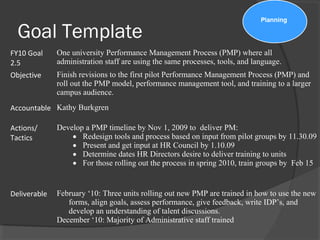
Goal Template
FY10 Goal
2.5
One university Performance Management Process (PMP) where all
administration staff are using the same processes, tools, and language.
Objective Finish revisions to the first pilot Performance Management Process (PMP) and
roll out the PMP model, performance management tool, and training to a larger
campus audience.
Accountable Kathy Burkgren
Actions/
Tactics
Develop a PMP timeline by Nov 1, 2009 to deliver PM:
• Redesign tools and process based on input from pilot groups by 11.30.09
• Present and get input at HR Council by 1.10.09
• Determine dates HR Directors desire to deliver training to units
• For those rolling out the process in spring 2010, train groups by Feb 15
Deliverable February ‘10: Three units rolling out new PMP are trained in how to use the new
forms, align goals, assess performance, give feedback, write IDP’s, and
develop an understanding of talent discussions.
December ‘10: Majority of Administrative staff trained
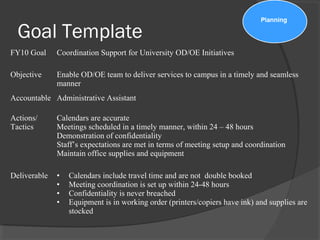
Goal Template
FY10 Goal Coordination Support for University OD/OE Initiatives
Objective Enable OD/OE team to deliver services to campus in a timely and seamless
manner
Accountable Administrative Assistant
Actions/
Tactics
Calendars are accurate
Meetings scheduled in a timely manner, within 24 – 48 hours
Demonstration of confidentiality
Staff’s expectations are met in terms of meeting setup and coordination
Maintain office supplies and equipment
Deliverable • Calendars include travel time and are not double booked
• Meeting coordination is set up within 24-48 hours
• Confidentiality is never breached
• Equipment is in working order (printers/copiers have ink) and supplies are
stocked
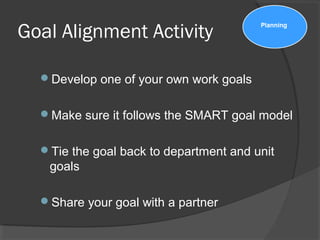
Goal Alignment Activity
Develop one of your own work goals
Make sure it follows the SMART goal model
Tie the goal back to department and unit
goals
Share your goal with a partner
Components of Cornell’s
PMP
University Mission
Unit Values and Goals
Department Goals
Individual Goals
Coaching
C
oaching
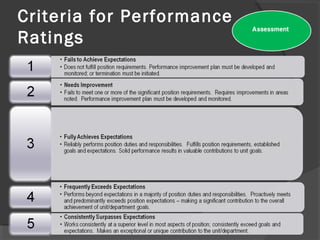
Criteria for Performance
Ratings
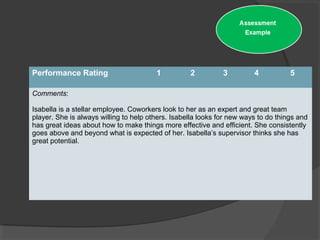
Performance Rating 1 2 3 4 5
Comments:
Isabella is a stellar employee. Coworkers look to her as an expert and great team
player. She is always willing to help others. Isabella looks for new ways to do things and
has great ideas about how to make things more effective and efficient. She consistently
goes above and beyond what is expected of her. Isabella’s supervisor thinks she has
great potential.
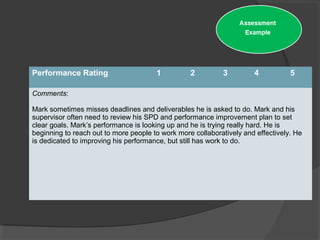
Performance Rating 1 2 3 4 5
Comments:
Mark sometimes misses deadlines and deliverables he is asked to do. Mark and his
supervisor often need to review his SPD and performance improvement plan to set
clear goals. Mark’s performance is looking up and he is trying really hard. He is
beginning to reach out to more people to work more collaboratively and effectively. He
is dedicated to improving his performance, but still has work to do.
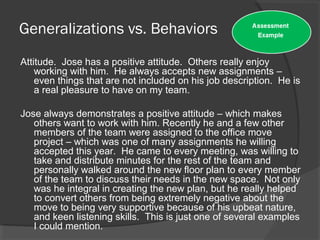
Generalizations vs. Behaviors
Attitude. Jose has a positive attitude. Others really enjoy
working with him. He always accepts new assignments –
even things that are not included on his job description. He is
a real pleasure to have on my team.
Jose always demonstrates a positive attitude – which makes
others want to work with him. Recently he and a few other
members of the team were assigned to the office move
project – which was one of many assignments he willing
accepted this year. He came to every meeting, was willing to
take and distribute minutes for the rest of the team and
personally walked around the new floor plan to every member
of the team to discuss their needs in the new space. Not only
was he integral in creating the new plan, but he really helped
to convert others from being extremely negative about the
move to being very supportive because of his upbeat nature,
and keen listening skills. This is just one of several examples
I could mention.
Assessment Activity
 Complete your PD:
 Rate yourself on all categories of the PD using:
1) Performance Level Matrix
2) Talent Management Matrix
 Note at least one thing you want to improve
Delivering Feedback
Conducting a Performance Dialogue Meeting
What’s in it for you?
Modeling
Activity
Components of Cornell’s
PMP
University Mission
Unit Values and Goals
Department Goals
Individual Goals
Coaching
C
oaching
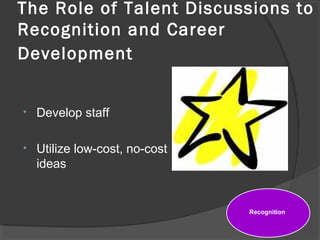
The Role of Talent Discussions to
Recognition and Career
Development
• Develop staff
• Utilize low-cost, no-cost
ideas
Recognition
Components of Cornell’s
PMP
University Mission
Unit Values and Goals
Department Goals
Individual Goals
Coaching
C
oaching
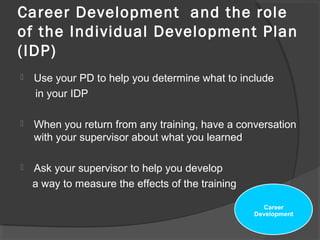
Career Development and the role
of the Individual Development Plan
(IDP)
 Use your PD to help you determine what to include
in your IDP
 When you return from any training, have a conversation
with your supervisor about what you learned
 Ask your supervisor to help you develop
a way to measure the effects of the training
Career
Development
Individual Development Plan
(IDP) Activity
 Complete your own IDP
Career
Development
Talent Discussion
What it is?
Why have talent discussions?
Career
Development and
Recognition
Talent Management Matrix
May be new in the job. May be in
the wrong job/wrong manager.
Action: Give time for development
or needs intervention.
Valued talent, capacity for
advancement after further
potential has been realized.
Action: Look for opportunities for
growth and new experiences.
Capacity for immediate
advancement. Potential for senior
succession.
Action: Look for opportunities to
promote. Give top level assignments.
Partner with executives. Reward
and recognize.
May be new in job or organization.
May have lost pace with the
changes in the organization.
Action: Continue orientation.
Give time for development.
Challenge with clear expectations.
Steady and dependable
performers, but capable of more.
May not understand changes in the
organization.
Action: Challenge, allow
opportunities for growth and new
experiences.
Capacity for immediate, one level
advancement. Consider best track –
Individual contributor, project
manager, or general manager.
Action: Look for opportunities to
expand role and challenge, reward
and recognize. Engage in decision
making.
Has reached job potential and is
underperforming.
Action: Manage performance, set
clear improvement plan, or exit
organization.
Steady and dependable and have
reached career potential.
Action: Engage, challenge, focus
and motivate.
Excellent performer; has reached
career potential.
Action: Engage in training others.
Challenge, reward and recognize.
Performance
Chapter 2 performance management-process

Chapter 2 performance management-process

  • 1.
  • 2.
    Training Agenda and Objectives ○Overview ○ Goal-Setting ○ Assessing Performance ○ Delivering Feedback ○ Creating an Individual Development Plan ○ Talent Discussion ○ Close
  • 3.
    Effective Performance ManagementA comprehensiveprocess maximizing engagement, development, and performance of all employees in the employment lifecycle by: • Proactively focusing on employee development, talent and succession management • Aligning employee work to department goals and objectives (line of sight), defining and communicating performance expectations regularly • Linking performance to compensation, recognition, and rewards • Remaining flexible, efficient, measurable, fair, and transparent
  • 4.
    University Mission Unit Valuesand Goals Department Goals Individual Goals Components of Cornell’s PMP Coaching Recognition Correlate SIP and performance Correlate promotions and bonuses Utilize low-cost, no-cost ideas C oaching Career Development Create Individual Development Plan (IDP) Utilize rotations and on-campus and off-campus training Talent Discussion (Development)
  • 5.
    PMP Tools:  PerformanceDialogue (PD)  Individual Goal Alignment worksheet  Individual Development Plan (IDP)  PMP Instruction Sheet  Supervisor e-mail requesting feedback  Performance Dialogue Definitions page  Rating Scale and Definitions form  Performance Level Matrix (Skills for Success)  Talent Management Matrix
  • 6.
    University Mission Unit Valuesand Goals Department Goals Individual Goals Components of Cornell’s PMP Coaching Recognition Correlate SIP and performance Correlate promotions and bonuses Utilize low-cost, no-cost ideas C oaching Career Development Create Individual Development Plan (IDP) Utilize rotations and on-campus and off-campus training Talent Discussion (Development)
  • 7.
    Developing Goals  SMARTGoal Model Specific Measureable Accountable Realistic Time-bound
  • 8.
    Goal Template FY10 Goal 2.5 Oneuniversity Performance Management Process (PMP) where all administration staff are using the same processes, tools, and language. Objective Finish revisions to the first pilot Performance Management Process (PMP) and roll out the PMP model, performance management tool, and training to a larger campus audience. Accountable Kathy Burkgren Actions/ Tactics Develop a PMP timeline by Nov 1, 2009 to deliver PM: • Redesign tools and process based on input from pilot groups by 11.30.09 • Present and get input at HR Council by 1.10.09 • Determine dates HR Directors desire to deliver training to units • For those rolling out the process in spring 2010, train groups by Feb 15 Deliverable February ‘10: Three units rolling out new PMP are trained in how to use the new forms, align goals, assess performance, give feedback, write IDP’s, and develop an understanding of talent discussions. December ‘10: Majority of Administrative staff trained
  • 9.
    Goal Template FY10 GoalCoordination Support for University OD/OE Initiatives Objective Enable OD/OE team to deliver services to campus in a timely and seamless manner Accountable Administrative Assistant Actions/ Tactics Calendars are accurate Meetings scheduled in a timely manner, within 24 – 48 hours Demonstration of confidentiality Staff’s expectations are met in terms of meeting setup and coordination Maintain office supplies and equipment Deliverable • Calendars include travel time and are not double booked • Meeting coordination is set up within 24-48 hours • Confidentiality is never breached • Equipment is in working order (printers/copiers have ink) and supplies are stocked
  • 10.
    Goal Alignment Activity Developone of your own work goals Make sure it follows the SMART goal model Tie the goal back to department and unit goals Share your goal with a partner
  • 11.
    Components of Cornell’s PMP UniversityMission Unit Values and Goals Department Goals Individual Goals Coaching C oaching
  • 12.
  • 13.
    Performance Rating 12 3 4 5 Comments: Isabella is a stellar employee. Coworkers look to her as an expert and great team player. She is always willing to help others. Isabella looks for new ways to do things and has great ideas about how to make things more effective and efficient. She consistently goes above and beyond what is expected of her. Isabella’s supervisor thinks she has great potential.
  • 14.
    Performance Rating 12 3 4 5 Comments: Mark sometimes misses deadlines and deliverables he is asked to do. Mark and his supervisor often need to review his SPD and performance improvement plan to set clear goals. Mark’s performance is looking up and he is trying really hard. He is beginning to reach out to more people to work more collaboratively and effectively. He is dedicated to improving his performance, but still has work to do.
  • 15.
    Generalizations vs. Behaviors Attitude.Jose has a positive attitude. Others really enjoy working with him. He always accepts new assignments – even things that are not included on his job description. He is a real pleasure to have on my team. Jose always demonstrates a positive attitude – which makes others want to work with him. Recently he and a few other members of the team were assigned to the office move project – which was one of many assignments he willing accepted this year. He came to every meeting, was willing to take and distribute minutes for the rest of the team and personally walked around the new floor plan to every member of the team to discuss their needs in the new space. Not only was he integral in creating the new plan, but he really helped to convert others from being extremely negative about the move to being very supportive because of his upbeat nature, and keen listening skills. This is just one of several examples I could mention.
  • 16.
    Assessment Activity  Completeyour PD:  Rate yourself on all categories of the PD using: 1) Performance Level Matrix 2) Talent Management Matrix  Note at least one thing you want to improve
  • 17.
    Delivering Feedback Conducting aPerformance Dialogue Meeting What’s in it for you? Modeling Activity
  • 18.
    Components of Cornell’s PMP UniversityMission Unit Values and Goals Department Goals Individual Goals Coaching C oaching
  • 19.
    The Role ofTalent Discussions to Recognition and Career Development • Develop staff • Utilize low-cost, no-cost ideas Recognition
  • 20.
    Components of Cornell’s PMP UniversityMission Unit Values and Goals Department Goals Individual Goals Coaching C oaching
  • 21.
    Career Development andthe role of the Individual Development Plan (IDP)  Use your PD to help you determine what to include in your IDP  When you return from any training, have a conversation with your supervisor about what you learned  Ask your supervisor to help you develop a way to measure the effects of the training Career Development
  • 22.
    Individual Development Plan (IDP)Activity  Complete your own IDP Career Development
  • 23.
    Talent Discussion What itis? Why have talent discussions? Career Development and Recognition
  • 24.
    Talent Management Matrix Maybe new in the job. May be in the wrong job/wrong manager. Action: Give time for development or needs intervention. Valued talent, capacity for advancement after further potential has been realized. Action: Look for opportunities for growth and new experiences. Capacity for immediate advancement. Potential for senior succession. Action: Look for opportunities to promote. Give top level assignments. Partner with executives. Reward and recognize. May be new in job or organization. May have lost pace with the changes in the organization. Action: Continue orientation. Give time for development. Challenge with clear expectations. Steady and dependable performers, but capable of more. May not understand changes in the organization. Action: Challenge, allow opportunities for growth and new experiences. Capacity for immediate, one level advancement. Consider best track – Individual contributor, project manager, or general manager. Action: Look for opportunities to expand role and challenge, reward and recognize. Engage in decision making. Has reached job potential and is underperforming. Action: Manage performance, set clear improvement plan, or exit organization. Steady and dependable and have reached career potential. Action: Engage, challenge, focus and motivate. Excellent performer; has reached career potential. Action: Engage in training others. Challenge, reward and recognize. Performance