WELCOME
MODULE – 1
Part- A
Acquisition of Human Resources
1
Human Resource Management
 Introduction
 Meaning
 Nature
 Scope
 Major functions of HRM
 Models of HRM
 Importance and Evolution of the concept of HRM
 HRM Vs. Personnel Management
 Role of HR Manager
 Skills and competencies of HR professionals
 HRM’s evolving role in the 21st century
2
Synopsis – Module 1
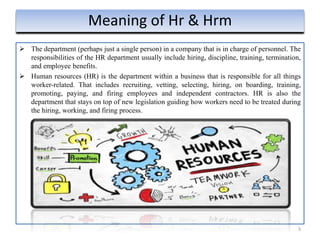
 The department (perhaps just a single person) in a company that is in charge of personnel. The
responsibilities of the HR department usually include hiring, discipline, training, termination,
and employee benefits.
 Human resources (HR) is the department within a business that is responsible for all things
worker-related. That includes recruiting, vetting, selecting, hiring, on boarding, training,
promoting, paying, and firing employees and independent contractors. HR is also the
department that stays on top of new legislation guiding how workers need to be treated during
the hiring, working, and firing process.
3
Meaning of Hr & Hrm
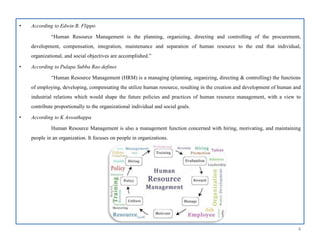
• According to Edwin B. Flippo
“Human Resource Management is the planning, organizing, directing and controlling of the procurement,
development, compensation, integration, maintenance and separation of human resource to the end that individual,
organizational, and social objectives are accomplished.”
• According to Pulapa Subba Rao defines
“Human Resource Management (HRM) is a managing (planning, organizing, directing & controlling) the functions
of employing, developing, compensating the utilize human resource, resulting in the creation and development of human and
industrial relations which would shape the future policies and practices of human resource management, with a view to
contribute proportionally to the organizational individual and social goals.
• According to K Aswathappa
Human Resource Management is also a management function concerned with hiring, motivating, and maintaining
people in an organization. It focuses on people in organizations.
4
 Every organization is essentially a blend of material and Human Resource(HR).
 HR refers to the knowledge, education, skills, training, and ability of the members
of the organization.
 HR are the most valuable and unique assets of the organization. Even though
specific HR functions / activities are the responsibility of the human resource
department, the actual management of human resources is the responsibility of all
the managers in organization.
 The scarcity of talented resources and the growing expectations of the modern day
worker have further increased the complexity of the human resource function.
5
INTRODUCTION
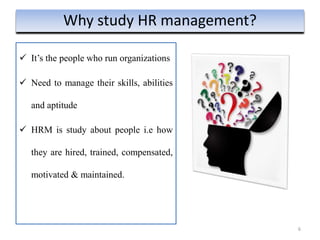
 It’s the people who run organizations
 Need to manage their skills, abilities
and aptitude
 HRM is study about people i.e how
they are hired, trained, compensated,
motivated & maintained.
6
Why study HR management?
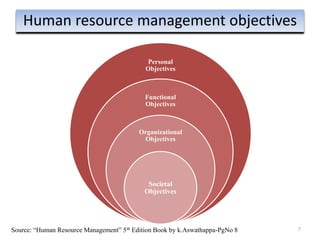
Personal
Objectives
Functional
Objectives
Organizational
Objectives
Societal
Objectives
7
Human resource management objectives
Source: “Human Resource Management” 5th Edition Book by k.Aswathappa-PgNo 8
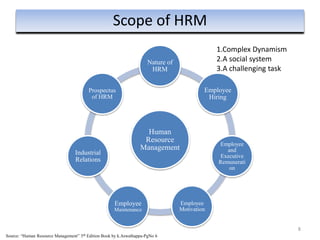
Human
Resource
Management
Nature of
HRM
Employee
Hiring
Employee
and
Executive
Remunerati
on
Employee
Motivation
Employee
Maintenance
Industrial
Relations
Prospectus
of HRM
8
Scope of HRM
Source: “Human Resource Management” 5th Edition Book by k.Aswathappa-PgNo 6
1.Complex Dynamism
2.A social system
3.A challenging task
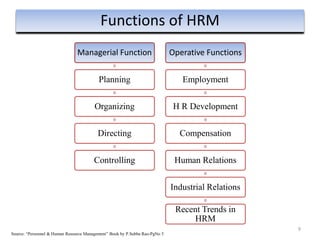
Managerial Function
Planning
Organizing
Directing
Controlling
Operative Functions
Employment
H R Development
Compensation
Human Relations
Industrial Relations
Recent Trends in
HRM
9
Functions of HRM
Source: “Personnel & Human Resource Management” Book by P.Subba Rao-PgNo 5
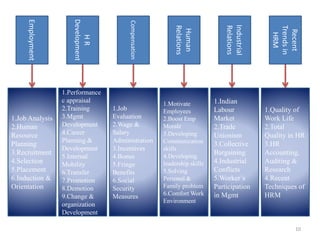
10
1.Job Analysis
2.Human
Resource
Planning
3.Recruitment
4.Selection
5.Placement
6.Induction &
Orientation
1.Performance
c appraisal
2.Training
3.Mgmt
Development
4.Career
Planning &
Development
5.Internal
Mobility
6.Transfer
7.Promotion
8.Demotion
9.Change &
organization
Development
1.Job
Evaluation
2.Wage &
Salary
Administration
3.Incentives
4.Bonus
5.Fringe
Benefits
6.Social
Security
Measures
1.Motivate
Employees
2.Boost Emp
Morale
3.Developing
Communication
skills
4.Developing
leadership skills
5.Solving
Personal &
Family problem
6.Comfort Work
Environment
1.Indian
Labour
Market
2.Trade
Unionism
3.Collective
Bargaining
4.Industrial
Conflicts
5.Worker’s
Participation
in Mgmt
1.Quality of
Work Life
2.Total
Quality in HR
3.HR
Accounting,
Auditing &
Research
4.Recent
Techniques of
HRM
Recent
Trendsin
HRM
Employment
HR
Development
Compensation
Human
Relations
Industrial
Relations
11
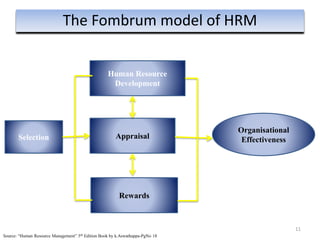
The Fombrum model of HRM
Human Resource
Development
Appraisal
Rewards
Selection
Organisational
Effectiveness
Source: “Human Resource Management” 5th Edition Book by k.Aswathappa-PgNo 18
12
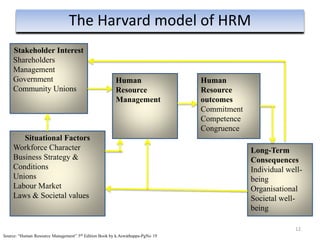
The Harvard model of HRM
Stakeholder Interest
Shareholders
Management
Government
Community Unions
Situational Factors
Workforce Character
Business Strategy &
Conditions
Unions
Labour Market
Laws & Societal values
Human
Resource
Management
Human
Resource
outcomes
Commitment
Competence
Congruence
Long-Term
Consequences
Individual well-
being
Organisational
Societal well-
being
Source: “Human Resource Management” 5th Edition Book by k.Aswathappa-PgNo 19
13
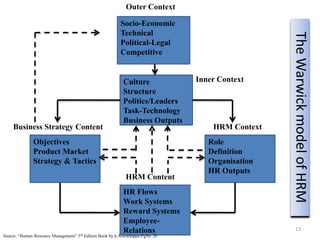
TheWarwickmodelofHRM
Culture
Structure
Politics/Leaders
Task-Technology
Business Outputs
Role
Definition
Organisation
HR Outputs
HR Flows
Work Systems
Reward Systems
Employee-
Relations
Objectives
Product Market
Strategy & Tactics
Socio-Economic
Technical
Political-Legal
Competitive
Outer Context
Inner Context
HRM Context
HRM Content
Business Strategy Content
Source: “Human Resource Management” 5th Edition Book by k.Aswathappa-PgNo 20
14
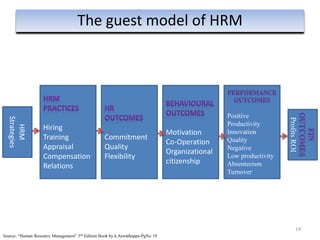
The guest model of HRM
Hiring
Training
Appraisal
Compensation
Relations
Commitment
Quality
Flexibility
Motivation
Co-Operation
Organizational
citizenship
Positive
Productivity
Innovation
Quality
Negative
Low productivity
Absenteeism
Turnover
HRM
Strategies
ProfitsROI
Source: “Human Resource Management” 5th Edition Book by k.Aswathappa-PgNo 19
15
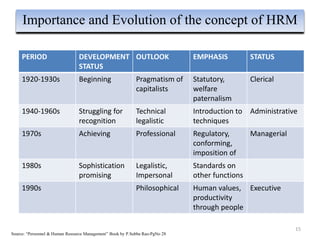
Importance and Evolution of the concept of HRM
PERIOD DEVELOPMENT
STATUS
OUTLOOK EMPHASIS STATUS
1920-1930s Beginning Pragmatism of
capitalists
Statutory,
welfare
paternalism
Clerical
1940-1960s Struggling for
recognition
Technical
legalistic
Introduction to
techniques
Administrative
1970s Achieving Professional Regulatory,
conforming,
imposition of
Managerial
1980s Sophistication
promising
Legalistic,
Impersonal
Standards on
other functions
1990s Philosophical Human values,
productivity
through people
Executive
Source: “Personnel & Human Resource Management” Book by P.Subba Rao-PgNo 28
16
Personnel Management
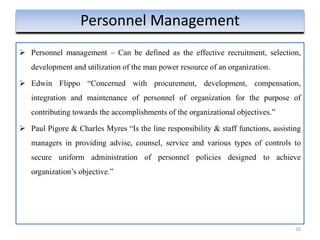
 Personnel management – Can be defined as the effective recruitment, selection,
development and utilization of the man power resource of an organization.
 Edwin Flippo “Concerned with procurement, development, compensation,
integration and maintenance of personnel of organization for the purpose of
contributing towards the accomplishments of the organizational objectives.”
 Paul Pigore & Charles Myres “Is the line responsibility & staff functions, assisting
managers in providing advise, counsel, service and various types of controls to
secure uniform administration of personnel policies designed to achieve
organization’s objective.”
17
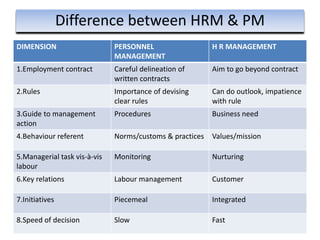
Difference between HRM & PM
DIMENSION PERSONNEL
MANAGEMENT
H R MANAGEMENT
1.Employment contract Careful delineation of
written contracts
Aim to go beyond contract
2.Rules Importance of devising
clear rules
Can do outlook, impatience
with rule
3.Guide to management
action
Procedures Business need
4.Behaviour referent Norms/customs & practices Values/mission
5.Managerial task vis-à-vis
labour
Monitoring Nurturing
6.Key relations Labour management Customer
7.Initiatives Piecemeal Integrated
8.Speed of decision Slow Fast
18
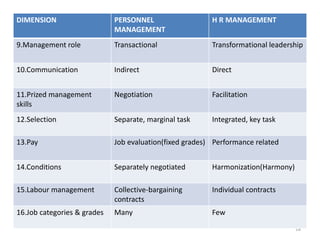
DIMENSION PERSONNEL
MANAGEMENT
H R MANAGEMENT
9.Management role Transactional Transformational leadership
10.Communication Indirect Direct
11.Prized management
skills
Negotiation Facilitation
12.Selection Separate, marginal task Integrated, key task
13.Pay Job evaluation(fixed grades) Performance related
14.Conditions Separately negotiated Harmonization(Harmony)
15.Labour management Collective-bargaining
contracts
Individual contracts
16.Job categories & grades Many Few
19
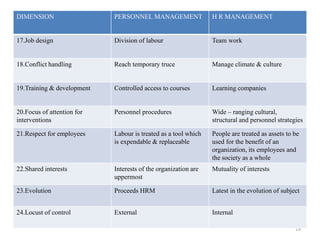
DIMENSION PERSONNEL MANAGEMENT H R MANAGEMENT
17.Job design Division of labour Team work
18.Conflict handling Reach temporary truce Manage climate & culture
19.Training & development Controlled access to courses Learning companies
20.Focus of attention for
interventions
Personnel procedures Wide – ranging cultural,
structural and personnel strategies
21.Respect for employees Labour is treated as a tool which
is expendable & replaceable
People are treated as assets to be
used for the benefit of an
organization, its employees and
the society as a whole
22.Shared interests Interests of the organization are
uppermost
Mutuality of interests
23.Evolution Proceeds HRM Latest in the evolution of subject
24.Locust of control External Internal
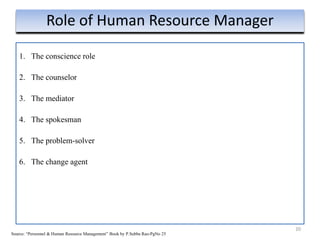
1. The conscience role
2. The counselor
3. The mediator
4. The spokesman
5. The problem-solver
6. The change agent
20
Role of Human Resource Manager
Source: “Personnel & Human Resource Management” Book by P.Subba Rao-PgNo 25
21
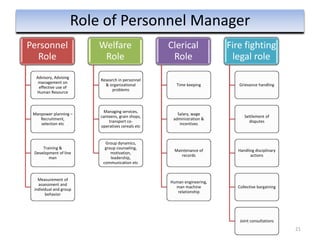
Role of Personnel Manager
Personnel
Role
Advisory, Advising
management on
effective use of
Human Resource
Manpower planning –
Recruitment,
selection etc
Training &
Development of line
man
Measurement of
assessment and
individual and group
behavior
Welfare
Role
Research in personnel
& organizational
problems
Managing services,
canteens, grain shops,
transport co-
operatives cereals etc
Group dynamics,
group counseling,
motivation,
leadership,
communication etc
Clerical
Role
Time keeping
Salary, wage
administration &
incentives
Maintenance of
records
Human engineering,
man machine
relationship
Fire fighting
legal role
Grievance handling
Settlement of
disputes
Handling disciplinary
actions
Collective bargaining
Joint consultations
22
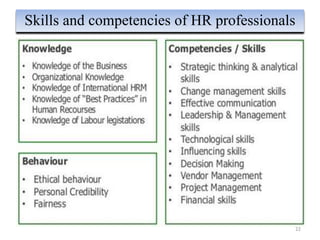
Skills and competencies of HR professionals
23
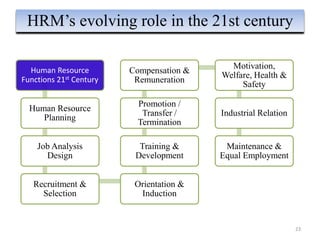
HRM’s evolving role in the 21st century
Human Resource
Functions 21st Century
Human Resource
Planning
Job Analysis
Design
Recruitment &
Selection
Orientation &
Induction
Training &
Development
Promotion /
Transfer /
Termination
Compensation &
Remuneration
Motivation,
Welfare, Health &
Safety
Industrial Relation
Maintenance &
Equal Employment
24

HRM module 1

  • 1.
    WELCOME MODULE – 1 Part-A Acquisition of Human Resources 1
  • 2.
    Human Resource Management Introduction  Meaning  Nature  Scope  Major functions of HRM  Models of HRM  Importance and Evolution of the concept of HRM  HRM Vs. Personnel Management  Role of HR Manager  Skills and competencies of HR professionals  HRM’s evolving role in the 21st century 2 Synopsis – Module 1
  • 3.
     The department(perhaps just a single person) in a company that is in charge of personnel. The responsibilities of the HR department usually include hiring, discipline, training, termination, and employee benefits.  Human resources (HR) is the department within a business that is responsible for all things worker-related. That includes recruiting, vetting, selecting, hiring, on boarding, training, promoting, paying, and firing employees and independent contractors. HR is also the department that stays on top of new legislation guiding how workers need to be treated during the hiring, working, and firing process. 3 Meaning of Hr & Hrm
  • 4.
    • According toEdwin B. Flippo “Human Resource Management is the planning, organizing, directing and controlling of the procurement, development, compensation, integration, maintenance and separation of human resource to the end that individual, organizational, and social objectives are accomplished.” • According to Pulapa Subba Rao defines “Human Resource Management (HRM) is a managing (planning, organizing, directing & controlling) the functions of employing, developing, compensating the utilize human resource, resulting in the creation and development of human and industrial relations which would shape the future policies and practices of human resource management, with a view to contribute proportionally to the organizational individual and social goals. • According to K Aswathappa Human Resource Management is also a management function concerned with hiring, motivating, and maintaining people in an organization. It focuses on people in organizations. 4

  • 5.
     Every organizationis essentially a blend of material and Human Resource(HR).  HR refers to the knowledge, education, skills, training, and ability of the members of the organization.  HR are the most valuable and unique assets of the organization. Even though specific HR functions / activities are the responsibility of the human resource department, the actual management of human resources is the responsibility of all the managers in organization.  The scarcity of talented resources and the growing expectations of the modern day worker have further increased the complexity of the human resource function. 5 INTRODUCTION
  • 6.
     It’s thepeople who run organizations  Need to manage their skills, abilities and aptitude  HRM is study about people i.e how they are hired, trained, compensated, motivated & maintained. 6 Why study HR management?
  • 7.
    Personal Objectives Functional Objectives Organizational Objectives Societal Objectives 7 Human resource managementobjectives Source: “Human Resource Management” 5th Edition Book by k.Aswathappa-PgNo 8
  • 8.
    Human Resource Management Nature of HRM Employee Hiring Employee and Executive Remunerati on Employee Motivation Employee Maintenance Industrial Relations Prospectus of HRM 8 Scopeof HRM Source: “Human Resource Management” 5th Edition Book by k.Aswathappa-PgNo 6 1.Complex Dynamism 2.A social system 3.A challenging task
  • 9.
    Managerial Function Planning Organizing Directing Controlling Operative Functions Employment HR Development Compensation Human Relations Industrial Relations Recent Trends in HRM 9 Functions of HRM Source: “Personnel & Human Resource Management” Book by P.Subba Rao-PgNo 5
  • 10.
    10 1.Job Analysis 2.Human Resource Planning 3.Recruitment 4.Selection 5.Placement 6.Induction & Orientation 1.Performance cappraisal 2.Training 3.Mgmt Development 4.Career Planning & Development 5.Internal Mobility 6.Transfer 7.Promotion 8.Demotion 9.Change & organization Development 1.Job Evaluation 2.Wage & Salary Administration 3.Incentives 4.Bonus 5.Fringe Benefits 6.Social Security Measures 1.Motivate Employees 2.Boost Emp Morale 3.Developing Communication skills 4.Developing leadership skills 5.Solving Personal & Family problem 6.Comfort Work Environment 1.Indian Labour Market 2.Trade Unionism 3.Collective Bargaining 4.Industrial Conflicts 5.Worker’s Participation in Mgmt 1.Quality of Work Life 2.Total Quality in HR 3.HR Accounting, Auditing & Research 4.Recent Techniques of HRM Recent Trendsin HRM Employment HR Development Compensation Human Relations Industrial Relations
  • 11.
    11 The Fombrum modelof HRM Human Resource Development Appraisal Rewards Selection Organisational Effectiveness Source: “Human Resource Management” 5th Edition Book by k.Aswathappa-PgNo 18
  • 12.
    12 The Harvard modelof HRM Stakeholder Interest Shareholders Management Government Community Unions Situational Factors Workforce Character Business Strategy & Conditions Unions Labour Market Laws & Societal values Human Resource Management Human Resource outcomes Commitment Competence Congruence Long-Term Consequences Individual well- being Organisational Societal well- being Source: “Human Resource Management” 5th Edition Book by k.Aswathappa-PgNo 19
  • 13.
    13 TheWarwickmodelofHRM Culture Structure Politics/Leaders Task-Technology Business Outputs Role Definition Organisation HR Outputs HRFlows Work Systems Reward Systems Employee- Relations Objectives Product Market Strategy & Tactics Socio-Economic Technical Political-Legal Competitive Outer Context Inner Context HRM Context HRM Content Business Strategy Content Source: “Human Resource Management” 5th Edition Book by k.Aswathappa-PgNo 20
  • 14.
    14 The guest modelof HRM Hiring Training Appraisal Compensation Relations Commitment Quality Flexibility Motivation Co-Operation Organizational citizenship Positive Productivity Innovation Quality Negative Low productivity Absenteeism Turnover HRM Strategies ProfitsROI Source: “Human Resource Management” 5th Edition Book by k.Aswathappa-PgNo 19
  • 15.
    15 Importance and Evolutionof the concept of HRM PERIOD DEVELOPMENT STATUS OUTLOOK EMPHASIS STATUS 1920-1930s Beginning Pragmatism of capitalists Statutory, welfare paternalism Clerical 1940-1960s Struggling for recognition Technical legalistic Introduction to techniques Administrative 1970s Achieving Professional Regulatory, conforming, imposition of Managerial 1980s Sophistication promising Legalistic, Impersonal Standards on other functions 1990s Philosophical Human values, productivity through people Executive Source: “Personnel & Human Resource Management” Book by P.Subba Rao-PgNo 28
  • 16.
    16 Personnel Management  Personnelmanagement – Can be defined as the effective recruitment, selection, development and utilization of the man power resource of an organization.  Edwin Flippo “Concerned with procurement, development, compensation, integration and maintenance of personnel of organization for the purpose of contributing towards the accomplishments of the organizational objectives.”  Paul Pigore & Charles Myres “Is the line responsibility & staff functions, assisting managers in providing advise, counsel, service and various types of controls to secure uniform administration of personnel policies designed to achieve organization’s objective.”
  • 17.
    17 Difference between HRM& PM DIMENSION PERSONNEL MANAGEMENT H R MANAGEMENT 1.Employment contract Careful delineation of written contracts Aim to go beyond contract 2.Rules Importance of devising clear rules Can do outlook, impatience with rule 3.Guide to management action Procedures Business need 4.Behaviour referent Norms/customs & practices Values/mission 5.Managerial task vis-à-vis labour Monitoring Nurturing 6.Key relations Labour management Customer 7.Initiatives Piecemeal Integrated 8.Speed of decision Slow Fast
  • 18.
    18 DIMENSION PERSONNEL MANAGEMENT H RMANAGEMENT 9.Management role Transactional Transformational leadership 10.Communication Indirect Direct 11.Prized management skills Negotiation Facilitation 12.Selection Separate, marginal task Integrated, key task 13.Pay Job evaluation(fixed grades) Performance related 14.Conditions Separately negotiated Harmonization(Harmony) 15.Labour management Collective-bargaining contracts Individual contracts 16.Job categories & grades Many Few
  • 19.
    19 DIMENSION PERSONNEL MANAGEMENTH R MANAGEMENT 17.Job design Division of labour Team work 18.Conflict handling Reach temporary truce Manage climate & culture 19.Training & development Controlled access to courses Learning companies 20.Focus of attention for interventions Personnel procedures Wide – ranging cultural, structural and personnel strategies 21.Respect for employees Labour is treated as a tool which is expendable & replaceable People are treated as assets to be used for the benefit of an organization, its employees and the society as a whole 22.Shared interests Interests of the organization are uppermost Mutuality of interests 23.Evolution Proceeds HRM Latest in the evolution of subject 24.Locust of control External Internal
  • 20.
    1. The consciencerole 2. The counselor 3. The mediator 4. The spokesman 5. The problem-solver 6. The change agent 20 Role of Human Resource Manager Source: “Personnel & Human Resource Management” Book by P.Subba Rao-PgNo 25
  • 21.
    21 Role of PersonnelManager Personnel Role Advisory, Advising management on effective use of Human Resource Manpower planning – Recruitment, selection etc Training & Development of line man Measurement of assessment and individual and group behavior Welfare Role Research in personnel & organizational problems Managing services, canteens, grain shops, transport co- operatives cereals etc Group dynamics, group counseling, motivation, leadership, communication etc Clerical Role Time keeping Salary, wage administration & incentives Maintenance of records Human engineering, man machine relationship Fire fighting legal role Grievance handling Settlement of disputes Handling disciplinary actions Collective bargaining Joint consultations
  • 22.
    22 Skills and competenciesof HR professionals
  • 23.
    23 HRM’s evolving rolein the 21st century Human Resource Functions 21st Century Human Resource Planning Job Analysis Design Recruitment & Selection Orientation & Induction Training & Development Promotion / Transfer / Termination Compensation & Remuneration Motivation, Welfare, Health & Safety Industrial Relation Maintenance & Equal Employment
  • 24.