WELCOME
MODULE – 3
Accounts
1
Accounts
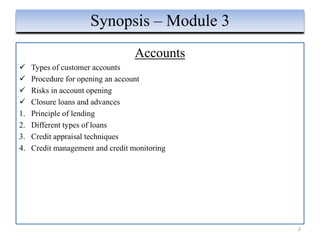
 Types of customer accounts
 Procedure for opening an account
 Risks in account opening
 Closure loans and advances
1. Principle of lending
2. Different types of loans
3. Credit appraisal techniques
4. Credit management and credit monitoring
2
Synopsis – Module 3
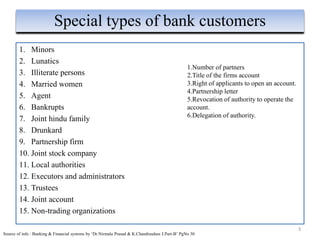
1. Minors
2. Lunatics
3. Illiterate persons
4. Married women
5. Agent
6. Bankrupts
7. Joint hindu family
8. Drunkard
9. Partnership firm
10. Joint stock company
11. Local authorities
12. Executors and administrators
13. Trustees
14. Joint account
15. Non-trading organizations
3
Special types of bank customers
Source of info : Banking & Financial systems by ‘Dr.Nirmala Prasad & K.Chandrasdass J.Part-B’ PgNo 30
1.Number of partners
2.Title of the firms account
3.Right of applicants to open an account.
4.Partnership letter
5.Revocation of authority to operate the
account.
6.Delegation of authority.
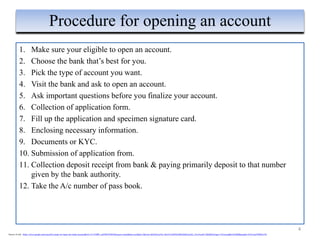
1. Make sure your eligible to open an account.
2. Choose the bank that’s best for you.
3. Pick the type of account you want.
4. Visit the bank and ask to open an account.
5. Ask important questions before you finalize your account.
6. Collection of application form.
7. Fill up the application and specimen signature card.
8. Enclosing necessary information.
9. Documents or KYC.
10. Submission of application from.
11. Collection deposit receipt from bank & paying primarily deposit to that number
given by the bank authority.
12. Take the A/c number of pass book.
4
Procedure for opening an account
Source of info : https://www.google.com/search?q=steps+to+open+an+bank+account&rlz=1C1CHBF_enIN887IN887&source=lnms&tbm=isch&sa=X&ved=2ahUKEwjNw-Xto5ToAhWIeX0KHaSKApAQ_AUoAnoECA0QBA#imgrc=TCinvmgRhoAEBM&imgdii=JX3Comf7MfOw1M
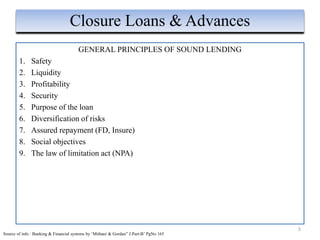
GENERAL PRINCIPLES OF SOUND LENDING
1. Safety
2. Liquidity
3. Profitability
4. Security
5. Purpose of the loan
6. Diversification of risks
7. Assured repayment (FD, Insure)
8. Social objectives
9. The law of limitation act (NPA)
5
Closure Loans & Advances
Source of info : Banking & Financial systems by ‘Mithani & Gordan” J.Part-B’ PgNo 165
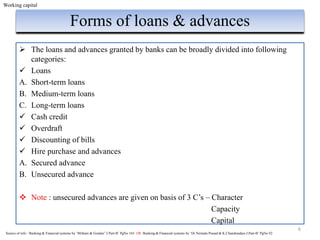
 The loans and advances granted by banks can be broadly divided into following
categories:
 Loans
A. Short-term loans
B. Medium-term loans
C. Long-term loans
 Cash credit
 Overdraft
 Discounting of bills
 Hire purchase and advances
A. Secured advance
B. Unsecured advance
 Note : unsecured advances are given on basis of 3 C’s – Character
Capacity
Capital
6
Forms of loans & advances
Source of info : Banking & Financial systems by ‘Mithani & Gordan” J.Part-B’ PgNo 165 OR Banking & Financial systems by ‘Dr.Nirmala Prasad & K.Chandrasdass J.Part-B’ PgNo 92
Working capital
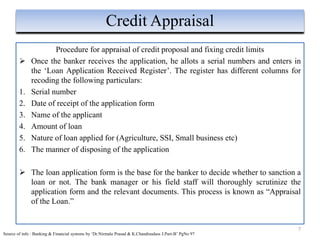
Procedure for appraisal of credit proposal and fixing credit limits
 Once the banker receives the application, he allots a serial numbers and enters in
the ‘Loan Application Received Register’. The register has different columns for
recoding the following particulars:
1. Serial number
2. Date of receipt of the application form
3. Name of the applicant
4. Amount of loan
5. Nature of loan applied for (Agriculture, SSI, Small business etc)
6. The manner of disposing of the application
 The loan application form is the base for the banker to decide whether to sanction a
loan or not. The bank manager or his field staff will thoroughly scrutinize the
application form and the relevant documents. This process is known as “Appraisal
of the Loan.”
7
Credit Appraisal
Source of info : Banking & Financial systems by ‘Dr.Nirmala Prasad & K.Chandrasdass J.Part-B’ PgNo 97
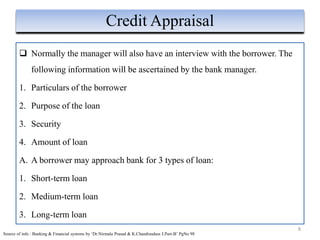
 Normally the manager will also have an interview with the borrower. The
following information will be ascertained by the bank manager.
1. Particulars of the borrower
2. Purpose of the loan
3. Security
4. Amount of loan
A. A borrower may approach bank for 3 types of loan:
1. Short-term loan
2. Medium-term loan
3. Long-term loan
8
Credit Appraisal
Source of info : Banking & Financial systems by ‘Dr.Nirmala Prasad & K.Chandrasdass J.Part-B’ PgNo 98
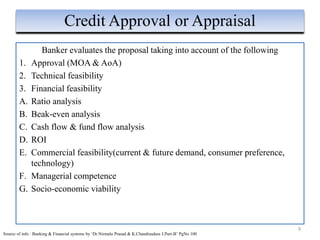
Banker evaluates the proposal taking into account of the following
1. Approval (MOA & AoA)
2. Technical feasibility
3. Financial feasibility
A. Ratio analysis
B. Beak-even analysis
C. Cash flow & fund flow analysis
D. ROI
E. Commercial feasibility(current & future demand, consumer preference,
technology)
F. Managerial competence
G. Socio-economic viability
9
Credit Approval or Appraisal
Source of info : Banking & Financial systems by ‘Dr.Nirmala Prasad & K.Chandrasdass J.Part-B’ PgNo 100
 Company - Credit Management refers to the process of providing credit,
recovering credit on the due date and also formulating a credit policy for a
company or organization. Credit Management is one of the techniques in
order to manage the bad debts of the company in an efficient manner.
Usually the credit period consist of the 15 days to 60 days and in some case
even 90 days. Firm’s credit policy is decided based on the investment a
firm does in account receivable. Example: Textile’s
 Credit management is the process of granting credit, setting the terms it's
granted on, recovering this credit when it's due, and ensuring compliance
with company credit policy, among other credit related functions. (Bank)
10
Credit Management
Factors determining credit policy
1. The effect of credit on the volume of sales
2. Credit terms
3. Cash discount
4. Policies and practices of the firm for selecting credit customers.
5. Paying practices and habits of the customers
6. The firms policy and practice of collection
7. The degree of operating efficiency in the billing, record keeping and adjustment
function
8. Other costs, such as internet, collection costs and bad debts etc.
5 C’s of Credit
1. Collateral
2. Credit
3. Capacity
4. Capital
5. Character
11
12

Principles and Practices of Banking module 3

  • 1.
  • 2.
    Accounts  Types ofcustomer accounts  Procedure for opening an account  Risks in account opening  Closure loans and advances 1. Principle of lending 2. Different types of loans 3. Credit appraisal techniques 4. Credit management and credit monitoring 2 Synopsis – Module 3
  • 3.
    1. Minors 2. Lunatics 3.Illiterate persons 4. Married women 5. Agent 6. Bankrupts 7. Joint hindu family 8. Drunkard 9. Partnership firm 10. Joint stock company 11. Local authorities 12. Executors and administrators 13. Trustees 14. Joint account 15. Non-trading organizations 3 Special types of bank customers Source of info : Banking & Financial systems by ‘Dr.Nirmala Prasad & K.Chandrasdass J.Part-B’ PgNo 30 1.Number of partners 2.Title of the firms account 3.Right of applicants to open an account. 4.Partnership letter 5.Revocation of authority to operate the account. 6.Delegation of authority.
  • 4.
    1. Make sureyour eligible to open an account. 2. Choose the bank that’s best for you. 3. Pick the type of account you want. 4. Visit the bank and ask to open an account. 5. Ask important questions before you finalize your account. 6. Collection of application form. 7. Fill up the application and specimen signature card. 8. Enclosing necessary information. 9. Documents or KYC. 10. Submission of application from. 11. Collection deposit receipt from bank & paying primarily deposit to that number given by the bank authority. 12. Take the A/c number of pass book. 4 Procedure for opening an account Source of info : https://www.google.com/search?q=steps+to+open+an+bank+account&rlz=1C1CHBF_enIN887IN887&source=lnms&tbm=isch&sa=X&ved=2ahUKEwjNw-Xto5ToAhWIeX0KHaSKApAQ_AUoAnoECA0QBA#imgrc=TCinvmgRhoAEBM&imgdii=JX3Comf7MfOw1M
  • 5.
    GENERAL PRINCIPLES OFSOUND LENDING 1. Safety 2. Liquidity 3. Profitability 4. Security 5. Purpose of the loan 6. Diversification of risks 7. Assured repayment (FD, Insure) 8. Social objectives 9. The law of limitation act (NPA) 5 Closure Loans & Advances Source of info : Banking & Financial systems by ‘Mithani & Gordan” J.Part-B’ PgNo 165
  • 6.
     The loansand advances granted by banks can be broadly divided into following categories:  Loans A. Short-term loans B. Medium-term loans C. Long-term loans  Cash credit  Overdraft  Discounting of bills  Hire purchase and advances A. Secured advance B. Unsecured advance  Note : unsecured advances are given on basis of 3 C’s – Character Capacity Capital 6 Forms of loans & advances Source of info : Banking & Financial systems by ‘Mithani & Gordan” J.Part-B’ PgNo 165 OR Banking & Financial systems by ‘Dr.Nirmala Prasad & K.Chandrasdass J.Part-B’ PgNo 92 Working capital
  • 7.
    Procedure for appraisalof credit proposal and fixing credit limits  Once the banker receives the application, he allots a serial numbers and enters in the ‘Loan Application Received Register’. The register has different columns for recoding the following particulars: 1. Serial number 2. Date of receipt of the application form 3. Name of the applicant 4. Amount of loan 5. Nature of loan applied for (Agriculture, SSI, Small business etc) 6. The manner of disposing of the application  The loan application form is the base for the banker to decide whether to sanction a loan or not. The bank manager or his field staff will thoroughly scrutinize the application form and the relevant documents. This process is known as “Appraisal of the Loan.” 7 Credit Appraisal Source of info : Banking & Financial systems by ‘Dr.Nirmala Prasad & K.Chandrasdass J.Part-B’ PgNo 97
  • 8.
     Normally themanager will also have an interview with the borrower. The following information will be ascertained by the bank manager. 1. Particulars of the borrower 2. Purpose of the loan 3. Security 4. Amount of loan A. A borrower may approach bank for 3 types of loan: 1. Short-term loan 2. Medium-term loan 3. Long-term loan 8 Credit Appraisal Source of info : Banking & Financial systems by ‘Dr.Nirmala Prasad & K.Chandrasdass J.Part-B’ PgNo 98
  • 9.
    Banker evaluates theproposal taking into account of the following 1. Approval (MOA & AoA) 2. Technical feasibility 3. Financial feasibility A. Ratio analysis B. Beak-even analysis C. Cash flow & fund flow analysis D. ROI E. Commercial feasibility(current & future demand, consumer preference, technology) F. Managerial competence G. Socio-economic viability 9 Credit Approval or Appraisal Source of info : Banking & Financial systems by ‘Dr.Nirmala Prasad & K.Chandrasdass J.Part-B’ PgNo 100
  • 10.
     Company -Credit Management refers to the process of providing credit, recovering credit on the due date and also formulating a credit policy for a company or organization. Credit Management is one of the techniques in order to manage the bad debts of the company in an efficient manner. Usually the credit period consist of the 15 days to 60 days and in some case even 90 days. Firm’s credit policy is decided based on the investment a firm does in account receivable. Example: Textile’s  Credit management is the process of granting credit, setting the terms it's granted on, recovering this credit when it's due, and ensuring compliance with company credit policy, among other credit related functions. (Bank) 10 Credit Management
  • 11.
    Factors determining creditpolicy 1. The effect of credit on the volume of sales 2. Credit terms 3. Cash discount 4. Policies and practices of the firm for selecting credit customers. 5. Paying practices and habits of the customers 6. The firms policy and practice of collection 7. The degree of operating efficiency in the billing, record keeping and adjustment function 8. Other costs, such as internet, collection costs and bad debts etc. 5 C’s of Credit 1. Collateral 2. Credit 3. Capacity 4. Capital 5. Character 11
  • 12.