Human Resource Management
Human Resource Planning
1. In simple words, HRP is understood as the process of forecasting an organization's future
demand for, and supply of, the right type of people in the right number.
2. After this only the HRM department can initiate the recruitment and selection process
3. It includes the estimation of how many qualified people are necessary to carry out the
assigned activities, how many people will be available, and what, if anything, must be done to
ensure that personal supply equals personnel demand at the appropriate point in the future.
4. Basically it’s the process by which an organization ensures that it has the right number &
kind of people, at the right place, at the right time, capable of effectively & efficiently
completing those tasks that will help the organisation achieve its overall objectives.
5. HRP is a sub-system of total organizational planning. HRP facilitates the realization of the
company’s objectives for the future by providing the right type and number of personnel.
6. HRP is also called Manpower planning, Personnel planning or Employment planning.
What is HRP?
Definition
1. According to Vetter, HRP is the process by which management determines how the
organization should move from its current man power position to desired manpower
position. Through planning, management strives to have the right time, doing things
which result in both the organization and individual receiving maximum long run
benefits.
2. According to Gordon Mc Beath, HRP is concerned with two things: Planning of
manpower requirements and Planning of Manpower supplies.
3. According to Beach, HRP is a process of determining and assuming that the
organization will have an adequate number of qualified persons, available at proper
times, performing jobs which meet the needs of the enterprise and which provides
satisfaction for the individuals involved.
Importance of HRP
1) FUTURE PERSONNEL NEEDS - Surplus or deficiency in staff strength, Results in the anomaly of surplus
labour with the lack of top executives
2) COPING WITH CHANGE - Enables an enterprise to cope with changes in competitive, forces, markets,
technology, products & government regulations
3) CREATING HIGHLY TALENTED PERSONNEL - HR manager must use his/her ingenuity to attract &
retain qualified & skilled personnel, Succession planning
5) PROTECTION OF WEAKER SECTIONS - SC/ST candidates, physically handicapped, children of the
socially disabled & physically oppressed and backward class citizens.
7) INTERNATIONAL STRATEGIES - Fill key jobs with foreign nationals and reassignment of employees from
within or across national borders
8) FOUNDATION FOR PERSONNEL FUNCTIONS - Provides information for designing & implementing,
recruiting, selection, personnel movement(transfers, promotions, layoffs) & training & development
Importance of HRP (Contd.)
9) INCREASING INVESTMENTS IN HUMAN RESOURCES - Human assets increase in value.
10) RESISTANCE TO CHANGE AND MOVE - Proper planning is required to do this
11) OTHER BENEFITS - Upper management has a better view of the HR dimensions of business
decision, More time is provided to locate talent, Better opportunities exist to include women &
minority groups in future growth plans, Better planning of assignments to develop managers can be
done.
Features
1) Futuristic
2) Continuous process
3) Part of corporate planning
4) Flexibility
5) Long term and short term plans
Nature of HRP
1. It is the process of analysing and identifying the availability and the need for human resources so that the
organization can meet its objectives.
2. The focus of HR planning is to ensure that the organization has the right number of human resources, with the
right capabilities, at the right times, and in the right places. In HR planning, an organization must consider the
availability and allocation of people to jobs over long periods of time, not just for the next month or the next
year.
3. HRP is a sub system in the total organizational planning. Actions may include shifting employees to other jobs in
the organization, laying off employees or otherwise cutting back the number of employees, developing present
employees, and/or increasing the number of employees in certain areas.
4. Factors to consider include the current employees‘ knowledge, skills, and abilities and the expected vacancies
resulting from retirements, promotions, transfers, and discharges.
5. To do this, HR planning requires efforts by HR professionals working with executives and managers.
Objectives of HRP
1. To ensure optimum utilization of human resources currently available in the
organization.
2. To assess or forecast the future skill requirement of the Organization.
3. To provide control measures to ensure that necessary resources are available as
and when required.
4. A series of specified reasons are there that attaches importance to manpower
planning and forecasting exercises. They are elaborated below:
1. To link manpower planning with the organizational planning
2. To determine recruitment levels
3. To anticipate redundancies
4. To determine optimum training levels
5. To provide a basis for management development programs
6. To cost the manpower
7. To assist productivity bargaining
8. To assess future accommodation requirement
9. To study the cost of overheads and value of service functions
10. To decide whether certain activity needs to be subcontracted, etc.
Types of HR planning
1. SHORT TERM
• Approaches to matching a weak individual and a job
• For optimum utilization of the strong incumbent
2. LONG TERM
• Projecting manpower requirements
• Taking stock of existing manpower
• Recruitment & selection
• HR devlopment
Approaches to HR planning
Two Approaches used in forecasting the demand for
human resources are-
1. Quantitative
2. Qualitative
HRP is a Four-Phased Process
1. The first phase involves the gathering and analysis of data through manpower inventories
and forecasts.
2. The second phase consists of establishing manpower objectives and policies and gaining
top management approval of these.
3. The third phase involves designing and implementing plans and promotions to enable
the organization to achieve its manpower objectives.
4. The fourth phase is concerned with control and evaluation of manpower plans to facilitate
progress in order to benefit both the organization and the individual. The long run view means
that gains may be sacrificed in the short run for the future grounds. The planning process
enables the organization to identify what its manpower needs is and what potential manpower
problems required current action. This leads to more effective and efficient performance.
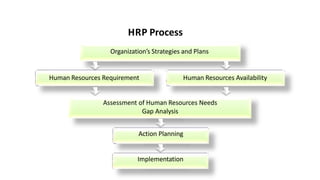
Organization’s Strategies and Plans
Human Resources Requirement Human Resources Availability
Assessment of Human Resources Needs
Gap Analysis
Action Planning
Implementation
HRP Process
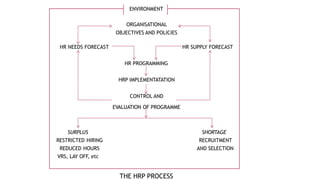
ENVIRONMENT
ORGANISATIONAL
OBJECTIVES AND POLICIES
HR NEEDS FORECAST HR SUPPLY FORECAST
HR PROGRAMMING
HRP IMPLEMENTATATION
CONTROL AND
EVALUATION OF PROGRAMME
SURPLUS SHORTAGE
RESTRICTED HIRING RECRUITMENT
REDUCED HOURS AND SELECTION
VRS, LAY OFF, etc
THE HRP PROCESS
HR Demand Forecast
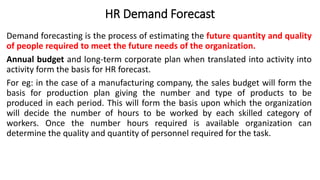
Demand forecasting is the process of estimating the future quantity and quality
of people required to meet the future needs of the organization.
Annual budget and long-term corporate plan when translated into activity into
activity form the basis for HR forecast.
For eg: in the case of a manufacturing company, the sales budget will form the
basis for production plan giving the number and type of products to be
produced in each period. This will form the basis upon which the organization
will decide the number of hours to be worked by each skilled category of
workers. Once the number hours required is available organization can
determine the quality and quantity of personnel required for the task.
HR Demand Forecast
1. Demand forecasting is the process of estimating the future quantity
and quality of people required.
2. The basis of the forecast must be the annual budget and long-term
corporate plan, translated into activity levels for each function and
department
3. Demand forecasting must consider several factors both internal and
external.
a) Internal factors include budget constraints, production levels, new
products and services, organizational structure and employee
separation.
b) Among external factors are competition (foreign and domestic),
economic climate, laws and regulatory bodies, changes in technology
and social factors.
Demand forecasting is essential because it helps the
organization to
1. Quantify the jobs, necessary for producing a given number of goods,
2. To determine the nature of staff mix required in the future,
3. To assess appropriate levels in different parts of organization so as to avoid unnecessary costs
to the organization,
4. To prevent shortages of personnel where and when, they are needed by the organization.
5. To monitor compliances with legal requirements with regard to reservation of jobs.
6. Techniques like managerial judgment, ratio - trend analysis, regression analysis, work study
techniques, Delphi techniques are some of the major methods used by the organization for
demand forecasting.
Forecasting Techniques
Managerial judgment
1. In this all managers sit together, discuss and arrive at a figure which would be the future demand for labour.
2. This technique may involve a ‘bottom-up’ or ‘top-down’ approach. A combination of both could yield
positive results.
Ratio-trend analysis
1. This is the quickest forecasting technique.
2. This technique involves studying past ratios, say, between the number of workers and sales in an
organization and forecasting future ratios, making some allowance for changes in the organization or its
method.
Work study techniques
1. Work study techniques can be used when it is possible to apply work measurement to calculate the length of
operations and the amount of labour required.
Delphi technique
1. This technique is the method of forecasting personnel needs.
2. It solicits estimates of personnel needs from a group of experts, usually managers.
3. The HRP experts act as intermediaries, summarize the various responses and report the findings back to
the experts.
4. Summaries and surveys are repeated until the experts opinion begin to agree.
Need For Supply Forecast
• Supply forecast determines whether the HR department will be able
to procure the required number of workers.
• Supply forecast measures the number of people likely to be available
from within and outside an organization, after making allowance for
absenteeism, internal movements and promotions, wastage and
changes in hours, and other conditions of work.
Supply forecast is required because it is needed as it
1. Helps to quantify the number of people and positions expected to be available in future to help the
organization realize its plans and meet its objectives
2. Helps to clarify the staff mixes that will arise in future
3. It assesses existing staffing in different parts of the organization.
4. It will enable the organization to prevent shortage of people where and when they are most needed.
5. It also helps to monitor future compliance with legal requirements of job reservations.
Supply analysis covers the existing human resources, internal sources of supply and external sources of
supply.
Supply Analysis
1. Existing human resources -
a) Skill inventories - Information about non-managers. Personal data, Skills, Special
qualifications, Salary and job history, Company data, Capacity of individual,
Special preference of individual
b) Management inventories - Work history, Strengths, Weakness, Promotion
potential, Career goals, Personal data, Number and types of employees
supervised, Total budget managed, Previous management duties
2. Internal sources of supply (Forecasting the supply of internal human resources)
3. External sources of supply (Forecasting the supply of external human resources)
Requisites for Successful HRP
1. HRP must be recognized as an integral part of corporate planning
2. Support of top management is essential
3. There should be some centralization with respect to HRP responsibilities in
order to have co-ordination between different levels of management.
4. Organization records must be complete, up to date and readily available.
5. Techniques used for HR planning should be those best suited to the data
available and degree of accuracy required.
6. Data collection, analysis, techniques of planning and the plan themselves need
to be constantly revised and improved in the light of experience.
Challenges for HR Planning
1) Globalization
2) Handling multicultural/Diverse Workforce
3) Employee selection
4) Training & Devlopment
5) Balance with work life
6) Retaining Talents
7) Conflict Managing
Barriers to HR plan
1. HR practitioners are perceived as experts in handling personnel matters, but are not experts in managing
business. The personnel plan conceived and formulated by the HR practitioners when enmeshed with
organizational plan, might make the overall strategic plan of the organization ineffective.
2. HR information often is incompatible with other information used in strategy formulation. Strategic planning
efforts have long been oriented towards financial forecasting, often to the exclusion of other types of
information. Financial forecasting takes precedence over HRP.
3. Conflict may exist between short term and long term HR needs. For example, there can be a conflict between
the pressure to get the work done on time and long term needs, such as preparing people for assuming
greater responsibilities. Many managers are of the belief that HR needs can be met immediately because
skills are available on the market as long as wages and salaries are competitive. Therefore, long times plans
are not required, short planning are only needed.
4. There is conflict between quantitative and qualitative approaches to HRP. Some people view HRP as a number
game designed to track the flow of people across the department. Others take a qualitative approach and
focus on individual employee concerns such as promotion and career development. Best result can be
achieved if there is a balance between the quantitative and qualitative approaches.
5. Non-involvement of operating managers renders HRP ineffective. HRP is not strictly an HR department
function. Successful planning needs a co-ordinated effort on the part of operating managers and HR
personnel.
Conclusion
1) An effective HRP is required for an organisation to be effective
2) HRP needs to be fully integrated to be organization plan
3) Secret of success is the right type of people available in the right
number at time at right place.

Human Resource Planning.pptx

  • 1.
  • 2.
    1. In simplewords, HRP is understood as the process of forecasting an organization's future demand for, and supply of, the right type of people in the right number. 2. After this only the HRM department can initiate the recruitment and selection process 3. It includes the estimation of how many qualified people are necessary to carry out the assigned activities, how many people will be available, and what, if anything, must be done to ensure that personal supply equals personnel demand at the appropriate point in the future. 4. Basically it’s the process by which an organization ensures that it has the right number & kind of people, at the right place, at the right time, capable of effectively & efficiently completing those tasks that will help the organisation achieve its overall objectives. 5. HRP is a sub-system of total organizational planning. HRP facilitates the realization of the company’s objectives for the future by providing the right type and number of personnel. 6. HRP is also called Manpower planning, Personnel planning or Employment planning. What is HRP?
  • 3.
    Definition 1. According toVetter, HRP is the process by which management determines how the organization should move from its current man power position to desired manpower position. Through planning, management strives to have the right time, doing things which result in both the organization and individual receiving maximum long run benefits. 2. According to Gordon Mc Beath, HRP is concerned with two things: Planning of manpower requirements and Planning of Manpower supplies. 3. According to Beach, HRP is a process of determining and assuming that the organization will have an adequate number of qualified persons, available at proper times, performing jobs which meet the needs of the enterprise and which provides satisfaction for the individuals involved.
  • 4.
    Importance of HRP 1)FUTURE PERSONNEL NEEDS - Surplus or deficiency in staff strength, Results in the anomaly of surplus labour with the lack of top executives 2) COPING WITH CHANGE - Enables an enterprise to cope with changes in competitive, forces, markets, technology, products & government regulations 3) CREATING HIGHLY TALENTED PERSONNEL - HR manager must use his/her ingenuity to attract & retain qualified & skilled personnel, Succession planning 5) PROTECTION OF WEAKER SECTIONS - SC/ST candidates, physically handicapped, children of the socially disabled & physically oppressed and backward class citizens. 7) INTERNATIONAL STRATEGIES - Fill key jobs with foreign nationals and reassignment of employees from within or across national borders 8) FOUNDATION FOR PERSONNEL FUNCTIONS - Provides information for designing & implementing, recruiting, selection, personnel movement(transfers, promotions, layoffs) & training & development
  • 5.
    Importance of HRP(Contd.) 9) INCREASING INVESTMENTS IN HUMAN RESOURCES - Human assets increase in value. 10) RESISTANCE TO CHANGE AND MOVE - Proper planning is required to do this 11) OTHER BENEFITS - Upper management has a better view of the HR dimensions of business decision, More time is provided to locate talent, Better opportunities exist to include women & minority groups in future growth plans, Better planning of assignments to develop managers can be done.
  • 6.
    Features 1) Futuristic 2) Continuousprocess 3) Part of corporate planning 4) Flexibility 5) Long term and short term plans
  • 7.
    Nature of HRP 1.It is the process of analysing and identifying the availability and the need for human resources so that the organization can meet its objectives. 2. The focus of HR planning is to ensure that the organization has the right number of human resources, with the right capabilities, at the right times, and in the right places. In HR planning, an organization must consider the availability and allocation of people to jobs over long periods of time, not just for the next month or the next year. 3. HRP is a sub system in the total organizational planning. Actions may include shifting employees to other jobs in the organization, laying off employees or otherwise cutting back the number of employees, developing present employees, and/or increasing the number of employees in certain areas. 4. Factors to consider include the current employees‘ knowledge, skills, and abilities and the expected vacancies resulting from retirements, promotions, transfers, and discharges. 5. To do this, HR planning requires efforts by HR professionals working with executives and managers.
  • 8.
    Objectives of HRP 1.To ensure optimum utilization of human resources currently available in the organization. 2. To assess or forecast the future skill requirement of the Organization. 3. To provide control measures to ensure that necessary resources are available as and when required. 4. A series of specified reasons are there that attaches importance to manpower planning and forecasting exercises. They are elaborated below:
  • 9.
    1. To linkmanpower planning with the organizational planning 2. To determine recruitment levels 3. To anticipate redundancies 4. To determine optimum training levels 5. To provide a basis for management development programs 6. To cost the manpower 7. To assist productivity bargaining 8. To assess future accommodation requirement 9. To study the cost of overheads and value of service functions 10. To decide whether certain activity needs to be subcontracted, etc.
  • 10.
    Types of HRplanning 1. SHORT TERM • Approaches to matching a weak individual and a job • For optimum utilization of the strong incumbent 2. LONG TERM • Projecting manpower requirements • Taking stock of existing manpower • Recruitment & selection • HR devlopment
  • 11.
    Approaches to HRplanning Two Approaches used in forecasting the demand for human resources are- 1. Quantitative 2. Qualitative
  • 12.
    HRP is aFour-Phased Process 1. The first phase involves the gathering and analysis of data through manpower inventories and forecasts. 2. The second phase consists of establishing manpower objectives and policies and gaining top management approval of these. 3. The third phase involves designing and implementing plans and promotions to enable the organization to achieve its manpower objectives. 4. The fourth phase is concerned with control and evaluation of manpower plans to facilitate progress in order to benefit both the organization and the individual. The long run view means that gains may be sacrificed in the short run for the future grounds. The planning process enables the organization to identify what its manpower needs is and what potential manpower problems required current action. This leads to more effective and efficient performance.
  • 13.
    Organization’s Strategies andPlans Human Resources Requirement Human Resources Availability Assessment of Human Resources Needs Gap Analysis Action Planning Implementation HRP Process
  • 14.
    ENVIRONMENT ORGANISATIONAL OBJECTIVES AND POLICIES HRNEEDS FORECAST HR SUPPLY FORECAST HR PROGRAMMING HRP IMPLEMENTATATION CONTROL AND EVALUATION OF PROGRAMME SURPLUS SHORTAGE RESTRICTED HIRING RECRUITMENT REDUCED HOURS AND SELECTION VRS, LAY OFF, etc THE HRP PROCESS
  • 15.
    HR Demand Forecast Demandforecasting is the process of estimating the future quantity and quality of people required to meet the future needs of the organization. Annual budget and long-term corporate plan when translated into activity into activity form the basis for HR forecast. For eg: in the case of a manufacturing company, the sales budget will form the basis for production plan giving the number and type of products to be produced in each period. This will form the basis upon which the organization will decide the number of hours to be worked by each skilled category of workers. Once the number hours required is available organization can determine the quality and quantity of personnel required for the task.
  • 16.
    HR Demand Forecast 1.Demand forecasting is the process of estimating the future quantity and quality of people required. 2. The basis of the forecast must be the annual budget and long-term corporate plan, translated into activity levels for each function and department 3. Demand forecasting must consider several factors both internal and external. a) Internal factors include budget constraints, production levels, new products and services, organizational structure and employee separation. b) Among external factors are competition (foreign and domestic), economic climate, laws and regulatory bodies, changes in technology and social factors.
  • 17.
    Demand forecasting isessential because it helps the organization to 1. Quantify the jobs, necessary for producing a given number of goods, 2. To determine the nature of staff mix required in the future, 3. To assess appropriate levels in different parts of organization so as to avoid unnecessary costs to the organization, 4. To prevent shortages of personnel where and when, they are needed by the organization. 5. To monitor compliances with legal requirements with regard to reservation of jobs. 6. Techniques like managerial judgment, ratio - trend analysis, regression analysis, work study techniques, Delphi techniques are some of the major methods used by the organization for demand forecasting.
  • 18.
    Forecasting Techniques Managerial judgment 1.In this all managers sit together, discuss and arrive at a figure which would be the future demand for labour. 2. This technique may involve a ‘bottom-up’ or ‘top-down’ approach. A combination of both could yield positive results. Ratio-trend analysis 1. This is the quickest forecasting technique. 2. This technique involves studying past ratios, say, between the number of workers and sales in an organization and forecasting future ratios, making some allowance for changes in the organization or its method. Work study techniques 1. Work study techniques can be used when it is possible to apply work measurement to calculate the length of operations and the amount of labour required. Delphi technique 1. This technique is the method of forecasting personnel needs. 2. It solicits estimates of personnel needs from a group of experts, usually managers. 3. The HRP experts act as intermediaries, summarize the various responses and report the findings back to the experts. 4. Summaries and surveys are repeated until the experts opinion begin to agree.
  • 19.
    Need For SupplyForecast • Supply forecast determines whether the HR department will be able to procure the required number of workers. • Supply forecast measures the number of people likely to be available from within and outside an organization, after making allowance for absenteeism, internal movements and promotions, wastage and changes in hours, and other conditions of work.
  • 20.
    Supply forecast isrequired because it is needed as it 1. Helps to quantify the number of people and positions expected to be available in future to help the organization realize its plans and meet its objectives 2. Helps to clarify the staff mixes that will arise in future 3. It assesses existing staffing in different parts of the organization. 4. It will enable the organization to prevent shortage of people where and when they are most needed. 5. It also helps to monitor future compliance with legal requirements of job reservations. Supply analysis covers the existing human resources, internal sources of supply and external sources of supply.
  • 21.
    Supply Analysis 1. Existinghuman resources - a) Skill inventories - Information about non-managers. Personal data, Skills, Special qualifications, Salary and job history, Company data, Capacity of individual, Special preference of individual b) Management inventories - Work history, Strengths, Weakness, Promotion potential, Career goals, Personal data, Number and types of employees supervised, Total budget managed, Previous management duties 2. Internal sources of supply (Forecasting the supply of internal human resources) 3. External sources of supply (Forecasting the supply of external human resources)
  • 22.
    Requisites for SuccessfulHRP 1. HRP must be recognized as an integral part of corporate planning 2. Support of top management is essential 3. There should be some centralization with respect to HRP responsibilities in order to have co-ordination between different levels of management. 4. Organization records must be complete, up to date and readily available. 5. Techniques used for HR planning should be those best suited to the data available and degree of accuracy required. 6. Data collection, analysis, techniques of planning and the plan themselves need to be constantly revised and improved in the light of experience.
  • 23.
    Challenges for HRPlanning 1) Globalization 2) Handling multicultural/Diverse Workforce 3) Employee selection 4) Training & Devlopment 5) Balance with work life 6) Retaining Talents 7) Conflict Managing
  • 24.
    Barriers to HRplan 1. HR practitioners are perceived as experts in handling personnel matters, but are not experts in managing business. The personnel plan conceived and formulated by the HR practitioners when enmeshed with organizational plan, might make the overall strategic plan of the organization ineffective. 2. HR information often is incompatible with other information used in strategy formulation. Strategic planning efforts have long been oriented towards financial forecasting, often to the exclusion of other types of information. Financial forecasting takes precedence over HRP. 3. Conflict may exist between short term and long term HR needs. For example, there can be a conflict between the pressure to get the work done on time and long term needs, such as preparing people for assuming greater responsibilities. Many managers are of the belief that HR needs can be met immediately because skills are available on the market as long as wages and salaries are competitive. Therefore, long times plans are not required, short planning are only needed. 4. There is conflict between quantitative and qualitative approaches to HRP. Some people view HRP as a number game designed to track the flow of people across the department. Others take a qualitative approach and focus on individual employee concerns such as promotion and career development. Best result can be achieved if there is a balance between the quantitative and qualitative approaches. 5. Non-involvement of operating managers renders HRP ineffective. HRP is not strictly an HR department function. Successful planning needs a co-ordinated effort on the part of operating managers and HR personnel.
  • 25.
    Conclusion 1) An effectiveHRP is required for an organisation to be effective 2) HRP needs to be fully integrated to be organization plan 3) Secret of success is the right type of people available in the right number at time at right place.