COURTNEY CAVALL HRIS INFORMATION SYSTEMS WITHIN HR 1
COURTNEY CAVALL HRIS INFORMATION SYSTEMS WITHIN HR
1. HRIS PERSPECTIVE WEEK 1 HUMAN RESOURCE
INFORMATION SYSTEM (HRIS)
2. EVALUATE THE HUMAN RESOURCES INFORMATION SYSTEM
FUNCTION ANALYZE THE EVOLUTION OF HRIS SYSTEMS IN
THE MODERN HUMAN RESOURCE DEPARTMENT
3. HRIS: DECISION SUPPORT
4. ANALYZE FACTORS INFLUENCING WHEN TO IMPLEMENT
HRIS- KEY FACTORS, WHICH INFLUENCE HRIS, DECISIONS &
IMPLEMENTATION
5. COMPREHENSIVE STUDY & DESIGN OF HRIS DATA SECURITY
6. EVALUATE DATA BENCHMARKS AND METRIC SYSTEMS
7. SIGNATURE COMPUTATION: ANALYZE AND RECOMMEND AN
HRIS APPLICATION:
 Introduction/Background Information
 Statement of Problem
 Literature Review
 Conclusions/Recommendations
COURTNEY CAVALL HRIS INFORMATION SYSTEMS WITHIN HR 2
HRIS Perspective: Human Resource Information System (HRIS)
The HRIS responsibility within an organization the Human Resource
Management department has numerous responsibilities therefore managers have to offer
employee’s with informative data. HR managers provide information related to data on
performance, salary, etc., along with other information that may be needed in order to
efficiently and effectively run the departments organization (Wall-Lievsay, 2014). As
suggested in HRM7001-8 HRIS: Perspective Week 1 assignment employees would rather
have information open for access to them without having to contact someone in HRM in
regards their compensation and benefit packages (Wall-Lievsay, 2014, p.1)
HRIS is a structured system that helps the HR department analyzes,
collects, and provide material which is needed in order to assist HR professionals and
employees to more efficiently in there work environment (Obeidat, 2012, p. 49).
Researcher Dr. Obeidat (2012) research stated that HRIS information within an
organization is defined as a system used to retain, store, change, examine, access, and
distribute (Obeidat, 2012, p. 49). Corporations rely on Human Resource Information
System (HRIS) to assist with improving their efficiency (Obeidat, 2012). Rodríguez &
Ventura, (2003) suggest the role of HR has shifted towards a substantial involvement in
the organizations strategic management, recognizing the importance of HR IS technology
(Obeidat, 2012, p. 49).
Definitions: Key Terms.
Definitions & Key Terms: Researchers terms will be defined to assist any reader to
comprehend context.
HRIS Systems: HRIS is the multipart databases from computer applications software
COURTNEY CAVALL HRIS INFORMATION SYSTEMS WITHIN HR 3
and hardware and that is needed to accumulate, trace, store, manipulate manage, provide,
and present data in any organization (Bulmash, 2006, p. 54). Systems involve computer
databases and the people who run then in order to manage. HR strategies and practices
require professional to implement them into the company working procedures. A
comprehensive HRIS must be operational and allow for the integration of HR policies
and procedures within a companies organization’s computer applications (Bulmash,
2006)
E-Systems. Provide a streamlined approach and delivery of benefits administration
assisting with cost reduction, delivering employee access to benefit information allowing
for employees to manage their own benefits services (Johnson, & Gueutal, 2011, p. 22).
E-compensation. Give managers the tools
to model different compensation structures
and to assess the costs and the fit with employee performance data of various pay
structures (Johnson, & Gueutal, 2011, p. 22).
E-compensation. An e-benefits methodology practices a web based method to
communicate information, specifically on employee benefits to employees allowing
employees to have access to along with HR to manage benefits online (Johnson, &
Gueutal, 2011, p. 22).
E-performance management. The storage in the system needs to be efficient and
maintained, information needs to be up to date data (Johnson, & Gueutal, 2011, p. 22).
HRIS Systems Asset To Stakeholders
HRIS systems can be a valuable asset to stakeholders through improved employee
increasing productivity, creating more efficient methods of communication efficiently
COURTNEY CAVALL HRIS INFORMATION SYSTEMS WITHIN HR 4
delivering information within seconds allowing quick responses to the ever changing
changes external environment of an organization (Obeidat, 2012).
Human resource information system has been suggested to be one of the most
treasured tools within an organization capabilities for internal and external where the
companies overall ability to implement, develop, and reconfigure to attend to rapidly
changing aspects in the environment (Obeidat, 2012). The system is efficient and
researches stated that HRIS allows for immediate responsiveness for getting needed
information, adopting a HRIS system allows for fewer human errors (Ngai, & Wat,
2006).
HRIS Study within Organizations
Organizations encounter many obstacles with regards to the competitive
advantage to be short. Wheelen and Hunger, (2012) suggest that they have began
to consider the innovation processes to excel their overall economic situation, in
order to be the for-runners in this area so they are ahead of other competitors
(Obeidat, 2012). Inauen & Schenker-Wicki, (2012) article suggested that by
increasing technological development there will be an enhanced for companies
to gain information creating global availability of knowledge (Obeidat, 2012).
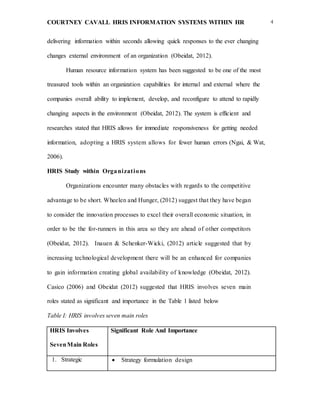
Casico (2006) and Obeidat (2012) suggested that HRIS involves seven main
roles stated as significant and importance in the Table 1 listed below
Table I: HRIS involves seven main roles
HRIS Involves
SevenMain Roles
Significant Role And Importance
1. Strategic  Strategy formulation design
COURTNEY CAVALL HRIS INFORMATION SYSTEMS WITHIN HR 5
integration  Organizes needed elements
 Assists employees decision making process
2. Forecasting and
planning
 HR analysis
 Future planning
 Estimates if employees meeting goals and objectives
3. Performance
development
 Tracks employees formal education and job experience
 Tracks employee assessments
 Prepare for employee’s development and improves
4. Human resources
analysis
 Employment planning
 Access to available positions for employment
 Supplies resources congruent with overall strategic goals
and vision
5. Knowledge
management
 Competitive advantage
 Well-organized use of data
 Organized memory storage
6. Communication
and integration
 Delivers information
 Mechanism for effective communication
 Connect people with information
7. Records and
compliance
 Meets legal requirements
 Contains the records
 Keeps records on hand
Jordanian pharmaceutical industry
COURTNEY CAVALL HRIS INFORMATION SYSTEMS WITHIN HR 6
Jordanian pharmaceutical organization is based in numerous geographical
locations, applying information systems to analysis, document, and to transfer knowledge
giving them a competitive advantage. Research suggested that the pharmaceutical sector
in Jordan concluded there was a significant relationship between variables of innovation
diffusion and human resource information system (Asmahan, 2013). Jordan
pharmaceutical focus on first the customer, then the customer feedback, then their overall
commitment in production to create an effective overall services process through
Knowledge transfer. The company believes in employee’s knowledge transfer and the
relation between the knowledge transfer, innovation, and the overall competitive
advantage (Asmahan, 2013).
Cisco
Cisco suggests that it provides a challenging work environment that is and very
worthwhile for the employee that is mutually beneficial for the company and its
employees by providing numerous benefits such as; flexible work openings, aspiring
environmental initiatives, multitude worker engagement programs, career expansion,
while upholding a commitment to a work-life balance (Cisco.com, 2014). Cisco
suggested they want the employees to experience with diverse cross-functional teams
functioning throughout the world. Cisco was rated in Fortune Magazine top as one of the
top ten “Best Companies to Work For" (Cisco.com, 2014).
Cisco’s management strategy incorporates goals directed towards financial and
technology gains, providing strategic analysis planning and decision-making procedures
that not only rive the company but also enhance the organizations productivity and
overall effectiveness throughout the organization company. Cisco’s HR professional’s
COURTNEY CAVALL HRIS INFORMATION SYSTEMS WITHIN HR 7
values are in line with self-motivated business managers and enhancing shareholders
worth (Cisco.com, 2014).
Cisco’s HR department is committed to the goal of building and enhancing a
global culture and organizational capability to ensure competitive advantage even in
times of market transitions (Cisco.com, 2014). The company states that it has cutting-
edge technology and enhanced analytics capabilities giving the companies employees the
ability to work across cultures from any geographic location at any given moment in time
(Cisco.com, 2014).
Communication and integration using HRIS: Remote Expert Smart Solution connects
managers, employees, and customers, through a multi-facet approach applying advanced
media technologies. Cisco Remote Expert Manager (REM) this system main controller of
the Remote Expert Smart Solution, that provide features that allow Cisco to best serve
there customer through simplistic methods of connected services for exchanges using
technology that is both simple and effective. Cisco network devices and technological
information system is designed help diminish human errors and create minimal to no
manual tasks connected with sustaining the network. The RME is the company’s
technological information system tools for management’s used effective record keeping
through inventory management and device configuration management, and change audit
services. (Cisco Systems, 2013 p.17).
Limitations HRIS Systems
One concern with the system falls on the fact that if there is one malfunction
within the system it could potentially cause the functions of the whole system to collapse
(Obeidat, 2012, p. 49). Ngai, & Wat, (2006) implied concerns about the implication of
COURTNEY CAVALL HRIS INFORMATION SYSTEMS WITHIN HR 8
the HRIS system when there is a lack of motivation from staff, or lack of understanding
from staff, and lack of the number of needed employees in order to implement the
program. Ngai, & Wat, (2006) also suggested that concerns may arise do to minimal to
no funding in order to properly develop as well as design the HRIS system, and
suggested that it may be hard to implement the program into an organization's culture
because this would a require change in the work using kindness and training of HR staff.
Conclusion and Recommendations
The study by Obeidat (2012) concluded that there is a relationship among
the advantage perceived by observer regarding innovation and the human
resource purpose. Obeidat (2012) advised when organization are integrating
HRIS system it would be important to observe and take in to account the
intrinsic interworking’s of the system and then decide if it would be compatible
within an organizations social system (Obeidat, 2012, p. 53).
Evaluate the Human Resources Information System Function
Analyze the evolution of HRIS systems in the modern human resource department
Weatherly’s (2005) research stated the since the 1980s human resource
information systems have been applied. HRIS systems began to regulate and effectively
manage and monitor compliance in legislation and create cost effect methods for
organizations (Thite et al’s., 2013).
Historical trends in the function of HR function are to assist in resolution between
management and employees. In the 20th century the employees function prior to
human resources management the role was focused mainly in secretarial work such
as record keeping of employee materials (SHRM.ORG, 2002). From 1963 to 1980 the
COURTNEY CAVALL HRIS INFORMATION SYSTEMS WITHIN HR 9
emergence of social issues creating the labor legislations and specified legislative
compliances. It was about this time that personnel departments were beginning to be
called human resources departments and the field of human resource management was
born (SHRM.ORG, 2002). The HRM function increased became a need when
compliance was required for employee protection laws, at this time the computer
technology began to evolve and companies had to figure out a lower cost methods
to deliver a more efficient method of productivity (SHRM.ORG, 2002). Thite,
Kavanagh, & Johnson, (2013) stated the in the late 1980s to the to the early 1990s the
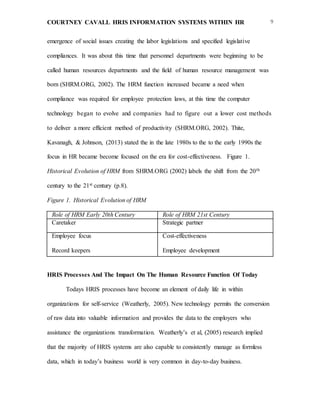
focus in HR became become focused on the era for cost-effectiveness. Figure 1.
Historical Evolution of HRM from SHRM.ORG (2002) labels the shift from the 20th
century to the 21st century (p.8).
Figure 1. Historical Evolution of HRM
Role of HRM Early 20th Century Role of HRM 21st Century
Caretaker Strategic partner
Employee focus
Record keepers
Cost-effectiveness
Employee development
HRIS Processes And The Impact On The Human Resource Function Of Today
Todays HRIS processes have become an element of daily life in within
organizations for self-service (Weatherly, 2005). New technology permits the conversion
of raw data into valuable information and provides the data to the employers who
assistance the organizations transformation. Weatherly’s et al, (2005) research implied
that the majority of HRIS systems are also capable to consistently manage as formless
data, which in today’s business world is very common in day-to-day business.
COURTNEY CAVALL HRIS INFORMATION SYSTEMS WITHIN HR 10
Weatherly’s (2005) suggest that due to the sophisticated technological advancements
over the years in HRIS applications, todays HR department personnel can effectively
manage Web-based technology without extra training.
Assess The Importance Of HRIS Programs For The Success Of An Organization.
HRIS is the multipart databases from computer applications software and
hardware and that is needed to accumulate, trace, store, manipulate manage, provide, and
present data in any organization (Bulmash, 2006, p. 54). Systems involve computer data
bases and the people who run then in order to manage. HR strategies and practices
require professional to implement them into the company working procedures. A
comprehensive HRIS must be operational and allow for the integration of HR policies
and procedures within a companies organization’s computer applications (Bulmash,
2006, p. 54).
The 2004 Cedar Workforce Technologies Survey, made 22 discoveries signifying
the prevalence of workforce technology use and linkages between the insertion and usage
of workforce technology resolutions and the accomplishment of organizational objectives
when applied by administration to achieve desired outcomes using successful strategies
(Weatherly et al, 2005, p. 6).
Innovation. Panayotopoulou, Galanaki, and Papalexandris, (2010), suggest that
HRM organizational characteristics related to innovations is higher rates of performance
in an organization. Thite, Kavanagh, & Johnson, ( 2013) stated one function as
performance management Compensation and benefits. Panayotopoulou et al’s, (2010)
research suggest that size of the company has been correlated as a predictor of
innovation, when a companies size increases the company may reach the point of ‘critical
COURTNEY CAVALL HRIS INFORMATION SYSTEMS WITHIN HR 11
mass’, validating the adoption of the certain innovations and acquisition of as a
necessitates.
Global Business Implications. Martin and Reddington (2010) research paper
suggested that employee services have implemented a global HRIS which permits a more
effective and efficient in providing data exchange altogether making it globally available
for all business groups to access the same database. Hannon et al., (1996) reviewed E-
HRM practices among multinational businesses (MNCs) in headquarters and various
affiliates, highlighting distinctive requirements between global and domestic HR
applications, examples stated in one study emphasized the necessity for location-specific
customization verse an integrated in order to accommodate nationwide policies and have
flexibility in customs (Panayotopoulou et al’s., 2010). Performance orientation is the
length to which a community supports and rewards innovation, high standards and
performance improvement creating inferences for specified choices made in the arena of
reward and compensation for participants of innovation and innovation (Panayotopoulou
et al’s., 2010). (SHRM.ORG, 2002). Its important to note that strategic compliance and
improved development of HRIS processes will still require cost effective cost-effective
system and development in the future (SHRM.ORG, 2002). Tansley and Watson (2000)
specify the importance of a vision and mission statement which is clear and the strategic
fit between HRIS and HR regarding and corporate strategies. Allowing the HR role to
play a significant role for the development of an HRIS project. More recent models have
identified role of HR professionals to build for and asses e-HRM goals and outcomes. It
is important to note that different factors have prominent roles in different geographical
areas with similar socio-cultural characteristics. It is also useful to keep in mind the
COURTNEY CAVALL HRIS INFORMATION SYSTEMS WITHIN HR 12
differences between back- and front-end systems, especially since real applications
increasingly combine the properties of different categories. Ensuring that staff has the
skills, knowledge and competencies to flawlessly execute their re-defined roles
(SHRM.ORG, 2002). There is a need to be aware of socio-cultural and organizational
factors affecting technology and the use of it within the in HRM and HRIS suppliers such
as and IT specialists.
Human Resources Enhancement of Employee & HRM Outcomes Using HRIS
HRIS improvements facilitate internal/external employee recruitment attracting
new people through flexible working hours and non-traditional pools of recruitment,
making the recruitment procedures for outsourcing of simplistic for HR managers. Also,
the HRIS process allows for easier access to social networking employee engagement,
and surveys sites that can be tailored to the employee.
Training. Online-career development to train employees is an exceptionally
crucial change will be needed on the method in which employees are trained, the
conveyance system for training has been suggest a shift towards online or eLearning,
opening a new avenue for training and development opportunities (SHRM.ORG, 2002).
An organization internal communication plays a key role in HRM and HRIS
implementation, HR managers have to facilitate appropriate methods communication
early in the process and speak openly and candidly to employees.
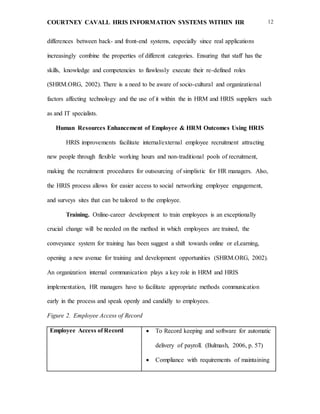
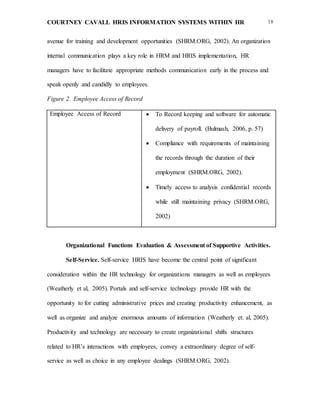
Figure 2. Employee Access of Record
Employee Access of Record  To Record keeping and software for automatic
delivery of payroll. (Bulmash, 2006, p. 57)
 Compliance with requirements of maintaining
COURTNEY CAVALL HRIS INFORMATION SYSTEMS WITHIN HR 13
the records through the duration of their
employment (SHRM.ORG, 2002).
 Timely access to analysis confidential records
while still maintaining privacy (SHRM.ORG,
2002)
Evaluate Two Organizational Functions & Assess Supportive
Self-Service. Self-service HRIS have become the central point of significant
consideration within the HR technology for organizations managers as well as employees
(Weatherly et al, 2005). Portals and self-service technology provide HR with the
opportunity to for cutting administrative prices and creating productivity enhancement, as
well as organize and analyze enormous amounts of information (Weatherly et. al, 2005).
Productivity and technology are necessary to create organizational shifts structures
related to HR’s interactions with employees, convey a extraordinary degree of self-
service as well as choice in any employee dealings (SHRM.ORG, 2002).
Leadership: Google as an example. Google’s attributes their success to its data-
powered function with regards to HR. Google is substituting the standard decision-
making process in HR, labeling its approach as “people analytics,” or “data-based
decision-making” (Sullivan, 2013, p 3). Google ubiquitous systems provides continuous
updates for “algorithm based decision-making,” or “fact or evidence-based decision-
making.” Google suggests that their strategic focus is on an innovative environment and
successful leaders. Google’s leaders are a key aspect in the technological success they
expect there their manager play specify roles with specific characteristics that lead to
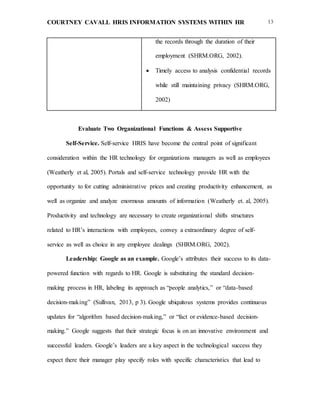
COURTNEY CAVALL HRIS INFORMATION SYSTEMS WITHIN HR 14
there overall success. Leaders are specialized in technical knowledge that is superior in
comparison, coaching with employees that involve one to one training and frequent
personalized employee feedback (Sullivan, 2013).
Weatherly’s (2005) research stated the since the 1980s human resource
information systems have been applied. HRIS systems began to regulate and effectively
manage and monitor compliance in legislation and create cost effect methods for
organizations (Thite et al’s., 2013).
Historical trends in the function of HR function are to assist in resolution between
management and employees. In the 20th century the employees function prior to
human resources management the role was focused mainly in secretarial work such
as record keeping of employee materials (SHRM.ORG, 2002). From 1963 to 1980 the
emergence of social issues creating the labor legislations and specified legislative
compliances. It was about this time that personnel departments were beginning to be
called human resources departments and the field of human resource management was
born (SHRM.ORG, 2002). The HRM function increased became a need when
compliance was required for employee protection laws, at this time the computer
technology began to evolve and companies had to figure out a lower cost methods
to deliver a more efficient method of productivity (SHRM.ORG, 2002). Thite,
Kavanagh, & Johnson, (2013) stated the in the late 1980s to the to the early 1990s the
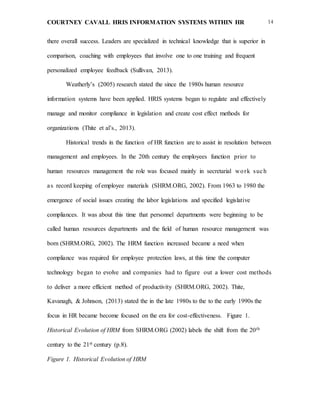
focus in HR became become focused on the era for cost-effectiveness. Figure 1.
Historical Evolution of HRM from SHRM.ORG (2002) labels the shift from the 20th
century to the 21st century (p.8).
Figure 1. Historical Evolution of HRM
COURTNEY CAVALL HRIS INFORMATION SYSTEMS WITHIN HR 15
Role of HRM Early 20th Century Role of HRM 21st Century
Caretaker Strategic partner
Employee focus
Record keepers
Cost-effectiveness
Employee development
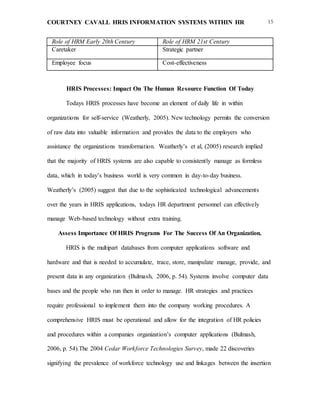
HRIS Processes: Impact On The Human Resource Function Of Today
Todays HRIS processes have become an element of daily life in within
organizations for self-service (Weatherly, 2005). New technology permits the conversion
of raw data into valuable information and provides the data to the employers who
assistance the organizations transformation. Weatherly’s et al, (2005) research implied
that the majority of HRIS systems are also capable to consistently manage as formless
data, which in today’s business world is very common in day-to-day business.
Weatherly’s (2005) suggest that due to the sophisticated technological advancements
over the years in HRIS applications, todays HR department personnel can effectively
manage Web-based technology without extra training.
Assess Importance Of HRIS Programs For The Success Of An Organization.
HRIS is the multipart databases from computer applications software and
hardware and that is needed to accumulate, trace, store, manipulate manage, provide, and
present data in any organization (Bulmash, 2006, p. 54). Systems involve computer data
bases and the people who run then in order to manage. HR strategies and practices
require professional to implement them into the company working procedures. A
comprehensive HRIS must be operational and allow for the integration of HR policies
and procedures within a companies organization’s computer applications (Bulmash,
2006, p. 54).The 2004 Cedar Workforce Technologies Survey, made 22 discoveries
signifying the prevalence of workforce technology use and linkages between the insertion
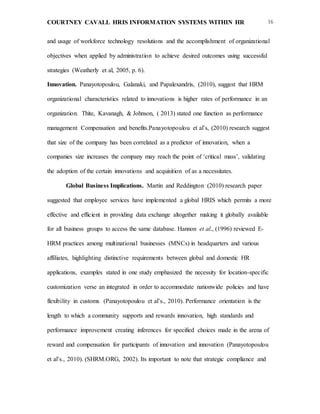
COURTNEY CAVALL HRIS INFORMATION SYSTEMS WITHIN HR 16
and usage of workforce technology resolutions and the accomplishment of organizational
objectives when applied by administration to achieve desired outcomes using successful
strategies (Weatherly et al, 2005, p. 6).
Innovation. Panayotopoulou, Galanaki, and Papalexandris, (2010), suggest that HRM
organizational characteristics related to innovations is higher rates of performance in an
organization. Thite, Kavanagh, & Johnson, ( 2013) stated one function as performance
management Compensation and benefits.Panayotopoulou et al’s, (2010) research suggest
that size of the company has been correlated as a predictor of innovation, when a
companies size increases the company may reach the point of ‘critical mass’, validating
the adoption of the certain innovations and acquisition of as a necessitates.
Global Business Implications. Martin and Reddington (2010) research paper
suggested that employee services have implemented a global HRIS which permits a more
effective and efficient in providing data exchange altogether making it globally available
for all business groups to access the same database. Hannon et al., (1996) reviewed E-
HRM practices among multinational businesses (MNCs) in headquarters and various
affiliates, highlighting distinctive requirements between global and domestic HR
applications, examples stated in one study emphasized the necessity for location-specific
customization verse an integrated in order to accommodate nationwide policies and have
flexibility in customs (Panayotopoulou et al’s., 2010). Performance orientation is the
length to which a community supports and rewards innovation, high standards and
performance improvement creating inferences for specified choices made in the arena of
reward and compensation for participants of innovation and innovation (Panayotopoulou
et al’s., 2010). (SHRM.ORG, 2002). Its important to note that strategic compliance and
COURTNEY CAVALL HRIS INFORMATION SYSTEMS WITHIN HR 17
improved development of HRIS processes will still require cost effective cost-effective
system and development in the future (SHRM.ORG, 2002). Tansley and Watson (2000)
specify the importance of a vision and mission statement which is clear and the strategic
fit between HRIS and HR regarding and corporate strategies. Allowing the HR role to
play a significant role for the development of an HRIS project. More recent models have
identified role of HR professionals to build for and asses e-HRM goals and outcomes. It
is important to note that different factors have prominent roles in different geographical
areas with similar socio-cultural characteristics. It is also useful to keep in mind the
differences between back- and front-end systems, especially since real applications
increasingly combine the properties of different categories. Ensuring that staff has the
skills, knowledge and competencies to flawlessly execute their re-defined roles
(SHRM.ORG, 2002). There is a need to be aware of socio-cultural and organizational
factors affecting technology and the use of it within the in HRM and HRIS suppliers such
as and IT specialists.
Human Resources Enhancement of Employee & HRM Outcomes Using HRIS
HRIS improvements facilitate internal/external employee recruitment attracting
new people through flexible working hours and non-traditional pools of recruitment,
making the recruitment procedures for outsourcing of simplistic for HR managers. Also,
the HRIS process allows for easier access to social networking employee engagement,
and surveys sites that can be tailored to the employee.
Training. Online-career development to train employees is an exceptionally crucial
change will be needed on the method in which employees are trained, the conveyance
system for training has been suggest to shift towards online or eLearning, opening a new
COURTNEY CAVALL HRIS INFORMATION SYSTEMS WITHIN HR 18
avenue for training and development opportunities (SHRM.ORG, 2002). An organization
internal communication plays a key role in HRM and HRIS implementation, HR
managers have to facilitate appropriate methods communication early in the process and
speak openly and candidly to employees.
Figure 2. Employee Access of Record
Employee Access of Record  To Record keeping and software for automatic
delivery of payroll. (Bulmash, 2006, p. 57)
 Compliance with requirements of maintaining
the records through the duration of their
employment (SHRM.ORG, 2002).
 Timely access to analysis confidential records
while still maintaining privacy (SHRM.ORG,
2002)
Organizational Functions Evaluation & Assessment of Supportive Activities.
Self-Service. Self-service HRIS have become the central point of significant
consideration within the HR technology for organizations managers as well as employees
(Weatherly et al, 2005). Portals and self-service technology provide HR with the
opportunity to for cutting administrative prices and creating productivity enhancement, as
well as organize and analyze enormous amounts of information (Weatherly et. al, 2005).
Productivity and technology are necessary to create organizational shifts structures
related to HR’s interactions with employees, convey a extraordinary degree of self-
service as well as choice in any employee dealings (SHRM.ORG, 2002).
COURTNEY CAVALL HRIS INFORMATION SYSTEMS WITHIN HR 19
Leadership: Google as an example. Google’s attributes their success to its data-
powered function with regards to HR. Google is substituting the standard decision-
making process in HR, labeling its approach as “people analytics,” or “data-based
decision-making” (Sullivan, 2013, p 3). Google ubiquitous systems provides continuous
updates for “algorithm based decision-making,” or “fact or evidence-based decision-
making.” Google suggests that their strategic focus is on an innovative environment and
successful leaders. Google’s leaders are a key aspect in the technological success they
expect there their manager play specify roles with specific characteristics that lead to
there overall success. Leaders are specialized in technical knowledge that is superior in
comparison, coaching with employees that involve one to one training and frequent
personalized employee feedback (Sullivan, 2013).
Analyze Factors Influencing When to Implement HRIS
Key Factors, Which Influence HRIS, Decisions & Implementation
Parry, (2011) reviewed factors that contribute to the overall flow and efficient
functioning within HR related to its strategic orientation of a sophisticated systems.
Obeidat (2012) research reviewed a study by Ball (2001), which showed that during the
90’s HRIS sixty percent of Fortune 500 corporations provided maintenance and backing
for day to day operations for human resource management during late. HRIS has
continued to be utilized administrative purposes but has advanced to a more also for
strategic process involving business decision-making purposes (Obeidat, 2012).
Management Information System gives essential data to managers which in turn provides
support to regulate continuing decisions and reporting.
COURTNEY CAVALL HRIS INFORMATION SYSTEMS WITHIN HR 20
Effective management under the cooperation with HRIS as a computerized
function adds to the company’s competitive advantage (Parry, 2011) under the
management of HR. HRIS would benefit from systems that interact with flexibility and
increase productivity (Haines, & Petit, 1997). Obeidat, (2012) suggests that a
computerized analysis of data allows for quick but information based decision-making,
making it a vital function with the operation system of strategic decision making. HR
decisions are based on the very function or an organization making a decision through
analysis of identifying human resource needs and the implementation of the decisions
based on the needs (Obeidat, 2012).
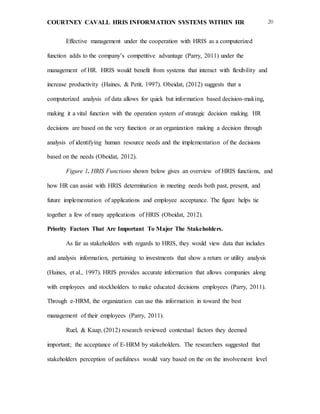
Figure 1. HRIS Functions shown below gives an overview of HRIS functions, and
how HR can assist with HRIS determination in meeting needs both past, present, and
future implementation of applications and employee acceptance. The figure helps tie
together a few of many applications of HRIS (Obeidat, 2012).
Priority Factors That Are Important To Major The Stakeholders.
As far as stakeholders with regards to HRIS, they would view data that includes
and analysis information, pertaining to investments that show a return or utility analysis
(Haines, et al., 1997). HRIS provides accurate information that allows companies along
with employees and stockholders to make educated decisions employees (Parry, 2011).
Through e-HRM, the organization can use this information in toward the best
management of their employees (Parry, 2011).
Ruel, & Kaap, (2012) research reviewed contextual factors they deemed
important; the acceptance of E-HRM by stakeholders. The researchers suggested that
stakeholders perception of usefulness would vary based on the on the involvement level
COURTNEY CAVALL HRIS INFORMATION SYSTEMS WITHIN HR 21
related to e-HRM’s design and implementation of the technology and perceptual views of
of data privacy and security perception of privacy or data security related to the
acceptance of e-HRM, as well as an employees capability to implement the use of the
technology (Ruel, & Kaap, 2012)
Analyzed Employee-Centered Information An Effective System
Reddick, (2009) suggested that Internet or Web-based computer usage can be a
channel for employees and HR to use the self-service HR function in their organizations
department. The benefits on a organizational level for self-service are suggested to reduce
staff, improve timeliness, and increases accuracy of HR data.
Reddick, (2009) suggests that self-service and web based process are functional,
lost cost, and efficient process to be used within HRIS for; quick updates, easy employee
access for trainings/information/& benefits, HR job postings and job descriptions.
Specifically through Web-based methods of HRIS in corporations can mix conventional
and electronic learning methods. Ruel, & Kaap (2012) analyzed contextual factors based
on HRM value related to what employees value in regards to the use of self services
systems the findings concluded that systems which are well-defined, simple to use and
effective with regards to various day to day uses, especially when accessing documents
and records which are streamlined and relatively errorless. Employees also valued
organizations designating a person who is available to assist there if there is a need.
Haines, et al., (1997) suggests that when systems provide support applications
related to human resource management there was a higher correlation with a higher
employees user satisfaction. Haines, et al., (1997) suggests also implied that stronger
relationship communication and collaboration with system usage facilities motivation for
COURTNEY CAVALL HRIS INFORMATION SYSTEMS WITHIN HR 22
employees to complete their work functions. The researchers suggested that employers
would benefit from proving numerous methods for user support; one example would be
as in-house training (Haines, et al., 1997). Another benefit for any HRIS department
would be the presence and accessibility of internal support (Haines, et al., 1997) to
employees through 30% of employees through Web and email communications
(Reddick, 2009). Reddick, (2009) research results inferred that the majority of web based
self service simply provides information, but the most significant factor that was deemed
a success was the improvement of data accuracy with HRIS.Koch and McGrath (1996)
stated that company’s that it is important for HR to be managed effectively, therefore
they have highly qualified employees, in turn the company will be more likely to more
likely to invest in e-HRM (Parry, 2011).
Parry, (2011), suggested that adoption of e-HRM opened increased the HR functions
value while still maintaining the same operating costs. Organizations should consider the
value of the adoption of e-HRM with regards to the HR function assists with the power to
design and implement the structures in a manner that promotes as well capitalized on
benefits.
Supporting Analyze of IBM Company
IBM used new technology to streamline work productions and address employee
management issues and through web-based systems, IBM became proficient in the use of
of HRIS. On January of 2007, IBM started a program function for “new media”
communication division within its business (HR Pay ‘n’ Time, Inc., 2008). IBM had the
goal of educating, promoting and supporting the use and utilization of social media
within the contextual dimensions of its employee base to enhance connected
COURTNEY CAVALL HRIS INFORMATION SYSTEMS WITHIN HR 23
communication and did so through blogging sites, which ended up effectively connecting
340,000 global employees (HR Pay ‘n’ Time, Inc., 2008).
IBM has saved 1.2 million dollars per year using an employee enrollment plan
online which paperless and is utilized for all employees (HR Pay ‘n’ Time, Inc., 2008).
The enrollment plan online paperless system has benefited employees with regards to
privacy of employee information offering restricted access through password protection
for their on personal information (HR Pay ‘n’ Time, Inc., 2008). IBM implemented the
HRIS operating system allowing for the flexibility for employees to check their benefits
at their convenience, this also benefited the company by diminishing costs providing
employers . Senior Communications Specialist at IBM Mr. Donnelly stated that since the
launch of the online enrollment program he discovered that employees prefer the web
access for numerous reasons one simple reason is for employee access, he added it is an
added benefit for retired employees to have access to benefits (HR Pay ‘n’ Time, Inc.,
2008).
Comprehensive Study & Design of HRIS Data Security
Courtney Cavall, Vice President of Human Resources
In todays business culture it is almost essential for organizations to effectively
manage information systems and data through electronic based methods (Marler & Barry
2005). HRIS data security systems are designed and supportive business structures such
as a database management systems electronically allows (Marler & Barry 2005). A
comprehensive HRIS data security systems uses related business processes other than just
HR to integrate a working database flow for complex inquiries and analytical accounts
Companies can buy, lease, or develop their own HRIS data security system. Theses
COURTNEY CAVALL HRIS INFORMATION SYSTEMS WITHIN HR 24
systems are essential to a company in order to retrieve store and secure as well as manage
to the majority of business transaction processes that occur daily (Marler & Barry 2005).
Benefits of DBMS. DBMS is essentially an effective electronic management for the
company but is necessary for corporate efficiency and streamlined information sharing
(Marler & Barry 2005). Marler & Barry (2005) suggested that DBMS is not only
essential but also a benefit for data management in order to maintain our corporate
integrity;
 Ensures employee information and records are secured and protected
 Allows data to be accessed quickly to numerous many users simultaneously.
 Computes accurate data and corrections can be made with ease if necessary.
 Provides a preventive method to recover lost data and provides a system to
backup data if ever needed.
 Protected records and employee information compensation data, medical
information in employee records, and any other private information on
employees.
 Computer programs provide control over the preset of software applications
Maintaining A High Level Of Data Security Within Any HRIS
The organization such as ours that is related to the health care field has to not only
keep employee records safe and confidential but also client records efficiently managed.
Diehl (2009), suggested limit disclosures and secure personnel and medical records from
unauthorized users, to minimize access. Diehl (2009), also recommended if and whenever
possible to request employee consent for disclosures.
In order to maintain confidential information related to employee records researcher
COURTNEY CAVALL HRIS INFORMATION SYSTEMS WITHIN HR 25
suggest the following specific steps for protection of privacy policies with regards to
employer rights (Diehl, 2009). Since employee files keep personal, medical, and other
confidential employee records they are to be secured documents considering they contain
sensitive and private materials so it would be beneficial to separate employee’s records in
separate sections or separate file folders which are labeled, particularly with regards to
medical records from personnel files (Martucci & Shankland, 2011).
Bisbee, (2012) suggested an electronic record keeping system applying separate
folders depending on the information, he emphasized that when keeping any records
system on an employee (especially for a new hire) apply folders that are based in the
computer and labeled specifically to the information pertaining to the file folder. Bisbee,
(2012) defined three file labels and information each would contain (p. 7);
1. Employee personnel file: which is made up of the fundamental basic information
about the employee such as; full name, home address, personal phone numbers, contacts
in case of emergency, SSN, etc. A DBMS software provides efficient management and
recovery of information on the employee, below in figure 3 is a clear example of what
would be needed for a newly hired employee.
2. Employee payroll file: enclosing wage and benefits compensation, rate of pay along
with any legal documentation that may affects or be related to the employees employee’s
salary.
3. A medical file. HIPAA requires employee medical information to be maintained and
kept confidentially. Information about health insurance
4. Employee I-9 form file.
Employees Trust The Organization.
COURTNEY CAVALL HRIS INFORMATION SYSTEMS WITHIN HR 26
Mudor & Tooksoon (2011) referred to Lee and Lee (2007) suggested that a firms
following markers assist with regards to employee efficiency, productively as well as
quality in their work and when a company provides flexibility with the following HRM
practices business performance, fellowship, training/development, performance
appraisals related to compensation/incentives, and HR planning (Weitzman, 2013).
Smith, (2002) suggested that due to the fact that employees have continual fear about job
security with the present economy companies such as FedEx believes in informing
employees will assist with keeping them motivated keep and work morale high, FedEx
launched a campaign to build the spirit of with the intention that if they feel informed and
in the loop with work events they will be more willing and capable to meet customer
needs their job security, FedEx mounted a comprehensive campaign was launched to
keep employees informed and motivated since they too have vested interest in a
company’s success(Smith, 2002).
Employee Related Concerns.
If a company or program within a company is not successful in there efforts to
secure records, or build trust with an employee the employees job security and economic
future would be threatened (Smith, 2002), this may potentially be a cause for them to
request records. Shanoff, (2007) suggests that concerns from employees may include
poor documentation personnel records or work related events. Theoretically employees
have open access to personal records and files but the researcher raised the question from
an employers standpoint in occasions when employees ask for records, "Why do you
need to see your file?” Requesting personal records may raise employer concerns
regarding the reasoning for the request, and could result in consequences for employees
COURTNEY CAVALL HRIS INFORMATION SYSTEMS WITHIN HR 27
such as in being transferred, job demotion, or in the worst case terminated form
employment (Shanoff, 2007).
Potential Legal Issues If Private Information
If there is ever an issue of concern on the employers behalf be sure to provide a
legitimate explanations: for the records and investigative techniques used in the
organization. Diehl (2009),
Employers are mandated to keep employee statements in the employees personnel
file but laws vary depending on the state-to-state (Martucci & Shankland, 2011).
Businesses are required to give employees copies of all written documentation regarding
disciplinary activities according to new amended laws (Weitzman, 2013). Weitzman,
(2013) suggested clear record keeping, ample notice any situation where disciplinary
action is taken there is to be clear documentation of disciplinary action also on file would
be any termination notices. Additionally kept in the employee record would be
performance evaluations, if there is a discrepancy from the employee a written statement
from the employee is required in the documents describing their position (Weitzman,
2013), in order to have clear account kept on record for employees and employers in their
personal file. Additionally added was to the record would be outside correspondence
anytime a disclosure is give to a third party the information is to part of the file as well
(Weitzman, 2013).
Consequence of Non-Compliance
Non-compliance can result in corporate fines anywhere from $500 dollars for the
first violation and for any succeeding violation it can cost up to $1,000 dollars
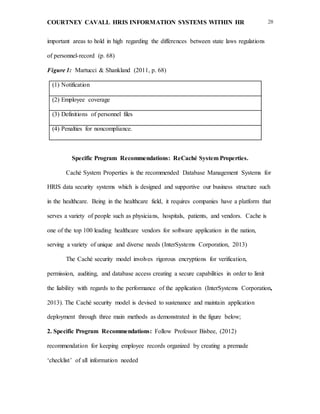
(Weitzman, 2013). Martucci & Shankland (2011) defined four areas of significance and
COURTNEY CAVALL HRIS INFORMATION SYSTEMS WITHIN HR 28
important areas to hold in high regarding the differences between state laws regulations
of personnel-record (p. 68)
Figure 1: Martucci & Shankland (2011, p. 68)
(1) Notification
(2) Employee coverage
(3) Definitions of personnel files
(4) Penalties for noncompliance.
Specific Program Recommendations: ReCaché System Properties.
Caché System Properties is the recommended Database Management Systems for
HRIS data security systems which is designed and supportive our business structure such
in the healthcare. Being in the healthcare field, it requires companies have a platform that
serves a variety of people such as physicians, hospitals, patients, and vendors. Cache is
one of the top 100 leading healthcare vendors for software application in the nation,
serving a variety of unique and diverse needs (InterSystems Corporation, 2013)
The Caché security model involves rigorous encryptions for verification,
permission, auditing, and database access creating a secure capabilities in order to limit
the liability with regards to the performance of the application (InterSystems Corporation,
2013). The Caché security model is devised to sustenance and maintain application
deployment through three main methods as demonstrated in the figure below;
2. Specific Program Recommendations: Follow Professor Bisbee, (2012)
recommendation for keeping employee records organized by creating a premade
‘checklist’ of all information needed
COURTNEY CAVALL HRIS INFORMATION SYSTEMS WITHIN HR 29
3. Specific Program Recommendations: An Electronically formatted system that is
computer based only for keeping records, in the records the file folders need to be labeled
and separated to a designated folder which is both secure and operational.
4. Specific Program Recommendations: Develop a secured system to destroy records
5. Specific Program Recommendations: If there is ever an issue of concern on the
employer’s behalf be sure to provide a legitimate explanations for the records and
investigative techniques, and know the specified law in any state of operation.
Evaluate Data Benchmarks and Metric Systems
A strategic HR function is one in which HRM is tied to the strategic management
process in business (Parry & Tyson, 2011). HR functions can increase strategic
orientation with relation to specified outcomes, which outlines the procedural steps that
are practical implications for the design. Enhancement efficiency and effectiveness are
reliant upon not just the design of a particular system but also on how the system is
implemented.
Parry & Tyson (2011), suggested the study delivered empirical evidence to
suggest that with clearly stated goals based on realistic outcomes, which connect to the
organizational image. The researchers specified some evidence that was regarding the
strategic influence of e-HRM that assists in helping support HR reach and achieve its
strategic aims (Parry & Tyson, 2011). HR functions can increase strategic orientation
with relation to specified outcomes, which outlines the procedural steps that are practical
implications for the design. Enhancement efficiency and effectiveness are reliant upon
not just the design of a particular system but also on how the system is implemented
(Parry & Tyson, 2011).
COURTNEY CAVALL HRIS INFORMATION SYSTEMS WITHIN HR 30
HRIS needs to develop a customized and specified system in order to report
critical data immediately when presented with critical situations. The data needs to be
accessed immediately and the retrieved information then quickly generated into a report
that provides useful, accurate, and reliable data. A well designed system combined with
the precise benchmarks and metrics can provide the corporation necessary information to
make critical decisions.
Benchmarking
Benchmarking demonstrates the pace in which the competition is moving in a
different direction as compared to strategize in order to be ahead in its specified market.
Benchmarking encourages companies to always be moving to something better (Fitz-Enz,
2009). Benchmarking efforts began developed with the standards of HR metrics
concerning the management and practice of human capital (Carlson & Kavanagh, 2008).
Benchmarking data can be beneficial to provide insight in order to create an outline of
possibilities and give foresight into the future (Carlson & Kavanagh, 2008).
The Benchmarking model measures the process, which rates if quality, time and
cost are being used to reach the overall goal and alignment with the company’s outcome.
If there is a problem in one of there areas preventative measures can be taken to re-align
the company with its overall objective.
The Concept Of “Garbage In, Garbage Out”
A system is only as useful as the data that is put in and the information that is
retrieved from it. When the information put into the system is incorrect or not valid or
reliable, the reports that are retrieved from the system will be just as unreliable.
Regardless of whether the data entered was accurate or inaccurate there have been
COURTNEY CAVALL HRIS INFORMATION SYSTEMS WITHIN HR 31
complications with the implementation process of HRIS for numerous reasons, HR’s lack
of knowledge regarding the systems design and tangible use, not enough funding or time
to properly implement the system (Ngai & Wat, 2006).
Cohen (2003) suggested that just because there is a system does not mean there is
a realistic plan or accurately entered data into the system, its just means there is software
to use. Although business implement Succession planning and systems to reach there
goals does not mean that a company has skilled or capable employees to implement
theses system nor does it mean they have management that to map out a clear plan
(Cohen 2003). Succession planning tend to fall short and repeat past mistakes verse
anticipate future plans to overcome then, so the cycle becomes a continues failure and
initiatives fall short of their intent (Cohen 2003).
Ball, (2001) completed a survey in 1998 with Fortune 500 companies to determine
the percentage of companies that use HRIS to sustenance day-to-day HRM practice the
results suggested that 60% of the companies surveyed did use HRIS in daily HRM
practices (Ngai & Wat, 2006).
Today HRIS is now part of the basic model for day-to-day decision-making
purposes in companies on a strategic level (Ngai & Wat, 2006). The survey suggests that
respondents from HR were using IT conduct routine business activities. Hong Kong
industries perceived that the greatest benefits to the implementation of HRIS were the
quick response and access to information that it brought, and the greatest barrier was
insufficient financial support. The findings from the survey concluded by suggesting that
on average 86% of HRIS systems that are implemented are typically for payroll and
general information (Ngai & Wat, 2006).
COURTNEY CAVALL HRIS INFORMATION SYSTEMS WITHIN HR 32
It is true that HRIS can access information immediately and provide instantaneous
responses, making them capable to generate critical information immediately which
would be beneficial in an emergency (Ngai & Wat, 2006)..Situations arise and responses
are needed based on the most accurate and recent information with regards to whether
HR should or should not release certain forms of information (Ngai & Wat, 2006). It
would be important to add that automated and quick responses are not always the best
choices, decisions are made by human resource, the management department, and
stakeholders and people are the final decision makers because they are accountable not
the system (Ngai & Wat, 2006). HRM systems have robotic with automated activities
dispensing quick information and fast administrative processed to make immediate
decisions based on the collected information, but this does not necessary mean the
information is accurate now does the process match the overall strategic plan, even if the
process is streamlined (Ngai & Wat, 2006).
In order to improve as well as sustain current performance or enhance it
company’s can use measurement results in aligned with set goals taken to improve
performance. Satisfactory or does it need improvement (Beaumont, 1996). If current
performance is low and the company wants to address set hard-hitting goal for
improvement goals, they can look to their competition’s applicable benchmarks in order
to make an informed decision. Since competition advance or develop at any time its
important to know the competition’s benchmarking points in order to maintain strategy.
If there is something that is not working change is obviously needed, but structured
change takes people in the organization use resources, so its key to make them available
in order to reach a specified goal.
COURTNEY CAVALL HRIS INFORMATION SYSTEMS WITHIN HR 33
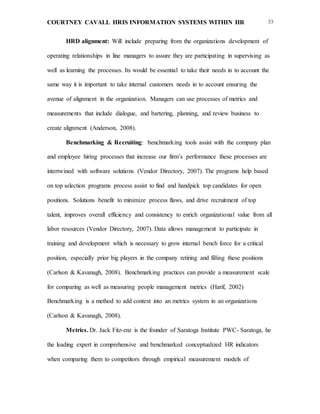
HRD alignment: Will include preparing from the organizations development of
operating relationships in line managers to assure they are participating in supervising as
well as learning the processes. Its would be essential to take their needs in to account the
same way it is important to take internal customers needs in to account ensuring the
avenue of alignment in the organization. Managers can use processes of metrics and
measurements that include dialogue, and bartering, planning, and review business to
create alignment (Anderson, 2008).
Benchmarking & Recruiting: benchmarking tools assist with the company plan
and employee hiring processes that increase our firm’s performance these processes are
intertwined with software solutions (Vendor Directory, 2007). The programs help based
on top selection programs process assist to find and handpick top candidates for open
positions. Solutions benefit to minimize process flaws, and drive recruitment of top
talent, improves overall efficiency and consistency to enrich organizational value from all
labor resources (Vendor Directory, 2007). Data allows management to participate in
training and development which is necessary to grow internal bench force for a critical
position, especially prior big players in the company retiring and filling these positions
(Carlson & Kavanagh, 2008). Benchmarking practices can provide a measurement scale
for comparing as well as measuring people management metrics (Harif, 2002)
Benchmarking is a method to add context into an metrics system in an organizations
(Carlson & Kavanagh, 2008).
Metrics. Dr. Jack Fitz-enz is the founder of Saratoga Institute PWC- Saratoga, he
the leading expert in comprehensive and benchmarked conceptualized HR indicators
when comparing them to competitors through empirical measurement models of
COURTNEY CAVALL HRIS INFORMATION SYSTEMS WITHIN HR 34
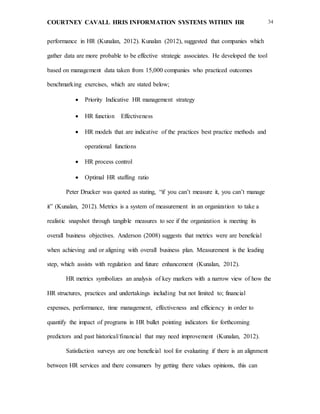
performance in HR (Kunalan, 2012). Kunalan (2012), suggested that companies which
gather data are more probable to be effective strategic associates. He developed the tool
based on management data taken from 15,000 companies who practiced outcomes
benchmarking exercises, which are stated below;
 Priority Indicative HR management strategy 

 HR function
 Effectiveness
 HR models that are indicative of the practices best practice methods and
operational functions
 HR process control

 Optimal HR staffing ratio
Peter Drucker was quoted as stating, “if you can’t measure it, you can’t manage
it” (Kunalan, 2012). Metrics is a system of measurement in an organization to take a
realistic snapshot through tangible measures to see if the organization is meeting its
overall business objectives. Anderson (2008) suggests that metrics were are beneficial
when achieving and or aligning with overall business plan. Measurement is the leading
step, which assists with regulation and future enhancement (Kunalan, 2012).
HR metrics symbolizes an analysis of key markers with a narrow view of how the
HR structures, practices and undertakings including but not limited to; financial
expenses, performance, time management, effectiveness and efficiency in order to
quantify the impact of programs in HR bullet pointing indicators for forthcoming
predictors and past historical/financial that may need improvement (Kunalan, 2012).
Satisfaction surveys are one beneficial tool for evaluating if there is an alignment
between HR services and there consumers by getting there values opinions, this can
COURTNEY CAVALL HRIS INFORMATION SYSTEMS WITHIN HR 35
provide insight for future training programs (Kunalan, 2012).
Standardization: Standardization enables benchmarking through management
commonly system had led to more consistent HR processes (Parry & Tyson, 2011).
Standardization is a process that involves the presentation of e-HRM outcome addressing
the unintended outcome. Companies suggest through the standardizing practices of
setting goals and benchmarking this will allow for a more consistent approach regarding
sharing information and training employees (Parry & Tyson, 2011). When applying a
more standardized process in an organization this will create a more efficient operation
therefore it will be more common to introduce and expect goals be reached in the
company (Parry & Tyson, 2011).
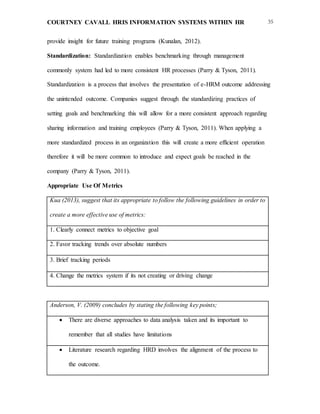
Appropriate Use Of Metrics
Kua (2013), suggest that its appropriate to follow the following guidelines in order to
create a more effective use of metrics:
1. Clearly connect metrics to objective goal
2. Favor tracking trends over absolute numbers
3. Brief tracking periods

4. Change the metrics system if its not creating or driving change
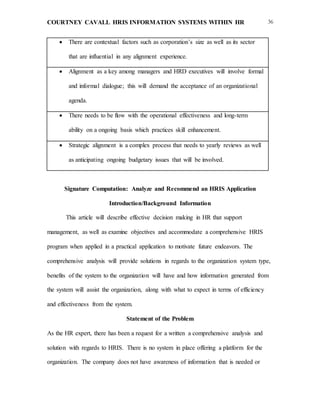
Anderson, V. (2009) concludes by stating the following key points;
 There are diverse approaches to data analysis taken and its important to
remember that all studies have limitations
 Literature research regarding HRD involves the alignment of the process to
the outcome.
COURTNEY CAVALL HRIS INFORMATION SYSTEMS WITHIN HR 36
 There are contextual factors such as corporation’s size as well as its sector
that are influential in any alignment experience.
 Alignment as a key among managers and HRD executives will involve formal
and informal dialogue; this will demand the acceptance of an organizational
agenda.
 There needs to be flow with the operational effectiveness and long-term
ability on a ongoing basis which practices skill enhancement.
 Strategic alignment is a complex process that needs to yearly reviews as well
as anticipating ongoing budgetary issues that will be involved.
Signature Computation: Analyze and Recommend an HRIS Application
Introduction/Background Information
This article will describe effective decision making in HR that support
management, as well as examine objectives and accommodate a comprehensive HRIS
program when applied in a practical application to motivate future endeavors. The
comprehensive analysis will provide solutions in regards to the organization system type,
benefits of the system to the organization will have and how information generated from
the system will assist the organization, along with what to expect in terms of efficiency
and effectiveness from the system.
Statement of the Problem
As the HR expert, there has been a request for a written a comprehensive analysis and
solution with regards to HRIS. There is no system in place offering a platform for the
organization. The company does not have awareness of information that is needed or
COURTNEY CAVALL HRIS INFORMATION SYSTEMS WITHIN HR 37
necessary platforms and required or necessary data information. The company has not yet
determined what type of system is needed, nor has it looked into the benefits of a
implementing a system. There is also a lack comprehensive explanation behind what is
expected for the company to have an efficient and effective system. The company has
defined what is to be expected in terms of a more effective and efficient system.
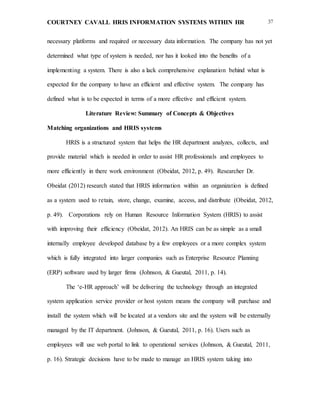
Literature Review: Summary of Concepts & Objectives
Matching organizations and HRIS systems
HRIS is a structured system that helps the HR department analyzes, collects, and
provide material which is needed in order to assist HR professionals and employees to
more efficiently in there work environment (Obeidat, 2012, p. 49). Researcher Dr.
Obeidat (2012) research stated that HRIS information within an organization is defined
as a system used to retain, store, change, examine, access, and distribute (Obeidat, 2012,
p. 49). Corporations rely on Human Resource Information System (HRIS) to assist
with improving their efficiency (Obeidat, 2012). An HRIS can be as simple as a small
internally employee developed database by a few employees or a more complex system
which is fully integrated into larger companies such as Enterprise Resource Planning
(ERP) software used by larger firms (Johnson, & Gueutal, 2011, p. 14).
The ‘e-HR approach’ will be delivering the technology through an integrated
system application service provider or host system means the company will purchase and
install the system which will be located at a vendors site and the system will be externally
managed by the IT department. (Johnson, & Gueutal, 2011, p. 16). Users such as
employees will use web portal to link to operational services (Johnson, & Gueutal, 2011,
p. 16). Strategic decisions have to be made to manage an HRIS system taking into
COURTNEY CAVALL HRIS INFORMATION SYSTEMS WITHIN HR 38
account data integrity along with data sharing when selecting a vendor, HR and IT
manages the relationship with the vendor (Johnson, & Gueutal, 2011, p. 16).
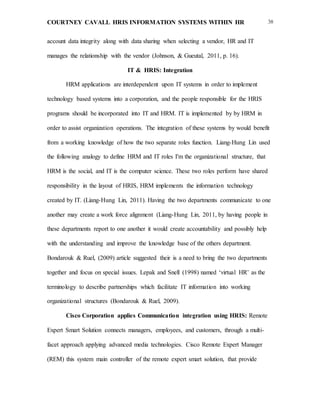
IT & HRIS: Integration
HRM applications are interdependent upon IT systems in order to implement
technology based systems into a corporation, and the people responsible for the HRIS
programs should be incorporated into IT and HRM. IT is implemented by by HRM in
order to assist organization operations. The integration of these systems by would benefit
from a working knowledge of how the two separate roles function. Liang-Hung Lin used
the following analogy to define HRM and IT roles I'm the organizational structure, that
HRM is the social, and IT is the computer science. These two roles perform have shared
responsibility in the layout of HRIS, HRM implements the information technology
created by IT. (Liang-Hung Lin, 2011). Having the two departments communicate to one
another may create a work force alignment (Liang-Hung Lin, 2011, by having people in
these departments report to one another it would create accountability and possibly help
with the understanding and improve the knowledge base of the others department.
Bondarouk & Ruel, (2009) article suggested their is a need to bring the two departments
together and focus on special issues. Lepak and Snell (1998) named ‘virtual HR’ as the
terminology to describe partnerships which facilitate IT information into working
organizational structures (Bondarouk & Ruel, 2009).
Cisco Corporation applies Communication integration using HRIS: Remote
Expert Smart Solution connects managers, employees, and customers, through a multi-
facet approach applying advanced media technologies. Cisco Remote Expert Manager
(REM) this system main controller of the remote expert smart solution, that provide
COURTNEY CAVALL HRIS INFORMATION SYSTEMS WITHIN HR 39
features that allow Cisco to best serve there customer through simplistic methods of
connected services for exchanges using technology that is both simple and effective.
Cisco network devices and technological information system is designed help diminish
human errors and create minimal to no manual tasks connected with sustaining the
network. The RME is the company’s technological information system tools for
management’s used effective record keeping through inventory management and device
configuration management, and change audit services. (Cisco Systems, 2013, p.17).
Obeidat (2012) advised when organization are integrating HRIS system it would be
important to observe and take in to account the intrinsic interworking’s of the system and
then decide if it would be compatible within an organizations social system (Obeidat,
2012, p. 53).
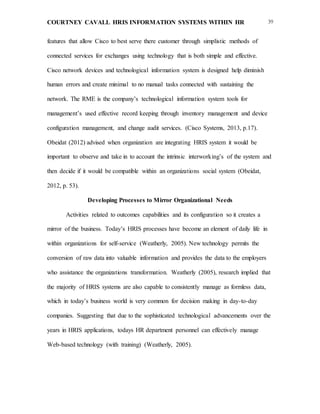
Developing Processes to Mirror Organizational Needs
Activities related to outcomes capabilities and its configuration so it creates a
mirror of the business. Today’s HRIS processes have become an element of daily life in
within organizations for self-service (Weatherly, 2005). New technology permits the
conversion of raw data into valuable information and provides the data to the employers
who assistance the organizations transformation. Weatherly (2005), research implied that
the majority of HRIS systems are also capable to consistently manage as formless data,
which in today’s business world is very common for decision making in day-to-day
companies. Suggesting that due to the sophisticated technological advancements over the
years in HRIS applications, todays HR department personnel can effectively manage
Web-based technology (with training) (Weatherly, 2005).
COURTNEY CAVALL HRIS INFORMATION SYSTEMS WITHIN HR 40
System Development Process for an HRIS. “SDLC has five general phases: (1)
planning, (2) analysis, (3) design, (4) implementation, and (5) maintenance” (Thite,
Kavanagh, & Johnson, 2009, p. 22). The development process of HRIS discusses steps,
which are implemented from the moment a corporation contemplates the use of a
“computerizing its human resources functions through the analysis, design, development,
implementation, maintenance, evaluation, and improvement of the system” (Thite,
Kavanagh, & Johnson, 2009, p. 22).
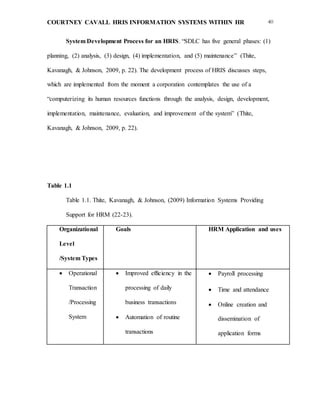
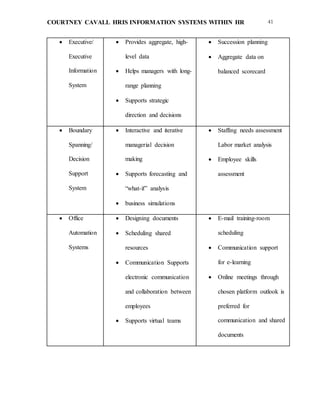
Table 1.1
Table 1.1. Thite, Kavanagh, & Johnson, (2009) Information Systems Providing
Support for HRM (22-23).
Organizational
Level
/System Types
Goals HRM Application and uses
 Operational
Transaction
/Processing
System
 Improved efficiency in the
processing of daily
business transactions
 Automation of routine
transactions
 Payroll processing

 Time and attendance
 Online creation and
dissemination of
application forms
COURTNEY CAVALL HRIS INFORMATION SYSTEMS WITHIN HR 41
 Executive/
Executive
Information
System
 Provides aggregate, high-
level data
 Helps managers with long-
range planning
 Supports strategic
direction and decisions
 Succession planning
 Aggregate data on
balanced scorecard
 Boundary
Spanning/
Decision
Support
System
 Interactive and iterative
managerial decision
making
 Supports forecasting and
“what-if” analysis
 business simulations
 Staffing needs assessment
Labor market analysis
 Employee skills
assessment
 Office
Automation
Systems
 Designing documents
 Scheduling shared
resources
 Communication Supports
electronic communication
and collaboration between
employees
 Supports virtual teams
 E-mail training-room
scheduling
 Communication support
for e-learning
 Online meetings through
chosen platform outlook is
preferred for
communication and shared
documents
COURTNEY CAVALL HRIS INFORMATION SYSTEMS WITHIN HR 42
Innovation. Panayotopoulou, Galanaki, and Papalexandris, (2010), suggest that
HRM organizational characteristics related to innovations is higher rates of performance
in an organization. Thite, Kavanagh, & Johnson, (2013) stated one function as
performance management compensation and benefits.
Decision support models
HRIS are built to generate reports and sustenance managerial decision-making.
As compliance reporting requirements have become more regimented requiring data and
analysis, HRIS is a huge value (Johnson, & Gueutal, 2011, p. 22).
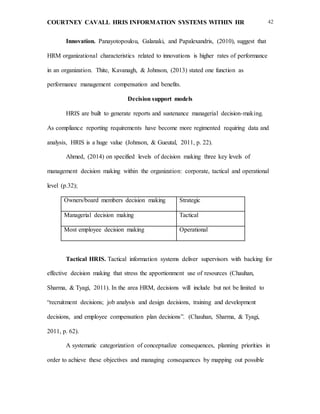
Ahmed, (2014) on specified levels of decision making three key levels of
management decision making within the organization: corporate, tactical and operational
level (p.32);
Owners/board members decision making Strategic
Managerial decision making Tactical
Most employee decision making Operational
Tactical HRIS. Tactical information systems deliver supervisors with backing for
effective decision making that stress the apportionment use of resources (Chauhan,
Sharma, & Tyagi, 2011). In the area HRM, decisions will include but not be limited to
“recruitment decisions; job analysis and design decisions, training and development
decisions, and employee compensation plan decisions”. (Chauhan, Sharma, & Tyagi,
2011, p. 62).
A systematic categorization of conceptualize consequences, planning priorities in
order to achieve these objectives and managing consequences by mapping out possible
COURTNEY CAVALL HRIS INFORMATION SYSTEMS WITHIN HR 43
undesired consequences and offering operating instructions to manage them (Strohmeier,
2009). Chauhan, et al., (2011) conclude that HRIS plays an essential role in the Human
Resource Management with regards to the administrative & analytical purposes in order
to integrate information that will help organization reach its overall mission.
HRIS security policies and procedures: Confidential record keeping
In order to maintain confidential information related to employee records
researcher suggest the following specific steps for protection of privacy policies with
regards to employer rights (Martucci & Shankland, 2011). Since employee files keep
personal, medical, and other confidential employee records they are to be secured
documents considering they contain sensitive and private materials so it would be
beneficial to separate employee’s records in separate sections or separate file folders
which are labeled, particularly with regards to medical records from personnel files
(Martucci & Shankland, 2011). Bisbee (2012), suggested an electronic record keeping
system applying separate folders depending on the information, he emphasized that when
keeping any records system on an employee (especially for a new hire) apply folders that
are based in the computer and labeled specifically to the information pertaining to the file
folder.
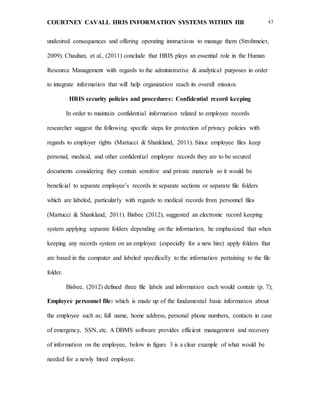
Bisbee, (2012) defined three file labels and information each would contain (p. 7);
Employee personnel file: which is made up of the fundamental basic information about
the employee such as; full name, home address, personal phone numbers, contacts in case
of emergency, SSN, etc. A DBMS software provides efficient management and recovery
of information on the employee, below in figure 3 is a clear example of what would be
needed for a newly hired employee.
COURTNEY CAVALL HRIS INFORMATION SYSTEMS WITHIN HR 44
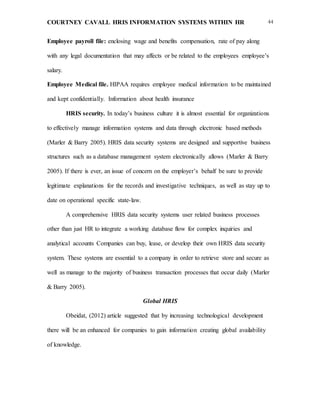
Employee payroll file: enclosing wage and benefits compensation, rate of pay along
with any legal documentation that may affects or be related to the employees employee’s
salary.
Employee Medical file. HIPAA requires employee medical information to be maintained
and kept confidentially. Information about health insurance
HRIS security. In today’s business culture it is almost essential for organizations
to effectively manage information systems and data through electronic based methods
(Marler & Barry 2005). HRIS data security systems are designed and supportive business
structures such as a database management system electronically allows (Marler & Barry
2005). If there is ever, an issue of concern on the employer’s behalf be sure to provide
legitimate explanations for the records and investigative techniques, as well as stay up to
date on operational specific state-law.
A comprehensive HRIS data security systems user related business processes
other than just HR to integrate a working database flow for complex inquiries and
analytical accounts Companies can buy, lease, or develop their own HRIS data security
system. These systems are essential to a company in order to retrieve store and secure as
well as manage to the majority of business transaction processes that occur daily (Marler
& Barry 2005).
Global HRIS
Obeidat, (2012) article suggested that by increasing technological development
there will be an enhanced for companies to gain information creating global availability
of knowledge.
COURTNEY CAVALL HRIS INFORMATION SYSTEMS WITHIN HR 45
Goals and outcomes. It is important to note that different factors have prominent
roles in different geographical areas with similar socio-cultural characteristics. It is also
useful to keep in mind the differences between back- and front-end systems, especially
since real applications increasingly combine the properties of different categories
(Chauhan, Sharma, & Tyagi, 2011).
Global business implications. Martin and Reddington (2010), research paper
suggested that employee services have implemented a global HRIS which permits a more
effective and efficient in providing data exchange altogether making it globally available
for all business groups to access the same database. Hannon et al., (1996) reviewed E-
HRM practices among multinational businesses (MNCs) in headquarters and various
affiliates, highlighting distinctive requirements between global and domestic HR
applications, examples stated in one study emphasized the necessity for location-specific
customization verse an integrated in order to accommodate nationwide policies and have
flexibility in customs (Panayotopoulou et al’s., 2010).
Conclusions/Recommendations
Streamline. Chauhan, Sharma, & Tyagi, (2011) suggest HRIS can be to create a
streamlined the workflow processes by using decision support software evaluate
programs and provide information to improve planning and the development of
programs.
Automated system. It HRM systems have robotic with automated activities dispensing
quick information and access a fast administrative process in order to make
immediate decisions based on the collected information, related to the companies overall
strategic plan. Situations arise and responses are needed based on the most accurate and
COURTNEY CAVALL HRIS INFORMATION SYSTEMS WITHIN HR 46
recent information with regards to whether HR should or should not release certain forms
of information (Ngai & Wat, 2006). It would be important to add that automated and quick
responses are not always the best choices, decisions are made by human resource, the
management department, and stakeholders and people are the final decision makers
because they are accountable not the system (Ngai & Wat, 2006).
Electronic Records. Bisbee, (2012) recommendation for keeping employee
records organized by creating a premade ‘checklist’ of all information needed. An
electronically formatted system that is computer based only for keeping records, in the
records, the file folders need to be labeled and separated to a designated folder, which is
both secure and operational
E-Learning. E-Learning can permit for effective and successful learning tools
method of e-learning. Point one: Trainer and trainees who are in separate locations can be
offered e-learning courses or training programs using technology to deliver materials and
education. It can also provide effective communication supported by tools like “chat, e-
mail and online discussions” (Johnson, & and Gueutal, 2011, p. 14). Point two: Web-
Based Training (WBT)/Webcasts/Webinars Live web-based delivery of instruction to
trainees in remote locations” (Johnson, & and Gueutal, 2011, p. 14).
Vendor. Develop a secured system to destroy records or chose an outside
platform through a specified vendor. HR strategies are implemented using technology
from using outside vendors tend to be more cost effective and typically offer a
comprehensive system for HR, so the initial business decision would be for the use a
single platform for integrated solutions. This is an integrated system offering a solution
for one platform that encompasses numerous HR functions integrated solution single
COURTNEY CAVALL HRIS INFORMATION SYSTEMS WITHIN HR 47
vendor to develop for the various companies needs such as a “general ledger, customer
relationship management and logistics” (Johnson, & and Gueutal, 2011, p. 14).
HRIS Vendors. With numerous vendors in today corporate world offering HRIS
packages, one was chosen from The International Association for Human Resource
Information Management Web site, Oracle Corporation, which offers a platform to fit
the companies needs.
Oracle Cloud. is the recommended database management systems for HRIS data
security systems, which is designed, and supportive our business structures. This requires
companies have a platform that serves a variety of people through a specified vendor.
Oracle cloud offers complete comprehensive and integrated processes with an open
service platform (Oracle Cloud, 2013, p., 4). It has cutting-edge innovations for
professional users developed with social interaction and collaboration tools using the
latest innovations “across sales and marketing, customer service, finance and accounting,
supply chain management, human capital and talent management” (Oracle Cloud, 2013,
p.6) Comparative database management systems are applied though many vendors,
amazon is comparable to oracle cloud. Researcher prefers oracle cloud.
Managed Cloud Services. Managed Cloud Services offers the ability to manage onsite
applications with assistance from partners at Oracle’s data cite centers.
PlanSource. PlanSource is a cloud-based program also recommend by the researcher,
providing employee benefits bought, sold, and managed through comprehensive services
including the integration of benefits administration, decision support, payroll and HRIS
technology (PR, 2012).
COURTNEY CAVALL HRIS INFORMATION SYSTEMS WITHIN HR 48
References.
Asmahan, A. (2013). Knowledge Sharing In Jordan Pharmaceutical Industries. Applied
Science Private University Department of Management Information System.
European Scientific Journal, 9, No.3, 60-71. ISSN 1857- 7431
COURTNEY CAVALL HRIS INFORMATION SYSTEMS WITHIN HR 49
Ahmed, M. (2014) International Journal of Information, Business and Management
International Journal of Information, Business and Management, Vol. 6, No.1,
2014. ISSN 2076-9202. Retrieved August 25, 2014 at
http://ijibm.elitehall.com/IJIBM_Vol5No1_Feb2013.pdf
Anderson, V. (2008). Desperately seeking alignment: reflections of senior line managers
and HRD executives. Human Resource Development International, 12(3), 263-
277. doi:10.1080/13678860902982009
Beaumont, L., (1996). Metrics — a practical example, 1-17. Retrieved September 4, 2014
at
http://webcache.googleusercontent.com/search?q=cache:mUyhqsrHm98J:www.h
umiliationstudies.org/documents/Beaumontmetricsid.pdf+&cd=5&hl=en&ct=clnk
&gl=us&client=firefox-a
Bondarouk, T. V., & Ruël, H. M. (2009). Electronic Human Resource Management:
challenges in the digital era. International Journal Of Human Resource Ahmed , M.
(2013) International Journal of Information, Business and Management
International Journal of Information, Business and Management, Vol. 6, No.1,
2014. ISSN 2076-9202. http://ijibm.elitehall.com/IJIBM_Vol5No1_Feb2013.pdf
Bisbee, G. (2012). Start 2013 with a new system for your employee records. HR
Specialist: Employment Law, 42(12), 7.
Bedell, M., Canniff, M., Wyrick, C. (2008). Chapter 3 Systems Considerations in the
Design of an HRIS, 2-30. Retrieved August 25, 2014 at
http://webcache.googleusercontent.com/search?q=cache:U4ZF
Bisbee, G. (2012). Start 2013 with a new system for your employee records. HR
COURTNEY CAVALL HRIS INFORMATION SYSTEMS WITHIN HR 50
Specialist: Employment Law, 42(12), 7.
Bulmash, J. (2006). Chapter 3 Human Resources Management And Technology. Human
Resources Management in Perspective. Retrieved August 1, 2014 at
http://www.google.com/url?s.pearsoned.ca%2Fassets%2Fhip%2Fus%2Fhip_us_p
earsonhighered%2Fsamplechapter%2F0132270870.pdf&ei
Bondarouk, T. V., & Ruël, H. M. (2009). Electronic Human Resource Management:
challenges in the digital era. International Journal Of Human Resource
Management, 20(3), 505-514. doi:10.1080/09585190802707235z
Cohen, D. (2003). Garbage in, Garbage Out. Workplace News. Strategic Action group, 1
Kua A., (2013) An Appropriate Use of Metrics Retrieved September 4, 2014 at
http://martinfowler.com/articles/useOfMetrics.htmlDiehl, S. W. (2009). Managing
employee privacy: 6 steps to protect employer rights. HR
Specialist: Minnesota Employment Law, 2(5), 6.
Chauhan, A., Sharma, S., & Tyagi, T. (2011). Role of HRIS in Improving Modern HR
Operations. Review Of Management, 1(2), 58-70
Cisco.com. (2014). Cisco Systems, Inc. Retrieved on July 27, 2014 at
http://www.cisco.com
Cisco Systems. (2013). Cisco Remote Expert 1.8.5, 1-17. Retrieved on July 27, 2014 at
http://www.cisco.com/c/dam/en/us/td/docs/solutions/Enterprise/collaboration/Re
mote_Expert/re_ar.pdf.
Diehl, S. W. (2009). Managing employee privacy: 6 steps to protect employer rights. HR
Specialist: Minnesota Employment Law, 2(5), 6.
Dulebohn, J., and. Johnson, R. (2013). "Human resource metrics and decision support: A
COURTNEY CAVALL HRIS INFORMATION SYSTEMS WITHIN HR 51
classification framework." Human Resource Management Review 23, no.
Emerging Issues in Theory and Research on Electronic Human Resource
Management (eHRM): 71-83. Science Direct, EBSCOhost (accessed September
11, 2014).
InterSystems Corporation. (2013) Retrieved August 25, 2014
http://www.intersystems.com/your-industry/healthcare/
Johnson, R., and Gueutal, H. (2011) Practice Guidelines Series Transforming HR
Through Technology The Use of E-HR and HRIS in Organizations. SHRM
Foundation’s, 1-28 Retrieved September 11, 2014 at www.shrm.org/foundation.
Kumar, D. M., & Pandya, S. (2012). Leveraging technology towards HR excellence.
Information Management and Business Review, 4(3), 205-216. Retrieved from
http://search.proquest.com.proxy1.ncu.edu/docview/1010056135?accountid=2818
0
Marbury, F., & Walker, R. (2013). ACA: Understanding the Impact, Defining a
Path Forward. Benefits Therefore, looking for a new system that will serve the
needs of the organization will be partially the responsibility of the human
resources department.
Martin, G., & Reddington, M. (2010). Theorizing the links between e-HR and strategic
HRM: a model, case illustration and reflections. International Journal Of Human
Resource Management, 21(10), 1553- 1574. doi:10.1080/09585192.2010.500483
Martucci, W. C., & Shankland, R. J. (2011). Employee access to personnel files.
Employment Relations Today (Wiley), 37(4), 67-73. doi:10.1002/ert.20323
Ngai, E. W. T., & Wat, F. K. T. (2006). Human resource information systems: A review
COURTNEY CAVALL HRIS INFORMATION SYSTEMS WITHIN HR 52
and empirical analysis. Personnel Review, 35(3), 297-314. Retrieved September
11, 2014 at
http://search.proquest.com.proxy1.ncu.edu/docview/214798236?accountid=28180
Obeidat, B. (2012). The relationship between innovation diffusion and human resource
information system (HRIS). Perspectives Of Innovations, Economics & Business,
12(3), 41-58.
Oracle Cloud. (2013) Applications Empowering the Modern Business in the Cloud
Dynamic Markets Cloud Report, Executive strategy series, 1-10. Retrieved
September 11, 2014 at oracle.com.
Parry, E., & Tyson, S. (2011). Desired goals and actual outcomes of e-HRM. Human
Resource Management Journal, 21(3), 335-354. doi:10.1111/j.1748-
8583.2010.001
Panayotopoulou, L., Galanaki, E., & Papalexandris, N. (2010). Adoption of electronic
systems in HRM: is national background of the firm relevant? New Technology,
Work and Employment Adoption of electronic systems in HRM. New
Technology, Work & Employment, 25(3), 253-269. doi:10.1111/j.1468-
005X.2010.00252.x
PlanSource (PR), N. (2013, June 27). PlanSource Highlights Its Integrated Benefits
Administration, Payroll, and HRIS Platform Features to Help Employers With
Healthcare Reform Compliance. PR Newswire US.
Strohmeier, S. (2009). Concepts of e-HRM consequences: a categorization, review and
suggestion. International Journal Of Human Resource Management, 20(3), 528-
543. doi:10.1080/09585190802707292
COURTNEY CAVALL HRIS INFORMATION SYSTEMS WITHIN HR 53
Society for Human Resource Management, (SHRM). (2002) The Future of the HR
Profession Eight Leading Consulting Firms Share Their Visions for the Future of
Human Resources. Society for Human Resource Management. Retrieved on July
31, 2014 at http://www.shrm.org/about/pressroom/documents/future_of_hr.pdf.
Shanoff, B. (2007). What's in my file? Waste age, 38(10), 22.
Thite, M., Kavanagh, M., & Johnson D. (2014) Chapter 1: Evolution of Human Resource
Management and Human Resource Information Systems. The Role of Information
Technology. 1-34. Retrieved August 22, 2014 at http://www.sagepub.com/upm-
data/41671_1.pdf.
Wall-Lievsay, B. (2014). Analyze how Human Resources Information Systems are Used
Perspective.
Weatherly, L. (2005). HR Technology: Leveraging the Shift to Self-Service—It's
Time to Go Strategic. HR Magazine, 1-11.
Weiyin, H., Thong, J. L., Chasalow, L. C., & Dhillon, G. (2011). User Acceptance of
Agile Information Systems: A Model and Empirical Test. Journal Of
Management Information Systems, 28(1), 235-272.
Weitzman, P. A. (2013). New law ups rights for current, former employees. Fairfield
County Business Journal, 49(41), 8.
Weeks, K. O. (2013). An Analysis of Human Resource Information Systems impact on
Employees. Journal Of Management Policy & Practice, 14(3), 35-49.
Vendor Directory. (2007). Workforce Management, 85(24), 1-79.
Management, 20(3), 505-514. doi:10.1080/09585190802707235z

hris information systems within hr review

  • 1.
    COURTNEY CAVALL HRISINFORMATION SYSTEMS WITHIN HR 1 COURTNEY CAVALL HRIS INFORMATION SYSTEMS WITHIN HR 1. HRIS PERSPECTIVE WEEK 1 HUMAN RESOURCE INFORMATION SYSTEM (HRIS) 2. EVALUATE THE HUMAN RESOURCES INFORMATION SYSTEM FUNCTION ANALYZE THE EVOLUTION OF HRIS SYSTEMS IN THE MODERN HUMAN RESOURCE DEPARTMENT 3. HRIS: DECISION SUPPORT 4. ANALYZE FACTORS INFLUENCING WHEN TO IMPLEMENT HRIS- KEY FACTORS, WHICH INFLUENCE HRIS, DECISIONS & IMPLEMENTATION 5. COMPREHENSIVE STUDY & DESIGN OF HRIS DATA SECURITY 6. EVALUATE DATA BENCHMARKS AND METRIC SYSTEMS 7. SIGNATURE COMPUTATION: ANALYZE AND RECOMMEND AN HRIS APPLICATION:  Introduction/Background Information  Statement of Problem  Literature Review  Conclusions/Recommendations
  • 2.
    COURTNEY CAVALL HRISINFORMATION SYSTEMS WITHIN HR 2 HRIS Perspective: Human Resource Information System (HRIS) The HRIS responsibility within an organization the Human Resource Management department has numerous responsibilities therefore managers have to offer employee’s with informative data. HR managers provide information related to data on performance, salary, etc., along with other information that may be needed in order to efficiently and effectively run the departments organization (Wall-Lievsay, 2014). As suggested in HRM7001-8 HRIS: Perspective Week 1 assignment employees would rather have information open for access to them without having to contact someone in HRM in regards their compensation and benefit packages (Wall-Lievsay, 2014, p.1) HRIS is a structured system that helps the HR department analyzes, collects, and provide material which is needed in order to assist HR professionals and employees to more efficiently in there work environment (Obeidat, 2012, p. 49). Researcher Dr. Obeidat (2012) research stated that HRIS information within an organization is defined as a system used to retain, store, change, examine, access, and distribute (Obeidat, 2012, p. 49). Corporations rely on Human Resource Information System (HRIS) to assist with improving their efficiency (Obeidat, 2012). Rodríguez & Ventura, (2003) suggest the role of HR has shifted towards a substantial involvement in the organizations strategic management, recognizing the importance of HR IS technology (Obeidat, 2012, p. 49). Definitions: Key Terms. Definitions & Key Terms: Researchers terms will be defined to assist any reader to comprehend context. HRIS Systems: HRIS is the multipart databases from computer applications software
  • 3.
    COURTNEY CAVALL HRISINFORMATION SYSTEMS WITHIN HR 3 and hardware and that is needed to accumulate, trace, store, manipulate manage, provide, and present data in any organization (Bulmash, 2006, p. 54). Systems involve computer databases and the people who run then in order to manage. HR strategies and practices require professional to implement them into the company working procedures. A comprehensive HRIS must be operational and allow for the integration of HR policies and procedures within a companies organization’s computer applications (Bulmash, 2006) E-Systems. Provide a streamlined approach and delivery of benefits administration assisting with cost reduction, delivering employee access to benefit information allowing for employees to manage their own benefits services (Johnson, & Gueutal, 2011, p. 22). E-compensation. Give managers the tools
to model different compensation structures and to assess the costs and the fit with employee performance data of various pay structures (Johnson, & Gueutal, 2011, p. 22). E-compensation. An e-benefits methodology practices a web based method to communicate information, specifically on employee benefits to employees allowing employees to have access to along with HR to manage benefits online (Johnson, & Gueutal, 2011, p. 22). E-performance management. The storage in the system needs to be efficient and maintained, information needs to be up to date data (Johnson, & Gueutal, 2011, p. 22). HRIS Systems Asset To Stakeholders HRIS systems can be a valuable asset to stakeholders through improved employee increasing productivity, creating more efficient methods of communication efficiently
  • 4.
    COURTNEY CAVALL HRISINFORMATION SYSTEMS WITHIN HR 4 delivering information within seconds allowing quick responses to the ever changing changes external environment of an organization (Obeidat, 2012). Human resource information system has been suggested to be one of the most treasured tools within an organization capabilities for internal and external where the companies overall ability to implement, develop, and reconfigure to attend to rapidly changing aspects in the environment (Obeidat, 2012). The system is efficient and researches stated that HRIS allows for immediate responsiveness for getting needed information, adopting a HRIS system allows for fewer human errors (Ngai, & Wat, 2006). HRIS Study within Organizations Organizations encounter many obstacles with regards to the competitive advantage to be short. Wheelen and Hunger, (2012) suggest that they have began to consider the innovation processes to excel their overall economic situation, in order to be the for-runners in this area so they are ahead of other competitors (Obeidat, 2012). Inauen & Schenker-Wicki, (2012) article suggested that by increasing technological development there will be an enhanced for companies to gain information creating global availability of knowledge (Obeidat, 2012). Casico (2006) and Obeidat (2012) suggested that HRIS involves seven main roles stated as significant and importance in the Table 1 listed below Table I: HRIS involves seven main roles HRIS Involves SevenMain Roles Significant Role And Importance 1. Strategic  Strategy formulation design
  • 5.
    COURTNEY CAVALL HRISINFORMATION SYSTEMS WITHIN HR 5 integration  Organizes needed elements  Assists employees decision making process 2. Forecasting and planning  HR analysis  Future planning  Estimates if employees meeting goals and objectives 3. Performance development  Tracks employees formal education and job experience  Tracks employee assessments  Prepare for employee’s development and improves 4. Human resources analysis  Employment planning  Access to available positions for employment  Supplies resources congruent with overall strategic goals and vision 5. Knowledge management  Competitive advantage  Well-organized use of data  Organized memory storage 6. Communication and integration  Delivers information  Mechanism for effective communication  Connect people with information 7. Records and compliance  Meets legal requirements  Contains the records  Keeps records on hand Jordanian pharmaceutical industry
  • 6.
    COURTNEY CAVALL HRISINFORMATION SYSTEMS WITHIN HR 6 Jordanian pharmaceutical organization is based in numerous geographical locations, applying information systems to analysis, document, and to transfer knowledge giving them a competitive advantage. Research suggested that the pharmaceutical sector in Jordan concluded there was a significant relationship between variables of innovation diffusion and human resource information system (Asmahan, 2013). Jordan pharmaceutical focus on first the customer, then the customer feedback, then their overall commitment in production to create an effective overall services process through Knowledge transfer. The company believes in employee’s knowledge transfer and the relation between the knowledge transfer, innovation, and the overall competitive advantage (Asmahan, 2013). Cisco Cisco suggests that it provides a challenging work environment that is and very worthwhile for the employee that is mutually beneficial for the company and its employees by providing numerous benefits such as; flexible work openings, aspiring environmental initiatives, multitude worker engagement programs, career expansion, while upholding a commitment to a work-life balance (Cisco.com, 2014). Cisco suggested they want the employees to experience with diverse cross-functional teams functioning throughout the world. Cisco was rated in Fortune Magazine top as one of the top ten “Best Companies to Work For" (Cisco.com, 2014). Cisco’s management strategy incorporates goals directed towards financial and technology gains, providing strategic analysis planning and decision-making procedures that not only rive the company but also enhance the organizations productivity and overall effectiveness throughout the organization company. Cisco’s HR professional’s
  • 7.
    COURTNEY CAVALL HRISINFORMATION SYSTEMS WITHIN HR 7 values are in line with self-motivated business managers and enhancing shareholders worth (Cisco.com, 2014). Cisco’s HR department is committed to the goal of building and enhancing a global culture and organizational capability to ensure competitive advantage even in times of market transitions (Cisco.com, 2014). The company states that it has cutting- edge technology and enhanced analytics capabilities giving the companies employees the ability to work across cultures from any geographic location at any given moment in time (Cisco.com, 2014). Communication and integration using HRIS: Remote Expert Smart Solution connects managers, employees, and customers, through a multi-facet approach applying advanced media technologies. Cisco Remote Expert Manager (REM) this system main controller of the Remote Expert Smart Solution, that provide features that allow Cisco to best serve there customer through simplistic methods of connected services for exchanges using technology that is both simple and effective. Cisco network devices and technological information system is designed help diminish human errors and create minimal to no manual tasks connected with sustaining the network. The RME is the company’s technological information system tools for management’s used effective record keeping through inventory management and device configuration management, and change audit services. (Cisco Systems, 2013 p.17). Limitations HRIS Systems One concern with the system falls on the fact that if there is one malfunction within the system it could potentially cause the functions of the whole system to collapse (Obeidat, 2012, p. 49). Ngai, & Wat, (2006) implied concerns about the implication of
  • 8.
    COURTNEY CAVALL HRISINFORMATION SYSTEMS WITHIN HR 8 the HRIS system when there is a lack of motivation from staff, or lack of understanding from staff, and lack of the number of needed employees in order to implement the program. Ngai, & Wat, (2006) also suggested that concerns may arise do to minimal to no funding in order to properly develop as well as design the HRIS system, and suggested that it may be hard to implement the program into an organization's culture because this would a require change in the work using kindness and training of HR staff. Conclusion and Recommendations The study by Obeidat (2012) concluded that there is a relationship among the advantage perceived by observer regarding innovation and the human resource purpose. Obeidat (2012) advised when organization are integrating HRIS system it would be important to observe and take in to account the intrinsic interworking’s of the system and then decide if it would be compatible within an organizations social system (Obeidat, 2012, p. 53). Evaluate the Human Resources Information System Function Analyze the evolution of HRIS systems in the modern human resource department Weatherly’s (2005) research stated the since the 1980s human resource information systems have been applied. HRIS systems began to regulate and effectively manage and monitor compliance in legislation and create cost effect methods for organizations (Thite et al’s., 2013). Historical trends in the function of HR function are to assist in resolution between management and employees. In the 20th century the employees function prior to human resources management the role was focused mainly in secretarial work such as record keeping of employee materials (SHRM.ORG, 2002). From 1963 to 1980 the
  • 9.
    COURTNEY CAVALL HRISINFORMATION SYSTEMS WITHIN HR 9 emergence of social issues creating the labor legislations and specified legislative compliances. It was about this time that personnel departments were beginning to be called human resources departments and the field of human resource management was born (SHRM.ORG, 2002). The HRM function increased became a need when compliance was required for employee protection laws, at this time the computer technology began to evolve and companies had to figure out a lower cost methods to deliver a more efficient method of productivity (SHRM.ORG, 2002). Thite, Kavanagh, & Johnson, (2013) stated the in the late 1980s to the to the early 1990s the focus in HR became become focused on the era for cost-effectiveness. Figure 1. Historical Evolution of HRM from SHRM.ORG (2002) labels the shift from the 20th century to the 21st century (p.8). Figure 1. Historical Evolution of HRM Role of HRM Early 20th Century Role of HRM 21st Century Caretaker Strategic partner Employee focus Record keepers Cost-effectiveness Employee development HRIS Processes And The Impact On The Human Resource Function Of Today Todays HRIS processes have become an element of daily life in within organizations for self-service (Weatherly, 2005). New technology permits the conversion of raw data into valuable information and provides the data to the employers who assistance the organizations transformation. Weatherly’s et al, (2005) research implied that the majority of HRIS systems are also capable to consistently manage as formless data, which in today’s business world is very common in day-to-day business.
  • 10.
    COURTNEY CAVALL HRISINFORMATION SYSTEMS WITHIN HR 10 Weatherly’s (2005) suggest that due to the sophisticated technological advancements over the years in HRIS applications, todays HR department personnel can effectively manage Web-based technology without extra training. Assess The Importance Of HRIS Programs For The Success Of An Organization. HRIS is the multipart databases from computer applications software and hardware and that is needed to accumulate, trace, store, manipulate manage, provide, and present data in any organization (Bulmash, 2006, p. 54). Systems involve computer data bases and the people who run then in order to manage. HR strategies and practices require professional to implement them into the company working procedures. A comprehensive HRIS must be operational and allow for the integration of HR policies and procedures within a companies organization’s computer applications (Bulmash, 2006, p. 54). The 2004 Cedar Workforce Technologies Survey, made 22 discoveries signifying the prevalence of workforce technology use and linkages between the insertion and usage of workforce technology resolutions and the accomplishment of organizational objectives when applied by administration to achieve desired outcomes using successful strategies (Weatherly et al, 2005, p. 6). Innovation. Panayotopoulou, Galanaki, and Papalexandris, (2010), suggest that HRM organizational characteristics related to innovations is higher rates of performance in an organization. Thite, Kavanagh, & Johnson, ( 2013) stated one function as performance management Compensation and benefits. Panayotopoulou et al’s, (2010) research suggest that size of the company has been correlated as a predictor of innovation, when a companies size increases the company may reach the point of ‘critical
  • 11.
    COURTNEY CAVALL HRISINFORMATION SYSTEMS WITHIN HR 11 mass’, validating the adoption of the certain innovations and acquisition of as a necessitates. Global Business Implications. Martin and Reddington (2010) research paper suggested that employee services have implemented a global HRIS which permits a more effective and efficient in providing data exchange altogether making it globally available for all business groups to access the same database. Hannon et al., (1996) reviewed E- HRM practices among multinational businesses (MNCs) in headquarters and various affiliates, highlighting distinctive requirements between global and domestic HR applications, examples stated in one study emphasized the necessity for location-specific customization verse an integrated in order to accommodate nationwide policies and have flexibility in customs (Panayotopoulou et al’s., 2010). Performance orientation is the length to which a community supports and rewards innovation, high standards and performance improvement creating inferences for specified choices made in the arena of reward and compensation for participants of innovation and innovation (Panayotopoulou et al’s., 2010). (SHRM.ORG, 2002). Its important to note that strategic compliance and improved development of HRIS processes will still require cost effective cost-effective system and development in the future (SHRM.ORG, 2002). Tansley and Watson (2000) specify the importance of a vision and mission statement which is clear and the strategic fit between HRIS and HR regarding and corporate strategies. Allowing the HR role to play a significant role for the development of an HRIS project. More recent models have identified role of HR professionals to build for and asses e-HRM goals and outcomes. It is important to note that different factors have prominent roles in different geographical areas with similar socio-cultural characteristics. It is also useful to keep in mind the
  • 12.
    COURTNEY CAVALL HRISINFORMATION SYSTEMS WITHIN HR 12 differences between back- and front-end systems, especially since real applications increasingly combine the properties of different categories. Ensuring that staff has the skills, knowledge and competencies to flawlessly execute their re-defined roles (SHRM.ORG, 2002). There is a need to be aware of socio-cultural and organizational factors affecting technology and the use of it within the in HRM and HRIS suppliers such as and IT specialists. Human Resources Enhancement of Employee & HRM Outcomes Using HRIS HRIS improvements facilitate internal/external employee recruitment attracting new people through flexible working hours and non-traditional pools of recruitment, making the recruitment procedures for outsourcing of simplistic for HR managers. Also, the HRIS process allows for easier access to social networking employee engagement, and surveys sites that can be tailored to the employee. Training. Online-career development to train employees is an exceptionally crucial change will be needed on the method in which employees are trained, the conveyance system for training has been suggest a shift towards online or eLearning, opening a new avenue for training and development opportunities (SHRM.ORG, 2002). An organization internal communication plays a key role in HRM and HRIS implementation, HR managers have to facilitate appropriate methods communication early in the process and speak openly and candidly to employees. Figure 2. Employee Access of Record Employee Access of Record  To Record keeping and software for automatic delivery of payroll. (Bulmash, 2006, p. 57)  Compliance with requirements of maintaining
  • 13.
    COURTNEY CAVALL HRISINFORMATION SYSTEMS WITHIN HR 13 the records through the duration of their employment (SHRM.ORG, 2002).  Timely access to analysis confidential records while still maintaining privacy (SHRM.ORG, 2002) Evaluate Two Organizational Functions & Assess Supportive Self-Service. Self-service HRIS have become the central point of significant consideration within the HR technology for organizations managers as well as employees (Weatherly et al, 2005). Portals and self-service technology provide HR with the opportunity to for cutting administrative prices and creating productivity enhancement, as well as organize and analyze enormous amounts of information (Weatherly et. al, 2005). Productivity and technology are necessary to create organizational shifts structures related to HR’s interactions with employees, convey a extraordinary degree of self- service as well as choice in any employee dealings (SHRM.ORG, 2002). Leadership: Google as an example. Google’s attributes their success to its data- powered function with regards to HR. Google is substituting the standard decision- making process in HR, labeling its approach as “people analytics,” or “data-based decision-making” (Sullivan, 2013, p 3). Google ubiquitous systems provides continuous updates for “algorithm based decision-making,” or “fact or evidence-based decision- making.” Google suggests that their strategic focus is on an innovative environment and successful leaders. Google’s leaders are a key aspect in the technological success they expect there their manager play specify roles with specific characteristics that lead to
  • 14.
    COURTNEY CAVALL HRISINFORMATION SYSTEMS WITHIN HR 14 there overall success. Leaders are specialized in technical knowledge that is superior in comparison, coaching with employees that involve one to one training and frequent personalized employee feedback (Sullivan, 2013). Weatherly’s (2005) research stated the since the 1980s human resource information systems have been applied. HRIS systems began to regulate and effectively manage and monitor compliance in legislation and create cost effect methods for organizations (Thite et al’s., 2013). Historical trends in the function of HR function are to assist in resolution between management and employees. In the 20th century the employees function prior to human resources management the role was focused mainly in secretarial work such as record keeping of employee materials (SHRM.ORG, 2002). From 1963 to 1980 the emergence of social issues creating the labor legislations and specified legislative compliances. It was about this time that personnel departments were beginning to be called human resources departments and the field of human resource management was born (SHRM.ORG, 2002). The HRM function increased became a need when compliance was required for employee protection laws, at this time the computer technology began to evolve and companies had to figure out a lower cost methods to deliver a more efficient method of productivity (SHRM.ORG, 2002). Thite, Kavanagh, & Johnson, (2013) stated the in the late 1980s to the to the early 1990s the focus in HR became become focused on the era for cost-effectiveness. Figure 1. Historical Evolution of HRM from SHRM.ORG (2002) labels the shift from the 20th century to the 21st century (p.8). Figure 1. Historical Evolution of HRM
  • 15.
    COURTNEY CAVALL HRISINFORMATION SYSTEMS WITHIN HR 15 Role of HRM Early 20th Century Role of HRM 21st Century Caretaker Strategic partner Employee focus Record keepers Cost-effectiveness Employee development HRIS Processes: Impact On The Human Resource Function Of Today Todays HRIS processes have become an element of daily life in within organizations for self-service (Weatherly, 2005). New technology permits the conversion of raw data into valuable information and provides the data to the employers who assistance the organizations transformation. Weatherly’s et al, (2005) research implied that the majority of HRIS systems are also capable to consistently manage as formless data, which in today’s business world is very common in day-to-day business. Weatherly’s (2005) suggest that due to the sophisticated technological advancements over the years in HRIS applications, todays HR department personnel can effectively manage Web-based technology without extra training. Assess Importance Of HRIS Programs For The Success Of An Organization. HRIS is the multipart databases from computer applications software and hardware and that is needed to accumulate, trace, store, manipulate manage, provide, and present data in any organization (Bulmash, 2006, p. 54). Systems involve computer data bases and the people who run then in order to manage. HR strategies and practices require professional to implement them into the company working procedures. A comprehensive HRIS must be operational and allow for the integration of HR policies and procedures within a companies organization’s computer applications (Bulmash, 2006, p. 54).The 2004 Cedar Workforce Technologies Survey, made 22 discoveries signifying the prevalence of workforce technology use and linkages between the insertion
  • 16.
    COURTNEY CAVALL HRISINFORMATION SYSTEMS WITHIN HR 16 and usage of workforce technology resolutions and the accomplishment of organizational objectives when applied by administration to achieve desired outcomes using successful strategies (Weatherly et al, 2005, p. 6). Innovation. Panayotopoulou, Galanaki, and Papalexandris, (2010), suggest that HRM organizational characteristics related to innovations is higher rates of performance in an organization. Thite, Kavanagh, & Johnson, ( 2013) stated one function as performance management Compensation and benefits.Panayotopoulou et al’s, (2010) research suggest that size of the company has been correlated as a predictor of innovation, when a companies size increases the company may reach the point of ‘critical mass’, validating the adoption of the certain innovations and acquisition of as a necessitates. Global Business Implications. Martin and Reddington (2010) research paper suggested that employee services have implemented a global HRIS which permits a more effective and efficient in providing data exchange altogether making it globally available for all business groups to access the same database. Hannon et al., (1996) reviewed E- HRM practices among multinational businesses (MNCs) in headquarters and various affiliates, highlighting distinctive requirements between global and domestic HR applications, examples stated in one study emphasized the necessity for location-specific customization verse an integrated in order to accommodate nationwide policies and have flexibility in customs (Panayotopoulou et al’s., 2010). Performance orientation is the length to which a community supports and rewards innovation, high standards and performance improvement creating inferences for specified choices made in the arena of reward and compensation for participants of innovation and innovation (Panayotopoulou et al’s., 2010). (SHRM.ORG, 2002). Its important to note that strategic compliance and
  • 17.
    COURTNEY CAVALL HRISINFORMATION SYSTEMS WITHIN HR 17 improved development of HRIS processes will still require cost effective cost-effective system and development in the future (SHRM.ORG, 2002). Tansley and Watson (2000) specify the importance of a vision and mission statement which is clear and the strategic fit between HRIS and HR regarding and corporate strategies. Allowing the HR role to play a significant role for the development of an HRIS project. More recent models have identified role of HR professionals to build for and asses e-HRM goals and outcomes. It is important to note that different factors have prominent roles in different geographical areas with similar socio-cultural characteristics. It is also useful to keep in mind the differences between back- and front-end systems, especially since real applications increasingly combine the properties of different categories. Ensuring that staff has the skills, knowledge and competencies to flawlessly execute their re-defined roles (SHRM.ORG, 2002). There is a need to be aware of socio-cultural and organizational factors affecting technology and the use of it within the in HRM and HRIS suppliers such as and IT specialists. Human Resources Enhancement of Employee & HRM Outcomes Using HRIS HRIS improvements facilitate internal/external employee recruitment attracting new people through flexible working hours and non-traditional pools of recruitment, making the recruitment procedures for outsourcing of simplistic for HR managers. Also, the HRIS process allows for easier access to social networking employee engagement, and surveys sites that can be tailored to the employee. Training. Online-career development to train employees is an exceptionally crucial change will be needed on the method in which employees are trained, the conveyance system for training has been suggest to shift towards online or eLearning, opening a new
  • 18.
    COURTNEY CAVALL HRISINFORMATION SYSTEMS WITHIN HR 18 avenue for training and development opportunities (SHRM.ORG, 2002). An organization internal communication plays a key role in HRM and HRIS implementation, HR managers have to facilitate appropriate methods communication early in the process and speak openly and candidly to employees. Figure 2. Employee Access of Record Employee Access of Record  To Record keeping and software for automatic delivery of payroll. (Bulmash, 2006, p. 57)  Compliance with requirements of maintaining the records through the duration of their employment (SHRM.ORG, 2002).  Timely access to analysis confidential records while still maintaining privacy (SHRM.ORG, 2002) Organizational Functions Evaluation & Assessment of Supportive Activities. Self-Service. Self-service HRIS have become the central point of significant consideration within the HR technology for organizations managers as well as employees (Weatherly et al, 2005). Portals and self-service technology provide HR with the opportunity to for cutting administrative prices and creating productivity enhancement, as well as organize and analyze enormous amounts of information (Weatherly et. al, 2005). Productivity and technology are necessary to create organizational shifts structures related to HR’s interactions with employees, convey a extraordinary degree of self- service as well as choice in any employee dealings (SHRM.ORG, 2002).
  • 19.
    COURTNEY CAVALL HRISINFORMATION SYSTEMS WITHIN HR 19 Leadership: Google as an example. Google’s attributes their success to its data- powered function with regards to HR. Google is substituting the standard decision- making process in HR, labeling its approach as “people analytics,” or “data-based decision-making” (Sullivan, 2013, p 3). Google ubiquitous systems provides continuous updates for “algorithm based decision-making,” or “fact or evidence-based decision- making.” Google suggests that their strategic focus is on an innovative environment and successful leaders. Google’s leaders are a key aspect in the technological success they expect there their manager play specify roles with specific characteristics that lead to there overall success. Leaders are specialized in technical knowledge that is superior in comparison, coaching with employees that involve one to one training and frequent personalized employee feedback (Sullivan, 2013). Analyze Factors Influencing When to Implement HRIS Key Factors, Which Influence HRIS, Decisions & Implementation Parry, (2011) reviewed factors that contribute to the overall flow and efficient functioning within HR related to its strategic orientation of a sophisticated systems. Obeidat (2012) research reviewed a study by Ball (2001), which showed that during the 90’s HRIS sixty percent of Fortune 500 corporations provided maintenance and backing for day to day operations for human resource management during late. HRIS has continued to be utilized administrative purposes but has advanced to a more also for strategic process involving business decision-making purposes (Obeidat, 2012). Management Information System gives essential data to managers which in turn provides support to regulate continuing decisions and reporting.
  • 20.
    COURTNEY CAVALL HRISINFORMATION SYSTEMS WITHIN HR 20 Effective management under the cooperation with HRIS as a computerized function adds to the company’s competitive advantage (Parry, 2011) under the management of HR. HRIS would benefit from systems that interact with flexibility and increase productivity (Haines, & Petit, 1997). Obeidat, (2012) suggests that a computerized analysis of data allows for quick but information based decision-making, making it a vital function with the operation system of strategic decision making. HR decisions are based on the very function or an organization making a decision through analysis of identifying human resource needs and the implementation of the decisions based on the needs (Obeidat, 2012). Figure 1. HRIS Functions shown below gives an overview of HRIS functions, and how HR can assist with HRIS determination in meeting needs both past, present, and future implementation of applications and employee acceptance. The figure helps tie together a few of many applications of HRIS (Obeidat, 2012). Priority Factors That Are Important To Major The Stakeholders. As far as stakeholders with regards to HRIS, they would view data that includes and analysis information, pertaining to investments that show a return or utility analysis (Haines, et al., 1997). HRIS provides accurate information that allows companies along with employees and stockholders to make educated decisions employees (Parry, 2011). Through e-HRM, the organization can use this information in toward the best management of their employees (Parry, 2011). Ruel, & Kaap, (2012) research reviewed contextual factors they deemed important; the acceptance of E-HRM by stakeholders. The researchers suggested that stakeholders perception of usefulness would vary based on the on the involvement level
  • 21.
    COURTNEY CAVALL HRISINFORMATION SYSTEMS WITHIN HR 21 related to e-HRM’s design and implementation of the technology and perceptual views of of data privacy and security perception of privacy or data security related to the acceptance of e-HRM, as well as an employees capability to implement the use of the technology (Ruel, & Kaap, 2012) Analyzed Employee-Centered Information An Effective System Reddick, (2009) suggested that Internet or Web-based computer usage can be a channel for employees and HR to use the self-service HR function in their organizations department. The benefits on a organizational level for self-service are suggested to reduce staff, improve timeliness, and increases accuracy of HR data. Reddick, (2009) suggests that self-service and web based process are functional, lost cost, and efficient process to be used within HRIS for; quick updates, easy employee access for trainings/information/& benefits, HR job postings and job descriptions. Specifically through Web-based methods of HRIS in corporations can mix conventional and electronic learning methods. Ruel, & Kaap (2012) analyzed contextual factors based on HRM value related to what employees value in regards to the use of self services systems the findings concluded that systems which are well-defined, simple to use and effective with regards to various day to day uses, especially when accessing documents and records which are streamlined and relatively errorless. Employees also valued organizations designating a person who is available to assist there if there is a need. Haines, et al., (1997) suggests that when systems provide support applications related to human resource management there was a higher correlation with a higher employees user satisfaction. Haines, et al., (1997) suggests also implied that stronger relationship communication and collaboration with system usage facilities motivation for
  • 22.
    COURTNEY CAVALL HRISINFORMATION SYSTEMS WITHIN HR 22 employees to complete their work functions. The researchers suggested that employers would benefit from proving numerous methods for user support; one example would be as in-house training (Haines, et al., 1997). Another benefit for any HRIS department would be the presence and accessibility of internal support (Haines, et al., 1997) to employees through 30% of employees through Web and email communications (Reddick, 2009). Reddick, (2009) research results inferred that the majority of web based self service simply provides information, but the most significant factor that was deemed a success was the improvement of data accuracy with HRIS.Koch and McGrath (1996) stated that company’s that it is important for HR to be managed effectively, therefore they have highly qualified employees, in turn the company will be more likely to more likely to invest in e-HRM (Parry, 2011). Parry, (2011), suggested that adoption of e-HRM opened increased the HR functions value while still maintaining the same operating costs. Organizations should consider the value of the adoption of e-HRM with regards to the HR function assists with the power to design and implement the structures in a manner that promotes as well capitalized on benefits. Supporting Analyze of IBM Company IBM used new technology to streamline work productions and address employee management issues and through web-based systems, IBM became proficient in the use of of HRIS. On January of 2007, IBM started a program function for “new media” communication division within its business (HR Pay ‘n’ Time, Inc., 2008). IBM had the goal of educating, promoting and supporting the use and utilization of social media within the contextual dimensions of its employee base to enhance connected
  • 23.
    COURTNEY CAVALL HRISINFORMATION SYSTEMS WITHIN HR 23 communication and did so through blogging sites, which ended up effectively connecting 340,000 global employees (HR Pay ‘n’ Time, Inc., 2008). IBM has saved 1.2 million dollars per year using an employee enrollment plan online which paperless and is utilized for all employees (HR Pay ‘n’ Time, Inc., 2008). The enrollment plan online paperless system has benefited employees with regards to privacy of employee information offering restricted access through password protection for their on personal information (HR Pay ‘n’ Time, Inc., 2008). IBM implemented the HRIS operating system allowing for the flexibility for employees to check their benefits at their convenience, this also benefited the company by diminishing costs providing employers . Senior Communications Specialist at IBM Mr. Donnelly stated that since the launch of the online enrollment program he discovered that employees prefer the web access for numerous reasons one simple reason is for employee access, he added it is an added benefit for retired employees to have access to benefits (HR Pay ‘n’ Time, Inc., 2008). Comprehensive Study & Design of HRIS Data Security Courtney Cavall, Vice President of Human Resources In todays business culture it is almost essential for organizations to effectively manage information systems and data through electronic based methods (Marler & Barry 2005). HRIS data security systems are designed and supportive business structures such as a database management systems electronically allows (Marler & Barry 2005). A comprehensive HRIS data security systems uses related business processes other than just HR to integrate a working database flow for complex inquiries and analytical accounts Companies can buy, lease, or develop their own HRIS data security system. Theses
  • 24.
    COURTNEY CAVALL HRISINFORMATION SYSTEMS WITHIN HR 24 systems are essential to a company in order to retrieve store and secure as well as manage to the majority of business transaction processes that occur daily (Marler & Barry 2005). Benefits of DBMS. DBMS is essentially an effective electronic management for the company but is necessary for corporate efficiency and streamlined information sharing (Marler & Barry 2005). Marler & Barry (2005) suggested that DBMS is not only essential but also a benefit for data management in order to maintain our corporate integrity;  Ensures employee information and records are secured and protected  Allows data to be accessed quickly to numerous many users simultaneously.  Computes accurate data and corrections can be made with ease if necessary.  Provides a preventive method to recover lost data and provides a system to backup data if ever needed.  Protected records and employee information compensation data, medical information in employee records, and any other private information on employees.  Computer programs provide control over the preset of software applications Maintaining A High Level Of Data Security Within Any HRIS The organization such as ours that is related to the health care field has to not only keep employee records safe and confidential but also client records efficiently managed. Diehl (2009), suggested limit disclosures and secure personnel and medical records from unauthorized users, to minimize access. Diehl (2009), also recommended if and whenever possible to request employee consent for disclosures. In order to maintain confidential information related to employee records researcher
  • 25.
    COURTNEY CAVALL HRISINFORMATION SYSTEMS WITHIN HR 25 suggest the following specific steps for protection of privacy policies with regards to employer rights (Diehl, 2009). Since employee files keep personal, medical, and other confidential employee records they are to be secured documents considering they contain sensitive and private materials so it would be beneficial to separate employee’s records in separate sections or separate file folders which are labeled, particularly with regards to medical records from personnel files (Martucci & Shankland, 2011). Bisbee, (2012) suggested an electronic record keeping system applying separate folders depending on the information, he emphasized that when keeping any records system on an employee (especially for a new hire) apply folders that are based in the computer and labeled specifically to the information pertaining to the file folder. Bisbee, (2012) defined three file labels and information each would contain (p. 7); 1. Employee personnel file: which is made up of the fundamental basic information about the employee such as; full name, home address, personal phone numbers, contacts in case of emergency, SSN, etc. A DBMS software provides efficient management and recovery of information on the employee, below in figure 3 is a clear example of what would be needed for a newly hired employee. 2. Employee payroll file: enclosing wage and benefits compensation, rate of pay along with any legal documentation that may affects or be related to the employees employee’s salary. 3. A medical file. HIPAA requires employee medical information to be maintained and kept confidentially. Information about health insurance 4. Employee I-9 form file. Employees Trust The Organization.
  • 26.
    COURTNEY CAVALL HRISINFORMATION SYSTEMS WITHIN HR 26 Mudor & Tooksoon (2011) referred to Lee and Lee (2007) suggested that a firms following markers assist with regards to employee efficiency, productively as well as quality in their work and when a company provides flexibility with the following HRM practices business performance, fellowship, training/development, performance appraisals related to compensation/incentives, and HR planning (Weitzman, 2013). Smith, (2002) suggested that due to the fact that employees have continual fear about job security with the present economy companies such as FedEx believes in informing employees will assist with keeping them motivated keep and work morale high, FedEx launched a campaign to build the spirit of with the intention that if they feel informed and in the loop with work events they will be more willing and capable to meet customer needs their job security, FedEx mounted a comprehensive campaign was launched to keep employees informed and motivated since they too have vested interest in a company’s success(Smith, 2002). Employee Related Concerns. If a company or program within a company is not successful in there efforts to secure records, or build trust with an employee the employees job security and economic future would be threatened (Smith, 2002), this may potentially be a cause for them to request records. Shanoff, (2007) suggests that concerns from employees may include poor documentation personnel records or work related events. Theoretically employees have open access to personal records and files but the researcher raised the question from an employers standpoint in occasions when employees ask for records, "Why do you need to see your file?” Requesting personal records may raise employer concerns regarding the reasoning for the request, and could result in consequences for employees
  • 27.
    COURTNEY CAVALL HRISINFORMATION SYSTEMS WITHIN HR 27 such as in being transferred, job demotion, or in the worst case terminated form employment (Shanoff, 2007). Potential Legal Issues If Private Information If there is ever an issue of concern on the employers behalf be sure to provide a legitimate explanations: for the records and investigative techniques used in the organization. Diehl (2009), Employers are mandated to keep employee statements in the employees personnel file but laws vary depending on the state-to-state (Martucci & Shankland, 2011). Businesses are required to give employees copies of all written documentation regarding disciplinary activities according to new amended laws (Weitzman, 2013). Weitzman, (2013) suggested clear record keeping, ample notice any situation where disciplinary action is taken there is to be clear documentation of disciplinary action also on file would be any termination notices. Additionally kept in the employee record would be performance evaluations, if there is a discrepancy from the employee a written statement from the employee is required in the documents describing their position (Weitzman, 2013), in order to have clear account kept on record for employees and employers in their personal file. Additionally added was to the record would be outside correspondence anytime a disclosure is give to a third party the information is to part of the file as well (Weitzman, 2013). Consequence of Non-Compliance Non-compliance can result in corporate fines anywhere from $500 dollars for the first violation and for any succeeding violation it can cost up to $1,000 dollars (Weitzman, 2013). Martucci & Shankland (2011) defined four areas of significance and
  • 28.
    COURTNEY CAVALL HRISINFORMATION SYSTEMS WITHIN HR 28 important areas to hold in high regarding the differences between state laws regulations of personnel-record (p. 68) Figure 1: Martucci & Shankland (2011, p. 68) (1) Notification (2) Employee coverage (3) Definitions of personnel files (4) Penalties for noncompliance. Specific Program Recommendations: ReCaché System Properties. Caché System Properties is the recommended Database Management Systems for HRIS data security systems which is designed and supportive our business structure such in the healthcare. Being in the healthcare field, it requires companies have a platform that serves a variety of people such as physicians, hospitals, patients, and vendors. Cache is one of the top 100 leading healthcare vendors for software application in the nation, serving a variety of unique and diverse needs (InterSystems Corporation, 2013) The Caché security model involves rigorous encryptions for verification, permission, auditing, and database access creating a secure capabilities in order to limit the liability with regards to the performance of the application (InterSystems Corporation, 2013). The Caché security model is devised to sustenance and maintain application deployment through three main methods as demonstrated in the figure below; 2. Specific Program Recommendations: Follow Professor Bisbee, (2012) recommendation for keeping employee records organized by creating a premade ‘checklist’ of all information needed
  • 29.
    COURTNEY CAVALL HRISINFORMATION SYSTEMS WITHIN HR 29 3. Specific Program Recommendations: An Electronically formatted system that is computer based only for keeping records, in the records the file folders need to be labeled and separated to a designated folder which is both secure and operational. 4. Specific Program Recommendations: Develop a secured system to destroy records 5. Specific Program Recommendations: If there is ever an issue of concern on the employer’s behalf be sure to provide a legitimate explanations for the records and investigative techniques, and know the specified law in any state of operation. Evaluate Data Benchmarks and Metric Systems A strategic HR function is one in which HRM is tied to the strategic management process in business (Parry & Tyson, 2011). HR functions can increase strategic orientation with relation to specified outcomes, which outlines the procedural steps that are practical implications for the design. Enhancement efficiency and effectiveness are reliant upon not just the design of a particular system but also on how the system is implemented. Parry & Tyson (2011), suggested the study delivered empirical evidence to suggest that with clearly stated goals based on realistic outcomes, which connect to the organizational image. The researchers specified some evidence that was regarding the strategic influence of e-HRM that assists in helping support HR reach and achieve its strategic aims (Parry & Tyson, 2011). HR functions can increase strategic orientation with relation to specified outcomes, which outlines the procedural steps that are practical implications for the design. Enhancement efficiency and effectiveness are reliant upon not just the design of a particular system but also on how the system is implemented (Parry & Tyson, 2011).
  • 30.
    COURTNEY CAVALL HRISINFORMATION SYSTEMS WITHIN HR 30 HRIS needs to develop a customized and specified system in order to report critical data immediately when presented with critical situations. The data needs to be accessed immediately and the retrieved information then quickly generated into a report that provides useful, accurate, and reliable data. A well designed system combined with the precise benchmarks and metrics can provide the corporation necessary information to make critical decisions. Benchmarking Benchmarking demonstrates the pace in which the competition is moving in a different direction as compared to strategize in order to be ahead in its specified market. Benchmarking encourages companies to always be moving to something better (Fitz-Enz, 2009). Benchmarking efforts began developed with the standards of HR metrics concerning the management and practice of human capital (Carlson & Kavanagh, 2008). Benchmarking data can be beneficial to provide insight in order to create an outline of possibilities and give foresight into the future (Carlson & Kavanagh, 2008). The Benchmarking model measures the process, which rates if quality, time and cost are being used to reach the overall goal and alignment with the company’s outcome. If there is a problem in one of there areas preventative measures can be taken to re-align the company with its overall objective. The Concept Of “Garbage In, Garbage Out” A system is only as useful as the data that is put in and the information that is retrieved from it. When the information put into the system is incorrect or not valid or reliable, the reports that are retrieved from the system will be just as unreliable. Regardless of whether the data entered was accurate or inaccurate there have been
  • 31.
    COURTNEY CAVALL HRISINFORMATION SYSTEMS WITHIN HR 31 complications with the implementation process of HRIS for numerous reasons, HR’s lack of knowledge regarding the systems design and tangible use, not enough funding or time to properly implement the system (Ngai & Wat, 2006). Cohen (2003) suggested that just because there is a system does not mean there is a realistic plan or accurately entered data into the system, its just means there is software to use. Although business implement Succession planning and systems to reach there goals does not mean that a company has skilled or capable employees to implement theses system nor does it mean they have management that to map out a clear plan (Cohen 2003). Succession planning tend to fall short and repeat past mistakes verse anticipate future plans to overcome then, so the cycle becomes a continues failure and initiatives fall short of their intent (Cohen 2003). Ball, (2001) completed a survey in 1998 with Fortune 500 companies to determine the percentage of companies that use HRIS to sustenance day-to-day HRM practice the results suggested that 60% of the companies surveyed did use HRIS in daily HRM practices (Ngai & Wat, 2006). Today HRIS is now part of the basic model for day-to-day decision-making purposes in companies on a strategic level (Ngai & Wat, 2006). The survey suggests that respondents from HR were using IT conduct routine business activities. Hong Kong industries perceived that the greatest benefits to the implementation of HRIS were the quick response and access to information that it brought, and the greatest barrier was insufficient financial support. The findings from the survey concluded by suggesting that on average 86% of HRIS systems that are implemented are typically for payroll and general information (Ngai & Wat, 2006).
  • 32.
    COURTNEY CAVALL HRISINFORMATION SYSTEMS WITHIN HR 32 It is true that HRIS can access information immediately and provide instantaneous responses, making them capable to generate critical information immediately which would be beneficial in an emergency (Ngai & Wat, 2006)..Situations arise and responses are needed based on the most accurate and recent information with regards to whether HR should or should not release certain forms of information (Ngai & Wat, 2006). It would be important to add that automated and quick responses are not always the best choices, decisions are made by human resource, the management department, and stakeholders and people are the final decision makers because they are accountable not the system (Ngai & Wat, 2006). HRM systems have robotic with automated activities dispensing quick information and fast administrative processed to make immediate decisions based on the collected information, but this does not necessary mean the information is accurate now does the process match the overall strategic plan, even if the process is streamlined (Ngai & Wat, 2006). In order to improve as well as sustain current performance or enhance it company’s can use measurement results in aligned with set goals taken to improve performance. Satisfactory or does it need improvement (Beaumont, 1996). If current performance is low and the company wants to address set hard-hitting goal for improvement goals, they can look to their competition’s applicable benchmarks in order to make an informed decision. Since competition advance or develop at any time its important to know the competition’s benchmarking points in order to maintain strategy. If there is something that is not working change is obviously needed, but structured change takes people in the organization use resources, so its key to make them available in order to reach a specified goal.
  • 33.
    COURTNEY CAVALL HRISINFORMATION SYSTEMS WITHIN HR 33 HRD alignment: Will include preparing from the organizations development of operating relationships in line managers to assure they are participating in supervising as well as learning the processes. Its would be essential to take their needs in to account the same way it is important to take internal customers needs in to account ensuring the avenue of alignment in the organization. Managers can use processes of metrics and measurements that include dialogue, and bartering, planning, and review business to create alignment (Anderson, 2008). Benchmarking & Recruiting: benchmarking tools assist with the company plan and employee hiring processes that increase our firm’s performance these processes are intertwined with software solutions (Vendor Directory, 2007). The programs help based on top selection programs process assist to find and handpick top candidates for open positions. Solutions benefit to minimize process flaws, and drive recruitment of top talent, improves overall efficiency and consistency to enrich organizational value from all labor resources (Vendor Directory, 2007). Data allows management to participate in training and development which is necessary to grow internal bench force for a critical position, especially prior big players in the company retiring and filling these positions (Carlson & Kavanagh, 2008). Benchmarking practices can provide a measurement scale for comparing as well as measuring people management metrics (Harif, 2002) Benchmarking is a method to add context into an metrics system in an organizations (Carlson & Kavanagh, 2008). Metrics. Dr. Jack Fitz-enz is the founder of Saratoga Institute PWC- Saratoga, he the leading expert in comprehensive and benchmarked conceptualized HR indicators when comparing them to competitors through empirical measurement models of
  • 34.
    COURTNEY CAVALL HRISINFORMATION SYSTEMS WITHIN HR 34 performance in HR (Kunalan, 2012). Kunalan (2012), suggested that companies which gather data are more probable to be effective strategic associates. He developed the tool based on management data taken from 15,000 companies who practiced outcomes benchmarking exercises, which are stated below;  Priority Indicative HR management strategy 
  HR function
 Effectiveness  HR models that are indicative of the practices best practice methods and operational functions  HR process control
  Optimal HR staffing ratio Peter Drucker was quoted as stating, “if you can’t measure it, you can’t manage it” (Kunalan, 2012). Metrics is a system of measurement in an organization to take a realistic snapshot through tangible measures to see if the organization is meeting its overall business objectives. Anderson (2008) suggests that metrics were are beneficial when achieving and or aligning with overall business plan. Measurement is the leading step, which assists with regulation and future enhancement (Kunalan, 2012). HR metrics symbolizes an analysis of key markers with a narrow view of how the HR structures, practices and undertakings including but not limited to; financial expenses, performance, time management, effectiveness and efficiency in order to quantify the impact of programs in HR bullet pointing indicators for forthcoming predictors and past historical/financial that may need improvement (Kunalan, 2012). Satisfaction surveys are one beneficial tool for evaluating if there is an alignment between HR services and there consumers by getting there values opinions, this can
  • 35.
    COURTNEY CAVALL HRISINFORMATION SYSTEMS WITHIN HR 35 provide insight for future training programs (Kunalan, 2012). Standardization: Standardization enables benchmarking through management commonly system had led to more consistent HR processes (Parry & Tyson, 2011). Standardization is a process that involves the presentation of e-HRM outcome addressing the unintended outcome. Companies suggest through the standardizing practices of setting goals and benchmarking this will allow for a more consistent approach regarding sharing information and training employees (Parry & Tyson, 2011). When applying a more standardized process in an organization this will create a more efficient operation therefore it will be more common to introduce and expect goals be reached in the company (Parry & Tyson, 2011). Appropriate Use Of Metrics Kua (2013), suggest that its appropriate to follow the following guidelines in order to create a more effective use of metrics: 1. Clearly connect metrics to objective goal 2. Favor tracking trends over absolute numbers 3. Brief tracking periods
 4. Change the metrics system if its not creating or driving change Anderson, V. (2009) concludes by stating the following key points;  There are diverse approaches to data analysis taken and its important to remember that all studies have limitations  Literature research regarding HRD involves the alignment of the process to the outcome.
  • 36.
    COURTNEY CAVALL HRISINFORMATION SYSTEMS WITHIN HR 36  There are contextual factors such as corporation’s size as well as its sector that are influential in any alignment experience.  Alignment as a key among managers and HRD executives will involve formal and informal dialogue; this will demand the acceptance of an organizational agenda.  There needs to be flow with the operational effectiveness and long-term ability on a ongoing basis which practices skill enhancement.  Strategic alignment is a complex process that needs to yearly reviews as well as anticipating ongoing budgetary issues that will be involved. Signature Computation: Analyze and Recommend an HRIS Application Introduction/Background Information This article will describe effective decision making in HR that support management, as well as examine objectives and accommodate a comprehensive HRIS program when applied in a practical application to motivate future endeavors. The comprehensive analysis will provide solutions in regards to the organization system type, benefits of the system to the organization will have and how information generated from the system will assist the organization, along with what to expect in terms of efficiency and effectiveness from the system. Statement of the Problem As the HR expert, there has been a request for a written a comprehensive analysis and solution with regards to HRIS. There is no system in place offering a platform for the organization. The company does not have awareness of information that is needed or
  • 37.
    COURTNEY CAVALL HRISINFORMATION SYSTEMS WITHIN HR 37 necessary platforms and required or necessary data information. The company has not yet determined what type of system is needed, nor has it looked into the benefits of a implementing a system. There is also a lack comprehensive explanation behind what is expected for the company to have an efficient and effective system. The company has defined what is to be expected in terms of a more effective and efficient system. Literature Review: Summary of Concepts & Objectives Matching organizations and HRIS systems HRIS is a structured system that helps the HR department analyzes, collects, and provide material which is needed in order to assist HR professionals and employees to more efficiently in there work environment (Obeidat, 2012, p. 49). Researcher Dr. Obeidat (2012) research stated that HRIS information within an organization is defined as a system used to retain, store, change, examine, access, and distribute (Obeidat, 2012, p. 49). Corporations rely on Human Resource Information System (HRIS) to assist with improving their efficiency (Obeidat, 2012). An HRIS can be as simple as a small internally employee developed database by a few employees or a more complex system which is fully integrated into larger companies such as Enterprise Resource Planning (ERP) software used by larger firms (Johnson, & Gueutal, 2011, p. 14). The ‘e-HR approach’ will be delivering the technology through an integrated system application service provider or host system means the company will purchase and install the system which will be located at a vendors site and the system will be externally managed by the IT department. (Johnson, & Gueutal, 2011, p. 16). Users such as employees will use web portal to link to operational services (Johnson, & Gueutal, 2011, p. 16). Strategic decisions have to be made to manage an HRIS system taking into
  • 38.
    COURTNEY CAVALL HRISINFORMATION SYSTEMS WITHIN HR 38 account data integrity along with data sharing when selecting a vendor, HR and IT manages the relationship with the vendor (Johnson, & Gueutal, 2011, p. 16). IT & HRIS: Integration HRM applications are interdependent upon IT systems in order to implement technology based systems into a corporation, and the people responsible for the HRIS programs should be incorporated into IT and HRM. IT is implemented by by HRM in order to assist organization operations. The integration of these systems by would benefit from a working knowledge of how the two separate roles function. Liang-Hung Lin used the following analogy to define HRM and IT roles I'm the organizational structure, that HRM is the social, and IT is the computer science. These two roles perform have shared responsibility in the layout of HRIS, HRM implements the information technology created by IT. (Liang-Hung Lin, 2011). Having the two departments communicate to one another may create a work force alignment (Liang-Hung Lin, 2011, by having people in these departments report to one another it would create accountability and possibly help with the understanding and improve the knowledge base of the others department. Bondarouk & Ruel, (2009) article suggested their is a need to bring the two departments together and focus on special issues. Lepak and Snell (1998) named ‘virtual HR’ as the terminology to describe partnerships which facilitate IT information into working organizational structures (Bondarouk & Ruel, 2009). Cisco Corporation applies Communication integration using HRIS: Remote Expert Smart Solution connects managers, employees, and customers, through a multi- facet approach applying advanced media technologies. Cisco Remote Expert Manager (REM) this system main controller of the remote expert smart solution, that provide
  • 39.
    COURTNEY CAVALL HRISINFORMATION SYSTEMS WITHIN HR 39 features that allow Cisco to best serve there customer through simplistic methods of connected services for exchanges using technology that is both simple and effective. Cisco network devices and technological information system is designed help diminish human errors and create minimal to no manual tasks connected with sustaining the network. The RME is the company’s technological information system tools for management’s used effective record keeping through inventory management and device configuration management, and change audit services. (Cisco Systems, 2013, p.17). Obeidat (2012) advised when organization are integrating HRIS system it would be important to observe and take in to account the intrinsic interworking’s of the system and then decide if it would be compatible within an organizations social system (Obeidat, 2012, p. 53). Developing Processes to Mirror Organizational Needs Activities related to outcomes capabilities and its configuration so it creates a mirror of the business. Today’s HRIS processes have become an element of daily life in within organizations for self-service (Weatherly, 2005). New technology permits the conversion of raw data into valuable information and provides the data to the employers who assistance the organizations transformation. Weatherly (2005), research implied that the majority of HRIS systems are also capable to consistently manage as formless data, which in today’s business world is very common for decision making in day-to-day companies. Suggesting that due to the sophisticated technological advancements over the years in HRIS applications, todays HR department personnel can effectively manage Web-based technology (with training) (Weatherly, 2005).
  • 40.
    COURTNEY CAVALL HRISINFORMATION SYSTEMS WITHIN HR 40 System Development Process for an HRIS. “SDLC has five general phases: (1) planning, (2) analysis, (3) design, (4) implementation, and (5) maintenance” (Thite, Kavanagh, & Johnson, 2009, p. 22). The development process of HRIS discusses steps, which are implemented from the moment a corporation contemplates the use of a “computerizing its human resources functions through the analysis, design, development, implementation, maintenance, evaluation, and improvement of the system” (Thite, Kavanagh, & Johnson, 2009, p. 22). Table 1.1 Table 1.1. Thite, Kavanagh, & Johnson, (2009) Information Systems Providing Support for HRM (22-23). Organizational Level /System Types Goals HRM Application and uses  Operational Transaction /Processing System  Improved efficiency in the processing of daily business transactions  Automation of routine transactions  Payroll processing
  Time and attendance  Online creation and dissemination of application forms
  • 41.
    COURTNEY CAVALL HRISINFORMATION SYSTEMS WITHIN HR 41  Executive/ Executive Information System  Provides aggregate, high- level data  Helps managers with long- range planning  Supports strategic direction and decisions  Succession planning  Aggregate data on balanced scorecard  Boundary Spanning/ Decision Support System  Interactive and iterative managerial decision making  Supports forecasting and “what-if” analysis  business simulations  Staffing needs assessment Labor market analysis  Employee skills assessment  Office Automation Systems  Designing documents  Scheduling shared resources  Communication Supports electronic communication and collaboration between employees  Supports virtual teams  E-mail training-room scheduling  Communication support for e-learning  Online meetings through chosen platform outlook is preferred for communication and shared documents
  • 42.
    COURTNEY CAVALL HRISINFORMATION SYSTEMS WITHIN HR 42 Innovation. Panayotopoulou, Galanaki, and Papalexandris, (2010), suggest that HRM organizational characteristics related to innovations is higher rates of performance in an organization. Thite, Kavanagh, & Johnson, (2013) stated one function as performance management compensation and benefits. Decision support models HRIS are built to generate reports and sustenance managerial decision-making. As compliance reporting requirements have become more regimented requiring data and analysis, HRIS is a huge value (Johnson, & Gueutal, 2011, p. 22). Ahmed, (2014) on specified levels of decision making three key levels of management decision making within the organization: corporate, tactical and operational level (p.32); Owners/board members decision making Strategic Managerial decision making Tactical Most employee decision making Operational Tactical HRIS. Tactical information systems deliver supervisors with backing for effective decision making that stress the apportionment use of resources (Chauhan, Sharma, & Tyagi, 2011). In the area HRM, decisions will include but not be limited to “recruitment decisions; job analysis and design decisions, training and development decisions, and employee compensation plan decisions”. (Chauhan, Sharma, & Tyagi, 2011, p. 62). A systematic categorization of conceptualize consequences, planning priorities in order to achieve these objectives and managing consequences by mapping out possible
  • 43.
    COURTNEY CAVALL HRISINFORMATION SYSTEMS WITHIN HR 43 undesired consequences and offering operating instructions to manage them (Strohmeier, 2009). Chauhan, et al., (2011) conclude that HRIS plays an essential role in the Human Resource Management with regards to the administrative & analytical purposes in order to integrate information that will help organization reach its overall mission. HRIS security policies and procedures: Confidential record keeping In order to maintain confidential information related to employee records researcher suggest the following specific steps for protection of privacy policies with regards to employer rights (Martucci & Shankland, 2011). Since employee files keep personal, medical, and other confidential employee records they are to be secured documents considering they contain sensitive and private materials so it would be beneficial to separate employee’s records in separate sections or separate file folders which are labeled, particularly with regards to medical records from personnel files (Martucci & Shankland, 2011). Bisbee (2012), suggested an electronic record keeping system applying separate folders depending on the information, he emphasized that when keeping any records system on an employee (especially for a new hire) apply folders that are based in the computer and labeled specifically to the information pertaining to the file folder. Bisbee, (2012) defined three file labels and information each would contain (p. 7); Employee personnel file: which is made up of the fundamental basic information about the employee such as; full name, home address, personal phone numbers, contacts in case of emergency, SSN, etc. A DBMS software provides efficient management and recovery of information on the employee, below in figure 3 is a clear example of what would be needed for a newly hired employee.
  • 44.
    COURTNEY CAVALL HRISINFORMATION SYSTEMS WITHIN HR 44 Employee payroll file: enclosing wage and benefits compensation, rate of pay along with any legal documentation that may affects or be related to the employees employee’s salary. Employee Medical file. HIPAA requires employee medical information to be maintained and kept confidentially. Information about health insurance HRIS security. In today’s business culture it is almost essential for organizations to effectively manage information systems and data through electronic based methods (Marler & Barry 2005). HRIS data security systems are designed and supportive business structures such as a database management system electronically allows (Marler & Barry 2005). If there is ever, an issue of concern on the employer’s behalf be sure to provide legitimate explanations for the records and investigative techniques, as well as stay up to date on operational specific state-law. A comprehensive HRIS data security systems user related business processes other than just HR to integrate a working database flow for complex inquiries and analytical accounts Companies can buy, lease, or develop their own HRIS data security system. These systems are essential to a company in order to retrieve store and secure as well as manage to the majority of business transaction processes that occur daily (Marler & Barry 2005). Global HRIS Obeidat, (2012) article suggested that by increasing technological development there will be an enhanced for companies to gain information creating global availability of knowledge.
  • 45.
    COURTNEY CAVALL HRISINFORMATION SYSTEMS WITHIN HR 45 Goals and outcomes. It is important to note that different factors have prominent roles in different geographical areas with similar socio-cultural characteristics. It is also useful to keep in mind the differences between back- and front-end systems, especially since real applications increasingly combine the properties of different categories (Chauhan, Sharma, & Tyagi, 2011). Global business implications. Martin and Reddington (2010), research paper suggested that employee services have implemented a global HRIS which permits a more effective and efficient in providing data exchange altogether making it globally available for all business groups to access the same database. Hannon et al., (1996) reviewed E- HRM practices among multinational businesses (MNCs) in headquarters and various affiliates, highlighting distinctive requirements between global and domestic HR applications, examples stated in one study emphasized the necessity for location-specific customization verse an integrated in order to accommodate nationwide policies and have flexibility in customs (Panayotopoulou et al’s., 2010). Conclusions/Recommendations Streamline. Chauhan, Sharma, & Tyagi, (2011) suggest HRIS can be to create a streamlined the workflow processes by using decision support software evaluate programs and provide information to improve planning and the development of programs. Automated system. It HRM systems have robotic with automated activities dispensing quick information and access a fast administrative process in order to make immediate decisions based on the collected information, related to the companies overall strategic plan. Situations arise and responses are needed based on the most accurate and
  • 46.
    COURTNEY CAVALL HRISINFORMATION SYSTEMS WITHIN HR 46 recent information with regards to whether HR should or should not release certain forms of information (Ngai & Wat, 2006). It would be important to add that automated and quick responses are not always the best choices, decisions are made by human resource, the management department, and stakeholders and people are the final decision makers because they are accountable not the system (Ngai & Wat, 2006). Electronic Records. Bisbee, (2012) recommendation for keeping employee records organized by creating a premade ‘checklist’ of all information needed. An electronically formatted system that is computer based only for keeping records, in the records, the file folders need to be labeled and separated to a designated folder, which is both secure and operational E-Learning. E-Learning can permit for effective and successful learning tools method of e-learning. Point one: Trainer and trainees who are in separate locations can be offered e-learning courses or training programs using technology to deliver materials and education. It can also provide effective communication supported by tools like “chat, e- mail and online discussions” (Johnson, & and Gueutal, 2011, p. 14). Point two: Web- Based Training (WBT)/Webcasts/Webinars Live web-based delivery of instruction to trainees in remote locations” (Johnson, & and Gueutal, 2011, p. 14). Vendor. Develop a secured system to destroy records or chose an outside platform through a specified vendor. HR strategies are implemented using technology from using outside vendors tend to be more cost effective and typically offer a comprehensive system for HR, so the initial business decision would be for the use a single platform for integrated solutions. This is an integrated system offering a solution for one platform that encompasses numerous HR functions integrated solution single
  • 47.
    COURTNEY CAVALL HRISINFORMATION SYSTEMS WITHIN HR 47 vendor to develop for the various companies needs such as a “general ledger, customer relationship management and logistics” (Johnson, & and Gueutal, 2011, p. 14). HRIS Vendors. With numerous vendors in today corporate world offering HRIS packages, one was chosen from The International Association for Human Resource Information Management Web site, Oracle Corporation, which offers a platform to fit the companies needs. Oracle Cloud. is the recommended database management systems for HRIS data security systems, which is designed, and supportive our business structures. This requires companies have a platform that serves a variety of people through a specified vendor. Oracle cloud offers complete comprehensive and integrated processes with an open service platform (Oracle Cloud, 2013, p., 4). It has cutting-edge innovations for professional users developed with social interaction and collaboration tools using the latest innovations “across sales and marketing, customer service, finance and accounting, supply chain management, human capital and talent management” (Oracle Cloud, 2013, p.6) Comparative database management systems are applied though many vendors, amazon is comparable to oracle cloud. Researcher prefers oracle cloud. Managed Cloud Services. Managed Cloud Services offers the ability to manage onsite applications with assistance from partners at Oracle’s data cite centers. PlanSource. PlanSource is a cloud-based program also recommend by the researcher, providing employee benefits bought, sold, and managed through comprehensive services including the integration of benefits administration, decision support, payroll and HRIS technology (PR, 2012).
  • 48.
    COURTNEY CAVALL HRISINFORMATION SYSTEMS WITHIN HR 48 References. Asmahan, A. (2013). Knowledge Sharing In Jordan Pharmaceutical Industries. Applied Science Private University Department of Management Information System. European Scientific Journal, 9, No.3, 60-71. ISSN 1857- 7431
  • 49.
    COURTNEY CAVALL HRISINFORMATION SYSTEMS WITHIN HR 49 Ahmed, M. (2014) International Journal of Information, Business and Management International Journal of Information, Business and Management, Vol. 6, No.1, 2014. ISSN 2076-9202. Retrieved August 25, 2014 at http://ijibm.elitehall.com/IJIBM_Vol5No1_Feb2013.pdf Anderson, V. (2008). Desperately seeking alignment: reflections of senior line managers and HRD executives. Human Resource Development International, 12(3), 263- 277. doi:10.1080/13678860902982009 Beaumont, L., (1996). Metrics — a practical example, 1-17. Retrieved September 4, 2014 at http://webcache.googleusercontent.com/search?q=cache:mUyhqsrHm98J:www.h umiliationstudies.org/documents/Beaumontmetricsid.pdf+&cd=5&hl=en&ct=clnk &gl=us&client=firefox-a Bondarouk, T. V., & Ruël, H. M. (2009). Electronic Human Resource Management: challenges in the digital era. International Journal Of Human Resource Ahmed , M. (2013) International Journal of Information, Business and Management International Journal of Information, Business and Management, Vol. 6, No.1, 2014. ISSN 2076-9202. http://ijibm.elitehall.com/IJIBM_Vol5No1_Feb2013.pdf Bisbee, G. (2012). Start 2013 with a new system for your employee records. HR Specialist: Employment Law, 42(12), 7. Bedell, M., Canniff, M., Wyrick, C. (2008). Chapter 3 Systems Considerations in the Design of an HRIS, 2-30. Retrieved August 25, 2014 at http://webcache.googleusercontent.com/search?q=cache:U4ZF Bisbee, G. (2012). Start 2013 with a new system for your employee records. HR
  • 50.
    COURTNEY CAVALL HRISINFORMATION SYSTEMS WITHIN HR 50 Specialist: Employment Law, 42(12), 7. Bulmash, J. (2006). Chapter 3 Human Resources Management And Technology. Human Resources Management in Perspective. Retrieved August 1, 2014 at http://www.google.com/url?s.pearsoned.ca%2Fassets%2Fhip%2Fus%2Fhip_us_p earsonhighered%2Fsamplechapter%2F0132270870.pdf&ei Bondarouk, T. V., & Ruël, H. M. (2009). Electronic Human Resource Management: challenges in the digital era. International Journal Of Human Resource Management, 20(3), 505-514. doi:10.1080/09585190802707235z Cohen, D. (2003). Garbage in, Garbage Out. Workplace News. Strategic Action group, 1 Kua A., (2013) An Appropriate Use of Metrics Retrieved September 4, 2014 at http://martinfowler.com/articles/useOfMetrics.htmlDiehl, S. W. (2009). Managing employee privacy: 6 steps to protect employer rights. HR Specialist: Minnesota Employment Law, 2(5), 6. Chauhan, A., Sharma, S., & Tyagi, T. (2011). Role of HRIS in Improving Modern HR Operations. Review Of Management, 1(2), 58-70 Cisco.com. (2014). Cisco Systems, Inc. Retrieved on July 27, 2014 at http://www.cisco.com Cisco Systems. (2013). Cisco Remote Expert 1.8.5, 1-17. Retrieved on July 27, 2014 at http://www.cisco.com/c/dam/en/us/td/docs/solutions/Enterprise/collaboration/Re mote_Expert/re_ar.pdf. Diehl, S. W. (2009). Managing employee privacy: 6 steps to protect employer rights. HR Specialist: Minnesota Employment Law, 2(5), 6. Dulebohn, J., and. Johnson, R. (2013). "Human resource metrics and decision support: A
  • 51.
    COURTNEY CAVALL HRISINFORMATION SYSTEMS WITHIN HR 51 classification framework." Human Resource Management Review 23, no. Emerging Issues in Theory and Research on Electronic Human Resource Management (eHRM): 71-83. Science Direct, EBSCOhost (accessed September 11, 2014). InterSystems Corporation. (2013) Retrieved August 25, 2014 http://www.intersystems.com/your-industry/healthcare/ Johnson, R., and Gueutal, H. (2011) Practice Guidelines Series Transforming HR Through Technology The Use of E-HR and HRIS in Organizations. SHRM Foundation’s, 1-28 Retrieved September 11, 2014 at www.shrm.org/foundation. Kumar, D. M., & Pandya, S. (2012). Leveraging technology towards HR excellence. Information Management and Business Review, 4(3), 205-216. Retrieved from http://search.proquest.com.proxy1.ncu.edu/docview/1010056135?accountid=2818 0 Marbury, F., & Walker, R. (2013). ACA: Understanding the Impact, Defining a Path Forward. Benefits Therefore, looking for a new system that will serve the needs of the organization will be partially the responsibility of the human resources department. Martin, G., & Reddington, M. (2010). Theorizing the links between e-HR and strategic HRM: a model, case illustration and reflections. International Journal Of Human Resource Management, 21(10), 1553- 1574. doi:10.1080/09585192.2010.500483 Martucci, W. C., & Shankland, R. J. (2011). Employee access to personnel files. Employment Relations Today (Wiley), 37(4), 67-73. doi:10.1002/ert.20323 Ngai, E. W. T., & Wat, F. K. T. (2006). Human resource information systems: A review
  • 52.
    COURTNEY CAVALL HRISINFORMATION SYSTEMS WITHIN HR 52 and empirical analysis. Personnel Review, 35(3), 297-314. Retrieved September 11, 2014 at http://search.proquest.com.proxy1.ncu.edu/docview/214798236?accountid=28180 Obeidat, B. (2012). The relationship between innovation diffusion and human resource information system (HRIS). Perspectives Of Innovations, Economics & Business, 12(3), 41-58. Oracle Cloud. (2013) Applications Empowering the Modern Business in the Cloud Dynamic Markets Cloud Report, Executive strategy series, 1-10. Retrieved September 11, 2014 at oracle.com. Parry, E., & Tyson, S. (2011). Desired goals and actual outcomes of e-HRM. Human Resource Management Journal, 21(3), 335-354. doi:10.1111/j.1748- 8583.2010.001 Panayotopoulou, L., Galanaki, E., & Papalexandris, N. (2010). Adoption of electronic systems in HRM: is national background of the firm relevant? New Technology, Work and Employment Adoption of electronic systems in HRM. New Technology, Work & Employment, 25(3), 253-269. doi:10.1111/j.1468- 005X.2010.00252.x PlanSource (PR), N. (2013, June 27). PlanSource Highlights Its Integrated Benefits Administration, Payroll, and HRIS Platform Features to Help Employers With Healthcare Reform Compliance. PR Newswire US. Strohmeier, S. (2009). Concepts of e-HRM consequences: a categorization, review and suggestion. International Journal Of Human Resource Management, 20(3), 528- 543. doi:10.1080/09585190802707292
  • 53.
    COURTNEY CAVALL HRISINFORMATION SYSTEMS WITHIN HR 53 Society for Human Resource Management, (SHRM). (2002) The Future of the HR Profession Eight Leading Consulting Firms Share Their Visions for the Future of Human Resources. Society for Human Resource Management. Retrieved on July 31, 2014 at http://www.shrm.org/about/pressroom/documents/future_of_hr.pdf. Shanoff, B. (2007). What's in my file? Waste age, 38(10), 22. Thite, M., Kavanagh, M., & Johnson D. (2014) Chapter 1: Evolution of Human Resource Management and Human Resource Information Systems. The Role of Information Technology. 1-34. Retrieved August 22, 2014 at http://www.sagepub.com/upm- data/41671_1.pdf. Wall-Lievsay, B. (2014). Analyze how Human Resources Information Systems are Used Perspective. Weatherly, L. (2005). HR Technology: Leveraging the Shift to Self-Service—It's Time to Go Strategic. HR Magazine, 1-11. Weiyin, H., Thong, J. L., Chasalow, L. C., & Dhillon, G. (2011). User Acceptance of Agile Information Systems: A Model and Empirical Test. Journal Of Management Information Systems, 28(1), 235-272. Weitzman, P. A. (2013). New law ups rights for current, former employees. Fairfield County Business Journal, 49(41), 8. Weeks, K. O. (2013). An Analysis of Human Resource Information Systems impact on Employees. Journal Of Management Policy & Practice, 14(3), 35-49. Vendor Directory. (2007). Workforce Management, 85(24), 1-79. Management, 20(3), 505-514. doi:10.1080/09585190802707235z