WELCOME TO THE PRESENTATION ON
MERGERS AND ACQUISITIONS
Important Aspects
M&A

Some definitions
M and A




A merger is a strategy through which two firms agree
to integrate their operations on a relatively co-equal
basis because they have resources and capabilities
that together may create a stronger competitive
advantage. HUL and TOMCO merged to serve as a
counter thrust to the P & G-Godrej tie-up
A merger is said to occur when two or more
companies combine into one company. One or more
companies may merge with an existing company or
they may merge to form a new company. DaimlerBenz and Chrysler ceased to exist when the two firms
merged and a new company ,Daimler-Chrysler was
created.
M and A




In a merger there is complete amalgamation
of the assets and liabilities as well as
shareholders’ interests and businesses of the
merging companies.
The fundamental characteristic of merger is
that the acquiring company takes over the
ownership of the other company and
combines its operations with its own
operations.
M and A
An acquisition is a strategy through
which one firm buys a controlling stake
or 100 percent interest in another firm
with the intent of using a core
competence more effectively by making
the acquired firm a subsidiary business
within its portfolio.
 Most mergers are friendly transactions,
where as acquisitions include unfriendly
take overs.

M and A




Acquisitions may be defined as an act of acquiring
effective control over assets or management of a
company by another company without any
combinations of businesses or companies. In an
acquisition two or more companies may remain
independent but there may be change in the control
of the target company.
A takeover is a type of an acquisition strategy wherein
the target firm does not/did not solicit the acquiring
firm. Thus when an acquisition is a “forced” or
“unwilling” acquisition it is called a take-over.
Classifications of mergers








Horizontal mergers: take place where two merging
companies produce similar product in the same
industry
Vertical mergers occur when two firms, each working
at different stages in the production of the same good,
combine.
Congeneric mergers occur where two merging firms
are in the same industry, but have no mutual
buyer/customer or supplier relationship
Conglomerate mergers take place when two firms
operate in different industries.
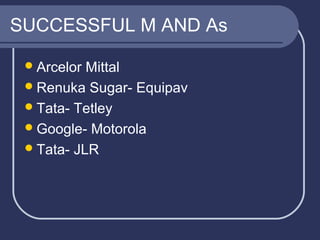
SUCCESSFUL M AND As
 Arcelor

Mittal
 Renuka Sugar- Equipav
 Tata- Tetley
 Google- Motorola
 Tata- JLR
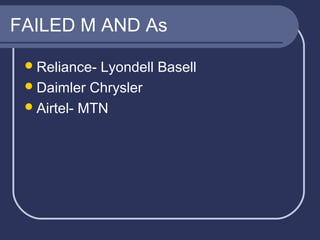
FAILED M AND As
 Reliance-

Lyondell Basell
 Daimler Chrysler
 Airtel- MTN
M&A

Pros and Cons
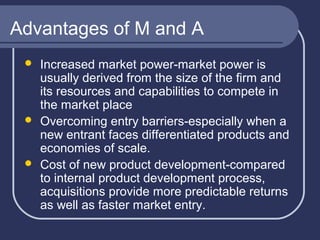
Advantages of M and A






Increased market power-market power is
usually derived from the size of the firm and
its resources and capabilities to compete in
the market place
Overcoming entry barriers-especially when a
new entrant faces differentiated products and
economies of scale.
Cost of new product development-compared
to internal product development process,
acquisitions provide more predictable returns
as well as faster market entry.
Advantages……….







Increased speed to market-acquisitions result
in more rapid market entries
Lower risks compared to developing new
products-internal product development
process can be risky. Managers view
acquisitions as carrying lower risks.
Increased diversification-it is difficult for
companies to develop products for new
markets/new customers
Avoid excessive competition
Problems….




Inability to achieve synergy: synergy exists when the
value created by units working together exceeds the
value those units could create working independently.
Too much diversification: in general, firms using
related diversification strategies outperform those
employing unrelated diversification strategies.
However, regardless of the type of diversification
strategy implemented, declines in performance
usually result from over-diversification. Another
problem resulting from too much diversification is the
tendency for acquisitions to become substitutes for
innovation.
Problems….
Too large: evidence suggests that a
larger size creates efficiencies in
various organizational functions only
when the new firm is not too large.
 Managers overtly focused on
acquisitions: too much time spent
searching for viable acquisition
candidates, completing effective duediligence processes and preparing for
negotiations

M&A

Cultural Factors
Cultural factors


Prior to the 1980s most research on
M&A focused strategic, financial and
operational consequences of M&A.
Current thinking is that cultural clashes
are seen to be the main reason for M&A
failures.
Cultural factors in mergers and
acquisitions






Cultural factors in IM and A s can be studied at organizational
and national levels.
Hofstede used six dimensions of organizational culture and four
(five) dimensions of national culture.
Hofstede’s national cultural dimensions include power distance,
uncertainty avoidance individualism/collectivism and
masculinity/femininity.
His organizational cultural dimensions are process
oriented/result oriented, employee oriented/job oriented,
parochial/professional, open/closed system, loose/tight control
and normative/pragmatic.
Organizational culture






National culture=values. It is normative
Organizational culture=practices. It is
descriptive
Process orientation vs. Results orientation.
How things are done vs. what gets done
Concern for employee vs. concern for the job.
Parochial (narrow minded) vs. professional.
Identity taken from the organizational vs.
identity from the outside.
Organizational…….
Open vs. closed. Easy to join and work
vs. difficult to join (only specific kinds of
people can work in such organizations)
 Loose vs. tight.Casual/improvization vs.
serious/great emphasis on punctuality
 Normative vs. pragmatic. Ideological vs.
market driven.

Human resource implications: the
merger-emotion syndrome










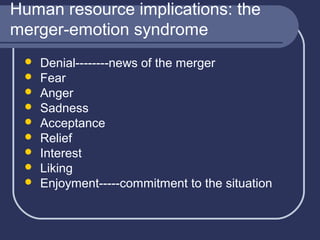
Denial--------news of the merger
Fear
Anger
Sadness
Acceptance
Relief
Interest
Liking
Enjoyment-----commitment to the situation
HR ASPECTS IN MERGERS
AND ACQUISITIONS
ROLE OF HR
HR IMPERATIVES
 RETENTION

OF KEY EMPLOYEES
 COMPLIANCE WITH APPLICABLE
LAWS
 ALIGNMENT WITH COMPENSATION
AND BENEFIT PLANS
 CULTURE FIT
 EMPLOYEE COMMUNICATIONS
ISSUES IN M AND A
 LACK

OF COMMUNICATIONS
 LACK OF TRAINING
 LOSS OF KEY PEOPLE
 POWER AND POLITICS
 CULTURE CLASH
 EMPLOYEE RESISTANCE
What should be communicated?
If leadership cannot stand up in front of the company and
say the following, resistance will worsen:
 “We’re doing this because we must.”
 “We’re doing this because we are failing and if we
don’t, we all stand to lose our jobs.”
 “We’re doing this because it is going to help us. It is
going to allow us to grow. We’re all going to be better
off during and after this transitional period.”
 “We MUST make this change or we may not be in
existence 2 years from now.”
WHERE HR COMES IN-- TRAIN

MANAGERS ON THE NATURE OF
CHANGE
 TECHNICAL RE- TRAINING
 FAMILY ASSISTANCE PROGRAMMES
 STRESS REDUCTION PROGRAMMES
 EXPLAINING NEW ROLES
 HELPING PEOPLE WHO LOST THEIR JOBS
 POST MERGER TEAM BUILDING
HR ROLES--PRE- M AND A PHASE
 Assessment of differences
 Role clarity
 Management styles
POST M AND A PHASE
 Designation for employees
 Compensation and PMS
 IR
Five top mistakes HR make
 Not

being involved early enough
 Not understanding employee needs and
concerns
 Not understanding and empowering
leadership team
 Not working with receiving business unit
 Not understanding the time, work that
acquisitions and integrations require.
THANK YOU
QUESTIONS?

Role of HR in M and A

  • 1.
    WELCOME TO THEPRESENTATION ON MERGERS AND ACQUISITIONS Important Aspects
  • 2.
  • 3.
    M and A   Amerger is a strategy through which two firms agree to integrate their operations on a relatively co-equal basis because they have resources and capabilities that together may create a stronger competitive advantage. HUL and TOMCO merged to serve as a counter thrust to the P & G-Godrej tie-up A merger is said to occur when two or more companies combine into one company. One or more companies may merge with an existing company or they may merge to form a new company. DaimlerBenz and Chrysler ceased to exist when the two firms merged and a new company ,Daimler-Chrysler was created.
  • 4.
    M and A   Ina merger there is complete amalgamation of the assets and liabilities as well as shareholders’ interests and businesses of the merging companies. The fundamental characteristic of merger is that the acquiring company takes over the ownership of the other company and combines its operations with its own operations.
  • 5.
    M and A Anacquisition is a strategy through which one firm buys a controlling stake or 100 percent interest in another firm with the intent of using a core competence more effectively by making the acquired firm a subsidiary business within its portfolio.  Most mergers are friendly transactions, where as acquisitions include unfriendly take overs. 
  • 6.
    M and A   Acquisitionsmay be defined as an act of acquiring effective control over assets or management of a company by another company without any combinations of businesses or companies. In an acquisition two or more companies may remain independent but there may be change in the control of the target company. A takeover is a type of an acquisition strategy wherein the target firm does not/did not solicit the acquiring firm. Thus when an acquisition is a “forced” or “unwilling” acquisition it is called a take-over.
  • 7.
    Classifications of mergers     Horizontalmergers: take place where two merging companies produce similar product in the same industry Vertical mergers occur when two firms, each working at different stages in the production of the same good, combine. Congeneric mergers occur where two merging firms are in the same industry, but have no mutual buyer/customer or supplier relationship Conglomerate mergers take place when two firms operate in different industries.
  • 8.
    SUCCESSFUL M ANDAs  Arcelor Mittal  Renuka Sugar- Equipav  Tata- Tetley  Google- Motorola  Tata- JLR
  • 9.
    FAILED M ANDAs  Reliance- Lyondell Basell  Daimler Chrysler  Airtel- MTN
  • 10.
  • 11.
    Advantages of Mand A    Increased market power-market power is usually derived from the size of the firm and its resources and capabilities to compete in the market place Overcoming entry barriers-especially when a new entrant faces differentiated products and economies of scale. Cost of new product development-compared to internal product development process, acquisitions provide more predictable returns as well as faster market entry.
  • 12.
    Advantages……….     Increased speed tomarket-acquisitions result in more rapid market entries Lower risks compared to developing new products-internal product development process can be risky. Managers view acquisitions as carrying lower risks. Increased diversification-it is difficult for companies to develop products for new markets/new customers Avoid excessive competition
  • 13.
    Problems….   Inability to achievesynergy: synergy exists when the value created by units working together exceeds the value those units could create working independently. Too much diversification: in general, firms using related diversification strategies outperform those employing unrelated diversification strategies. However, regardless of the type of diversification strategy implemented, declines in performance usually result from over-diversification. Another problem resulting from too much diversification is the tendency for acquisitions to become substitutes for innovation.
  • 14.
    Problems…. Too large: evidencesuggests that a larger size creates efficiencies in various organizational functions only when the new firm is not too large.  Managers overtly focused on acquisitions: too much time spent searching for viable acquisition candidates, completing effective duediligence processes and preparing for negotiations 
  • 15.
  • 16.
    Cultural factors  Prior tothe 1980s most research on M&A focused strategic, financial and operational consequences of M&A. Current thinking is that cultural clashes are seen to be the main reason for M&A failures.
  • 17.
    Cultural factors inmergers and acquisitions     Cultural factors in IM and A s can be studied at organizational and national levels. Hofstede used six dimensions of organizational culture and four (five) dimensions of national culture. Hofstede’s national cultural dimensions include power distance, uncertainty avoidance individualism/collectivism and masculinity/femininity. His organizational cultural dimensions are process oriented/result oriented, employee oriented/job oriented, parochial/professional, open/closed system, loose/tight control and normative/pragmatic.
  • 18.
    Organizational culture      National culture=values.It is normative Organizational culture=practices. It is descriptive Process orientation vs. Results orientation. How things are done vs. what gets done Concern for employee vs. concern for the job. Parochial (narrow minded) vs. professional. Identity taken from the organizational vs. identity from the outside.
  • 19.
    Organizational……. Open vs. closed.Easy to join and work vs. difficult to join (only specific kinds of people can work in such organizations)  Loose vs. tight.Casual/improvization vs. serious/great emphasis on punctuality  Normative vs. pragmatic. Ideological vs. market driven. 
  • 20.
    Human resource implications:the merger-emotion syndrome          Denial--------news of the merger Fear Anger Sadness Acceptance Relief Interest Liking Enjoyment-----commitment to the situation
  • 21.
    HR ASPECTS INMERGERS AND ACQUISITIONS ROLE OF HR
  • 22.
    HR IMPERATIVES  RETENTION OFKEY EMPLOYEES  COMPLIANCE WITH APPLICABLE LAWS  ALIGNMENT WITH COMPENSATION AND BENEFIT PLANS  CULTURE FIT  EMPLOYEE COMMUNICATIONS
  • 23.
    ISSUES IN MAND A  LACK OF COMMUNICATIONS  LACK OF TRAINING  LOSS OF KEY PEOPLE  POWER AND POLITICS  CULTURE CLASH  EMPLOYEE RESISTANCE
  • 24.
    What should becommunicated? If leadership cannot stand up in front of the company and say the following, resistance will worsen:  “We’re doing this because we must.”  “We’re doing this because we are failing and if we don’t, we all stand to lose our jobs.”  “We’re doing this because it is going to help us. It is going to allow us to grow. We’re all going to be better off during and after this transitional period.”  “We MUST make this change or we may not be in existence 2 years from now.”
  • 25.
    WHERE HR COMESIN-- TRAIN MANAGERS ON THE NATURE OF CHANGE  TECHNICAL RE- TRAINING  FAMILY ASSISTANCE PROGRAMMES  STRESS REDUCTION PROGRAMMES  EXPLAINING NEW ROLES  HELPING PEOPLE WHO LOST THEIR JOBS  POST MERGER TEAM BUILDING
  • 26.
    HR ROLES--PRE- MAND A PHASE  Assessment of differences  Role clarity  Management styles POST M AND A PHASE  Designation for employees  Compensation and PMS  IR
  • 27.
    Five top mistakesHR make  Not being involved early enough  Not understanding employee needs and concerns  Not understanding and empowering leadership team  Not working with receiving business unit  Not understanding the time, work that acquisitions and integrations require.
  • 28.