Health
Promotion &
Wellness
Social Media Strategy
Social Media (SoMe)
Definition of SOCIAL MEDIA
forms of electronic communication
through which users create online
communities to share
information, ideas, personal
messages, and other content
Why Social Media is Important
Facebook Statistics 2012:
 An average Facebook user has 130
friends and likes 80 pages
 56% of consumer say that they are more likely
recommend a brand after becoming a fan
 Each week on Facebook more than 3.5
billion pieces of content are shared
Why Social Media is Important
Twitter Statistics 2012:
 34% of marketers have generated leads
using Twitter
 55% of Twitter users access the platform
via their mobile
Why Social Media is Important
General Social Media Statistics 2012:
 20% of Google searches each day have
never been searched for before
 Out of the 6 billion people on the
planet 4.8 billion have a mobile and
only 4.2 billion own a toothbrush
How We Use Social: Highlights
from the Social Media Report 2012
 Mobile web usage has increased
 Social apps are particularly popular
 Computers most often
Social networking dominates our
online activity
 Social networks still dominate internet
usage
 Facebook dominates that
The top social networks are the
usual suspects, but others are closing in
 Facebook still tops social networks as the
most used
 Second is Blogger
 Twitter is now the third biggest social
network, up 13% from the previous year
We use social networking sites
everywhere, all the time
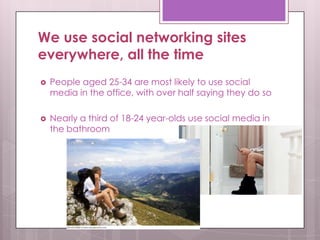
 People aged 25-34 are most likely to use social
media in the office, with over half saying they do so
 Nearly a third of 18-24 year-olds use social media in
the bathroom
We use social networking sites
everywhere, all the time
It’s easy to see why we love social
media!
HPW SoMe OBJECTIVES
 Create community within HPW student
population
 Promote HPW projects, programs, initiatives
 Enhance relationship between Health
Promotion Major & Stevens Point community
 Build awareness of HPW major
HPHD Mission
to develop
professionals who
study, promote, and
model lifelong
wellness for
individuals, families
and communities.
Questions we will address
 Who will manage the site?
 What content will be shared?
 Who will post content?
 How much time will it take?
 How much money will it cost?
 How will results be assessed and
communicated?
Who are we trying to reach?
Current students
Community members
Prospective students
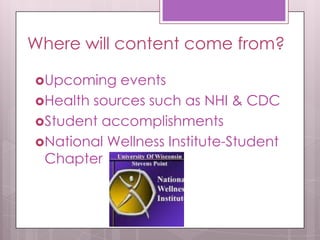
Where will content come from?
Upcoming events
Health sources such as NHI & CDC
Student accomplishments
National Wellness Institute-Student
Chapter
Posts will consist of…
 Activities and events within HPW program
 New additions, faculty, clubs, etc.
 HPW alumni “tell-all’s”
 Major due dates, reminders
Networks we will use
Facebook
Twitter
LinkedIn
Blog
Managing networks using
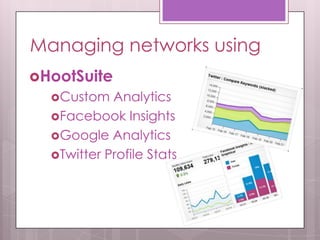
HootSuite
Custom Analytics
Facebook Insights
Google Analytics
Twitter Profile Stats
Staff & Training
 Community practicum faculty member -
Manager
 HPW Practicum students: 2-semester
commitment
 For additional discussion or
clarification, CPS marketing specialist, Eva
Donahoo, will share resources required to
manage central social media efforts, and
provide examples from selected units
experiencing success
Who will be posting?
 Practicum students under the direction of
the faculty community manager
How often?
 Postings will occur at least twice per
week.
Content posted to Facebook
page will be proactively managed
 Postings will not appear on the HPW
Facebook page until they’ve been
reviewed by a practicum student.
 Facebook activity log will be reviewed
daily.
Best Practices using SoMe
 UWSP SoMe administrators and those
assisting with posting:
 Social Media Best Practices.pdf

Hpw so me2

  • 1.
  • 2.
    Social Media (SoMe) Definitionof SOCIAL MEDIA forms of electronic communication through which users create online communities to share information, ideas, personal messages, and other content
  • 3.
    Why Social Mediais Important Facebook Statistics 2012:  An average Facebook user has 130 friends and likes 80 pages  56% of consumer say that they are more likely recommend a brand after becoming a fan  Each week on Facebook more than 3.5 billion pieces of content are shared
  • 4.
    Why Social Mediais Important Twitter Statistics 2012:  34% of marketers have generated leads using Twitter  55% of Twitter users access the platform via their mobile
  • 5.
    Why Social Mediais Important General Social Media Statistics 2012:  20% of Google searches each day have never been searched for before  Out of the 6 billion people on the planet 4.8 billion have a mobile and only 4.2 billion own a toothbrush
  • 6.
    How We UseSocial: Highlights from the Social Media Report 2012  Mobile web usage has increased  Social apps are particularly popular  Computers most often
  • 7.
    Social networking dominatesour online activity  Social networks still dominate internet usage  Facebook dominates that
  • 8.
    The top socialnetworks are the usual suspects, but others are closing in  Facebook still tops social networks as the most used  Second is Blogger  Twitter is now the third biggest social network, up 13% from the previous year
  • 9.
    We use socialnetworking sites everywhere, all the time  People aged 25-34 are most likely to use social media in the office, with over half saying they do so  Nearly a third of 18-24 year-olds use social media in the bathroom
  • 10.
    We use socialnetworking sites everywhere, all the time It’s easy to see why we love social media!
  • 11.
    HPW SoMe OBJECTIVES Create community within HPW student population  Promote HPW projects, programs, initiatives  Enhance relationship between Health Promotion Major & Stevens Point community  Build awareness of HPW major
  • 12.
    HPHD Mission to develop professionalswho study, promote, and model lifelong wellness for individuals, families and communities.
  • 13.
    Questions we willaddress  Who will manage the site?  What content will be shared?  Who will post content?  How much time will it take?  How much money will it cost?  How will results be assessed and communicated?
  • 14.
    Who are wetrying to reach? Current students Community members Prospective students
  • 15.
    Where will contentcome from? Upcoming events Health sources such as NHI & CDC Student accomplishments National Wellness Institute-Student Chapter
  • 16.
    Posts will consistof…  Activities and events within HPW program  New additions, faculty, clubs, etc.  HPW alumni “tell-all’s”  Major due dates, reminders
  • 17.
    Networks we willuse Facebook Twitter LinkedIn Blog
  • 18.
    Managing networks using HootSuite CustomAnalytics Facebook Insights Google Analytics Twitter Profile Stats
  • 19.
    Staff & Training Community practicum faculty member - Manager  HPW Practicum students: 2-semester commitment  For additional discussion or clarification, CPS marketing specialist, Eva Donahoo, will share resources required to manage central social media efforts, and provide examples from selected units experiencing success
  • 20.
    Who will beposting?  Practicum students under the direction of the faculty community manager How often?  Postings will occur at least twice per week.
  • 21.
    Content posted toFacebook page will be proactively managed  Postings will not appear on the HPW Facebook page until they’ve been reviewed by a practicum student.  Facebook activity log will be reviewed daily.
  • 22.
    Best Practices usingSoMe  UWSP SoMe administrators and those assisting with posting:  Social Media Best Practices.pdf

Editor's Notes