 Chromatography is essentially a group of techniques for
the separation of the compounds of mixtures by their
continuous distribution between two phases, one of
which is mobile phase and other is stationary phase.
Example: HPLC, GC
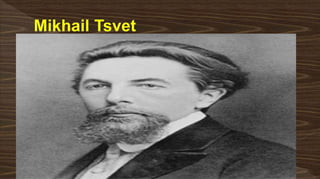
 14 May 1872 – 26 June 1919) invented adsorption
chromatography.
 He used liquid-adsorption column
chromatography.(1901)
 Tsvet's work was long ignored for political violence.
 10 years after his death Austrian biochemist
Richard Kuhn and his student
 Md. Moshiur Rahman 07(2047)
 Mehenaj jahan 02 (2042)
 Afzal hoassain 03 (2043)
 Nipa akter 04 (2044)
 Kaniz fatema 08 (2048)
 Samhan afroz 12 (2052)
 HPLC: High performance liquid chromatography
Definition :It is a chromatographic technique
used to separate component of mixture for the
purpose to identify, quantify or purify the
individual component of mixture.
 It is widely used in the field of analytical
chemistry.
a) Mobile phase: They consist of water, organic solvent
or mixtures of organic solvents. They are continuously
flown ‘like river water’ and carried samples. eg:
methanol, acetone,acetonitrile,water.
b) Stationary phase: They consist of a large number of
particles like silica. They are constant in a place and the
separation occurs in this phase.eg:C-18, C-12.
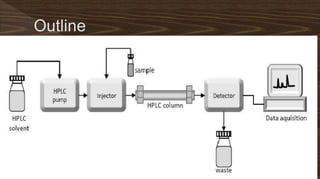
Several apparatus of HPLC
 Solvent reservoir
 Degasser
 Pump
 Mixing unit
 Guard column
 Injector
 column
 Detector
 Recorder
 Waste container
 Lab Solutions (Shimadzu)
 ChemStation (Agilent)
 ChromNAV 2.0 (JASCO)
 TRILUTION (Gilson)
 Chromeleon (JASCO)
 PrepCon5 (SCPA)
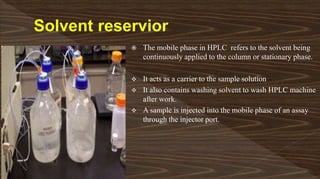
 The mobile phase in HPLC refers to the solvent being
continuously applied to the column or stationary phase.
 It acts as a carrier to the sample solution
 It also contains washing solvent to wash HPLC machine
after work.
 A sample is injected into the mobile phase of an assay
through the injector port.
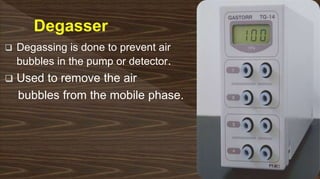
 Degassing is done to prevent air
bubbles in the pump or detector.
 Used to remove the air
bubbles from the mobile phase.
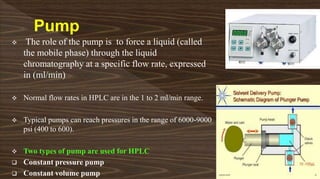
 The role of the pump is to force a liquid (called
the mobile phase) through the liquid
chromatography at a specific flow rate, expressed
in (ml/min)
 Normal flow rates in HPLC are in the 1 to 2 ml/min range.
 Typical pumps can reach pressures in the range of 6000-9000
psi (400 to 600).
 Two types of pump are used for HPLC
 Constant pressure pump
 Constant volume pump
 Mixing unit is used to mix solvent in different
proportion & pass through the column.
 Two types of mixing unit
- they are low pressure mixing chamber which
uses helium for degassing solvent.
-High pressure mixing chamber doesn’t require
helium for degassing solvent.
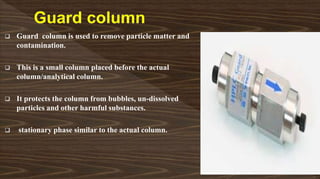
 Guard column is used to remove particle matter and
contamination.
 This is a small column placed before the actual
column/analytical column.
 It protects the column from bubbles, un-dissolved
particles and other harmful substances.
 stationary phase similar to the actual column.
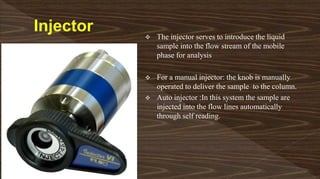
 The injector serves to introduce the liquid
sample into the flow stream of the mobile
phase for analysis
 For a manual injector: the knob is manually
operated to deliver the sample to the column.
 Auto injector :In this system the sample are
injected into the flow lines automatically
through self reading.
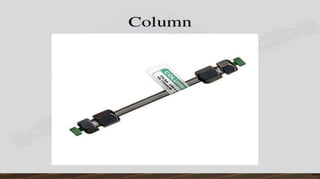
 Column is the part of HPLC machine , also called
heart of HPLC . It contain stationary phase &made
by glass or stainless steel.
 Main function of column is separation of compound
from the mixture
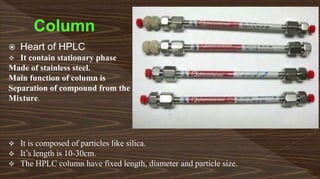
 Heart of HPLC
 It contain stationary phase
Made of stainless steel.
Main function of column is
Separation of compound from the
Mixture.
 It is composed of particles like silica.
 It’s length is 10-30cm.
 The HPLC column have fixed length, diameter and particle size.
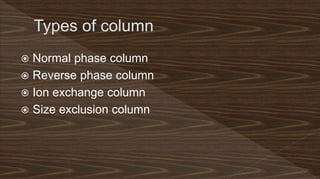
 Normal phase column
 Reverse phase column
 Ion exchange column
 Size exclusion column
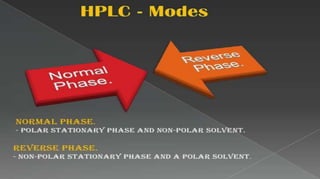
 Column work on the basis of column nature .If the
column is polar the non polar compound elute first &
the polar elute last from the column . If the column is
non polar the polar compound elute first & non polar
elute last from the mixture by the column.
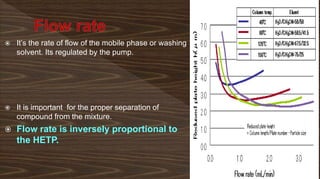
 It’s the rate of flow of the mobile phase or washing
solvent. Its regulated by the pump.
 It is important for the proper separation of
compound from the mixture.
 Flow rate is inversely proportional to
the HETP.
 Column oven is an oven which use to maintain a
desired temperature into the column . because
different temperature is needed to separation of
different component.
 column oven maintain the definite temperature for
proper separation of compound from mixture.
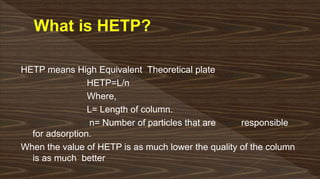
HETP means High Equivalent Theoretical plate
HETP=L/n
Where,
L= Length of column.
n= Number of particles that are responsible
for adsorption.
When the value of HETP is as much lower the quality of the column
is as much better
 Isocratic system means that composition of
mobile phase remains constant throughout the
rum.
 In gradient system pump composition of mobile
phase varies and is not constant .In which pump
can carry different solvents , mixing & carry
according to the reading to produce desired mobile
phase.
 Because it’s fully automated .Here less chance to
error in result .
 In isocratic its controlled manually so there is a
possibility to error in result.
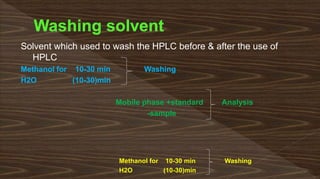
Solvent which used to wash the HPLC before & after the use of
HPLC
Methanol for 10-30 min Washing
H2O (10-30)min
Mobile phase +standard Analysis
-sample
Methanol for 10-30 min Washing
H2O (10-30)min
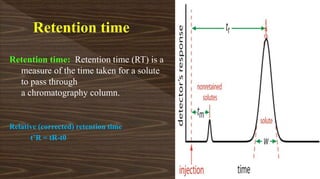
Retention time: Retention time (RT) is a
measure of the time taken for a solute
to pass through
a chromatography column.
Relative (corrected) retention time
t’R = tR-t0
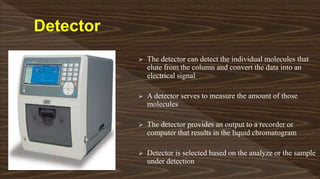
 The detector can detect the individual molecules that
elute from the column and convert the data into an
electrical signal
 A detector serves to measure the amount of those
molecules
 The detector provides an output to a recorder or
computer that results in the liquid chromatogram
 Detector is selected based on the analyze or the sample
under detection
several kinds of detector
 NMR,IR.
 Electrochemical detector.
 Uv visible detector.
 Fluorescence detector.
 Refractive index.
 Photodiode array detector
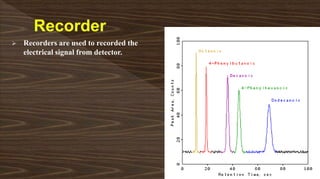
 Recorders are used to recorded the
electrical signal from detector.
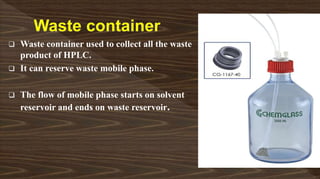
 Waste container used to collect all the waste
product of HPLC.
 It can reserve waste mobile phase.
 The flow of mobile phase starts on solvent
reservoir and ends on waste reservoir.
 Qualitative analysis
 Checking the purity of a compound
 Presence of impurities
 Quantitative analysis
 Multi component analysis or determination of mixture of drugs
 Isolation and identification of mixture of compound
 Purification of compound
 Environmental application
 Biochemical separation , forensic test.
 Biopharmaceutical & pharmacokinetic studies.
 Isolation & identification of drug.
 Stability studies.
 There is a high cost for equipment needed to conduct
HPLC.
 Its operation can be complex, requiring a trained
technician to operate. Because of the speed of the
process, the equipment has low sensitive.
 Separations fast and efficient (high resolution power)
 Continuous monitoring of the column effluent
 It can be applied to the separation and analysis of very complex mixtures.
 Accurate quantitative measurements.
 Repetitive and reproducible analysis using the same column.
 Adsorption, partition, ion exchange and exclusion column separations are
excellently made.
 Both aqueous and non aqueous samples can be analyzed with little or no
sample pre treatment
Hplc

Hplc

  • 4.
     Chromatography isessentially a group of techniques for the separation of the compounds of mixtures by their continuous distribution between two phases, one of which is mobile phase and other is stationary phase. Example: HPLC, GC
  • 6.
     14 May1872 – 26 June 1919) invented adsorption chromatography.  He used liquid-adsorption column chromatography.(1901)  Tsvet's work was long ignored for political violence.  10 years after his death Austrian biochemist Richard Kuhn and his student
  • 7.
     Md. MoshiurRahman 07(2047)  Mehenaj jahan 02 (2042)  Afzal hoassain 03 (2043)  Nipa akter 04 (2044)  Kaniz fatema 08 (2048)  Samhan afroz 12 (2052)
  • 9.
     HPLC: Highperformance liquid chromatography Definition :It is a chromatographic technique used to separate component of mixture for the purpose to identify, quantify or purify the individual component of mixture.  It is widely used in the field of analytical chemistry.
  • 10.
    a) Mobile phase:They consist of water, organic solvent or mixtures of organic solvents. They are continuously flown ‘like river water’ and carried samples. eg: methanol, acetone,acetonitrile,water. b) Stationary phase: They consist of a large number of particles like silica. They are constant in a place and the separation occurs in this phase.eg:C-18, C-12.
  • 11.
    Several apparatus ofHPLC  Solvent reservoir  Degasser  Pump  Mixing unit  Guard column  Injector  column  Detector  Recorder  Waste container
  • 12.
     Lab Solutions(Shimadzu)  ChemStation (Agilent)  ChromNAV 2.0 (JASCO)  TRILUTION (Gilson)  Chromeleon (JASCO)  PrepCon5 (SCPA)
  • 15.
     The mobilephase in HPLC refers to the solvent being continuously applied to the column or stationary phase.  It acts as a carrier to the sample solution  It also contains washing solvent to wash HPLC machine after work.  A sample is injected into the mobile phase of an assay through the injector port.
  • 16.
     Degassing isdone to prevent air bubbles in the pump or detector.  Used to remove the air bubbles from the mobile phase.
  • 17.
     The roleof the pump is to force a liquid (called the mobile phase) through the liquid chromatography at a specific flow rate, expressed in (ml/min)  Normal flow rates in HPLC are in the 1 to 2 ml/min range.  Typical pumps can reach pressures in the range of 6000-9000 psi (400 to 600).  Two types of pump are used for HPLC  Constant pressure pump  Constant volume pump
  • 18.
     Mixing unitis used to mix solvent in different proportion & pass through the column.  Two types of mixing unit - they are low pressure mixing chamber which uses helium for degassing solvent. -High pressure mixing chamber doesn’t require helium for degassing solvent.
  • 19.
     Guard columnis used to remove particle matter and contamination.  This is a small column placed before the actual column/analytical column.  It protects the column from bubbles, un-dissolved particles and other harmful substances.  stationary phase similar to the actual column.
  • 20.
     The injectorserves to introduce the liquid sample into the flow stream of the mobile phase for analysis  For a manual injector: the knob is manually operated to deliver the sample to the column.  Auto injector :In this system the sample are injected into the flow lines automatically through self reading.
  • 21.
     Column isthe part of HPLC machine , also called heart of HPLC . It contain stationary phase &made by glass or stainless steel.  Main function of column is separation of compound from the mixture
  • 23.
     Heart ofHPLC  It contain stationary phase Made of stainless steel. Main function of column is Separation of compound from the Mixture.  It is composed of particles like silica.  It’s length is 10-30cm.  The HPLC column have fixed length, diameter and particle size.
  • 24.
     Normal phasecolumn  Reverse phase column  Ion exchange column  Size exclusion column
  • 26.
     Column workon the basis of column nature .If the column is polar the non polar compound elute first & the polar elute last from the column . If the column is non polar the polar compound elute first & non polar elute last from the mixture by the column.
  • 27.
     It’s therate of flow of the mobile phase or washing solvent. Its regulated by the pump.  It is important for the proper separation of compound from the mixture.  Flow rate is inversely proportional to the HETP.
  • 28.
     Column ovenis an oven which use to maintain a desired temperature into the column . because different temperature is needed to separation of different component.  column oven maintain the definite temperature for proper separation of compound from mixture.
  • 29.
    HETP means HighEquivalent Theoretical plate HETP=L/n Where, L= Length of column. n= Number of particles that are responsible for adsorption. When the value of HETP is as much lower the quality of the column is as much better
  • 30.
     Isocratic systemmeans that composition of mobile phase remains constant throughout the rum.  In gradient system pump composition of mobile phase varies and is not constant .In which pump can carry different solvents , mixing & carry according to the reading to produce desired mobile phase.
  • 31.
     Because it’sfully automated .Here less chance to error in result .  In isocratic its controlled manually so there is a possibility to error in result.
  • 32.
    Solvent which usedto wash the HPLC before & after the use of HPLC Methanol for 10-30 min Washing H2O (10-30)min Mobile phase +standard Analysis -sample Methanol for 10-30 min Washing H2O (10-30)min
  • 33.
    Retention time: Retentiontime (RT) is a measure of the time taken for a solute to pass through a chromatography column. Relative (corrected) retention time t’R = tR-t0
  • 34.
     The detectorcan detect the individual molecules that elute from the column and convert the data into an electrical signal  A detector serves to measure the amount of those molecules  The detector provides an output to a recorder or computer that results in the liquid chromatogram  Detector is selected based on the analyze or the sample under detection
  • 35.
    several kinds ofdetector  NMR,IR.  Electrochemical detector.  Uv visible detector.  Fluorescence detector.  Refractive index.  Photodiode array detector
  • 36.
     Recorders areused to recorded the electrical signal from detector.
  • 37.
     Waste containerused to collect all the waste product of HPLC.  It can reserve waste mobile phase.  The flow of mobile phase starts on solvent reservoir and ends on waste reservoir.
  • 38.
     Qualitative analysis Checking the purity of a compound  Presence of impurities  Quantitative analysis  Multi component analysis or determination of mixture of drugs  Isolation and identification of mixture of compound  Purification of compound  Environmental application  Biochemical separation , forensic test.  Biopharmaceutical & pharmacokinetic studies.  Isolation & identification of drug.  Stability studies.
  • 39.
     There isa high cost for equipment needed to conduct HPLC.  Its operation can be complex, requiring a trained technician to operate. Because of the speed of the process, the equipment has low sensitive.
  • 40.
     Separations fastand efficient (high resolution power)  Continuous monitoring of the column effluent  It can be applied to the separation and analysis of very complex mixtures.  Accurate quantitative measurements.  Repetitive and reproducible analysis using the same column.  Adsorption, partition, ion exchange and exclusion column separations are excellently made.  Both aqueous and non aqueous samples can be analyzed with little or no sample pre treatment