HIGH PERFORMANCE LIQUID
CHROMATOGRAPHY(HPLC)
By
Ujjain Chaurasia (18311127)
M.Sc. Chemistry (2nd year)
DEPARTMENT OF CHEMISTRY
DR. B.R. AMBEDKAR NATIONAL INSTITUTE OF TECHNOLOGY,
JALANDHAR
Submitted to: Prof. (Dr.) N.C. Kothiyal 4/6/2022
UJJAIN CHAURASIA/M.Sc chemistry/18311127
1
HPLC
High performance liquid chromatography
4/6/2022
UJJAIN CHAURASIA/M.Sc chemistry/18311127
2
 A form of column chromatography to separate ,
identity, and quantify the compounds.
 Developed in 1970s.
 The most widely used analytical separation technique.
4/6/2022
UJJAIN CHAURASIA/M.Sc chemistry/18311127
3
CHROMATOGRAPHY:-
 Chromatography is a technique which separates components in a mixture
due to the differing time taken for each component to travel through it by a
mobile phase.
 Basically ,all chromatographic systems consists of two phases.
 Mobile phase-liquid or gaseous and flow over or through the stationary
phase.
 Stationary phase- solid, liquid or a solid/liquid mixture which is immobilized.
4/6/2022
UJJAIN CHAURASIA/M.Sc chemistry/18311127
4
Some chromatography terms
 Analyte
 substance that is to be separated during chromatography.
 Immobilized phase
 Stationary phase which is immobilized on the support
particles or on the inner wall of column tubing.
 Mobile phase
 Phase which moves in a definite direction.(liquid/gas/fluid)
4/6/2022
UJJAIN CHAURASIA/M.Sc chemistry/18311127
5
 Consists of the sample being separated/analysed and the
solvent that moves the sample through the column.
 Effluent
 Mobile phase leaving the column.
4/6/2022
UJJAIN CHAURASIA/M.Sc chemistry/18311127
6
Different types of chromatography methods
 Paper chromatography
 Liquid chromatography
 Gas chromatography
 High performance liquid chromatography
4/6/2022
UJJAIN CHAURASIA/M.Sc chemistry/18311127
7
High performance liquid chromatography
 HPLC is an extension of conventional liquid chromatography.
 Powerful tool in analytical techniques.
 Columns are tightly packed ,and the eluent is forced through
the column under high pressure (up to 5,000 psi ) by a pump.
 Allow to use a very smaller particle size for the column packing
material which gives a much greater surface area for
interactions between the stationary phase and the molecules
flowing through it.
 Allow a much better separation of the components of the
mixture. 4/6/2022
UJJAIN CHAURASIA/M.Sc chemistry/18311127
8
HPLC Technique
 Utilizes liquid mobile phase to separate the mixture.
 Analytic are first dissolved in a solvent then through the
column under high pressure of up to 400 atm.
 Mixture is resolved into its components in the column.
 The total separation time is often 5 or 10 minutes rather
than hours or even days required for some separations
by gravity flow with the larger systems 4/6/2022
UJJAIN CHAURASIA/M.Sc chemistry/18311127
9
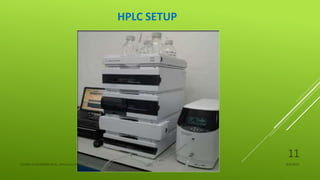
Components of HPLC
• Pump
• Injector
• Column
• Detector
• Recorder or data system
4/6/2022
UJJAIN CHAURASIA/M.Sc chemistry/18311127
10
HPLC SETUP
4/6/2022
UJJAIN CHAURASIA/M.Sc chemistry/18311127
11
Pump
 A pump forces the mobile phase through the column at a much
greater velocity than gravity-flow columns.
 The pump can be pneumatic, syringetype ,reciprocating, or
hydraulic amplifier.
 Pneumatic pumps are used for preoperative purposes.
 The most widely used pump today is the multihead pump with
two or more reciprocating pistons.
4/6/2022
UJJAIN CHAURASIA/M.Sc chemistry/18311127
12
 Pumps are designed in order to maintain a stable flow rate, avoiding pulsations
even when the composition of the mobile phase varies.
 flow range – 0.01-10 ml/min.
HPLC Pump
4/6/2022
UJJAIN CHAURASIA/M.Sc chemistry/18311127
13
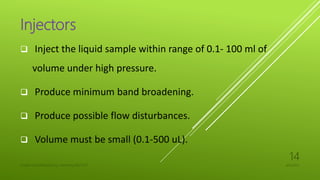
Injectors
 Inject the liquid sample within range of 0.1- 100 ml of
volume under high pressure.
 Produce minimum band broadening.
 Produce possible flow disturbances.
 Volume must be small (0.1-500 uL).
4/6/2022
UJJAIN CHAURASIA/M.Sc chemistry/18311127
14
A model injector
4/6/2022
UJJAIN CHAURASIA/M.Sc chemistry/18311127
15
INJECTOR
4/6/2022
UJJAIN CHAURASIA/M.Sc chemistry/18311127
16
Columns
 Smooth-bore stainless steel or heavy walled glass tubing.
 Hundreds of packed columns differing in size and packing are available
from manufacture.
 E.g. Column packing vary in size (3 to 20 um) with the smaller particles
used mostly for analytical separations and the larger ones for
preparative separation.
 The most common material used for column packing is silica gel.
4/6/2022
UJJAIN CHAURASIA/M.Sc chemistry/18311127
17
HPLC columns
4/6/2022
UJJAIN CHAURASIA/M.Sc chemistry/18311127
18
Detector
 HPLC detectors monitor the elute as it leaves the column.
 Produce an electronic signal proportional to the
concentration of each separated component.
 Crucial in trace analysis.
 High sensitivity.
 Fast response.
 Simplifies quantitation.
 Insensitive to changes in type of solvent.
 flow rate and temp. 4/6/2022
UJJAIN CHAURASIA/M.Sc chemistry/18311127
19
The most widely used detection methods
 Spectrophotometers
 Fluorometers
 Electrochemical detectors
 Mass spectrometer
 Refractive index detector
4/6/2022
UJJAIN CHAURASIA/M.Sc chemistry/18311127
20
Depending on the relative polarity of the solvent and stationary
phase, there are two variants in use in HPLC:-
1. Normal phase HPLC
 Utilize polar adsorbent surface and nonpolar eluent.
 Polar substance in the mixture sticks to polar adsorbent than
non-polar.
 Non-polar ones will pass more quickly through the column.
2. Reversed phase HPLC
 Utilize non-polar adsorbent surface and polar eluent.
 Attraction between non-polar compound in the mixture and
non-polar adsorbent. 4/6/2022
UJJAIN CHAURASIA/M.Sc chemistry/18311127
21
 Polar molecules will travel through the column more quickly
because there is strong attraction between polar solvent and
polar molecules when pass through the column.
 Reversed phase HPLC is the most commonly used form of
HPLC.
 Solvents used in mobile phase
 hexane, heptane, cyclohexane, carbon tetrachloride, benzene,
toluene, diethyl ether, chloroform etc.
 Adsorbents used in stationary phase
 silica gel, alumina, celite, cellulose powder, ion-exchange,
cellulose, starch.
4/6/2022
UJJAIN CHAURASIA/M.Sc chemistry/18311127
22
Retention time
 The time taken for a particular compound to travel through the
column to the detector.
 From the time at which the sample is injected to the point at which
the display shows a maximum peak height for that compound.
4/6/2022
UJJAIN CHAURASIA/M.Sc chemistry/18311127
23
Applications
 HPLC is used for Chemistry and biochemistry research
 analyzing complex mixtures, Purifying chemical compounds
 Quality control to ensure the purity of raw materials
 Analyzing air and water pollutants,
 Monitoring materials that may jeopardize occupational safety or health
 Monitoring pesticide levels in the environment.
 To survey food and drug products,
 To identify confiscated narcotics
 To determine the amount of such chemical compounds found in new
drugs in pharmaceutics
4/6/2022
UJJAIN CHAURASIA/M.Sc chemistry/18311127
24
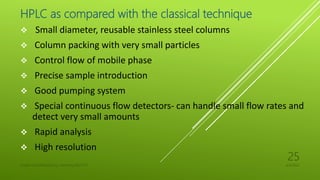
HPLC as compared with the classical technique
 Small diameter, reusable stainless steel columns
 Column packing with very small particles
 Control flow of mobile phase
 Precise sample introduction
 Good pumping system
 Special continuous flow detectors- can handle small flow rates and
detect very small amounts
 Rapid analysis
 High resolution
4/6/2022
UJJAIN CHAURASIA/M.Sc chemistry/18311127
25
Disadvantages of HPLC
• Cost
• Complexity
• Low sensitivity for some compounds
• Irreversibly adsorbed compounds not detected
• Co-elution difficult to detect
4/6/2022
UJJAIN CHAURASIA/M.Sc chemistry/18311127
26
Summary
 The modern day technique is greatly enhanced in terms of
selectivity, resolution, through miniaturization and the use of
very elaborate stationary phases.
 Therefore HPLC is widely used for separation of molecules in
biological, pharmaceutical, food, environmental and
industrial process.
4/6/2022
UJJAIN CHAURASIA/M.Sc chemistry/18311127
27
References:
• Harold Varley practical clinical chemistry
• http://scimedia.com
• http://www.forumsci.co.il/HPLC
4/6/2022
UJJAIN CHAURASIA/M.Sc chemistry/18311127
28
4/6/2022
UJJAIN CHAURASIA/M.Sc chemistry/18311127
29

High performance liquid chromatography

  • 1.
    HIGH PERFORMANCE LIQUID CHROMATOGRAPHY(HPLC) By UjjainChaurasia (18311127) M.Sc. Chemistry (2nd year) DEPARTMENT OF CHEMISTRY DR. B.R. AMBEDKAR NATIONAL INSTITUTE OF TECHNOLOGY, JALANDHAR Submitted to: Prof. (Dr.) N.C. Kothiyal 4/6/2022 UJJAIN CHAURASIA/M.Sc chemistry/18311127 1
  • 2.
    HPLC High performance liquidchromatography 4/6/2022 UJJAIN CHAURASIA/M.Sc chemistry/18311127 2
  • 3.
     A formof column chromatography to separate , identity, and quantify the compounds.  Developed in 1970s.  The most widely used analytical separation technique. 4/6/2022 UJJAIN CHAURASIA/M.Sc chemistry/18311127 3
  • 4.
    CHROMATOGRAPHY:-  Chromatography isa technique which separates components in a mixture due to the differing time taken for each component to travel through it by a mobile phase.  Basically ,all chromatographic systems consists of two phases.  Mobile phase-liquid or gaseous and flow over or through the stationary phase.  Stationary phase- solid, liquid or a solid/liquid mixture which is immobilized. 4/6/2022 UJJAIN CHAURASIA/M.Sc chemistry/18311127 4
  • 5.
    Some chromatography terms Analyte  substance that is to be separated during chromatography.  Immobilized phase  Stationary phase which is immobilized on the support particles or on the inner wall of column tubing.  Mobile phase  Phase which moves in a definite direction.(liquid/gas/fluid) 4/6/2022 UJJAIN CHAURASIA/M.Sc chemistry/18311127 5
  • 6.
     Consists ofthe sample being separated/analysed and the solvent that moves the sample through the column.  Effluent  Mobile phase leaving the column. 4/6/2022 UJJAIN CHAURASIA/M.Sc chemistry/18311127 6
  • 7.
    Different types ofchromatography methods  Paper chromatography  Liquid chromatography  Gas chromatography  High performance liquid chromatography 4/6/2022 UJJAIN CHAURASIA/M.Sc chemistry/18311127 7
  • 8.
    High performance liquidchromatography  HPLC is an extension of conventional liquid chromatography.  Powerful tool in analytical techniques.  Columns are tightly packed ,and the eluent is forced through the column under high pressure (up to 5,000 psi ) by a pump.  Allow to use a very smaller particle size for the column packing material which gives a much greater surface area for interactions between the stationary phase and the molecules flowing through it.  Allow a much better separation of the components of the mixture. 4/6/2022 UJJAIN CHAURASIA/M.Sc chemistry/18311127 8
  • 9.
    HPLC Technique  Utilizesliquid mobile phase to separate the mixture.  Analytic are first dissolved in a solvent then through the column under high pressure of up to 400 atm.  Mixture is resolved into its components in the column.  The total separation time is often 5 or 10 minutes rather than hours or even days required for some separations by gravity flow with the larger systems 4/6/2022 UJJAIN CHAURASIA/M.Sc chemistry/18311127 9
  • 10.
    Components of HPLC •Pump • Injector • Column • Detector • Recorder or data system 4/6/2022 UJJAIN CHAURASIA/M.Sc chemistry/18311127 10
  • 11.
  • 12.
    Pump  A pumpforces the mobile phase through the column at a much greater velocity than gravity-flow columns.  The pump can be pneumatic, syringetype ,reciprocating, or hydraulic amplifier.  Pneumatic pumps are used for preoperative purposes.  The most widely used pump today is the multihead pump with two or more reciprocating pistons. 4/6/2022 UJJAIN CHAURASIA/M.Sc chemistry/18311127 12
  • 13.
     Pumps aredesigned in order to maintain a stable flow rate, avoiding pulsations even when the composition of the mobile phase varies.  flow range – 0.01-10 ml/min. HPLC Pump 4/6/2022 UJJAIN CHAURASIA/M.Sc chemistry/18311127 13
  • 14.
    Injectors  Inject theliquid sample within range of 0.1- 100 ml of volume under high pressure.  Produce minimum band broadening.  Produce possible flow disturbances.  Volume must be small (0.1-500 uL). 4/6/2022 UJJAIN CHAURASIA/M.Sc chemistry/18311127 14
  • 15.
    A model injector 4/6/2022 UJJAINCHAURASIA/M.Sc chemistry/18311127 15
  • 16.
  • 17.
    Columns  Smooth-bore stainlesssteel or heavy walled glass tubing.  Hundreds of packed columns differing in size and packing are available from manufacture.  E.g. Column packing vary in size (3 to 20 um) with the smaller particles used mostly for analytical separations and the larger ones for preparative separation.  The most common material used for column packing is silica gel. 4/6/2022 UJJAIN CHAURASIA/M.Sc chemistry/18311127 17
  • 18.
  • 19.
    Detector  HPLC detectorsmonitor the elute as it leaves the column.  Produce an electronic signal proportional to the concentration of each separated component.  Crucial in trace analysis.  High sensitivity.  Fast response.  Simplifies quantitation.  Insensitive to changes in type of solvent.  flow rate and temp. 4/6/2022 UJJAIN CHAURASIA/M.Sc chemistry/18311127 19
  • 20.
    The most widelyused detection methods  Spectrophotometers  Fluorometers  Electrochemical detectors  Mass spectrometer  Refractive index detector 4/6/2022 UJJAIN CHAURASIA/M.Sc chemistry/18311127 20
  • 21.
    Depending on therelative polarity of the solvent and stationary phase, there are two variants in use in HPLC:- 1. Normal phase HPLC  Utilize polar adsorbent surface and nonpolar eluent.  Polar substance in the mixture sticks to polar adsorbent than non-polar.  Non-polar ones will pass more quickly through the column. 2. Reversed phase HPLC  Utilize non-polar adsorbent surface and polar eluent.  Attraction between non-polar compound in the mixture and non-polar adsorbent. 4/6/2022 UJJAIN CHAURASIA/M.Sc chemistry/18311127 21
  • 22.
     Polar moleculeswill travel through the column more quickly because there is strong attraction between polar solvent and polar molecules when pass through the column.  Reversed phase HPLC is the most commonly used form of HPLC.  Solvents used in mobile phase  hexane, heptane, cyclohexane, carbon tetrachloride, benzene, toluene, diethyl ether, chloroform etc.  Adsorbents used in stationary phase  silica gel, alumina, celite, cellulose powder, ion-exchange, cellulose, starch. 4/6/2022 UJJAIN CHAURASIA/M.Sc chemistry/18311127 22
  • 23.
    Retention time  Thetime taken for a particular compound to travel through the column to the detector.  From the time at which the sample is injected to the point at which the display shows a maximum peak height for that compound. 4/6/2022 UJJAIN CHAURASIA/M.Sc chemistry/18311127 23
  • 24.
    Applications  HPLC isused for Chemistry and biochemistry research  analyzing complex mixtures, Purifying chemical compounds  Quality control to ensure the purity of raw materials  Analyzing air and water pollutants,  Monitoring materials that may jeopardize occupational safety or health  Monitoring pesticide levels in the environment.  To survey food and drug products,  To identify confiscated narcotics  To determine the amount of such chemical compounds found in new drugs in pharmaceutics 4/6/2022 UJJAIN CHAURASIA/M.Sc chemistry/18311127 24
  • 25.
    HPLC as comparedwith the classical technique  Small diameter, reusable stainless steel columns  Column packing with very small particles  Control flow of mobile phase  Precise sample introduction  Good pumping system  Special continuous flow detectors- can handle small flow rates and detect very small amounts  Rapid analysis  High resolution 4/6/2022 UJJAIN CHAURASIA/M.Sc chemistry/18311127 25
  • 26.
    Disadvantages of HPLC •Cost • Complexity • Low sensitivity for some compounds • Irreversibly adsorbed compounds not detected • Co-elution difficult to detect 4/6/2022 UJJAIN CHAURASIA/M.Sc chemistry/18311127 26
  • 27.
    Summary  The modernday technique is greatly enhanced in terms of selectivity, resolution, through miniaturization and the use of very elaborate stationary phases.  Therefore HPLC is widely used for separation of molecules in biological, pharmaceutical, food, environmental and industrial process. 4/6/2022 UJJAIN CHAURASIA/M.Sc chemistry/18311127 27
  • 28.
    References: • Harold Varleypractical clinical chemistry • http://scimedia.com • http://www.forumsci.co.il/HPLC 4/6/2022 UJJAIN CHAURASIA/M.Sc chemistry/18311127 28
  • 29.