
www.petroEDGEasia.net
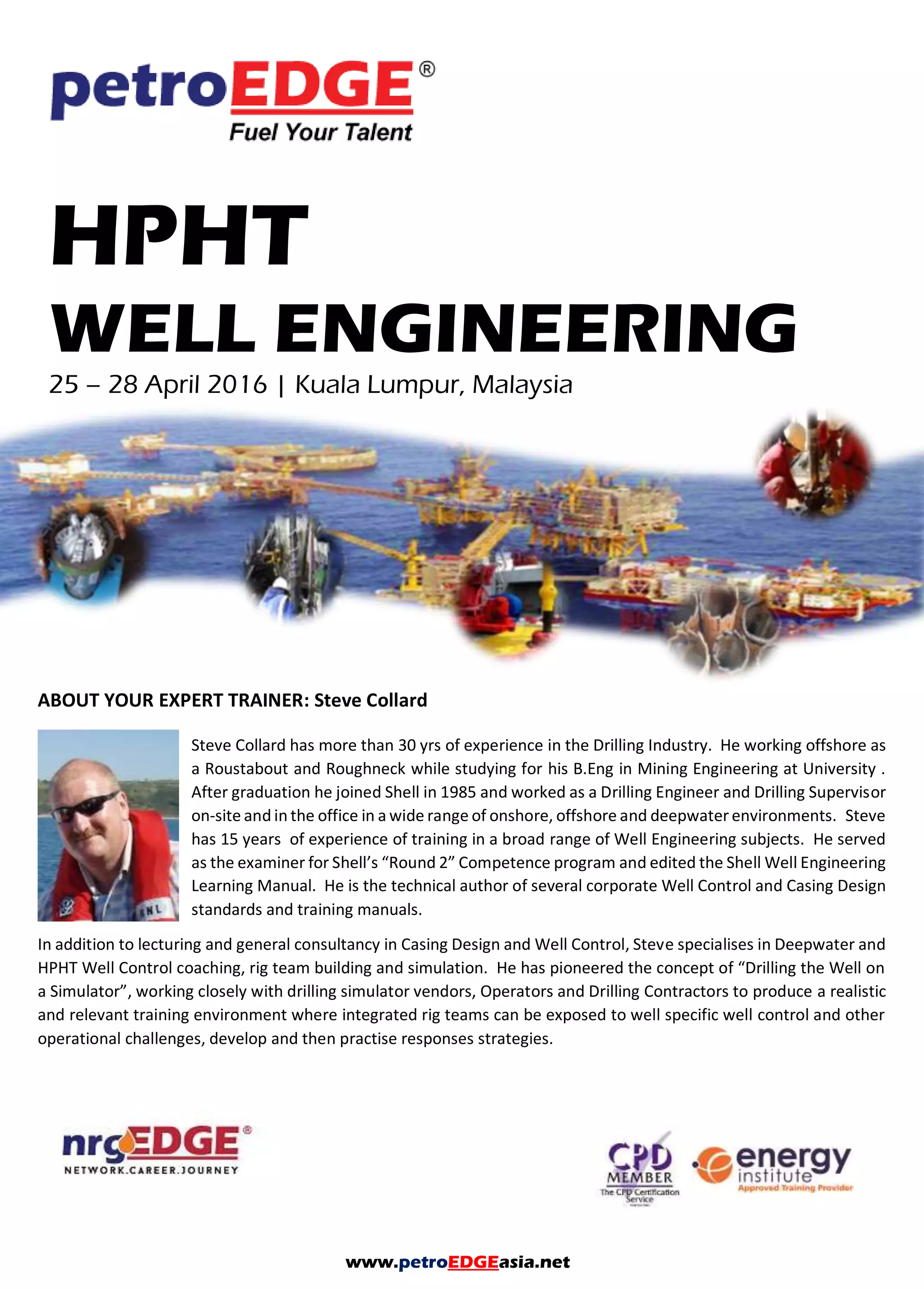
HPHT
WELL ENGINEERING
25 – 28 April 2016 | Kuala Lumpur, Malaysia
ABOUT YOUR EXPERT TRAINER: Steve Collard
Steve Collard has more than 30 yrs of experience in the Drilling Industry. He working offshore as
a Roustabout and Roughneck while studying for his B.Eng in Mining Engineering at University .
After graduation he joined Shell in 1985 and worked as a Drilling Engineer and Drilling Supervisor
on-site and in the office in a wide range of onshore, offshore and deepwater environments. Steve
has 15 years of experience of training in a broad range of Well Engineering subjects. He served
as the examiner for Shell’s “Round 2” Competence program and edited the Shell Well Engineering
Learning Manual. He is the technical author of several corporate Well Control and Casing Design
standards and training manuals.
In addition to lecturing and general consultancy in Casing Design and Well Control, Steve specialises in Deepwater and
HPHT Well Control coaching, rig team building and simulation. He has pioneered the concept of “Drilling the Well on
a Simulator”, working closely with drilling simulator vendors, Operators and Drilling Contractors to produce a realistic
and relevant training environment where integrated rig teams can be exposed to well specific well control and other
operational challenges, develop and then practise responses strategies.
Conduct this training course in-house for more effective savings!
Call us at +65 6741 9927 or email to info@asiaedge.net.
HPHT WELL ENGINEERING
25 – 28 April 2016 | Kuala Lumpur, Malaysia
Course Overview
HPHT (High Pressure - High Temperature) wells have a downhole environment of more than 10,000psi (690 bar) and/or 300
deg F (140 deg C). These conditions are increasingly encountered in many basins worldwide, as exploration and production
examine deeper and hotter objectives.
In attending this course, participants will gain knowledge and develops skills relating to HPHT Well Engineering. The course
focuses on key characteristics and challenges of HPHT wells from well design, planning, engineering and operational
perspectives. It covers a range of topics including:
 Well Design - Casing and drillstring design, well barriers, thermal effects, drilling fluid and cement selection
 Operational Planning - Rig selection, BOP equipment issues, rig team training
 Well Delivery – fingerprinting, well bore breathing, high-reliability drilling practices, well control and well
abandonment
Who Should Attend?
Personnel directly or indirectly involved in the design and delivery of HPHT wells:
 Well Design Engineers
 Completions Design Engineers
 Drilling Operations Supervision: Operator Rig Superintendents, Drilling Contractors, Rig Managers and Senior Offshore
personnel (OIMs, Toolpushers, etc)
 Exploration and Production Geologists, Production Technologists and other asset stakeholders
*The course content presumes participants will have significant experience in the design and/or delivery of conventional wells.
As such it is unlikely to be suitable for personnel with less than 5 years of relevant industry experience.
Competence Development
At the end of this course delegates should be able to:
 Understand the differences in well design between HPHT and conventional wells
 Describe the effects of HPHT on casing and fluids design
 Successfully pick casing seats to manage the transition from conventional to highly over-pressured formations
 Understand the difference between working stress and probabilistic well design
 Explain the impact of high temperature on casing performance properties
 Quantify casing loads associated with HPHT wells
 Perform biaxial collapse and triaxial burst casing design for HPHT wells
 Identify rig equipment critical to HPHT well delivery and select rigs suitable for HPHT drilling operations
 Explain and describe the challenges of well control in HPHT environments from pressure prediction, detection and
well control procedures
 Explain how ballooning / wellbore breathing can be identified and managed
 Describe what is meant by fingerprinting and develop rig procedures to use fingerprinting effectively
 Explain the importance of Cement Placement
 Explain why crew training and communication are critical aspects in successful HPHT well delivery
Conduct this training course in-house for more effective savings!
Call us at +65 6741 9927 or email to info@asiaedge.net.
HPHT WELL ENGINEERING
25 – 28 April 2016 | Kuala Lumpur, Malaysia
COURSE AGENDA
The following subjects will be addressed during the course
CHARACTERISTICS OF HPHT WELLS
The industry definition of an HPHT well and examines the
characteristics that make HPHT wells challenging. A review of
why HPHT wells fail is considered in order to focus attention
on the key differences between HPHT and conventional wells.
CASING DESIGN IN HPHT WELLS
A review of the principals of casing design with a focus on the
effects of temperature on casing design criteria, such as load
and yield strength changes.
The course will review uniaxial and triaxial pipe strength, the
implications of manufacturing standards and tolerances as
per ISO 10400 and the impact of downhole environmental
conditions. Participants will develop an understanding of the
how connections are tested using ISO 13679 and how to select
suitably pre-qualified connections for use in a well.
The importance of casing wear and its impact on casing design
and well integrity are discussed. Participants will master the
process of detailed casing design, identifying relevant load
conditions for the lifetime of the well and producing an
optimised casing scheme that can withstand triaxial burst and
biaxial collapse loading under downhole conditions. HPHT
Service Load design challenges such buckling and trapped
annular pressures will be addressed as well as managing the
impact of corrosion and casing wear.
DRILLING FLUIDS AND CEMENT
Temperature has a profound effect on drilling fluid rheology
while the high gradients required to balance high bottom hole
pressures create challenges to carrying capacity and barite
sag. High temperatures can also compromise drilling fluid
additives. This section addresses the selection and design of
drilling fluids for HPHT wells including the choice between
water based and oil based fluid systems. Thermal impact on
rheology and additive stability is discussed as is rig fluid
system design including shakers and mud coolers. Thermal
impact on cement slurries and cement placement practices
are also addressed.
RIG AND EQUIPMENT SELECTION
A detailed review of the essential requirements of the rig and
drilling equipment is provided which covers the rig, fluids
control equipment and well control equipment, and
instrumentation. Particular attention will be given to
qualification and testing of BOP equipment and the sizing and
performance assessment of surface gas handling equipment.
FINGERPRINTING
The impact of temperature in fluid density and volume
downhole means that conventional well control signals are
less reliable in HPHT operations. It is critical to understand the
normal behaviour of a well such that abnormal behaviour can
be rapidly identified and reacted to. Proactive information
gathering or “fingerprinting” prior to and while drilling an
HPHT section achieves this. The array of data to be analysed
and modern mud logging techniques that can be used are
addressed.
WELL CONTROL
Comprehensive knowledge and sound skills in the principals
and practisers of well control are critical to HPHT operations.
This section addresses pore pressure prediction and narrow
margin environments and their profound impact on kick
tolerance in the region of the transition zone. The origin of
abnormal pressure, and an explanation for narrow pressure
margins between pore and fracture pressure is covered. The
causes of kicks and kick detection are addressed including
early kick detection technology. Well control procedures to
combat influxes taken with the drillstring on bottom, off
bottom and with the drillstring out of the hole are reviewed.
These will include driller’s method, volumetric method,
bullheading, combined volumetric and stripping method and
snubbing.
KICKS AND LOSSES
Given the narrow margin between formation pressure and
fracture pressure in HPHT wells, the situation may arise where
there are simultaneous influx and losses leading to
underground flows. The causes and treatments for
underground flows are described and explained.
TEAMWORK AND TRAINING
Competence, teamwork and communications between well
delivery team members is critical to ensure the safe drilling
of HPHT wells. This section examines how rig team
communication and performance on critical wells can be
enhanced by processes such as “Drilling the Well on a
Simulator”.
HPHT WELL TESTING
This section addresses the surface and downhole equipment
required to temporarily complete and test flow HPHT wells.
Operating practises to address the challenges of HHPT well
testing are discussed.
Conduct this training course in-house for more effective savings!
Call us at +65 6741 9927 or email to info@asiaedge.net.
HPHT WELL ENGINEERING
25 – 28 April 2016 | Kuala Lumpur, Malaysia
What past participants said about this training programme:
 “Excellent preparation prior training start. Selection of audience need more improvement to ensure message
delivered to target group” Well Fluids Chemist, Sarawak Shell
 “Good and useful course for Drilling engineer who involves in designing and operations” Senior Drilling Engineer,
Talisman Malaysia
 “Good and handy insight to HPHT Well Engineering” Drilling Consultant, Halliburton Energy Services
 “This was a good introduction to some complexity of HPHT Wells and made me realise the time effort it take to plan
these wells” Drilling Engineer, Oil Search
 “Good general overview of the things to consider in the early stages of HPHT well planning” Drilling Superintendent,
Talisman Malaysia
HPHT DRILLING PRACTISES
High reliability well delivery requires the implementation of
drilling practises that can mitigate problems associated with
high mud gradients/mud rheology, narrow margin
environments and thermal effects. Such practises must
address pressure limitations of conventional mud circulation
systems such that the well can be safely closed in with high
surface pressures at any time. This section addresses HPHT
processes and practises and introduces the concept of the
“Safe Drilling Checklist”.
MANAGED PRESSURE DRILLING (MPD)
MPD offers solutions to a number of the challenges of HPHT
well delivery, specifically the narrow margin between pore
and fracture pressure through the transition zone. Some
Operators require all “dry BOP” HPHT wells to be drilled with
MDP in place while recent riser developments are seeing
subsea and deepwater HPHT wells using MPD equipment too.
This section addresses the benefits of MPD operations and
examines the equipment and practises for its implementation
in HPHT wells.
BOTTOM HOLE PRESSURE MANAGEMENT
The effect of temperature and pressure on drilling fluid
density, the importance of ECD management, and use of PWD
is explained. The importance of operational procedures to
minimise surge and swab effects is emphasised. Kick
tolerance and gas behaviour is discussed in terms of the
effects of temperature and the importance of monitoring gas
while drilling is explained. Ballooning, breathing and
supercharging will be explained.
HPHT WELL EVALUATION
This section reviews the temperature and pressure limitations
of conventional logging tools and examines the equipment
and operating practises now available to evaluate wells in
hostile conditions. Evolving technologies including ahead of
the bit measurements and the use of real time petrophysical
data to update pore pressure prediction models and optimise
drilling fluid gradients will be discussed.
HPHT WELL INTEGRITY AND FAILURE MODES
This section will address well integrity problems associated
with HPHT Well Delivery and Production. A number of case
studies will address problems encountered during the drilling
phase, reservoir compaction during production as well as
zonal isolation prior to and after well suspension and
abandonment.
www.petroEDGEasia.net
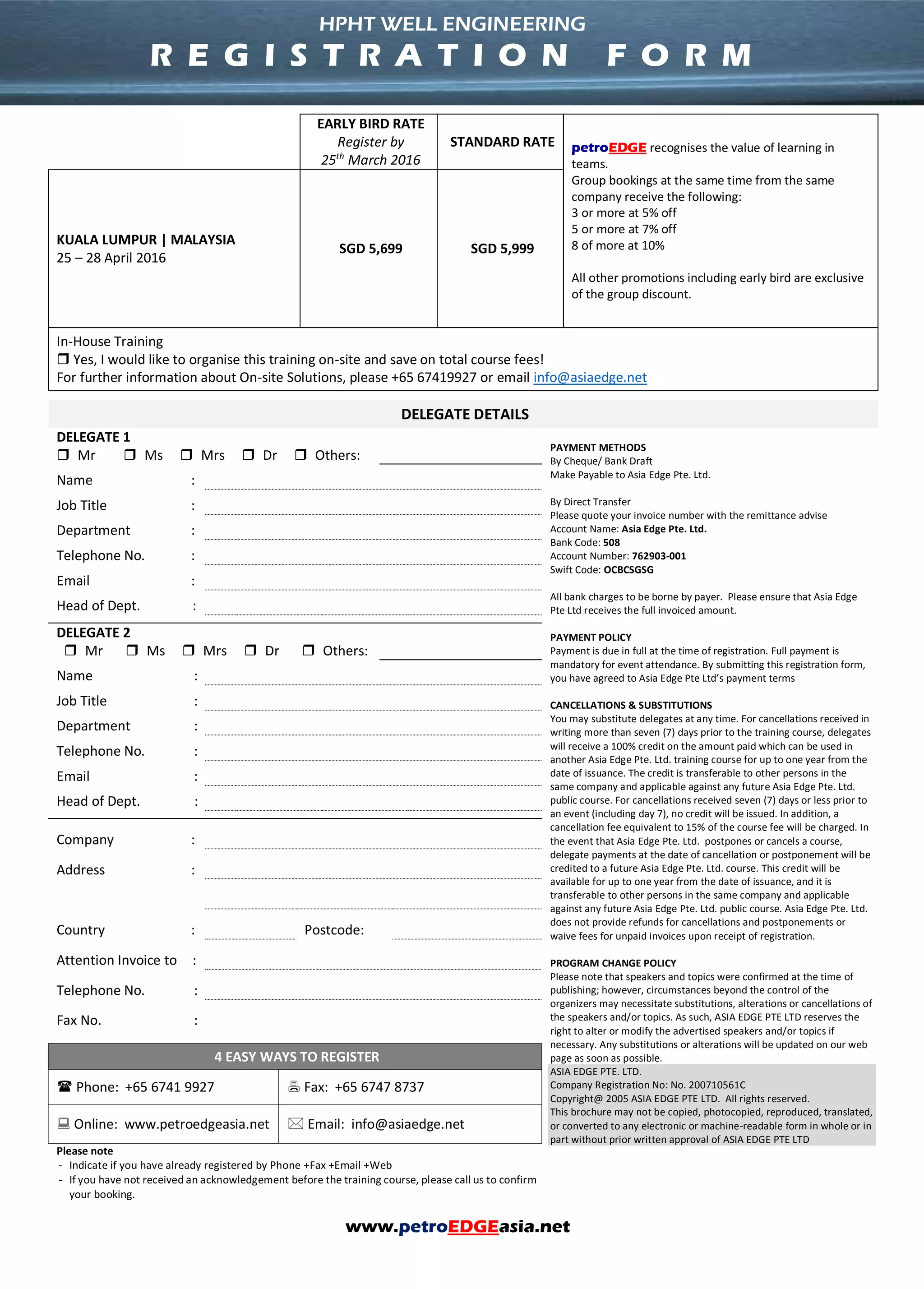
EARLY BIRD RATE
Register by
25th
March 2016
STANDARD RATE petroEDGE recognises the value of learning in
teams.
Group bookings at the same time from the same
company receive the following:
3 or more at 5% off
5 or more at 7% off
8 of more at 10%
All other promotions including early bird are exclusive
of the group discount.
KUALA LUMPUR | MALAYSIA
25 – 28 April 2016
SGD 5,699 SGD 5,999
In-House Training
 Yes, I would like to organise this training on-site and save on total course fees!
For further information about On-site Solutions, please +65 67419927 or email info@asiaedge.net
DELEGATE DETAILS
DELEGATE 1
PAYMENT METHODS
By Cheque/ Bank Draft
Make Payable to Asia Edge Pte. Ltd.
By Direct Transfer
Please quote your invoice number with the remittance advise
Account Name: Asia Edge Pte. Ltd.
Bank Code: 508
Account Number: 762903-001
Swift Code: OCBCSGSG
All bank charges to be borne by payer. Please ensure that Asia Edge
Pte Ltd receives the full invoiced amount.
PAYMENT POLICY
Payment is due in full at the time of registration. Full payment is
mandatory for event attendance. By submitting this registration form,
you have agreed to Asia Edge Pte Ltd’s payment terms
CANCELLATIONS & SUBSTITUTIONS
You may substitute delegates at any time. For cancellations received in
writing more than seven (7) days prior to the training course, delegates
will receive a 100% credit on the amount paid which can be used in
another Asia Edge Pte. Ltd. training course for up to one year from the
date of issuance. The credit is transferable to other persons in the
same company and applicable against any future Asia Edge Pte. Ltd.
public course. For cancellations received seven (7) days or less prior to
an event (including day 7), no credit will be issued. In addition, a
cancellation fee equivalent to 15% of the course fee will be charged. In
the event that Asia Edge Pte. Ltd. postpones or cancels a course,
delegate payments at the date of cancellation or postponement will be
credited to a future Asia Edge Pte. Ltd. course. This credit will be
available for up to one year from the date of issuance, and it is
transferable to other persons in the same company and applicable
against any future Asia Edge Pte. Ltd. public course. Asia Edge Pte. Ltd.
does not provide refunds for cancellations and postponements or
waive fees for unpaid invoices upon receipt of registration.
PROGRAM CHANGE POLICY
Please note that speakers and topics were confirmed at the time of
publishing; however, circumstances beyond the control of the
organizers may necessitate substitutions, alterations or cancellations of
the speakers and/or topics. As such, ASIA EDGE PTE LTD reserves the
right to alter or modify the advertised speakers and/or topics if
necessary. Any substitutions or alterations will be updated on our web
page as soon as possible.
ASIA EDGE PTE. LTD.
Company Registration No: No. 200710561C
Copyright@ 2005 ASIA EDGE PTE LTD. All rights reserved.
This brochure may not be copied, photocopied, reproduced, translated,
or converted to any electronic or machine-readable form in whole or in
part without prior written approval of ASIA EDGE PTE LTD
 Mr  Ms  Mrs  Dr  Others:
Name :
Job Title :
Department :
Telephone No. :
Email :
Head of Dept. :
DELEGATE 2
 Mr  Ms  Mrs  Dr  Others:
Name :
Job Title :
Department :
Telephone No. :
Email :
Head of Dept. :
Company :
Address :
Country : Postcode:
Attention Invoice to :
Telephone No. :
Fax No. :
4 EASY WAYS TO REGISTER
 Phone: +65 6741 9927  Fax: +65 6747 8737
 Online: www.petroedgeasia.net  Email: info@asiaedge.net
Please note
- Indicate if you have already registered by Phone +Fax +Email +Web
- If you have not received an acknowledgement before the training course, please call us to confirm
your booking.
HPHT WELL ENGINEERING
R E G I S T R A T I O N F O R M

HPHT WELL ENGINEERING

  • 1.
    www.petroEDGEasia.net HPHT WELL ENGINEERING 25 –28 April 2016 | Kuala Lumpur, Malaysia ABOUT YOUR EXPERT TRAINER: Steve Collard Steve Collard has more than 30 yrs of experience in the Drilling Industry. He working offshore as a Roustabout and Roughneck while studying for his B.Eng in Mining Engineering at University . After graduation he joined Shell in 1985 and worked as a Drilling Engineer and Drilling Supervisor on-site and in the office in a wide range of onshore, offshore and deepwater environments. Steve has 15 years of experience of training in a broad range of Well Engineering subjects. He served as the examiner for Shell’s “Round 2” Competence program and edited the Shell Well Engineering Learning Manual. He is the technical author of several corporate Well Control and Casing Design standards and training manuals. In addition to lecturing and general consultancy in Casing Design and Well Control, Steve specialises in Deepwater and HPHT Well Control coaching, rig team building and simulation. He has pioneered the concept of “Drilling the Well on a Simulator”, working closely with drilling simulator vendors, Operators and Drilling Contractors to produce a realistic and relevant training environment where integrated rig teams can be exposed to well specific well control and other operational challenges, develop and then practise responses strategies.
  • 2.
    Conduct this trainingcourse in-house for more effective savings! Call us at +65 6741 9927 or email to info@asiaedge.net. HPHT WELL ENGINEERING 25 – 28 April 2016 | Kuala Lumpur, Malaysia Course Overview HPHT (High Pressure - High Temperature) wells have a downhole environment of more than 10,000psi (690 bar) and/or 300 deg F (140 deg C). These conditions are increasingly encountered in many basins worldwide, as exploration and production examine deeper and hotter objectives. In attending this course, participants will gain knowledge and develops skills relating to HPHT Well Engineering. The course focuses on key characteristics and challenges of HPHT wells from well design, planning, engineering and operational perspectives. It covers a range of topics including:  Well Design - Casing and drillstring design, well barriers, thermal effects, drilling fluid and cement selection  Operational Planning - Rig selection, BOP equipment issues, rig team training  Well Delivery – fingerprinting, well bore breathing, high-reliability drilling practices, well control and well abandonment Who Should Attend? Personnel directly or indirectly involved in the design and delivery of HPHT wells:  Well Design Engineers  Completions Design Engineers  Drilling Operations Supervision: Operator Rig Superintendents, Drilling Contractors, Rig Managers and Senior Offshore personnel (OIMs, Toolpushers, etc)  Exploration and Production Geologists, Production Technologists and other asset stakeholders *The course content presumes participants will have significant experience in the design and/or delivery of conventional wells. As such it is unlikely to be suitable for personnel with less than 5 years of relevant industry experience. Competence Development At the end of this course delegates should be able to:  Understand the differences in well design between HPHT and conventional wells  Describe the effects of HPHT on casing and fluids design  Successfully pick casing seats to manage the transition from conventional to highly over-pressured formations  Understand the difference between working stress and probabilistic well design  Explain the impact of high temperature on casing performance properties  Quantify casing loads associated with HPHT wells  Perform biaxial collapse and triaxial burst casing design for HPHT wells  Identify rig equipment critical to HPHT well delivery and select rigs suitable for HPHT drilling operations  Explain and describe the challenges of well control in HPHT environments from pressure prediction, detection and well control procedures  Explain how ballooning / wellbore breathing can be identified and managed  Describe what is meant by fingerprinting and develop rig procedures to use fingerprinting effectively  Explain the importance of Cement Placement  Explain why crew training and communication are critical aspects in successful HPHT well delivery
  • 3.
    Conduct this trainingcourse in-house for more effective savings! Call us at +65 6741 9927 or email to info@asiaedge.net. HPHT WELL ENGINEERING 25 – 28 April 2016 | Kuala Lumpur, Malaysia COURSE AGENDA The following subjects will be addressed during the course CHARACTERISTICS OF HPHT WELLS The industry definition of an HPHT well and examines the characteristics that make HPHT wells challenging. A review of why HPHT wells fail is considered in order to focus attention on the key differences between HPHT and conventional wells. CASING DESIGN IN HPHT WELLS A review of the principals of casing design with a focus on the effects of temperature on casing design criteria, such as load and yield strength changes. The course will review uniaxial and triaxial pipe strength, the implications of manufacturing standards and tolerances as per ISO 10400 and the impact of downhole environmental conditions. Participants will develop an understanding of the how connections are tested using ISO 13679 and how to select suitably pre-qualified connections for use in a well. The importance of casing wear and its impact on casing design and well integrity are discussed. Participants will master the process of detailed casing design, identifying relevant load conditions for the lifetime of the well and producing an optimised casing scheme that can withstand triaxial burst and biaxial collapse loading under downhole conditions. HPHT Service Load design challenges such buckling and trapped annular pressures will be addressed as well as managing the impact of corrosion and casing wear. DRILLING FLUIDS AND CEMENT Temperature has a profound effect on drilling fluid rheology while the high gradients required to balance high bottom hole pressures create challenges to carrying capacity and barite sag. High temperatures can also compromise drilling fluid additives. This section addresses the selection and design of drilling fluids for HPHT wells including the choice between water based and oil based fluid systems. Thermal impact on rheology and additive stability is discussed as is rig fluid system design including shakers and mud coolers. Thermal impact on cement slurries and cement placement practices are also addressed. RIG AND EQUIPMENT SELECTION A detailed review of the essential requirements of the rig and drilling equipment is provided which covers the rig, fluids control equipment and well control equipment, and instrumentation. Particular attention will be given to qualification and testing of BOP equipment and the sizing and performance assessment of surface gas handling equipment. FINGERPRINTING The impact of temperature in fluid density and volume downhole means that conventional well control signals are less reliable in HPHT operations. It is critical to understand the normal behaviour of a well such that abnormal behaviour can be rapidly identified and reacted to. Proactive information gathering or “fingerprinting” prior to and while drilling an HPHT section achieves this. The array of data to be analysed and modern mud logging techniques that can be used are addressed. WELL CONTROL Comprehensive knowledge and sound skills in the principals and practisers of well control are critical to HPHT operations. This section addresses pore pressure prediction and narrow margin environments and their profound impact on kick tolerance in the region of the transition zone. The origin of abnormal pressure, and an explanation for narrow pressure margins between pore and fracture pressure is covered. The causes of kicks and kick detection are addressed including early kick detection technology. Well control procedures to combat influxes taken with the drillstring on bottom, off bottom and with the drillstring out of the hole are reviewed. These will include driller’s method, volumetric method, bullheading, combined volumetric and stripping method and snubbing. KICKS AND LOSSES Given the narrow margin between formation pressure and fracture pressure in HPHT wells, the situation may arise where there are simultaneous influx and losses leading to underground flows. The causes and treatments for underground flows are described and explained. TEAMWORK AND TRAINING Competence, teamwork and communications between well delivery team members is critical to ensure the safe drilling of HPHT wells. This section examines how rig team communication and performance on critical wells can be enhanced by processes such as “Drilling the Well on a Simulator”. HPHT WELL TESTING This section addresses the surface and downhole equipment required to temporarily complete and test flow HPHT wells. Operating practises to address the challenges of HHPT well testing are discussed.
  • 4.
    Conduct this trainingcourse in-house for more effective savings! Call us at +65 6741 9927 or email to info@asiaedge.net. HPHT WELL ENGINEERING 25 – 28 April 2016 | Kuala Lumpur, Malaysia What past participants said about this training programme:  “Excellent preparation prior training start. Selection of audience need more improvement to ensure message delivered to target group” Well Fluids Chemist, Sarawak Shell  “Good and useful course for Drilling engineer who involves in designing and operations” Senior Drilling Engineer, Talisman Malaysia  “Good and handy insight to HPHT Well Engineering” Drilling Consultant, Halliburton Energy Services  “This was a good introduction to some complexity of HPHT Wells and made me realise the time effort it take to plan these wells” Drilling Engineer, Oil Search  “Good general overview of the things to consider in the early stages of HPHT well planning” Drilling Superintendent, Talisman Malaysia HPHT DRILLING PRACTISES High reliability well delivery requires the implementation of drilling practises that can mitigate problems associated with high mud gradients/mud rheology, narrow margin environments and thermal effects. Such practises must address pressure limitations of conventional mud circulation systems such that the well can be safely closed in with high surface pressures at any time. This section addresses HPHT processes and practises and introduces the concept of the “Safe Drilling Checklist”. MANAGED PRESSURE DRILLING (MPD) MPD offers solutions to a number of the challenges of HPHT well delivery, specifically the narrow margin between pore and fracture pressure through the transition zone. Some Operators require all “dry BOP” HPHT wells to be drilled with MDP in place while recent riser developments are seeing subsea and deepwater HPHT wells using MPD equipment too. This section addresses the benefits of MPD operations and examines the equipment and practises for its implementation in HPHT wells. BOTTOM HOLE PRESSURE MANAGEMENT The effect of temperature and pressure on drilling fluid density, the importance of ECD management, and use of PWD is explained. The importance of operational procedures to minimise surge and swab effects is emphasised. Kick tolerance and gas behaviour is discussed in terms of the effects of temperature and the importance of monitoring gas while drilling is explained. Ballooning, breathing and supercharging will be explained. HPHT WELL EVALUATION This section reviews the temperature and pressure limitations of conventional logging tools and examines the equipment and operating practises now available to evaluate wells in hostile conditions. Evolving technologies including ahead of the bit measurements and the use of real time petrophysical data to update pore pressure prediction models and optimise drilling fluid gradients will be discussed. HPHT WELL INTEGRITY AND FAILURE MODES This section will address well integrity problems associated with HPHT Well Delivery and Production. A number of case studies will address problems encountered during the drilling phase, reservoir compaction during production as well as zonal isolation prior to and after well suspension and abandonment.
  • 5.
    www.petroEDGEasia.net EARLY BIRD RATE Registerby 25th March 2016 STANDARD RATE petroEDGE recognises the value of learning in teams. Group bookings at the same time from the same company receive the following: 3 or more at 5% off 5 or more at 7% off 8 of more at 10% All other promotions including early bird are exclusive of the group discount. KUALA LUMPUR | MALAYSIA 25 – 28 April 2016 SGD 5,699 SGD 5,999 In-House Training  Yes, I would like to organise this training on-site and save on total course fees! For further information about On-site Solutions, please +65 67419927 or email info@asiaedge.net DELEGATE DETAILS DELEGATE 1 PAYMENT METHODS By Cheque/ Bank Draft Make Payable to Asia Edge Pte. Ltd. By Direct Transfer Please quote your invoice number with the remittance advise Account Name: Asia Edge Pte. Ltd. Bank Code: 508 Account Number: 762903-001 Swift Code: OCBCSGSG All bank charges to be borne by payer. Please ensure that Asia Edge Pte Ltd receives the full invoiced amount. PAYMENT POLICY Payment is due in full at the time of registration. Full payment is mandatory for event attendance. By submitting this registration form, you have agreed to Asia Edge Pte Ltd’s payment terms CANCELLATIONS & SUBSTITUTIONS You may substitute delegates at any time. For cancellations received in writing more than seven (7) days prior to the training course, delegates will receive a 100% credit on the amount paid which can be used in another Asia Edge Pte. Ltd. training course for up to one year from the date of issuance. The credit is transferable to other persons in the same company and applicable against any future Asia Edge Pte. Ltd. public course. For cancellations received seven (7) days or less prior to an event (including day 7), no credit will be issued. In addition, a cancellation fee equivalent to 15% of the course fee will be charged. In the event that Asia Edge Pte. Ltd. postpones or cancels a course, delegate payments at the date of cancellation or postponement will be credited to a future Asia Edge Pte. Ltd. course. This credit will be available for up to one year from the date of issuance, and it is transferable to other persons in the same company and applicable against any future Asia Edge Pte. Ltd. public course. Asia Edge Pte. Ltd. does not provide refunds for cancellations and postponements or waive fees for unpaid invoices upon receipt of registration. PROGRAM CHANGE POLICY Please note that speakers and topics were confirmed at the time of publishing; however, circumstances beyond the control of the organizers may necessitate substitutions, alterations or cancellations of the speakers and/or topics. As such, ASIA EDGE PTE LTD reserves the right to alter or modify the advertised speakers and/or topics if necessary. Any substitutions or alterations will be updated on our web page as soon as possible. ASIA EDGE PTE. LTD. Company Registration No: No. 200710561C Copyright@ 2005 ASIA EDGE PTE LTD. All rights reserved. This brochure may not be copied, photocopied, reproduced, translated, or converted to any electronic or machine-readable form in whole or in part without prior written approval of ASIA EDGE PTE LTD  Mr  Ms  Mrs  Dr  Others: Name : Job Title : Department : Telephone No. : Email : Head of Dept. : DELEGATE 2  Mr  Ms  Mrs  Dr  Others: Name : Job Title : Department : Telephone No. : Email : Head of Dept. : Company : Address : Country : Postcode: Attention Invoice to : Telephone No. : Fax No. : 4 EASY WAYS TO REGISTER  Phone: +65 6741 9927  Fax: +65 6747 8737  Online: www.petroedgeasia.net  Email: info@asiaedge.net Please note - Indicate if you have already registered by Phone +Fax +Email +Web - If you have not received an acknowledgement before the training course, please call us to confirm your booking. HPHT WELL ENGINEERING R E G I S T R A T I O N F O R M