DRILLING FLUID CHALLENGES FOR
    OIL-WELL DEEP DRILLING


      Vassilios C. KELESSIDIS
        vaskel1@hotmail.com
          sk l1@h tm il m
    Technical University of Crete
    Mineral Resources Engineering
             SGEM 2009
      Albena, June 14-19, 2009
Research aim
Develop smart drilling fluids
Adaptable to harsh conditions
Have available t h i
H        il bl techniques for optimal
                        sf      ti l
measurements of fluid properties, particularly
rheology
Develop hydraulics models for pressure drop
prediction along the wellbore
Better understanding efficient cuttings
transport in a multiphase environment
                                              2
The problem
Drilling depths, total (>7000 m) and water (~
3000m) depths, are ever increasing
         depths
High pressures (>2000 bar) and high
temperatures (>3000C) are encountered
Narrow pressure tolerances
Harder rock is encountered, lower drilling
rates
Demand for better drilling fluids, avoid
p
problems -understand behavior in such hostile
       m
environments
Hydraulic programs for complex rheology
                                            3
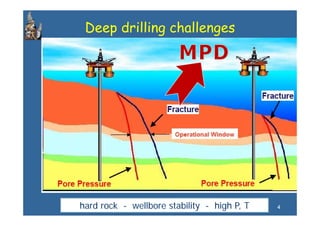
Deep drilling challenges


hard rock - wellbore stability - high P, T   4
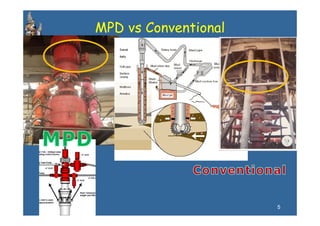
MPD vs Conventional


                      5
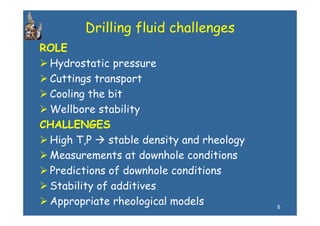
Drilling fluid challenges
ROLE
 Hydrostatic pressure
 Cuttings transport
 Cooling the bit
 Wellbore stability
           stab l ty
CHALLENGES
 High T P
      T,P    stable density and rheology
 Measurements at downhole conditions
 Predictions of downhole conditions
 Stability of additives
         y f
 Appropriate rheological models            6
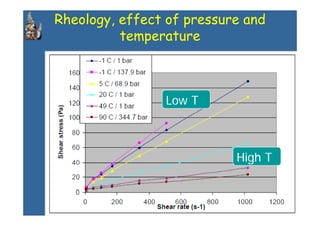
Rheology, effect of pressure and
          temperature


                Low T


                           High T


                                    7
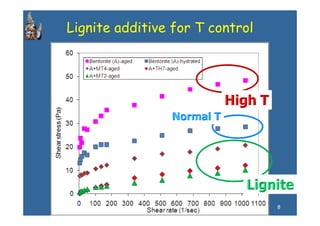
Lignite additive for T control


                                 8
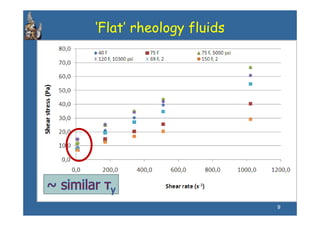
‘Flat’ rheology fluids


                         9
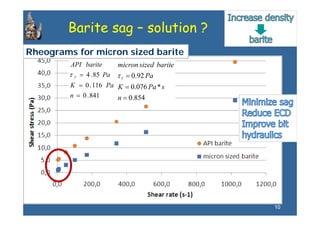
Barite sag – solution ?
Rheograms for micron sized barite
         API barite          micron sized barite
         τ   y   = 4 . 85 Pa τ y = 0.92 Pa
         K = 0 . 116 Pa * s = 0.076 Pa * s
                        K
         n = 0 . 841    n = 0.854


                                                   10
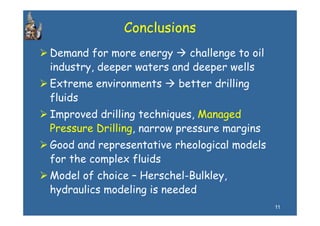
Conclusions
Demand for more energy     challenge to oil
industry, deeper waters and deeper wells
Extreme env ronments
        environments     better drilling
                                dr ll ng
fluids
Improved drilling techniques Managed
                   techniques,
Pressure Drilling, narrow pressure margins
Good and representative rheological models
for the complex fluids
           p
Model of choice – Herschel-Bulkley,
hydraulics modeling is needed
                                              11
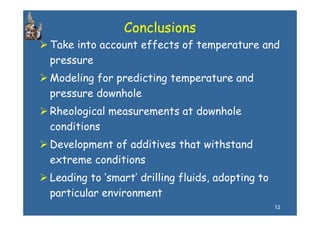
Conclusions
Take into account effects of temperature and
pressure
Modeling for predicting temperature and
pressure downhole
Rheological measurements at downhole
conditions
Development of additives that withstand
extreme conditions
Leading to ‘smart’ drilling fluids, adopting to
particular environment
   ti l       i        t
                                                  12
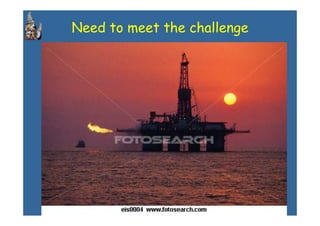
Need to meet the challenge


                             13

Challenges Drill Fluids

  • 1.
    DRILLING FLUID CHALLENGESFOR OIL-WELL DEEP DRILLING Vassilios C. KELESSIDIS vaskel1@hotmail.com sk l1@h tm il m Technical University of Crete Mineral Resources Engineering SGEM 2009 Albena, June 14-19, 2009
  • 2.
    Research aim Develop smartdrilling fluids Adaptable to harsh conditions Have available t h i H il bl techniques for optimal sf ti l measurements of fluid properties, particularly rheology Develop hydraulics models for pressure drop prediction along the wellbore Better understanding efficient cuttings transport in a multiphase environment 2
  • 3.
    The problem Drilling depths,total (>7000 m) and water (~ 3000m) depths, are ever increasing depths High pressures (>2000 bar) and high temperatures (>3000C) are encountered Narrow pressure tolerances Harder rock is encountered, lower drilling rates Demand for better drilling fluids, avoid p problems -understand behavior in such hostile m environments Hydraulic programs for complex rheology 3
  • 4.
    Deep drilling challenges hardrock - wellbore stability - high P, T 4
  • 5.
  • 6.
    Drilling fluid challenges ROLE Hydrostatic pressure Cuttings transport Cooling the bit Wellbore stability stab l ty CHALLENGES High T P T,P stable density and rheology Measurements at downhole conditions Predictions of downhole conditions Stability of additives y f Appropriate rheological models 6
  • 7.
    Rheology, effect ofpressure and temperature Low T High T 7
  • 8.
  • 9.
  • 10.
    Barite sag –solution ? Rheograms for micron sized barite API barite micron sized barite τ y = 4 . 85 Pa τ y = 0.92 Pa K = 0 . 116 Pa * s = 0.076 Pa * s K n = 0 . 841 n = 0.854 10
  • 11.
    Conclusions Demand for moreenergy challenge to oil industry, deeper waters and deeper wells Extreme env ronments environments better drilling dr ll ng fluids Improved drilling techniques Managed techniques, Pressure Drilling, narrow pressure margins Good and representative rheological models for the complex fluids p Model of choice – Herschel-Bulkley, hydraulics modeling is needed 11
  • 12.
    Conclusions Take into accounteffects of temperature and pressure Modeling for predicting temperature and pressure downhole Rheological measurements at downhole conditions Development of additives that withstand extreme conditions Leading to ‘smart’ drilling fluids, adopting to particular environment ti l i t 12
  • 13.
    Need to meetthe challenge 13