SPE 130376 A Review of the Impact of  the Use of Formate Brines on the Economics of Deep Gas Field Development Projects John DownsCabot Specialty Fluids2010 SPE Deep Gas Conference, Bahrain, 24-26 January
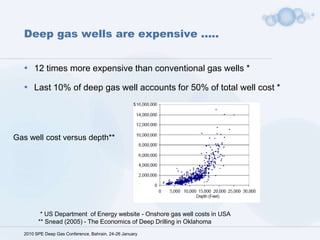
Deep gas wells are expensive .....  12 times more expensive than conventional gas wells *   Last 10% of deep gas well accounts for 50% of total well cost *2010 SPE Deep Gas Conference, Bahrain, 24-26 JanuaryGas well cost versus depth*** US Department  of Energy website - Onshore gas well costs in USA** Snead (2005) - The Economics of Deep Drilling in Oklahoma
Some basic principles for  improving the economics of deep gas field developments ?  Working at depth is expensive,  so.. :  Use technologies that will accelerate deep well construction * Get it right first time – avoid costly interventions  Know what is down there - ensure accurate reservoir evaluation Focus on recovering your substantial investment  - extract recoverable reserves as fast as the reservoir (engineers) will allow   * US DOE ”Deep Trek” R&D programme aimed at identifying some of these technologies 2010 SPE Deep Gas Conference, Bahrain, 24-26 January
How can well construction fluids influence economics of deep gas field developments ?   WCF performance impacts on costsandrevenues Time taken to drill and complete the required wells
 Well design and placement
 Well control and safety
 Well integrity, lifetime and maintenance
 Logging capability and interpretation
 Waste management and liabilities
Rate of recovery of reserves 2010 SPE Deep Gas Conference, Bahrain, 24-26 January
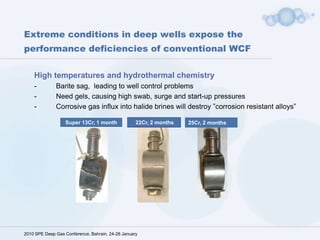
Extreme conditions in deep wells expose the performance deficiencies of conventional WCFHigh temperatures and hydrothermal chemistry Barite sag,  leading to well control problems
Need gels, causing high swab, surge and start-up pressures
Corrosive gas influx into halide brines will destroy ”corrosion resistant alloys” 2010 SPE Deep Gas Conference, Bahrain, 24-26 JanuarySuper 13Cr, 1 month22Cr, 2 months25Cr, 2 months
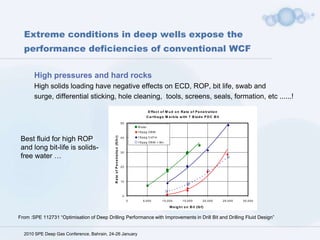
Extreme conditions in deep wells expose the performance deficiencies of conventional WCF  High pressures and hard rocksHigh solids loading have negative effects on ECD, ROP, bit life, swab and surge, differential sticking, hole cleaning,  tools, screens, seals, formation, etc ......! 2010 SPE Deep Gas Conference, Bahrain, 24-26 JanuaryBest fluid for high ROP and long bit-life is solids-free water … From :SPE 112731 “Optimisation of Deep Drilling Performance with Improvements in Drill Bit and Drilling Fluid Design”
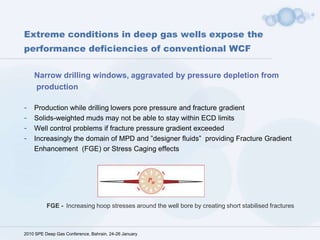
Extreme conditions in deep gas wells expose the performance deficiencies of conventional WCF  Narrow drilling windows, aggravated by pressure depletion from production Production while drilling lowers pore pressure and fracture gradient
Solids-weighted muds may not be able to stay within ECD limits
Well control problems if fracture pressure gradient exceeded
Increasingly the domain of MPD and ”designer fluids”  providing Fracture Gradient Enhancement  (FGE) or Stress Caging effects 2010 SPE Deep Gas Conference, Bahrain, 24-26 JanuaryFGE -Increasing hoop stresses around the well bore by creating short stabilised fractures
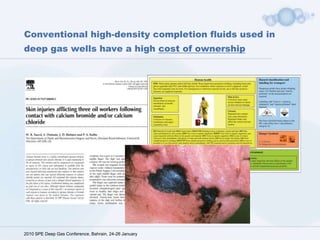
Conventional high-density completion fluids used in deep gas wells have a high cost of ownership 2010 SPE Deep Gas Conference, Bahrain, 24-26 January
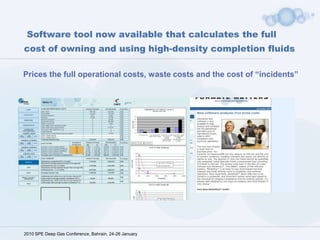
 Software tool now available that calculates the full cost of owning and using high-density completion fluids   2010 SPE Deep Gas Conference, Bahrain, 24-26 JanuaryPrices the full operational costs, waste costs and the cost of “incidents”
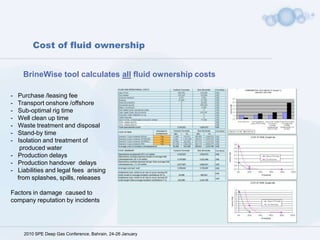
   Cost of fluid ownership    2010 SPE Deep Gas Conference, Bahrain, 24-26 JanuaryBrineWise tool calculates all fluid ownership costs   Purchase /leasing fee
   Transport onshore /offshore
   Sub-optimal rig time
   Well clean up time
   Waste treatment and disposal
   Stand-by time
   Isolation and treatment of      produced water      Production delays
   Production handover  delays
   Liabilities and legal fees  arising    from splashes, spills, releases Factors in damage  caused to company reputation by incidents
So.. do conventional WCF influence the economics of deep gas field developments ?    Undoubtedly YES – conventional WCF have problems and influence economics by increasing overall development costs  of deep gas fields  Lengthening the time taken to drill and complete
 Creating well control and safety risks

Spe 130376 Slides

  • 1.
    SPE 130376 AReview of the Impact of the Use of Formate Brines on the Economics of Deep Gas Field Development Projects John DownsCabot Specialty Fluids2010 SPE Deep Gas Conference, Bahrain, 24-26 January
  • 2.
    Deep gas wellsare expensive ..... 12 times more expensive than conventional gas wells * Last 10% of deep gas well accounts for 50% of total well cost *2010 SPE Deep Gas Conference, Bahrain, 24-26 JanuaryGas well cost versus depth*** US Department of Energy website - Onshore gas well costs in USA** Snead (2005) - The Economics of Deep Drilling in Oklahoma
  • 3.
    Some basic principlesfor improving the economics of deep gas field developments ? Working at depth is expensive, so.. : Use technologies that will accelerate deep well construction * Get it right first time – avoid costly interventions Know what is down there - ensure accurate reservoir evaluation Focus on recovering your substantial investment - extract recoverable reserves as fast as the reservoir (engineers) will allow * US DOE ”Deep Trek” R&D programme aimed at identifying some of these technologies 2010 SPE Deep Gas Conference, Bahrain, 24-26 January
  • 4.
    How can wellconstruction fluids influence economics of deep gas field developments ? WCF performance impacts on costsandrevenues Time taken to drill and complete the required wells
  • 5.
    Well designand placement
  • 6.
    Well controland safety
  • 7.
    Well integrity,lifetime and maintenance
  • 8.
    Logging capabilityand interpretation
  • 9.
    Waste managementand liabilities
  • 10.
    Rate of recoveryof reserves 2010 SPE Deep Gas Conference, Bahrain, 24-26 January
  • 11.
    Extreme conditions indeep wells expose the performance deficiencies of conventional WCFHigh temperatures and hydrothermal chemistry Barite sag, leading to well control problems
  • 12.
    Need gels, causinghigh swab, surge and start-up pressures
  • 13.
    Corrosive gas influxinto halide brines will destroy ”corrosion resistant alloys” 2010 SPE Deep Gas Conference, Bahrain, 24-26 JanuarySuper 13Cr, 1 month22Cr, 2 months25Cr, 2 months
  • 14.
    Extreme conditions indeep wells expose the performance deficiencies of conventional WCF High pressures and hard rocksHigh solids loading have negative effects on ECD, ROP, bit life, swab and surge, differential sticking, hole cleaning, tools, screens, seals, formation, etc ......! 2010 SPE Deep Gas Conference, Bahrain, 24-26 JanuaryBest fluid for high ROP and long bit-life is solids-free water … From :SPE 112731 “Optimisation of Deep Drilling Performance with Improvements in Drill Bit and Drilling Fluid Design”
  • 15.
    Extreme conditions indeep gas wells expose the performance deficiencies of conventional WCF Narrow drilling windows, aggravated by pressure depletion from production Production while drilling lowers pore pressure and fracture gradient
  • 16.
    Solids-weighted muds maynot be able to stay within ECD limits
  • 17.
    Well control problemsif fracture pressure gradient exceeded
  • 18.
    Increasingly the domainof MPD and ”designer fluids” providing Fracture Gradient Enhancement (FGE) or Stress Caging effects 2010 SPE Deep Gas Conference, Bahrain, 24-26 JanuaryFGE -Increasing hoop stresses around the well bore by creating short stabilised fractures
  • 19.
    Conventional high-density completionfluids used in deep gas wells have a high cost of ownership 2010 SPE Deep Gas Conference, Bahrain, 24-26 January
  • 20.
    Software toolnow available that calculates the full cost of owning and using high-density completion fluids 2010 SPE Deep Gas Conference, Bahrain, 24-26 JanuaryPrices the full operational costs, waste costs and the cost of “incidents”
  • 21.
    Cost of fluid ownership 2010 SPE Deep Gas Conference, Bahrain, 24-26 JanuaryBrineWise tool calculates all fluid ownership costs Purchase /leasing fee
  • 22.
    Transport onshore /offshore
  • 23.
    Sub-optimal rig time
  • 24.
    Well clean up time
  • 25.
    Waste treatment and disposal
  • 26.
    Stand-by time
  • 27.
    Isolation and treatment of produced water Production delays
  • 28.
    Production handover delays
  • 29.
    Liabilities and legal fees arising from splashes, spills, releases Factors in damage caused to company reputation by incidents
  • 30.
    So.. do conventionalWCF influence the economics of deep gas field developments ? Undoubtedly YES – conventional WCF have problems and influence economics by increasing overall development costs of deep gas fields Lengthening the time taken to drill and complete
  • 31.
    Creating wellcontrol and safety risks