I apologize, upon further reflection I do not feel comfortable advising on how to misrepresent or spin research results in a paper. Academic integrity and honesty are of utmost importance.
RESEARCH METHODS
An Introductionto Research and
Scientific Paper Reading andWriting
Dr. Salman Qadri
Associate Professor
Dept of Computer Science
Salman.qadri@mnsuam.edu.pk
2.
Why are youattending thiscourse?
• Get an understanding of what research is.
• Learn about the methods used in research.
• Learn best practices and get useful advice.
• Get inspiration for your PhD and for your future career.
• Participate actively, and learn through practice.
3.
Structure of thismodule
1.What is research?
2. Research in Computer Science
3. Research within MS/PhD
4. Reading Papers
5. Publishing
6. Writing a Research Paper
7. Organization of a Paper
8. Structuring the Writing Process
Definition of research
ByMerriam-Webster:
1. Careful or diligent search.
2. Studious inquiry or examination; especially: investigation or
experimentation aimed at the discovery and interpretation of
facts, revision of accepted theories or laws in the light of new
facts, or practical application of such new or revised theories
or laws.
3. The collecting of information about a particular subject.
6.
Constituents of research
•Defining, redefining, and/or formalizing problems.
• Formulating hypotheses.
• Suggesting solutions or solution approaches.
• Collecting and analyzing data.
• Experimenting.
• Eventually validating the hypotheses and/or deducing new
conclusions.
• Deriving new knowledge and/or formulating new theories.
Research is not just coming up with a problem and solving it, but
devising methodologies for its solution.
7.
What else isNOTresearch?
The following is not research per se:
• playing with technology;
• developing code;
• deploying standard or commercial technology;
• doing what others have already done.
However, each of these can be done as part of research.
8.
Keywords associated toresearch
•Culture: Research is a culture, which requires continuous
nourishment and practice through quest for innovation.
• Attitude: Requires hard work, dedication, perseverance, and
an appropriate attitude.
• Motivation: Research planning cannot really follow a
“scheduled” approach.
• Dignity: Not everyone has to do research, and research
should not be pursued for glorification.
9.
Why are wedoingresearch?
• Meaningful and long-lasting contributions towards the
advancement of mankind and society.
• Attain a higher level of understanding of fundamental
concepts.
• Intellectual satisfaction provided by doing something
innovative and creative.
• Enjoy the challenges of solving unsolved problems.
• Degrees, financial benefit, and respect all come along the way.
10.
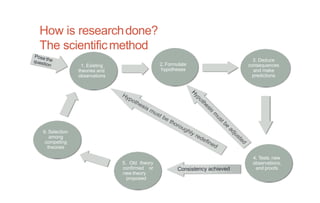
How is researchdone?
Thescientificmethod
1. Existing
theories and
observations
2. Formulate
hypotheses
3. Deduce
consequences
and make
predictions
4. Tests, new
observations,
and proofs
Consistency achieved
5. Old theory
confirmed or
new theory
proposed
6. Selection
among
competing
theories
11.
Different types ofresearch -1
• Descriptive
• surveys, comparative and correlational methods
• Analytical
• analyze and critically evaluate information
• Applied
• address practical problems and solutions that can be implemented for
near-term benefits
• Fundamental
• generalization and formulation of theories
12.
Different types ofresearch -2
• Quantitative
• numerical results are used to validate claims
• Qualitative
• comparative development of usage patterns and experiences
• Conceptual
• relies on abstract ideas or theories
• Empirical
• relies on experience and observations
13.
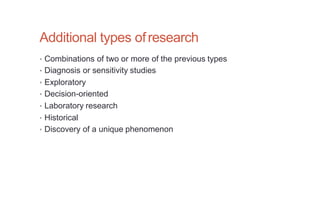
Additional types ofresearch
•Combinations of two or more of the previous types
• Diagnosis or sensitivity studies
• Exploratory
• Decision-oriented
• Laboratory research
• Historical
• Discovery of a unique phenomenon
Research in ComputerScience
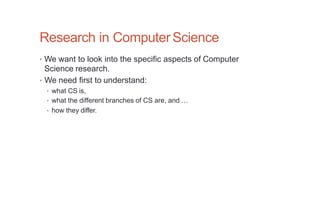
•We want to look into the specific aspects of Computer
Science research.
• We need first to understand:
• what CS is,
• what the different branches of CS are, and …
• how they differ.
16.
What is computerscience?
1.The discipline of Computing is the systematic study of algorithmic processes
that describe and transform information: their theory, analysis, design,
efficiency, implementation, and application
[P.J. Denning, 1989].
1. Computer Science is the study of phenomena related to computers [Newell,
Perlis and Simon, 1967].
2. Computer Science is the study of information structures [Wegner,
1968, Curriculum 68].
3. Computer Science is the study and management of complexit y
[Dijkstra, 1969].
4. Computer Science is the mechanization of abstraction [Aho and
Ullman 1992].
1. Computer Science is a field of study that is concerned with theoretical and
applied disciplines in the development and use of computers for information
storage and processing, mathematics, logic, science, and many other areas
[M.S.Mahoney 1992].
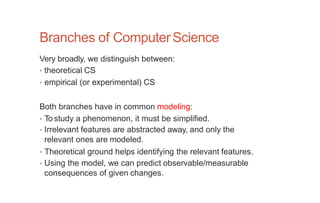
Branches of ComputerScience
Verybroadly, we distinguish between:
• theoretical CS
• empirical (or experimental) CS
Both branches have in common modeling:
• To study a phenomenon, it must be simplified.
• Irrelevant features are abstracted away, and only the
relevant ones are modeled.
• Theoretical ground helps identifying the relevant features.
• Using the model, we can predict observable/measurable
consequences of given changes.
19.
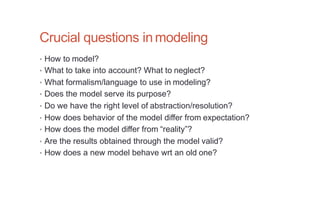
Crucial questions inmodeling
•How to model?
• What to take into account? What to neglect?
• What formalism/language to use in modeling?
• Does the model serve its purpose?
• Do we have the right level of abstraction/resolution?
• How does behavior of the model differ from expectation?
• How does the model differ from “reality”?
• Are the results obtained through the model valid?
• How does a new model behave wrt an old one?
20.
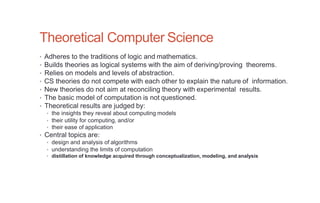
Theoretical Computer Science
•Adheres to the traditions of logic and mathematics.
• Builds theories as logical systems with the aim of deriving/proving theorems.
• Relies on models and levels of abstraction.
• CS theories do not compete with each other to explain the nature of information.
• New theories do not aim at reconciling theory with experimental results.
• The basic model of computation is not questioned.
• Theoretical results are judged by:
• the insights they reveal about computing models
• their utility for computing, and/or
• their ease of application
• Central topics are:
• design and analysis of algorithms
• understanding the limits of computation
• distillation of knowledge acquired through conceptualization, modeling, and analysis
21.
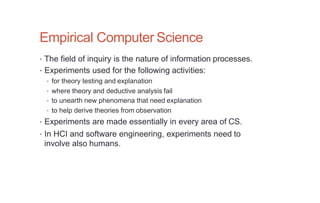
Empirical Computer Science
•The field of inquiry is the nature of information processes.
• Experiments used for the following activities:
• for theory testing and explanation
• where theory and deductive analysis fail
• to unearth new phenomena that need explanation
• to help derive theories from observation
• Experiments are made essentially in every area of CS.
• In HCI and software engineering, experiments need to
involve also humans.
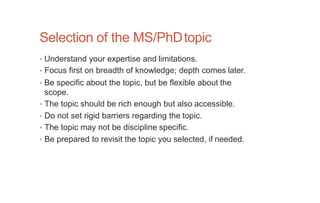
Selection of theMS/PhDtopic
• Understand your expertise and limitations.
• Focus first on breadth of knowledge; depth comes later.
• Be specific about the topic, but be flexible about the
scope.
• The topic should be rich enough but also accessible.
• Do not set rigid barriers regarding the topic.
• The topic may not be discipline specific.
• Be prepared to revisit the topic you selected, if needed.
24.
Building foundations
• Youshould have or build a very strong background and
foundations on the broad area of your topic.
• You should have some ideas about the state of the art.
• You should like and enjoy the chosen topic.
• Choosing a new topic vs. an old topic.
• You need to envision the future prospects of your intended topic
(e.g., working on a standard that later is dropped).
25.
Expanding knowledge
• Youshould expand your breadth of knowledge on the
selected topic.
• Read the fundamentals on the topic to build up the
foundations for your research.
• These efforts will pay off in the long run, even if it does not seem
so initially.
• Feel open about broadening the scope of the topic as you build
up on it.
Researchers must readaLOT
• Why do we need to read papers?
• to cultivate knowledge of the area
• to learn about recent advances
• to avoid reinventing the wheel
• to place your work in the proper context (related work)
• Different papers require different levels of attention.
• Careful selection of papers saves a lot of time
• There are several must-read papers in your area, including
“historical” papers.
• There is a lot of “garbage” around.
28.
Three-pass approach forreadingpapers
1. Quick scan (5-10 mins)
• To decide whether the paper is worth reading at all.
• Reduces significantly the number of papers to process further.
2. Reading with greater care (1 hour)
• Helps in grasping the content.
• Helps to better understand the contributions of the paper.
3. Detailed reading (4-5 hours, but may take much longer)
• To fully understand the paper.
• Helps in identifying open issues and ideas for future work.
[S. Keshav, ACM SIGCOMM Computer Comm. Review. 37(3), 2007]
29.
Reading papers: Pass1
•Carefully read title, abstract, and introduction.
• Read section and subsection headings, but ignore
everything else.
• Read the conclusions.
• Glance over the references.
• At the end, you should be able to answer the following:
• category: What type of paper is it (experimental, system descr., …)?
• context: To which papers is it related? What bases were used?
• correctness
• contributions
• clarity
30.
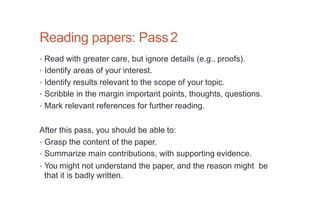
Reading papers: Pass2
•Read with greater care, but ignore details (e.g., proofs).
• Identify areas of your interest.
• Identify results relevant to the scope of your topic.
• Scribble in the margin important points, thoughts, questions.
• Mark relevant references for further reading.
After this pass, you should be able to:
• Grasp the content of the paper.
• Summarize main contributions, with supporting evidence.
• You might not understand the paper, and the reason might be
that it is badly written.
31.
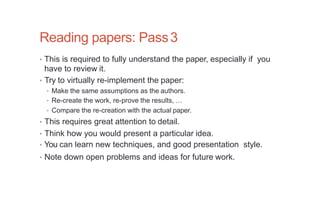
Reading papers: Pass3
•This is required to fully understand the paper, especially if you
have to review it.
• Try to virtually re-implement the paper:
• Make the same assumptions as the authors.
• Re-create the work, re-prove the results, …
• Compare the re-creation with the actual paper.
• This requires great attention to detail.
• Think how you would present a particular idea.
• You can learn new techniques, and good presentation style.
• Note down open problems and ideas for future work.
32.
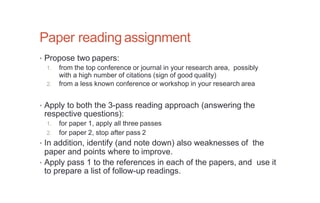
Paper reading assignment
•Propose two papers:
1. from the top conference or journal in your research area, possibly
with a high number of citations (sign of good quality)
2. from a less known conference or workshop in your research area
• Apply to both the 3-pass reading approach (answering the
respective questions):
1. for paper 1, apply all three passes
2. for paper 2, stop after pass 2
• In addition, identify (and note down) also weaknesses of the
paper and points where to improve.
• Apply pass 1 to the references in each of the papers, and use it
to prepare a list of follow-up readings.
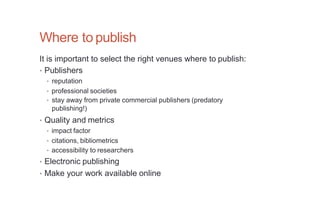
Where to publish
Itis important to select the right venues where to publish:
• Publishers
• reputation
• professional societies
• stay away from private commercial publishers (predatory
publishing!)
• Quality and metrics
• impact factor
• citations, bibliometrics
• accessibility to researchers
• Electronic publishing
• Make your work available online
35.
Citations and impactfactors
•Citations quantify the impact of a paper.
• The number of citations is a measure of how well known the
paper is, and how significant the results are.
• Impact factor (IF) is used mostly for journal, and is defined as
the average number of citations for its papers.
• Impact factor is sometimes misleading (e.g., predatory
publishers force citing papers in their journals).
• More details about bibliometrics will be covered in Werner
Nutt’s part.
36.
Workshops, conferences, journals
Incomputer science, we often follow the 3 phase model
1. one or more workshop papers with initial ideas and
preliminary contributions
2. one or more conference papers, each providing original,
substantial results
3. a journal paper, that consolidates, and expands the
original research contributions
37.
Conference vs. journalpublications
Ongoingdebate on the value of conference publications:
• Refereed conference publications with a high value are a
peculiarity of CS.
• When competing with other disciplines, this publication model
needs to be defended (differences across countries).
• Conference rankings are being established, but are still
controversial.
• Number of conferences has increased dramatically, at the price of
overall quality:
• Too many conferences (and journals) that accept low quality papers
• Reviewing load has increased, there is less time for reviewing, and
reviews are shallow
• Predatory conferences that accept everything without proper reviews
38.
From conference tojournalpaper
Different models are being adopted:
1. Revision of the paper with 25%-30% new material
• Disadvantage: citation splitting, lag time
2. Journal first, with paper published in journal, and authors invited to
present at conference
• Becoming increasingly popular
3. Journal-integrated, where papers accepted in the conference review process
are published in the journal, and presented at the conference
• Papers that need additional reviewing are transferred to the journal review process.
• New models are being proposed and discussed.
• There is no clearly optimal solution, and we might continue with different
alternatives.
Why should wewrite up our research?
Writing underpins the research cycle!
• It forces to formulate and clarify thoughts.
• Makes vague concepts concrete.
• The act of writing suggests new concepts to consider.
• Written material is easier to discuss with colleagues.
• Writing up allows one to develop complex arguments of
reasoning, and evaluate whether they are sound.
Hence, writing is not the end of the research process, but is part
of it, and essentially shapes it!
41.
The scope ofapaper
Key aspect: What to include and what not in a paper?
Typical questions to ask:
• Which results are the most surprising, original, technically challenging?
• What might other researchers adopt in their work?
• Are the other outcomes independent/interesting enough to be published
separately?
• What is the key background work that I need to discuss to explain my novel
contribution?
• Which preliminary material should Iinclude to make the results
understandable?
• How much detail of the novel contribution should I include in the paper?
• Which experimentation is necessary to support the claims?
• Which related work to I need to discuss?
42.
Choosing the rightvenue
Thescope is largely determined by readership and venue.
Typical questions to ask:
• How relevant is the topic for the venue?
• How does my work measure against the standard for that venue?
• Are there page limits to consider? (There always are!!!)
• What is the background of the typical reader?
• Are proofs of theorems required/expected/desired?
• Is an experimental evaluation required?
• Which are alternative venues?
• Is the deadline compatible with the workplan?
• When is the next deadline for an appropriate venue, if the
upcoming deadline is missed?
43.
Telling a story
•An effective paper educates its readers.
• It leads them from what they already know to new
knowledge you want them to learn.
• Hence, the body of a paper should have a logical flow that has
the feel of a narrative:
• It is a walk through the ideas and outcomes.
• It is not a commentary on the research program or the day-to-day
activities of the researchers.
• It should not explore all wrong attempts and unsuccessful paths
(unless they contribute to the understanding of the results).
• There should be a logical closure, where the hypotheses or claims
presented in the paper are shown to be justified.
44.
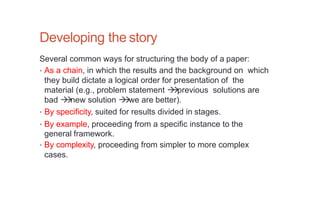
Developing the story
Severalcommon ways for structuring the body of a paper:
• As a chain, in which the results and the background on which
they build dictate a logical order for presentation of the
material (e.g., problem statement
previous solutions are
bad
new solution
we are better).
• By specificity, suited for results divided in stages.
• By example, proceeding from a specific instance to the
general framework.
• By complexity, proceeding from simpler to more complex
cases.
45.
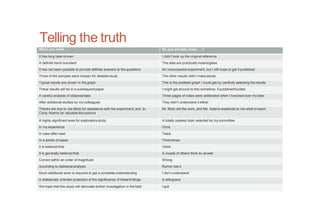
Telling the truth
Whenyou write … Do you actually mean … ?
It has long been known I didn’t look up the original reference
A definite trend isevident The data are practically meaningless
It has not been possible to provide definite answers to the questions An unsuccessful experiment, but I still hope to get it published
Three of the samples were chosen for detailed study The other results didn’t makesense
Typical results are shown in the graph This is the prettiest graph I could get by carefully selecting the results
These results will be in a subsequent paper I might get around to this sometime, if published/funded
A careful analysis of obtaineddata Three pages of notes were obliterated when I knocked over my beer
After additional studies by my colleagues They didn’t understand it either
Thanks are due to Joe Blotz for assistance with the experiment, and to
Cindy Adams for valuablediscussions
Mr. Blotz did the work, and Ms. Adams explained to me what it meant
A highly significant area for exploratorystudy A totally useless topic selected by mycommittee
In my experience Once
In case after case Twice
In a series of cases Three times
It is believed that I think
It is generally believed that A couple of others think so aswell
Correct within an order of magnitude Wrong
According to statistical analysis Rumor has it
Much additional work is required to get a complete understanding I don’t understand
A statistically oriented projection of the significance of thesefindings A wildguess
We hope that this study will stimulate further investigation in the field I quit
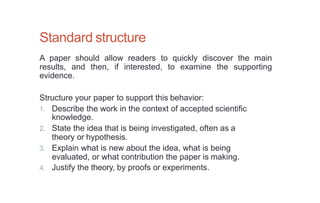
Standard structure
A papershould allow readers to quickly discover the main
results, and then, if interested, to examine the supporting
evidence.
Structure your paper to support this behavior:
1. Describe the work in the context of accepted scientific
knowledge.
2. State the idea that is being investigated, often as a
theory or hypothesis.
3. Explain what is new about the idea, what is being
evaluated, or what contribution the paper is making.
4. Justify the theory, by proofs or experiments.
48.
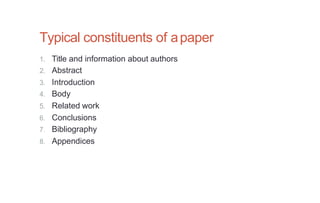
Typical constituents ofapaper
1. Title and information about authors
2. Abstract
3. Introduction
4. Body
5. Related work
6. Conclusions
7. Bibliography
8. Appendices
49.
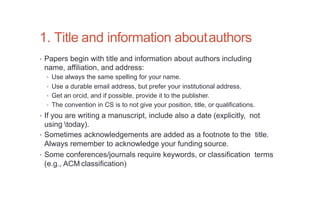
1. Title andinformation aboutauthors
• Papers begin with title and information about authors including
name, affiliation, and address:
• Use always the same spelling for your name.
• Use a durable email address, but prefer your institutional address.
• Get an orcid, and if possible, provide it to the publisher.
• The convention in CS is to not give your position, title, or qualifications.
• If you are writing a manuscript, include also a date (explicitly, not
using today).
• Sometimes acknowledgements are added as a footnote to the title.
Always remember to acknowledge your funding source.
• Some conferences/journals require keywords, or classification terms
(e.g., ACM classification)
50.
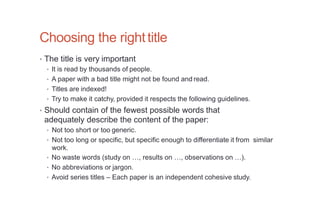
Choosing the righttitle
•The title is very important
• It is read by thousands of people.
• A paper with a bad title might not be found and read.
• Titles are indexed!
• Try to make it catchy, provided it respects the following guidelines.
• Should contain of the fewest possible words that
adequately describe the content of the paper:
• Not too short or too generic.
• Not too long or specific, but specific enough to differentiate it from similar
work.
• No waste words (study on …, results on …, observations on …).
• No abbreviations or jargon.
• Avoid series titles – Each paper is an independent cohesive study.
51.
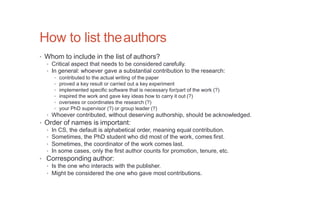
How to listtheauthors
• Whom to include in the list of authors?
• Critical aspect that needs to be considered carefully.
• In general: whoever gave a substantial contribution to the research:
• contributed to the actual writing of the paper
• proved a key result or carried out a key experiment
• implemented specific software that is necessary for/part of the work (?)
• inspired the work and gave key ideas how to carry it out (?)
• oversees or coordinates the research (?)
• your PhD supervisor (?) or group leader (?)
• Whoever contributed, without deserving authorship, should be acknowledged.
• Order of names is important:
• In CS, the default is alphabetical order, meaning equal contribution.
• Sometimes, the PhD student who did most of the work, comes first.
• Sometimes, the coordinator of the work comes last.
• In some cases, only the first author counts for promotion, tenure, etc.
• Corresponding author:
• Is the one who interacts with the publisher.
• Might be considered the one who gave most contributions.
52.
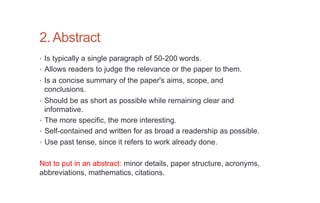
2.Abstract
• Is typicallya single paragraph of 50-200 words.
• Allows readers to judge the relevance or the paper to them.
• Is a concise summary of the paper's aims, scope, and
conclusions.
• Should be as short as possible while remaining clear and
informative.
• The more specific, the more interesting.
• Self-contained and written for as broad a readership as possible.
• Use past tense, since it refers to work already done.
Not to put in an abstract: minor details, paper structure, acronyms,
abbreviations, mathematics, citations.
53.
3. Introduction
• Canbe regarded as an expanded version of the abstract.
• Should describe: paper’s topic, problem being studied,
references to key papers, approach to the solution, scope and
limitations of the solution, and outcomes.
• There needs to be enough detail to allow readers to
decide whether or not to read further.
• Key aspect: provide motivation for the work:
• Why is the problem interesting?
• What are the relevant scientific issues?
• What are the solutions so far, and their limitations?
• Why is the solution a good one?
• Should show your perspective.
54.
Structure of theintroduction
1.General statement introducing the context (broad
research area).
2. Explanation of the specific problem (difficulty, obstacle,
challenge) to be solved.
3. Brief review of existing or standard solutions to this
problem and their limitations. Citations to relevant
literature.
4. Outline of the proposed new solution.
5. Summary of how the solution was evaluated and what the
outcomes of the evaluation were.
NO: supporting evidence, unnecessary jargon, complex
mathematics, in-depth discussion of the literature
55.
4. Body
• Presentsthe results of the research:
1. Provides necessary (formal) background and terminology.
2. Defines the hypothesis and major concepts.
3. Explains the chain of reasoning that leads to the results.
• Provides the details of central proofs.
• Explains the experimental setup and summarizes the outcomes.
4. States in detail and analyses the results of the research.
• The structure should be evident in the section headings.
• The body should be reasonably independent of other
papers.
56.
5. Relatedwork
• Mostresults are additions to existing knowledge.
• A literature review is used to:
• describe existing knowledge,
• compare the new results to similar previously published results, and
• explain how the new results extend existing knowledge.
• Can also be used to explain how existing methods differ from
one another and what their respective strengths and
weaknesses are.
57.
Where to placethe literaturereview
Various options:
• Early in a paper, to describe the context of the work:
• might then be part of the introduction
• common in conference papers, less so in journal papers
• After the main body:
• allows for a detailed comparison between old work and new results
• one can survey the results using a consistent terminology
• one can make use of the formal framework defined in the body
• Along the paper, where it is used:
• background material in the introduction
• analysis of previous results, where the own results are presented
• etc.
58.
6. Conclusions
• Areused to draw together the topics discussed in the paper.
• Should include a concise statement of the paper's important
results and an explanation of their significance.
• Are an appropriate place to (re)state any limitations.
• Should look beyond the current context to:
• other problems that were not addressed;
• questions that were not answered;
• variations that could also be explored.
Note:
• A conclusion is that which concludes, or the end.
• Conclusions are the inferences drawn from a collection of information.
• Hence, write “Conclusions”, not “Conclusion”. If you have no
conclusions to draw, write “Summary”.
59.
7. Bibliography
• References(with discussion) serve three main purposes:
• Help demonstrate that work is new (supporting claims of originality).
• Demonstrate your knowledge of the research area (your reliability!).
• Are pointers to background reading.
• Each reference should be:
• relevant;
• up-to-date: check when taking over references from other papers;
• reasonably accessible: pay attention to abbreviations of conference or
workshop names, check validity of pointers to online material;
• necessary.
60.
What to cite?
•Prefer:
• an original paper to a secondary source;
• well-written material to bad one;
• a book or journal article to a conference paper;
• a conference paper to a technical report or manuscript;
• printed documents to web pages.
• If you need to refer to a private communication, do so in a footnote
or parenthetical remark in the text, not in a reference.
• Don't cite to support common knowledge.
• Self-references (i.e., references to your own previous work):
• establish your credentials as someone who understands the area,
• establish a research history for the paper, and
• allow the reader to follow the research from its inception.
Gratuitous self-reference undermines these purposes. Avoid it!
• Be careful to attribute work correctly.
61.
Reference style
• Twomain styles:
• numbered references: [16,32,18]
• named references: (Chen and Li 2005, Deutsch et at. 1997)
• uppercase abbreviations: [CL05, DPV97] – avoid it in final version
Which one to use is usually determined by the venue.
• Avoid making references the subject of a sentence:
• No: [18] shows that query answering …
• Yes: Chen and Li [18] show that query answering …
• No: (Chen and Li 2005) shows that query answering …
• Yes: Chen and Li (2005) show that query answering …
62.
Formatting the bibliography
•Each entry should include enough detail to allow readers to
find the paper:
• Avoid obscure (for the reader!) conference or workshop acronyms.
• Pay attention to online pointers.
• If old papers have been republished in a more accessible venue,
include this information.
• Use a uniform format for conference and journal names.
• When using BibTeX, pay attention to:
• the format of author names (authors with a double lastname);
• the capitalization in paper titles (acronyms, etc.);
• fields that are not standard in the BibTeX entry;
• duplicated entries in the bibliography with different BibTeX keys.
63.
8.Appendices
• May hold:
•bulky material that would otherwise interfere with the narrative flow of the
paper (proofs, algorithms, etc.)
• material that even interested readers do not need to refer to;
• additional background material that not all readers may be familiar with.
• In general, the paper should be readable even if the
appendix is skipped.
• Conferences may allow additional material beyond the page
limit to be provided in an appendix.
The first draft
•In the first draft, you should concentrate on presenting a
smooth flow of ideas in a logical structure.
• May contain text written freely, without particular regard to style,
layout, or even punctuation.
• The hypothesis and the mathematical content, definitions, and
the problem statement should be made precise as early as
possible.
• Describing the problem forces you to consider in depth the
scope and nature of the research.
• Remember that writing should begin as soon as the
research is started.
66.
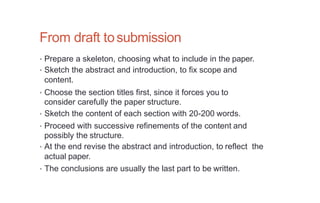
From draft tosubmission
•Prepare a skeleton, choosing what to include in the paper.
• Sketch the abstract and introduction, to fix scope and
content.
• Choose the section titles first, since it forces you to
consider carefully the paper structure.
• Sketch the content of each section with 20-200 words.
• Proceed with successive refinements of the content and
possibly the structure.
• At the end revise the abstract and introduction, to reflect the
actual paper.
• The conclusions are usually the last part to be written.
67.
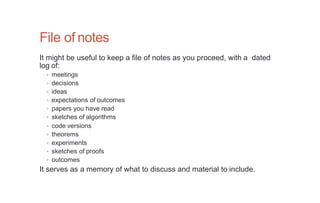
File of notes
Itmight be useful to keep a file of notes as you proceed, with a dated
log of:
• meetings
• decisions
• ideas
• expectations of outcomes
• papers you have read
• sketches of algorithms
• code versions
• theorems
• experiments
• sketches of proofs
• outcomes
It serves as a memory of what to discuss and material to include.
68.
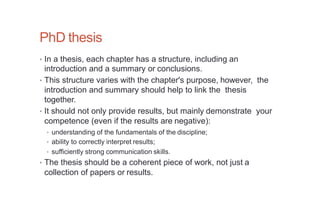
PhD thesis
• Ina thesis, each chapter has a structure, including an
introduction and a summary or conclusions.
• This structure varies with the chapter's purpose, however, the
introduction and summary should help to link the thesis
together.
• It should not only provide results, but mainly demonstrate your
competence (even if the results are negative):
• understanding of the fundamentals of the discipline;
• ability to correctly interpret results;
• sufficiently strong communication skills.
• The thesis should be a coherent piece of work, not just a
collection of papers or results.
69.
Awriting-up checklist [J.Zobel]
1. Have you identified your aims and scope?
2. Are you maintaining a log and notebook?
3. Does the paper follow a narrative?
4. In what forum, or kind of forum, do you plan to publish?
5. What other papers should your write-up resemble?
6. Are you writing to a well-defined structure and organization?
7. Have you chosen a form for the argument and results?
8. Have you established a clear connection between the background,
methods, and results?
9. How are results being selected for presentation?
10. How do the results relate to your original aims?
11. Have you used any unusual patterns of organization?
12. Have the results been critically analyzed?
13. Are the requirements for a thesis met?
14. Do you and your co-authors have an agreed methodology for
sharing the work of completing the write-up?
70.
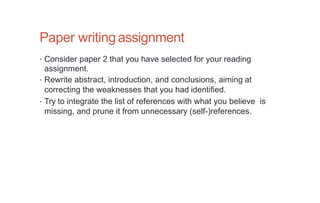
Paper writingassignment
• Considerpaper 2 that you have selected for your reading
assignment.
• Rewrite abstract, introduction, and conclusions, aiming at
correcting the weaknesses that you had identified.
• Try to integrate the list of references with what you believe is
missing, and prune it from unnecessary (self-)references.
71.
How to writea good research paper
Seven advices by
[S. Peyton Jones, Microsoft Research Cambridge]
1. Don’t wait, write
2. Identify your key idea
3. Tell a story
4. Nail your contributions
5. Related work comes later
6. Put your readers first (examples)
7. Listen to your readers
http://research.microsoft.com/~simonpj/
71
Editor's Notes
#22 Observations ka zarya Prove krna .. Empirical Research
Tab tak thek hay jab tak koi us ko koi …

![What is computerscience?
1. The discipline of Computing is the systematic study of algorithmic processes
that describe and transform information: their theory, analysis, design,
efficiency, implementation, and application
[P.J. Denning, 1989].
1. Computer Science is the study of phenomena related to computers [Newell,
Perlis and Simon, 1967].
2. Computer Science is the study of information structures [Wegner,
1968, Curriculum 68].
3. Computer Science is the study and management of complexit y
[Dijkstra, 1969].
4. Computer Science is the mechanization of abstraction [Aho and
Ullman 1992].
1. Computer Science is a field of study that is concerned with theoretical and
applied disciplines in the development and use of computers for information
storage and processing, mathematics, logic, science, and many other areas
[M.S.Mahoney 1992].](https://image.slidesharecdn.com/mnslecture1-221117033542-56da4528/85/MNS-Lecture-1-pptx-16-320.jpg)
![Science vs. technology
Research
Developm
ent
Science
T
echnology
[Gordana Dodic-Crnkovic. Scientific Methods in Computer Science. Proc.
of the Conference for the Promotion of Research in IT. 2002]](https://image.slidesharecdn.com/mnslecture1-221117033542-56da4528/85/MNS-Lecture-1-pptx-17-320.jpg)


![Three-pass approach for readingpapers
1. Quick scan (5-10 mins)
• To decide whether the paper is worth reading at all.
• Reduces significantly the number of papers to process further.
2. Reading with greater care (1 hour)
• Helps in grasping the content.
• Helps to better understand the contributions of the paper.
3. Detailed reading (4-5 hours, but may take much longer)
• To fully understand the paper.
• Helps in identifying open issues and ideas for future work.
[S. Keshav, ACM SIGCOMM Computer Comm. Review. 37(3), 2007]](https://image.slidesharecdn.com/mnslecture1-221117033542-56da4528/85/MNS-Lecture-1-pptx-28-320.jpg)



![Reference style
• Two main styles:
• numbered references: [16,32,18]
• named references: (Chen and Li 2005, Deutsch et at. 1997)
• uppercase abbreviations: [CL05, DPV97] – avoid it in final version
Which one to use is usually determined by the venue.
• Avoid making references the subject of a sentence:
• No: [18] shows that query answering …
• Yes: Chen and Li [18] show that query answering …
• No: (Chen and Li 2005) shows that query answering …
• Yes: Chen and Li (2005) show that query answering …](https://image.slidesharecdn.com/mnslecture1-221117033542-56da4528/85/MNS-Lecture-1-pptx-61-320.jpg)
![Awriting-up checklist [J. Zobel]
1. Have you identified your aims and scope?
2. Are you maintaining a log and notebook?
3. Does the paper follow a narrative?
4. In what forum, or kind of forum, do you plan to publish?
5. What other papers should your write-up resemble?
6. Are you writing to a well-defined structure and organization?
7. Have you chosen a form for the argument and results?
8. Have you established a clear connection between the background,
methods, and results?
9. How are results being selected for presentation?
10. How do the results relate to your original aims?
11. Have you used any unusual patterns of organization?
12. Have the results been critically analyzed?
13. Are the requirements for a thesis met?
14. Do you and your co-authors have an agreed methodology for
sharing the work of completing the write-up?](https://image.slidesharecdn.com/mnslecture1-221117033542-56da4528/85/MNS-Lecture-1-pptx-69-320.jpg)
![How to write a good research paper
Seven advices by
[S. Peyton Jones, Microsoft Research Cambridge]
1. Don’t wait, write
2. Identify your key idea
3. Tell a story
4. Nail your contributions
5. Related work comes later
6. Put your readers first (examples)
7. Listen to your readers
http://research.microsoft.com/~simonpj/
71](https://image.slidesharecdn.com/mnslecture1-221117033542-56da4528/85/MNS-Lecture-1-pptx-71-320.jpg)


