Module 1
Meaningof Research
Objectives of Engineering Research
Motivation in Engineering Research
Types of Engineering Research
Finding and Solving Worthwhile problem
Ethics in Engineering Research Practice
Types of Research Misconduct
Ethics Issues Related to Authorship
3.
Meaning of Research
Research in simple terms refers to search for knowledge.
It is a scientific and systematic search for information on a particular topic or issue.
It is also known as the art of scientific investigation.
Several social scientists have defined research in different ways.
It’s like being curious and looking for answers to things we don’t know yet.
Re + Search=Research (again & again and search means to find something)
Research is an attempt to know new things, facts, information etc, in a scientific manner.
4.
Definition: Researchrefers to a careful, well-defined, objective based, and systematic method of search for
knowledge.
--OR–
Research is defined as formulation of a theory that is driven by inquisitiveness (curious)for that which is unknown
and useful on a particular aspect so as to make an original contribution to expand the existing knowledge base.
--OR—
Research is a process of creating, or formulating knowledge that does not yet exist.
5.
Who needs research?
Researchis needed when you want to find out something new about something that interests
you.
6.
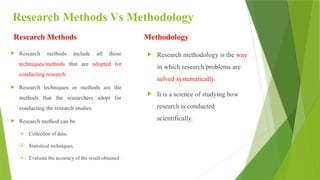
Research Methods VsMethodology
Research Methods
Research methods include all those
techniques/methods that are adopted for
conducting research.
Research techniques or methods are the
methods that the researchers adopt for
conducting the research studies.
Research method can be
Collection of data,
Statistical techniques,
Evaluate the accuracy of the result obtained.
Methodology
Research methodology is the way
in which research problems are
solved systematically.
It is a science of studying how
research is conducted
scientifically.
Research processis a series of steps or action taken to conduct a research.
The research process consists of a series of systematic procedures that a researcher must go
through in order to generate knowledge.
The research process starts with identifying a research problem and conducting a literature
review to understand the context.
The researcher sets research questions, objectives, and hypotheses based on the research
problem.
9.
Formulation of researchproblem
First step of research process is selecting the research topic, area of study
Literature review
Reviewing the already published material on the topic under research, sources of literature are
books, journals, research paper, scholarly articles etc,
Literature review provide foundational knowledge of topics under research
Research design
It include strategies & methodologies used for research.
Research design as a plan for a study, providing the overall framework for collecting data.
10.
Data collection
Datais the integral part of research, without data you cannot conclude results.
Many techniques are used for data collection e.g.questionaries, experiments, surveys, interviews etc.
Data analysis
Different statistical & mathematical tools are applied on data.
Conclusion
Conclusion means outcome of the research.
12.
Objectives of EngineeringResearch
The objective of engineering research is to solve new and important problem, and since the conclusion at the end of
one’s research outcome has to be new, but when one starts, the conclusion is unknown.
The main aim of the research is to apply scientific approaches to seek answer to open questions, and although
each research study is particularly suited for certain approach.
The objective of engineering research should be to develop new theoretical or applied knowledge and not
necessarily limited to obtaining abilities to obtain the desired result.
14.
Types of EngineeringResearch
In engineering research, different types of research approaches play a pivotal role in shaping the
path to discovery and innovation. These approaches includes
Descriptive
Analytical
Applied
Fundamental
Quantitative and
Qualitative
15.
Descriptive Research
DescriptiveResearch designs aims to observe, describe and document aspects of a situation as it
naturally occurs.
National Census:
An official survey that records information about demographics, employment and housing
Example: Imagine you’re a wildlife photographer in a forest, capturing images of animals without
disturbing them. Your goal is to documents and show the different species and their behaviors as they
naturally occur in their habitat.
16.
Analytical Research
Theresearcher has to use facts or information already available and analysis them to make a
critical evaluation of the material.
It involve in depth study and evolution
Example: Imagine you’re a forensic investigator examining a crime scene. You’re not just
documenting evidence; you’re piecing together clues to understand why the crime happened and
who might be responsible. You’re like a problem solver, unraveling the mysteries behind the
incident.
In engineering, this could involve investigating product failure to determine the root causes and
prevent failure issues.
18.
Applied Research orAction Research
Applied Research is directed towards solving practical problem and developing new
technologies or process.
Applied research seeks to solve an immediate problem facing the organization,
Example: Think of a car manufacturing facing a problem with their vehicle suddenly stalling.
They conduct research to identify and fix the immediate issues, ensuring that the cars run
smoothly and safely on the road. It’s like providing a quick solution to keep things running.
19.
Fundamental Research orPure Research or Basic Research
Aims to understand the basic fundamental principles and natural phenomena.
Fundamental research is concerned with generalizations and formulation of a theory.
Example: This is like astronomers studying the origins of galaxies and the fundamentals laws of
the universe. They delve into the deepest questions about the cosmos, aiming to expand our
understanding of the universe’s structures and evolution. It’s not about solving an immediate
problem but gaining profound knowledge.
21.
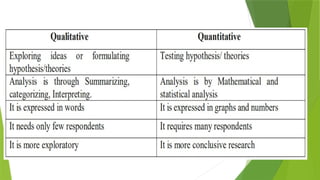
Quantitative Research
Quantitative studiesrely on numerical or measurable data.
Example: Imagine you’re a market researcher analyzing survey responses from thousand
of people to determine which smartphone features are most popular you use statistical data
to draw conclusions, making it clear that a certain percentage prefers larger screens or
better battery life.
22.
Qualitative Research
Qualitative researchis a type of research that aims to gather and analyze non-numerical
(descriptive) data in order to gain an understanding of individuals' social reality, including
understanding their attitudes, beliefs, and motivation. This type of research typically involves in-
depth interviews, focus groups, or observations in order to collect data that is rich in detail and
context.
1. ResearchGate
2. INTERNATIONALJOURNAL OF NOVEL RESEARCH AND DEVELOPMENT (IJNRD)
3. INTERNATIONAL JOURNAL OF CREATIVE RESEARCH THOUGHTS - IJCRT
(IJCRT.ORG)
4. INTERNATIONAL JOURNAL OF SCIENCE AND RESEARCH (IJSR)
5. International Journal for Science and Advance Research in Technology (IJSART)
29.
Ethics in EngineeringResearch Practice
Ethics is like a set of rules that help us know what’s right and what’s wrong.
These rules guide our behavior and help us make good choices in life
Engineering researchers must make ethical decisions and be responsible for the impact of their
research.
Information used in engineering research is important because it affects people.
36.
1. Define Research.Explain Research flow with a neat diagram.
2. State different objectives of Engineering Research
3. Explain different motivations of Engineering Research
4. Classify different types of Engineering Research
5. Differentiate between Descriptive and Analytical research with example
6. Differentiate between Fundamental and Applied research with examples
7. Compare Qualitative and Quantitative research with examples
8. Discuss how to identify and address Engineering research problems
9. Define Ethics in Engineering research. Give key aspects of ethics in engineering research
10. Write a short note on ethical issues related to Authorship
11. Summarize different types of Engineering Misconduct
37.
Common Types ofResearch Misconduct
1. Fabrication(Creating fake data)
Fabrication involves making up data or experiments because of time constraints or pressure. It undermines the integrity
of research and can lead to false information circulating in scientific literature.
2. Falsification(Altering data inappropriately)
Falsification occurs when data or experiments are misrepresented, altered or misinterpreted to support a particular
hypothesis, even if the actual results suggest otherwise.
It can harm research progress and trust
3. Plagiarism (Using other’s work without credits)
Is coping someone else’s work, including text, data, or ideas, without giving proper credit
Researchers should refrain from submitting the same article to multiple journals simultaneously, as
violates publication policies.
38.
Ethics Issues Relatedto Authorship
Sometimes, it’s tricky to decide who should called an author and what order they should be listed.
This is especially important today when researcher from all over the world work together some
people might help a lot with the research but not write the paper, so who gets credit?
Research ethics is about making sure research is used in the right way. While responsible conduct
of research is about how research is done.
Why it Matters
Help us to do good research and make sure it’s used for the right reasons
39.
The recommended stepsto solve a research problem
Understand the problem, restate it as if its your own, visualize the problem by drawing figures,
and determine if something more is needed.
Execute the plan to see if it works, and if it does not then start over with another approach.
Having delved into the problem and returned to it multiple times, one might have a flash of insight
or a new idea to solve the problem.