How to write a manuscript ?
Dr. Jeya venkatesh.P
MS Ortho, DNB Ortho, MRCS (England), Dip SICOT (Belgium).,
Ex-Senior resident, All India Institute of Medical Sciences (AIIMS), New Delhi,
Fellowship in Knee Surgery and Sports Medicine, SNUH, Korea
ISKSAA Midlands Fellowship, Birmingham, UK
‘SICOT meets SICOT’ Fellowship, Rhon Klinikum, Germany.
When you write a manuscript?
For Thesis
For Journal
For a conference abstract
For a research proposal
For Book Chapter
Have clear timelines from begining..
Start Writing early...
Finish in 2- 3 months
Split work among
authors
Outline of this talk..
1. Title
2. Abstract
3. Background
4. Objectives
5. Materials and methods
6. Results
7. Discussion
8. Conclusion
9. References
10. Revising & Plagiarism
11. Submission
12. Common mistakes.
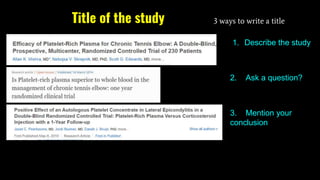
Title of the study 3 ways to write a title
1. Describe the study
2. Ask a question?
3. Mention your
conclusion
Authorship
Affiliation,
Source of funding,,
Disclaimers.
Register at Open Researcher and Contributor Identification (ORCID)
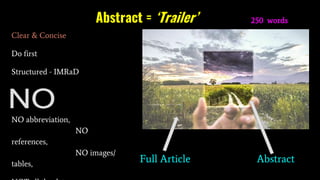
Abstract = ‘Trailer’
Clear & Concise
Do first
Structured - IMRaD
Full Article Abstract
NO abbreviation,
NO
references,
NO images/
tables,
250 words
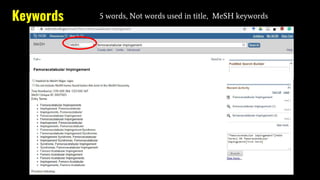
Keywords 5 words, Not words used in title, MeSH keywords
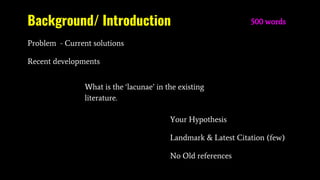
Background/ Introduction
Problem - Current solutions
Recent developments
500 words
Your Hypothesis
Landmark & Latest Citation (few)
No Old references
What is the ‘lacunae’ in the existing
literature.
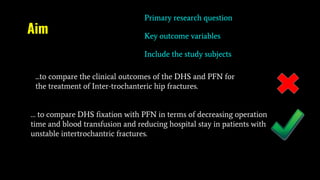
Aim
Primary research question
Key outcome variables
Include the study subjects
...to compare the clinical outcomes of the DHS and PFN for
the treatment of Inter-trochanteric hip fractures.
… to compare DHS fixation with PFN in terms of decreasing operation
time and blood transfusion and reducing hospital stay in patients with
unstable intertrochantric fractures.
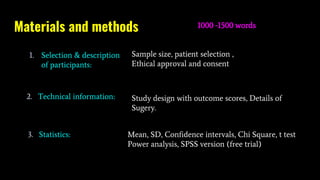
Materials and methods 1000 -1500 words
Sample size, patient selection ,
Ethical approval and consent
Study design with outcome scores, Details of
Sugery.
Mean, SD, Confidence intervals, Chi Square, t test
Power analysis, SPSS version (free trial)
1. Selection & description
of participants:
2. Technical information:
3. Statistics:
Results
Describe the key findings.
Data - Tables / Illustrations.
Proper legends, Footnotes.
500 words
No fear of negative results
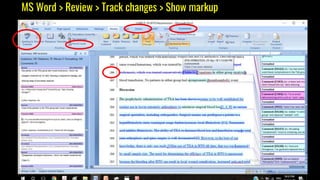
MS Word > Review > Track changes > Show markup
Discussion
Restatement of study question / problem.
Take the results one by one and discuss them.
Compare & Contrast with existing literature.
1000 words
Limitations.
Use the references freely to support discussion.
Conclusion
Derived from your findings
Conclude as per the laid down objectives.
Be concise.
Give future direction also.
Acknowledgement
Acknowledge those who were involved in the study but not fulfilling authorship
criteria
- project grants, Analytical or other service providers, intellectual support
Not for pleasing superiors like HOD, Dean or Chairman
Not for thanking spouse or parents.
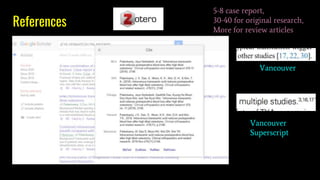
References
Vancouver
Vancouver
Superscript
5-8 case report,
30-40 for original research,
More for review articles
Revising & Editing
Self revison - Friends & Mentors
Active voice > Passive voice. Avoid ‘We’
Simple sentecses > Too long sentences
Font 12, Times new roman
Double spacing, Line numbers
Side headings
Word count each section
Spell check
Avoid Plaigarism
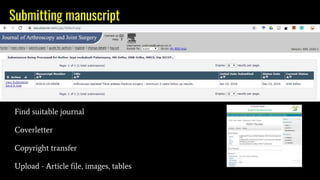
Submitting manuscript
Find suitable journal
Coverletter
Copyright transfer
Upload - Article file, images, tables
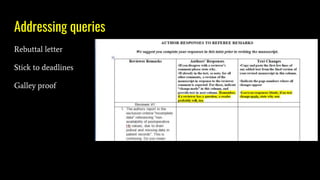
Addressing queries
Rebuttal letter
Stick to deadlines
Galley proof
Common mistakes from the authors
Never use word ‘case’ - prefer ‘patient’
Spell letters 1-10, Do not start a sentence with a
digit.
NO Present tense in methods, results
Contractions (don’t, isn’t), Acronyms (POD, FFD),
Tables in jpeg format
No undue repetition
In a nutshell..
Introduction: Why did we start?
Methods: What did we do?
Results: What did we find?
Discussion: Hence, what does it mean?
Conclusion: What do we recommend?

How to write a research manuscript?

  • 1.
    How to writea manuscript ? Dr. Jeya venkatesh.P MS Ortho, DNB Ortho, MRCS (England), Dip SICOT (Belgium)., Ex-Senior resident, All India Institute of Medical Sciences (AIIMS), New Delhi, Fellowship in Knee Surgery and Sports Medicine, SNUH, Korea ISKSAA Midlands Fellowship, Birmingham, UK ‘SICOT meets SICOT’ Fellowship, Rhon Klinikum, Germany.
  • 2.
    When you writea manuscript? For Thesis For Journal For a conference abstract For a research proposal For Book Chapter
  • 3.
    Have clear timelinesfrom begining.. Start Writing early... Finish in 2- 3 months Split work among authors
  • 4.
    Outline of thistalk.. 1. Title 2. Abstract 3. Background 4. Objectives 5. Materials and methods 6. Results 7. Discussion 8. Conclusion 9. References 10. Revising & Plagiarism 11. Submission 12. Common mistakes.
  • 5.
    Title of thestudy 3 ways to write a title 1. Describe the study 2. Ask a question? 3. Mention your conclusion
  • 6.
    Authorship Affiliation, Source of funding,, Disclaimers. Registerat Open Researcher and Contributor Identification (ORCID)
  • 7.
    Abstract = ‘Trailer’ Clear& Concise Do first Structured - IMRaD Full Article Abstract NO abbreviation, NO references, NO images/ tables, 250 words
  • 8.
    Keywords 5 words,Not words used in title, MeSH keywords
  • 9.
    Background/ Introduction Problem -Current solutions Recent developments 500 words Your Hypothesis Landmark & Latest Citation (few) No Old references What is the ‘lacunae’ in the existing literature.
  • 10.
    Aim Primary research question Keyoutcome variables Include the study subjects ...to compare the clinical outcomes of the DHS and PFN for the treatment of Inter-trochanteric hip fractures. … to compare DHS fixation with PFN in terms of decreasing operation time and blood transfusion and reducing hospital stay in patients with unstable intertrochantric fractures.
  • 11.
    Materials and methods1000 -1500 words Sample size, patient selection , Ethical approval and consent Study design with outcome scores, Details of Sugery. Mean, SD, Confidence intervals, Chi Square, t test Power analysis, SPSS version (free trial) 1. Selection & description of participants: 2. Technical information: 3. Statistics:
  • 12.
    Results Describe the keyfindings. Data - Tables / Illustrations. Proper legends, Footnotes. 500 words No fear of negative results
  • 13.
    MS Word >Review > Track changes > Show markup
  • 14.
    Discussion Restatement of studyquestion / problem. Take the results one by one and discuss them. Compare & Contrast with existing literature. 1000 words Limitations. Use the references freely to support discussion.
  • 15.
    Conclusion Derived from yourfindings Conclude as per the laid down objectives. Be concise. Give future direction also.
  • 16.
    Acknowledgement Acknowledge those whowere involved in the study but not fulfilling authorship criteria - project grants, Analytical or other service providers, intellectual support Not for pleasing superiors like HOD, Dean or Chairman Not for thanking spouse or parents.
  • 17.
    References Vancouver Vancouver Superscript 5-8 case report, 30-40for original research, More for review articles
  • 18.
    Revising & Editing Selfrevison - Friends & Mentors Active voice > Passive voice. Avoid ‘We’ Simple sentecses > Too long sentences Font 12, Times new roman Double spacing, Line numbers Side headings Word count each section Spell check
  • 19.
  • 20.
    Submitting manuscript Find suitablejournal Coverletter Copyright transfer Upload - Article file, images, tables
  • 21.
  • 22.
    Common mistakes fromthe authors Never use word ‘case’ - prefer ‘patient’ Spell letters 1-10, Do not start a sentence with a digit. NO Present tense in methods, results Contractions (don’t, isn’t), Acronyms (POD, FFD), Tables in jpeg format No undue repetition
  • 23.
    In a nutshell.. Introduction:Why did we start? Methods: What did we do? Results: What did we find? Discussion: Hence, what does it mean? Conclusion: What do we recommend?

Editor's Notes

  • #9 One easy hack is to use Mesh Key words, more chance of being picked up by search engines.
  • #10 a short introductory advertisement for a product that stimulates interest by remaining cryptic
  • #15 1. How we can incorporate these findings in clinical practice. Logical sequence, paraphrasing, cohesion & coherence , vocabulary 1. Limitations – preempt reviewers criticisms
  • #18 SUPERSCRIPT, Stick to journal requirements, Follow punctuation as per the journal’s guidelines strictly.
  • #19 Logical flow, cohesion & Coherence Each paragraph - Topic sentence Connecting link between succesive paragraphs Introduction matches with the discussion
  • #21 Article processing charges