Dr. RIA GANGULY
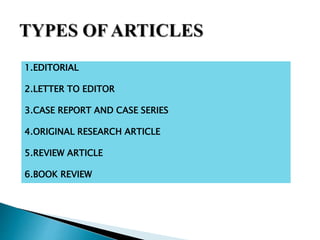
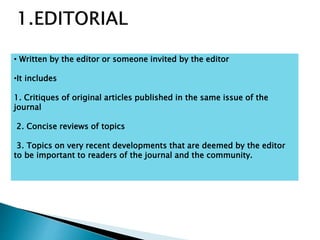
1.EDITORIAL
2.LETTER TO EDITOR
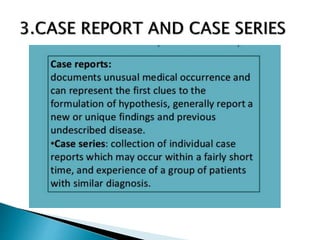
3.CASE REPORT AND CASE SERIES
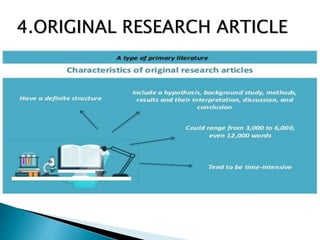
4.ORIGINAL RESEARCH ARTICLE
5.REVIEW ARTICLE
6.BOOK REVIEW
• Written by the editor or someone invited by the editor
•It includes
1. Critiques of original articles published in the same issue of the
journal
2. Concise reviews of topics
3. Topics on very recent developments that are deemed by the editor
to be important to readers of the journal and the community.
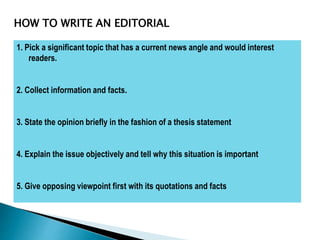
1. Pick a significant topic that has a current news angle and would interest
readers.
2. Collect information and facts.
3. State the opinion briefly in the fashion of a thesis statement
4. Explain the issue objectively and tell why this situation is important
5. Give opposing viewpoint first with its quotations and facts
HOW TO WRITE AN EDITORIAL
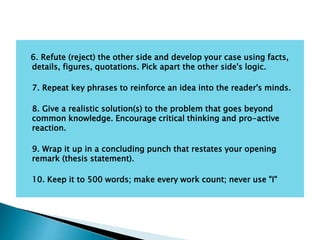
6. Refute (reject) the other side and develop your case using facts,
details, figures, quotations. Pick apart the other side's logic.
7. Repeat key phrases to reinforce an idea into the reader's minds.
8. Give a realistic solution(s) to the problem that goes beyond
common knowledge. Encourage critical thinking and pro-active
reaction.
9. Wrap it up in a concluding punch that restates your opening
remark (thesis statement).
10. Keep it to 500 words; make every work count; never use "I"
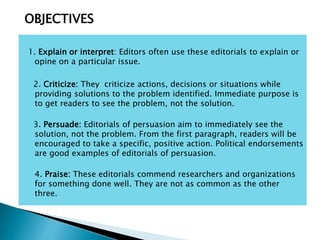
1. Explain or interpret: Editors often use these editorials to explain or
opine on a particular issue.
2. Criticize: They criticize actions, decisions or situations while
providing solutions to the problem identified. Immediate purpose is
to get readers to see the problem, not the solution.
3. Persuade: Editorials of persuasion aim to immediately see the
solution, not the problem. From the first paragraph, readers will be
encouraged to take a specific, positive action. Political endorsements
are good examples of editorials of persuasion.
4. Praise: These editorials commend researchers and organizations
for something done well. They are not as common as the other
three.
OBJECTIVES
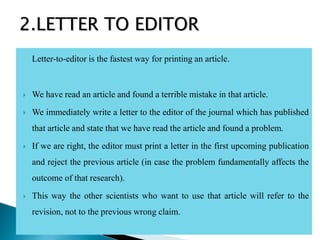
Letter-to-editor is the fastest way for printing an article.
 We have read an article and found a terrible mistake in that article.
 We immediately write a letter to the editor of the journal which has published
that article and state that we have read the article and found a problem.
 If we are right, the editor must print a letter in the first upcoming publication
and reject the previous article (in case the problem fundamentally affects the
outcome of that research).
 This way the other scientists who want to use that article will refer to the
revision, not to the previous wrong claim.
2.LETTER TO EDITOR
4.ORIGINAL RESEARCH ARTICLE
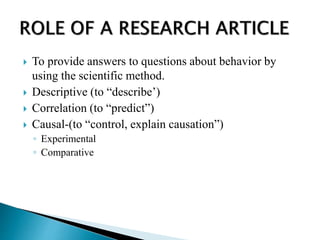
 To provide answers to questions about behavior by
using the scientific method.
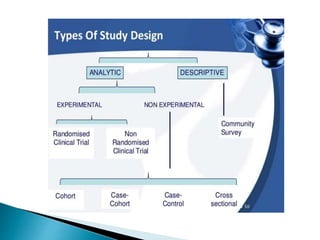
 Descriptive (to “describe’)
 Correlation (to “predict”)
 Causal-(to “control, explain causation”)
◦ Experimental
◦ Comparative
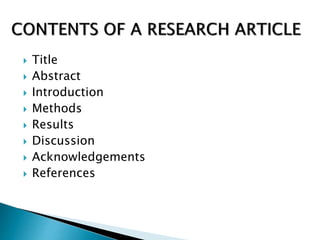
 Title
 Abstract
 Introduction
 Methods
 Results
 Discussion
 Acknowledgements
 References
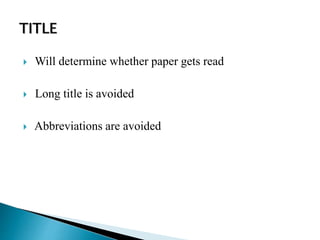
 Will determine whether paper gets read
 Long title is avoided
 Abbreviations are avoided
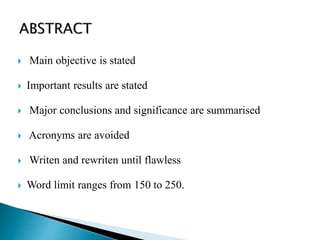
 Main objective is stated
 Important results are stated
 Major conclusions and significance are summarised
 Acronyms are avoided
 Writen and rewriten until flawless
 Word limit ranges from 150 to 250.
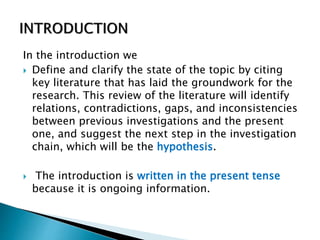
In the introduction we
 Define and clarify the state of the topic by citing
key literature that has laid the groundwork for the
research. This review of the literature will identify
relations, contradictions, gaps, and inconsistencies
between previous investigations and the present
one, and suggest the next step in the investigation
chain, which will be the hypothesis.
 The introduction is written in the present tense
because it is ongoing information.
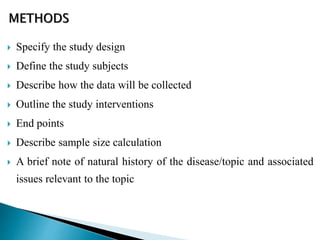
 Specify the study design
 Define the study subjects
 Describe how the data will be collected
 Outline the study interventions
 End points
 Describe sample size calculation
 A brief note of natural history of the disease/topic and associated
issues relevant to the topic
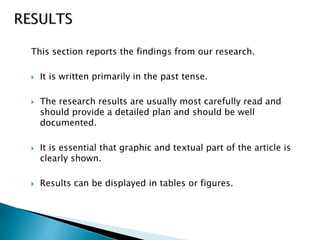
This section reports the findings from our research.
 It is written primarily in the past tense.
 The research results are usually most carefully read and
should provide a detailed plan and should be well
documented.
 It is essential that graphic and textual part of the article is
clearly shown.
 Results can be displayed in tables or figures.
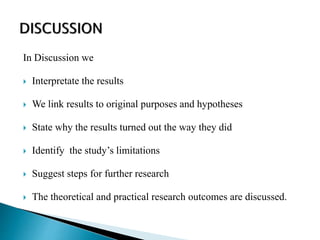
In Discussion we
 Interpretate the results
 We link results to original purposes and hypotheses
 State why the results turned out the way they did
 Identify the study’s limitations
 Suggest steps for further research
 The theoretical and practical research outcomes are discussed.
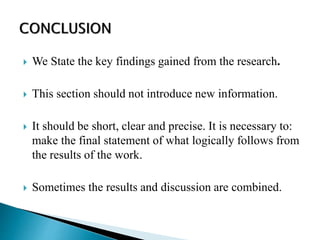
 We State the key findings gained from the research.
 This section should not introduce new information.
 It should be short, clear and precise. It is necessary to:
make the final statement of what logically follows from
the results of the work.
 Sometimes the results and discussion are combined.
 In the Acknowledgments we name persons that are
not an author but which assisted us when conducting
the research, writing up the article etc. Here we also
mention the sources of funding that supported the
research.
 Appendices contain information that is not essential
for understanding the paper, but that further clarifies a
point without burdening the body of the presentation.
An appendix is an optional part of the paper, and
usually used for online publications.
 Examples of what might be put in an appendix are:
large tables, figures, maps; explanation of 'new'
statistical/ mathematical procedures; data collection
methods.
 The reference is the information that is necessary to the
reader in identifying and finding used sources. The
basic rule when listing the sources used is that
references must be accurate, complete and should be
consistently applied.
 It should be Relevant and Recent
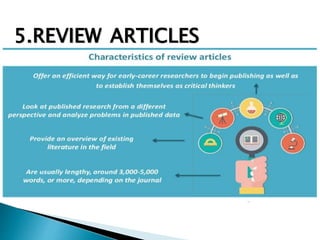
5.REVIEW ARTICLES
1.Narrative Reviews
Summarises research that lack explicit descriptions of systematic
methods to locate and synthesize articles.
Potentially biased
Qualitative analysis
2.Systematic Review
Summarises research that undergo rigorous methods to identify
appraise and synthesize research articles.
Quantitative analysis
TYPES OF REVIEW ARTICLES
3.Meta Analysis
It is a statistical analysis that combines the results of
multiple scientific studies.
A key benefit of this approach is the aggregation of information
leading to a higher statistical power and more robust point
estimate than is possible from the measure derived from any
individual study.
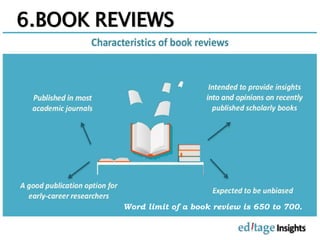
6.BOOK REVIEWS
Word limit of a book review is 650 to 700.
THANK YOU

Types of article in a journal

  • 1.
  • 2.
    1.EDITORIAL 2.LETTER TO EDITOR 3.CASEREPORT AND CASE SERIES 4.ORIGINAL RESEARCH ARTICLE 5.REVIEW ARTICLE 6.BOOK REVIEW
  • 3.
    • Written bythe editor or someone invited by the editor •It includes 1. Critiques of original articles published in the same issue of the journal 2. Concise reviews of topics 3. Topics on very recent developments that are deemed by the editor to be important to readers of the journal and the community.
  • 4.
    1. Pick asignificant topic that has a current news angle and would interest readers. 2. Collect information and facts. 3. State the opinion briefly in the fashion of a thesis statement 4. Explain the issue objectively and tell why this situation is important 5. Give opposing viewpoint first with its quotations and facts HOW TO WRITE AN EDITORIAL
  • 5.
    6. Refute (reject)the other side and develop your case using facts, details, figures, quotations. Pick apart the other side's logic. 7. Repeat key phrases to reinforce an idea into the reader's minds. 8. Give a realistic solution(s) to the problem that goes beyond common knowledge. Encourage critical thinking and pro-active reaction. 9. Wrap it up in a concluding punch that restates your opening remark (thesis statement). 10. Keep it to 500 words; make every work count; never use "I"
  • 6.
    1. Explain orinterpret: Editors often use these editorials to explain or opine on a particular issue. 2. Criticize: They criticize actions, decisions or situations while providing solutions to the problem identified. Immediate purpose is to get readers to see the problem, not the solution. 3. Persuade: Editorials of persuasion aim to immediately see the solution, not the problem. From the first paragraph, readers will be encouraged to take a specific, positive action. Political endorsements are good examples of editorials of persuasion. 4. Praise: These editorials commend researchers and organizations for something done well. They are not as common as the other three. OBJECTIVES
  • 7.
    Letter-to-editor is thefastest way for printing an article.  We have read an article and found a terrible mistake in that article.  We immediately write a letter to the editor of the journal which has published that article and state that we have read the article and found a problem.  If we are right, the editor must print a letter in the first upcoming publication and reject the previous article (in case the problem fundamentally affects the outcome of that research).  This way the other scientists who want to use that article will refer to the revision, not to the previous wrong claim. 2.LETTER TO EDITOR
  • 9.
  • 10.
     To provideanswers to questions about behavior by using the scientific method.  Descriptive (to “describe’)  Correlation (to “predict”)  Causal-(to “control, explain causation”) ◦ Experimental ◦ Comparative
  • 11.
     Title  Abstract Introduction  Methods  Results  Discussion  Acknowledgements  References
  • 12.
     Will determinewhether paper gets read  Long title is avoided  Abbreviations are avoided
  • 13.
     Main objectiveis stated  Important results are stated  Major conclusions and significance are summarised  Acronyms are avoided  Writen and rewriten until flawless  Word limit ranges from 150 to 250.
  • 14.
    In the introductionwe  Define and clarify the state of the topic by citing key literature that has laid the groundwork for the research. This review of the literature will identify relations, contradictions, gaps, and inconsistencies between previous investigations and the present one, and suggest the next step in the investigation chain, which will be the hypothesis.  The introduction is written in the present tense because it is ongoing information.
  • 15.
     Specify thestudy design  Define the study subjects  Describe how the data will be collected  Outline the study interventions  End points  Describe sample size calculation  A brief note of natural history of the disease/topic and associated issues relevant to the topic
  • 17.
    This section reportsthe findings from our research.  It is written primarily in the past tense.  The research results are usually most carefully read and should provide a detailed plan and should be well documented.  It is essential that graphic and textual part of the article is clearly shown.  Results can be displayed in tables or figures.
  • 18.
    In Discussion we Interpretate the results  We link results to original purposes and hypotheses  State why the results turned out the way they did  Identify the study’s limitations  Suggest steps for further research  The theoretical and practical research outcomes are discussed.
  • 19.
     We Statethe key findings gained from the research.  This section should not introduce new information.  It should be short, clear and precise. It is necessary to: make the final statement of what logically follows from the results of the work.  Sometimes the results and discussion are combined.
  • 20.
     In theAcknowledgments we name persons that are not an author but which assisted us when conducting the research, writing up the article etc. Here we also mention the sources of funding that supported the research.
  • 21.
     Appendices containinformation that is not essential for understanding the paper, but that further clarifies a point without burdening the body of the presentation. An appendix is an optional part of the paper, and usually used for online publications.  Examples of what might be put in an appendix are: large tables, figures, maps; explanation of 'new' statistical/ mathematical procedures; data collection methods.
  • 22.
     The referenceis the information that is necessary to the reader in identifying and finding used sources. The basic rule when listing the sources used is that references must be accurate, complete and should be consistently applied.  It should be Relevant and Recent
  • 23.
  • 24.
    1.Narrative Reviews Summarises researchthat lack explicit descriptions of systematic methods to locate and synthesize articles. Potentially biased Qualitative analysis 2.Systematic Review Summarises research that undergo rigorous methods to identify appraise and synthesize research articles. Quantitative analysis TYPES OF REVIEW ARTICLES
  • 25.
    3.Meta Analysis It isa statistical analysis that combines the results of multiple scientific studies. A key benefit of this approach is the aggregation of information leading to a higher statistical power and more robust point estimate than is possible from the measure derived from any individual study.
  • 26.
    6.BOOK REVIEWS Word limitof a book review is 650 to 700.
  • 27.

Editor's Notes

  • #8 Technically, the article suffers from a fundamental problem.