How to use the verb “to be”
The “to be” is a verb used to describe
something or someone. In English, it can be
used to say different things according to the
context. However, the most common use of
the to be verb is to talk about names, ages,
feeling, nationalities, and professions,
especially when talking in the present
tense.
The most tricky thing about this verb,
however, is that It’s also one of the most
irregular verbs in the English language.
This means, that unlike regular verbs,
which barely change when used when
different subjects -or even in different
tenses-, and when they do, they follow a
pattern, the “to be” verb changes almost
completely in most of its forms.
Forms of verb “to be” in the
present.
Since the to be verb is highly irregular, it’s
written in different ways according to the
tense of the verb (whether if it’s present,
past, future, or even in mixed tenses), and it
also varies according to the subject. Let’s
see the forms this verb can take when used
next to the subjects.
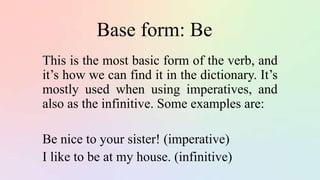
Base form: Be
This is the most basic form of the verb, and
it’s how we can find it in the dictionary. It’s
mostly used when using imperatives, and
also as the infinitive. Some examples are:
Be nice to your sister! (imperative)
I like to be at my house. (infinitive)
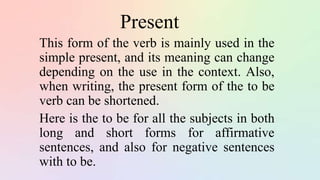
Present
This form of the verb is mainly used in the
simple present, and its meaning can change
depending on the use in the context. Also,
when writing, the present form of the to be
verb can be shortened.
Here is the to be for all the subjects in both
long and short forms for affirmative
sentences, and also for negative sentences
with to be.
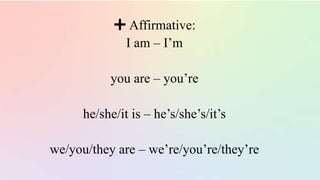
➕ Affirmative:
I am – I’m
you are – you’re
he/she/it is – he’s/she’s/it’s
we/you/they are – we’re/you’re/they’re
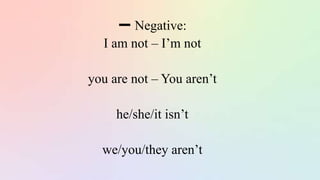
➖ Negative:
I am not – I’m not
you are not – You aren’t
he/she/it isn’t
we/you/they aren’t
Let’s see some examples of
this for sentences with the
“to be” verb.
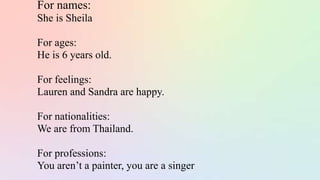
For names:
She is Sheila
For ages:
He is 6 years old.
For feelings:
Lauren and Sandra are happy.
For nationalities:
We are from Thailand.
For professions:
You aren’t a painter, you are a singer.
THANKS FOR WATCHING.

How to use the verb to be

  • 1.
    How to usethe verb “to be” The “to be” is a verb used to describe something or someone. In English, it can be used to say different things according to the context. However, the most common use of the to be verb is to talk about names, ages, feeling, nationalities, and professions, especially when talking in the present tense.
  • 2.
    The most trickything about this verb, however, is that It’s also one of the most irregular verbs in the English language. This means, that unlike regular verbs, which barely change when used when different subjects -or even in different tenses-, and when they do, they follow a pattern, the “to be” verb changes almost completely in most of its forms.
  • 3.
    Forms of verb“to be” in the present. Since the to be verb is highly irregular, it’s written in different ways according to the tense of the verb (whether if it’s present, past, future, or even in mixed tenses), and it also varies according to the subject. Let’s see the forms this verb can take when used next to the subjects.
  • 4.
    Base form: Be Thisis the most basic form of the verb, and it’s how we can find it in the dictionary. It’s mostly used when using imperatives, and also as the infinitive. Some examples are: Be nice to your sister! (imperative) I like to be at my house. (infinitive)
  • 5.
    Present This form ofthe verb is mainly used in the simple present, and its meaning can change depending on the use in the context. Also, when writing, the present form of the to be verb can be shortened. Here is the to be for all the subjects in both long and short forms for affirmative sentences, and also for negative sentences with to be.
  • 6.
    ➕ Affirmative: I am– I’m you are – you’re he/she/it is – he’s/she’s/it’s we/you/they are – we’re/you’re/they’re
  • 7.
    ➖ Negative: I amnot – I’m not you are not – You aren’t he/she/it isn’t we/you/they aren’t
  • 8.
    Let’s see someexamples of this for sentences with the “to be” verb.
  • 9.
    For names: She isSheila For ages: He is 6 years old. For feelings: Lauren and Sandra are happy. For nationalities: We are from Thailand. For professions: You aren’t a painter, you are a singer.
  • 10.