

TO BE AND TO HAVE 
Daniel <13> 
Deva <15> 
Kevin <26> 
Viscylla Jesslyn <43>
To Have
The verb to have is used in a number of 
different ways in English. Here are the main 
uses of the verb to have for reference, self-study 
and in-class use.
To Have - Main Verb 
To have is used as a main verb to indicate 
possession of objects, characteristics, 
relationships or other qualities. 
Examples : 
• He has three books by Hemingway. 
Jane has a sister in France. 
Frank has a lot of free time these days.
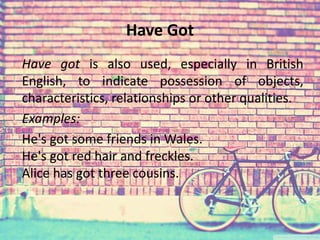
Have Got 
Have got is also used, especially in British 
English, to indicate possession of objects, 
characteristics, relationships or other qualities. 
Examples: 
He's got some friends in Wales. 
He's got red hair and freckles. 
Alice has got three cousins.
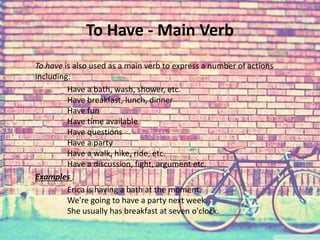
To Have - Main Verb 
To have is also used as a main verb to express a number of actions 
including: 
Have a bath, wash, shower, etc. 
Have breakfast, lunch, dinner 
Have fun 
Have time available 
Have questions 
Have a party 
Have a walk, hike, ride, etc. 
Have a discussion, fight, argument etc. 
Examples : 
Erica is having a bath at the moment. 
We're going to have a party next week. 
She usually has breakfast at seven o'clock.
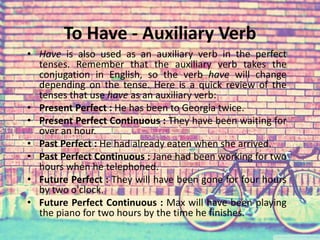
To Have - Auxiliary Verb 
• Have is also used as an auxiliary verb in the perfect 
tenses. Remember that the auxiliary verb takes the 
conjugation in English, so the verb have will change 
depending on the tense. Here is a quick review of the 
tenses that use have as an auxiliary verb: 
• Present Perfect : He has been to Georgia twice. 
• Present Perfect Continuous : They have been waiting for 
over an hour. 
• Past Perfect : He had already eaten when she arrived. 
• Past Perfect Continuous : Jane had been working for two 
hours when he telephoned. 
• Future Perfect : They will have been gone for four hours 
by two o'clock. 
• Future Perfect Continuous : Max will have been playing 
the piano for two hours by the time he finishes.
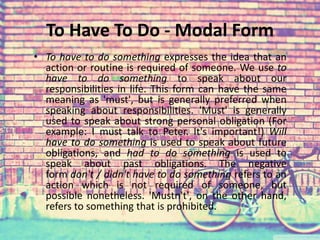
To Have To Do - Modal Form 
• To have to do something expresses the idea that an 
action or routine is required of someone. We use to 
have to do something to speak about our 
responsibilities in life. This form can have the same 
meaning as 'must', but is generally preferred when 
speaking about responsibilities. 'Must' is generally 
used to speak about strong personal obligation (For 
example: I must talk to Peter. It's important!) Will 
have to do something is used to speak about future 
obligations, and had to do something is used to 
speak about past obligations. The negative 
form don't / didn't have to do something refers to an 
action which is not required of someone, but 
possible nonetheless. 'Mustn't', on the other hand, 
refers to something that is prohibited.
Present Examples : 
Doug has to get up early every day. 
They have to work hard on Saturdays. 
She doesn't have to go to work on Saturdays. (It's 
possible, but not necessary) 
Past Examples : 
They had to leave early to catch the flight. 
Jennifer had to explain the situation to Peter. 
I didn't have to go to the meeting in Dallas. (I could 
have gone, but it wasn't necessary) 
Future Examples : 
He will have to get up early tomorrow. 
Janice will have to decide whether she wants to marry 
him or not. 
They won't have to purchase any additional materials. 
(They can, but it's not required.)
To Have Something Happen / Happening – Experiences 
- Have + object(s) + base form of verb / -ing form - 
This form is used to speak about experiences 
that have happened, or experience in general. 
Examples : 
We have people visit us all the time. 
Sherry had her children playing in the garden.
To Have Something Done - Arrangements 
- Have + object(s) + past participle - 
This form is used to speak about something 
that you arrange to have done for you. This 
form is also known as the causative 'have' 
because it expresses something which 
someone else causes to happen. 
Examples : 
She had them delivered to her home. 
We had Jack promoted to director.
To Be
The Verb TO BE 
Acts as a linking verb, joining the sentences subject 
with a subject complement or complement. A linking 
verb provides no action to a sentence.
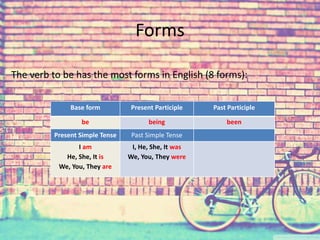
Forms 
The verb to be has the most forms in English (8 forms): 
Base form Present Participle Past Participle 
be being been 
Present Simple Tense Past Simple Tense 
I am 
He, She, It is 
We, You, They are 
I, He, She, It was 
We, You, They were
Meaning 
As a main verb in a sentence, to be is a stative 
verb serving as a copula (a verb linking the 
subject with it’s complement). As every sentence 
in English must have a verb, to be is used in many 
cases where there is no action described in the 
sentence.
Examples : 
I am Dan Smith. She is a doctor. We are from Spain. 
[Existence, identity] 
He was with his sister in Madrid while we were at home. 
[Location] 
I will be 32 in December. 
[Age] 
This dress is size 9. Her last apartment was very small. 
[Size] 
The sky is blue, and so is my favorite color. 
[Color] 
We are from Italy. 
[Origin] 
How are you today ? I ’m fine, thanks. 
[Mood] 
My new teacher is very nice. 
The results of our research are very promising.
Uses 
As an auxiliary verb, to be is used to create progressive verb forms and passive 
constructions. 
• The general formula for progressive forms is: 
Auxiliary verb + Main verb 
Be + Present Participle (Ving) 
Example : 
Donna is reading her new book. 
[ is reading is in the Present Progressive Tense] 
Her Parents have been working in book publishing for years. 
[ have been publishing is in the Present Progressive Tense] 
Ron may be traveling in India next month. 
[ may be traveling is a modal progressive form]
• The general formula for passive forms is: 
Auxiliary verb + Main verb 
Be + Past Participle 
Example : 
English is spoken around the world. 
[ is spoken is in the Present Simple Passive] 
While the new airport was being built, my parents decided to move. 
[ Was being built is in the Past Progressive Passive] 
This story could have been written differently. 
[ could have been written is in a modal perfect passive form]
In Negative Sentences 
When a sentence in either the Present Simple 
or Past Simple tenses has to be as a main verb, 
then no auxiliary verb is needed for negation. 
The word not is simply added after the verb. In 
other words, the verbs to be and to do do not 
appear in one verb phrase together.
Examples : 
Positive sentence – She is from Spain. 
Negative sentence – She is not from 
Spain. 
[ to be is the main verb, no auxiliary verb 
needed] 
Positive sentence – She works in Madrid. 
Negative Sentence – She doesn’t work in 
Madrid. 
[ to be is not he main verb, auxiliary verb 
needed]
In Questions 
When a sentence in either the Present Simple or 
Past Simple tenses has to be as a main verb, then 
no auxiliary verb is needed for forming questions. 
The be verb form is inverted before the subject. In 
other words, the verbs to be and to do do not 
appear in one verb phrase together.
Example : 
Positive sentence – She is from Spain. 
Yes/No question – Is she from Spain ? 
[ to be is the main verb, no auxiliary verb needed] 
Positive sentence – She works in Madrid. 
Yes/No question – Does she work in Madrid ? 
[ to be is not he main verb, auxiliary verb needed] 
Positive sentence – She is from Spain. 
Wh question – Where is she from ? 
[ to be is the main verb, no auxiliary verb needed] 
Positive sentence – She works in Madrid. 
Wh question – Where does she work in ? 
[ to be is not he main verb, auxiliary verb needed] 
Positive sentence – She is my friend from Spain. 
Wh Subject question – Who is she ? 
[ to be is the main verb, no auxiliary verb needed in a Wh subject question] 
Positive sentence – My Spanish friend works in Madrid. 
Wh Subject question – Who works in Madrid ? 
[ to be is not he main verb, no auxiliary verb needed in a Wh subject question]
With time expressions 
Frequency adverbs appear after the verb to 
be and not before, as with other verbs. 
She is usually on time and always works very 
well. 
[ usually appears after is, always appears 
before works]
Thank You for your attention

To be and to have (7)

  • 1.
    TO BE ANDTO HAVE Daniel <13> Deva <15> Kevin <26> Viscylla Jesslyn <43>
  • 2.
  • 3.
    The verb tohave is used in a number of different ways in English. Here are the main uses of the verb to have for reference, self-study and in-class use.
  • 4.
    To Have -Main Verb To have is used as a main verb to indicate possession of objects, characteristics, relationships or other qualities. Examples : • He has three books by Hemingway. Jane has a sister in France. Frank has a lot of free time these days.
  • 5.
    Have Got Havegot is also used, especially in British English, to indicate possession of objects, characteristics, relationships or other qualities. Examples: He's got some friends in Wales. He's got red hair and freckles. Alice has got three cousins.
  • 6.
    To Have -Main Verb To have is also used as a main verb to express a number of actions including: Have a bath, wash, shower, etc. Have breakfast, lunch, dinner Have fun Have time available Have questions Have a party Have a walk, hike, ride, etc. Have a discussion, fight, argument etc. Examples : Erica is having a bath at the moment. We're going to have a party next week. She usually has breakfast at seven o'clock.
  • 7.
    To Have -Auxiliary Verb • Have is also used as an auxiliary verb in the perfect tenses. Remember that the auxiliary verb takes the conjugation in English, so the verb have will change depending on the tense. Here is a quick review of the tenses that use have as an auxiliary verb: • Present Perfect : He has been to Georgia twice. • Present Perfect Continuous : They have been waiting for over an hour. • Past Perfect : He had already eaten when she arrived. • Past Perfect Continuous : Jane had been working for two hours when he telephoned. • Future Perfect : They will have been gone for four hours by two o'clock. • Future Perfect Continuous : Max will have been playing the piano for two hours by the time he finishes.
  • 8.
    To Have ToDo - Modal Form • To have to do something expresses the idea that an action or routine is required of someone. We use to have to do something to speak about our responsibilities in life. This form can have the same meaning as 'must', but is generally preferred when speaking about responsibilities. 'Must' is generally used to speak about strong personal obligation (For example: I must talk to Peter. It's important!) Will have to do something is used to speak about future obligations, and had to do something is used to speak about past obligations. The negative form don't / didn't have to do something refers to an action which is not required of someone, but possible nonetheless. 'Mustn't', on the other hand, refers to something that is prohibited.
  • 9.
    Present Examples : Doug has to get up early every day. They have to work hard on Saturdays. She doesn't have to go to work on Saturdays. (It's possible, but not necessary) Past Examples : They had to leave early to catch the flight. Jennifer had to explain the situation to Peter. I didn't have to go to the meeting in Dallas. (I could have gone, but it wasn't necessary) Future Examples : He will have to get up early tomorrow. Janice will have to decide whether she wants to marry him or not. They won't have to purchase any additional materials. (They can, but it's not required.)
  • 10.
    To Have SomethingHappen / Happening – Experiences - Have + object(s) + base form of verb / -ing form - This form is used to speak about experiences that have happened, or experience in general. Examples : We have people visit us all the time. Sherry had her children playing in the garden.
  • 11.
    To Have SomethingDone - Arrangements - Have + object(s) + past participle - This form is used to speak about something that you arrange to have done for you. This form is also known as the causative 'have' because it expresses something which someone else causes to happen. Examples : She had them delivered to her home. We had Jack promoted to director.
  • 12.
  • 13.
    The Verb TOBE Acts as a linking verb, joining the sentences subject with a subject complement or complement. A linking verb provides no action to a sentence.
  • 14.
    Forms The verbto be has the most forms in English (8 forms): Base form Present Participle Past Participle be being been Present Simple Tense Past Simple Tense I am He, She, It is We, You, They are I, He, She, It was We, You, They were
  • 15.
    Meaning As amain verb in a sentence, to be is a stative verb serving as a copula (a verb linking the subject with it’s complement). As every sentence in English must have a verb, to be is used in many cases where there is no action described in the sentence.
  • 16.
    Examples : Iam Dan Smith. She is a doctor. We are from Spain. [Existence, identity] He was with his sister in Madrid while we were at home. [Location] I will be 32 in December. [Age] This dress is size 9. Her last apartment was very small. [Size] The sky is blue, and so is my favorite color. [Color] We are from Italy. [Origin] How are you today ? I ’m fine, thanks. [Mood] My new teacher is very nice. The results of our research are very promising.
  • 17.
    Uses As anauxiliary verb, to be is used to create progressive verb forms and passive constructions. • The general formula for progressive forms is: Auxiliary verb + Main verb Be + Present Participle (Ving) Example : Donna is reading her new book. [ is reading is in the Present Progressive Tense] Her Parents have been working in book publishing for years. [ have been publishing is in the Present Progressive Tense] Ron may be traveling in India next month. [ may be traveling is a modal progressive form]
  • 18.
    • The generalformula for passive forms is: Auxiliary verb + Main verb Be + Past Participle Example : English is spoken around the world. [ is spoken is in the Present Simple Passive] While the new airport was being built, my parents decided to move. [ Was being built is in the Past Progressive Passive] This story could have been written differently. [ could have been written is in a modal perfect passive form]
  • 19.
    In Negative Sentences When a sentence in either the Present Simple or Past Simple tenses has to be as a main verb, then no auxiliary verb is needed for negation. The word not is simply added after the verb. In other words, the verbs to be and to do do not appear in one verb phrase together.
  • 20.
    Examples : Positivesentence – She is from Spain. Negative sentence – She is not from Spain. [ to be is the main verb, no auxiliary verb needed] Positive sentence – She works in Madrid. Negative Sentence – She doesn’t work in Madrid. [ to be is not he main verb, auxiliary verb needed]
  • 21.
    In Questions Whena sentence in either the Present Simple or Past Simple tenses has to be as a main verb, then no auxiliary verb is needed for forming questions. The be verb form is inverted before the subject. In other words, the verbs to be and to do do not appear in one verb phrase together.
  • 22.
    Example : Positivesentence – She is from Spain. Yes/No question – Is she from Spain ? [ to be is the main verb, no auxiliary verb needed] Positive sentence – She works in Madrid. Yes/No question – Does she work in Madrid ? [ to be is not he main verb, auxiliary verb needed] Positive sentence – She is from Spain. Wh question – Where is she from ? [ to be is the main verb, no auxiliary verb needed] Positive sentence – She works in Madrid. Wh question – Where does she work in ? [ to be is not he main verb, auxiliary verb needed] Positive sentence – She is my friend from Spain. Wh Subject question – Who is she ? [ to be is the main verb, no auxiliary verb needed in a Wh subject question] Positive sentence – My Spanish friend works in Madrid. Wh Subject question – Who works in Madrid ? [ to be is not he main verb, no auxiliary verb needed in a Wh subject question]
  • 23.
    With time expressions Frequency adverbs appear after the verb to be and not before, as with other verbs. She is usually on time and always works very well. [ usually appears after is, always appears before works]
  • 24.
    Thank You foryour attention